
BOARD MEETING DATE: August 9, 1996 AGENDA NO. 3
PROPOSAL:
Set Public Hearing September 13, 1996 to
Amend Rule 1171 - Solvent Cleaning Operations
SYNOPSIS:
Proposed Amended Rule 1171 will establish VOC and solvent vapor pressure limits that will reduce VOC emissions 20.5over 15 tons per day by year 2010 through greater use of aqueous cleaning technologies as well as acetone blend formulations. The proposed VOC limits will be effective January 1999, to allow sufficient time for facilities to convert to newer cleaning processes.
COMMITTEE:
Not applicable.
RECOMMENDED ACTION:
Set Public Hearing September 13, 1996 to Amend Rule 1171 - Solvent Cleaning Operations.
James M. Lents, Ph.D.
Executive Officer
PL:AG:LY:XV: TL
Background
Rule 1171 - Solvent Cleaning Operations, represents the single largest emission reduction rule which would have been subsumed by VOC RECLAIM, an emissions trading program. The VOC RECLAIM program, which had been under development since 1991, included about 1,200 companies that used paints, coatings, solvents, and adhesives. As proposed, this emissions trading program would have reduced VOC emissions by 20.8 tons per day by 2005. In January 1996, the AQMD Governing Board decided to stop work on VOC RECLAIM and directed staff to expeditiously proceed with the development of other VOC emission reduction rules to meet our AQMP commitments. Rule 1171 is the first and the largest emission reduction rule proposal in this category.
Both VOC RECLAIM and Proposed Amended Rule 1171 would have produced comparable VOC emission reductions by 2010. However, they differ in applicability and focus of control strategy. While VOC RECLAIM was designed for about 1,200 larger companies that used a variety of VOC products, this rule proposal is focused on solvent cleaning operations at any facility, irrespective of its size or permitting status. Therefore, Rule 1171, as proposed, will reduce VOC emissions from over 30,000 companies within the jurisdiction of the AQMD.
Rule 1171 - Solvent Cleaning Operations was originally was adopted on August 2, 1991, and further amended on May 8, 1995. The primary purpose of the rule is to reduce the emissions of Volatile Organic Compounds (VOCs) from solvent cleaning activities during the production, repair, maintenance, or servicing of products, tools, machinery, and general work areas. Such cleaning may be performed at auto repair facilities, garages and service stations, printing shops, metal fabrication facilities, electronics manufacturing facilities and other businesses. The rule does not apply to certain solvent cleaning operations that are governed by other AQMD rules including solvent degreasers (Rule 1122) and the cleaning of aircraft components (Rule 1124), nor does it apply to residential, institutional, or janitorial cleaning.
Prior to the adoption of Rule 1171 in 1991, each Regulation XI - Source Specific Standards rule contained provisions for solvent cleaning. The development of Rule 1171 unified such requirements, but introduced different solvent cleaning categories including general cleaning, repair and maintenance cleaning, cleaning of coating and adhesive application equipment, and cleaning of ink application equipment. Each solvent cleaning category was subject to prescribed VOC and/or vapor pressure limits. In addition, the devices and methods used for solvent cleaning operations were required to meet specific requirements.
Rule 1171 was amended in May 1995 to alleviate SIP deficiencies cited by the federal EPA and to addressrectify industry concerns. The amendments did not achieve additional VOC emission reductions. This action was largely administrative in nature and included addresseding specialty cleaning operations (e.g., medical device manufacturing) and the refinedment and clarifiedcation of rule language (e.g., test methods and definitions).
Proposal
Based on extensive AQMD study and supporting ARB data, the emission inventory for cleaning operations subject to Rule 1171 is projected at 35.9 tons per day of VOCs from permitted and unpermitted sources in both the industrial and commercial sectors. The proposed amendments to Rule 1171 will achieve VOC emissions reduction of 20.5 tons per day by 2010 or a 46% reduction in the future Rule 1171 VOC emission inventory.
The proposed emission abatements reflect staff�s technical assessment regarding low-VOC solvent cleaning materials available today. Aqueous cleaners containing no VOCs or minimal VOCs (< 50 grams per liter) are used successfully in repair and maintenance cleaning in various equipment including parts washers and remote reservoir cleaners. Aqueous cleaning materials cost less than their high-VOC organic solvent counterparts currently in use, although some aqueous cleaners may require heating, resulting in higher energy costs. The extended bath life of such cleaners also minimizes hazardous waste and its associated costs. Overall, the conversion from petroleum-based solvent cleaners to aqueous cleaners is driven by the resulting cost savings. Some key issues in the wide-scale employment of water-based cleaning systems include water resources, hazardous waste, and water quality.
Acetone, which has been delisted as a VOC, is used successfully in certain handwipe cleaning operations. Conversion to acetone costs no more than petroleum solvents cur-rently in use. Health and safety considerations are the key issues in employing acetone as a cleaning solvent, which is more acceptable in blends and diluted solutions than in its pure form.
In January, 1996, at the outset of this rulemaking effort, a Rule 1171 Advisory Panel was formed with experts from the solvent cleaning industry including manufacturers, vendors and consultants. AQMD staff met with the panel on several occasions to gather and discuss relevant information and technologies involving solvent cleaning operations prior to drafting a rule proposal. Three public meetings, noticed in newspapers pursuant to applicable law, were held to solicit public input relative to the staff rule proposal. Staff has met several times with individual companies and persons who requested pri-vate meetings to discuss Proposed Amended Rule 1171. Staff also visited various fa-cilities to observe first-hand a variety of cleaning processes including operations at fa-cilities that have successfully converted to low- and zero-VOC cleaning materials.
Summary of The Proposed Amendments
The staff proposal will:
lower the VOC limit for repair and maintenance cleaning from 900 to 50 grams per liter, effective January 1, 1999;
include special subcategories under repair and maintenance cleaning for medical devices and electrical apparatus components;
lower the vapor pressure limit for the cleaning of lithographic and letterpress ink application equipment from 25 mm Hg @ 68xF to 10 mm Hg @ 68xF, effective January 1, 1999;
lower the VOC limit for the cleaning of polyester resin application equipment from 200 to 50 grams per liter, effective January 1, 1997;
provide incentives (e.g. emission fee reduction and recordkeeping exemption) for the use of non-polluting cleaning materials as defined as in " Clean Air Solvents;";; and,
include an aerosol exemption which was inadvertently deleted from the May 1995 amendments.
Reactivity
Some providers of petroleum-based cleaning solvents and cleaning systems have opposed the staff-recommended lower VOC grams/liter limit based on the feasibility of aqueous or low VOC (<50 grams/liter) cleaning solvents and systems. The AQMD has been asked to consider the reactivity of a hydrocarbon-based or petroleum-based solvent in lieu of a total volume reduction of VOCs as currently proposed. The use of reactivity as a regulatory tool has been debated at the local, state, and national level for over twenty years. Reactivity of a solvent refers to its ozone forming potential. Reactivity issues were thoroughly assessed during the VOC RECLAIM rule development process over a period of several years. The results were inconclusive. Although it is inappropriate to delay VOC emission reductions based on this concern, it may be appropriate to study the issue further if new information not analyzed in previous AQMD study efforts is brought forward.
AQMP and Legal Mandates
The California Health and Safety Code requires the AQMD to adopt an AQMP to meet state and federal ambient air quality standards in the Basin. In addition, the California Health and Safety Code requires that the AQMD adopt rules and regulations that carry out the objectives of the AQMP.
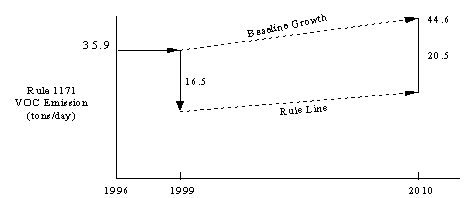
The Rule 1171 emissions inventory is estimated at 35.9 tons per day of VOCs, based on 1993 emissions data reported by the affected industry and subsequently corroborated by the ARB data. Based on current activity levels, no increase in the Rule 1171 inventory is assumed until 1999. With an AQMP growth rate of 2% per year from 1999 to 2010, the unregulated emissions inventory would grow to 44.6 tons per day in 2010. The rule�s impact on the current emission inventory and this growth will produce an esti-mated emission reduction of 20.5 tons per day. The picture is depicted graphically be-low.
CEQA
Pursuant to CEQA and the AQMD�s Certified Regulatory Program (Rule 110), staff has prepared a Draft Subsequent Environmental Assessment (EA) for Proposed Amended Rule 1171. The Draft Subsequent EA has been released for a 45-day public review pe-riod. All comments received on the Draft Subsequent EA will be responded to in the final EA document.
The environmental topics analyzed in this Draft Subsequent EA are air quality, water resources, hazards, public services (fire departments), and energy resources. The analysis concludes that the proposed amendments may result in significant adverse air quality and water resource impacts.
The potential air quality impacts would be due to increased NOx emissions associated with the electrical requirements to heat water-based cleaning systems. While it is un-likely that electric generating facilities would need to generate additional electricity to account for the potential incremental increased demand, the significant determination is based on a worst-case scenario.
As is currently the case with organic solvent-based cleaning operations, water-based cleaning activities may lead to adverse impacts on water resources if not handled prop-erly. This potential impact may be exacerbated by some vendors of water-based clean-ing solvents advertising that their products are sewer safe. Accordingly, the proposed amendments may result in significant adverse water quality impacts even though: 1) proper disposal would preclude this effect, and 2) some organic solvent-based cleaning operators may currently be illegally disposing of spent cleaning materials.
As a result of the determination of significance, a Statement of Findings and a Statement of Overriding Considerations will be prepared for the Governing Board�s review prior to the public hearing for the proposed amendments.
Socioeconomic Assessment
The socioeconomic assessment found that adoption of the proposed amendments to Rule 1171 would provide a cost savings to the affected industry of approximately $4.5 mil-lion annually. While compliance with the 50-gram-per-liter VOC content limit would increase equipment and operation costs, the savings in materials and disposal costs would more than offset these. The $4.5 million annual savings would be achieved in the categories of Surface Preparation and General Cleaning, and Remote Reservoir Clean-ing. Other cleaning categories are expected to comply with the amendments by switch-ing to acetone, aqueous cleaners, or lower vapor pressure solvents, with no increase in costs.
Implementation Plan
Source training classes will be scheduled to assist facilities in implementing the pro-posed revisions to Rule 1171. Notices will be sent to the sources affected by these amendments. Staff will conduct special outreach efforts to inform the general public about this solvent cleaning regulation.
Resource Impact
Current AQMD resources are sufficient to implement the proposed Rule 1171 amendmentsrule amendmentswith noegative the budget impact.
Summary of Key Issues
Rule Development Process
Key Contacts List
Rule Language
Staff Report
Socioeconomic Assessment
Draft Subsequent Environmental Assessment