
BOARD MEETING DATE: November 14, 1997 AGENDA NO. 32
PROPOSAL:
Public Hearing, November 14, 1997 to Adopt Proposed Rule 1138 - Control of Emissions from Restaurant Operations
SYNOPSIS:
Proposed Rule 1138 will reduce PM2.5 and VOC emissions from chain-driven charbroilers by requiring the addition of flameless catalytic oxidizers or equivalent methods. Catalytic oxidizers are concurrently being adopted as BACT through the update of AQMD BACT Guidelines. The proposed rule will reduce visible emissions and odors from about 800 restaurants. Future rule amendments may apply to other restaurant equipment if cost-effective technologies are available.
COMMITTEE:
Stationary Source, August 25, 1997, reviewed and discussed.
RECOMMENDED ACTION:
- Certify the Final Subsequent Environmental Assessment for Proposed Rule 1138 - Control of Emissions from Restaurant Operations, and
- Adopt Rule 1138 - Control of Emissions from Restaurant Operations, as proposed, in accordance with the attached Resolution.
Barry R. Wallerstein, D. Env.
Acting Executive Officer
Background
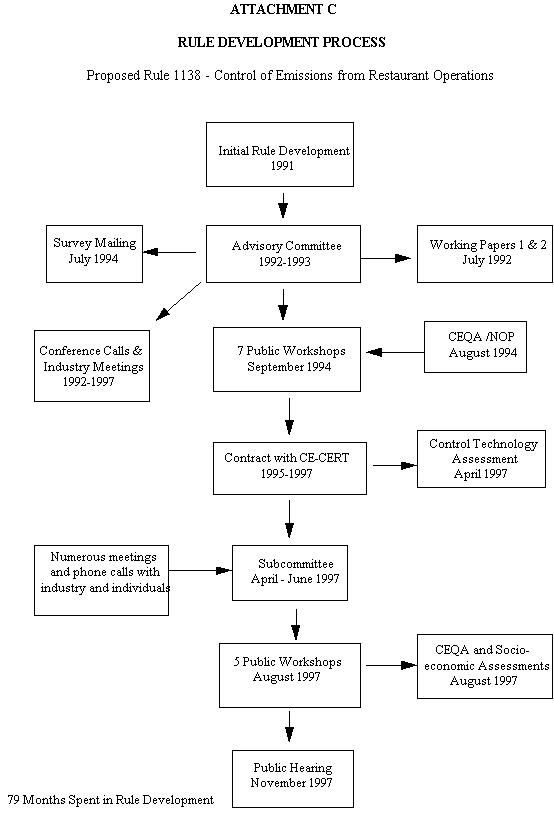
Since 1991, staff has worked extensively with industry to develop a cost-effective and technically feasible rule to control emissions from restaurant operations. This cooperative effort has included, for example, numerous meetings with the Subcommittee on PR 1138 and with individual companies, site visits and extensive outreach. Over 27, 000 mailings were made for the five public workshops held in August 1997. Years of research have resulted in significantly improving the technical understanding about this industry’s emissions. Through the extensive discussions and meetings with industry, the major issues have been resolved and general support for this proposed rule has been achieved.
A report to the Board, Status Report on Controlling Emissions of Particulate Matter and Volatile Organic Compounds from Restaurant Operations, on April 11, 1997 described the pollution-producing processes at restaurants and examined the availability of cost-effective control technologies to reduce PM and VOC emissions from such operations. Although restaurants as a whole emit an estimated 11.6 tons/day of PM and 1.6 tons/day of VOCs, the only process for which a cost-effective control technology has been identified is chain-driven charbroilers. At the December 1997 Governing Board meeting, the BACT Guidelines will be updated to reflect the application of catalytic incineration for chain-driven charbroilers. BACT and Best Available Retrofit Control Technology (BARCT) will be the same. Meanwhile, the search for cost-effective controls for under-fired charbroilers, which represent approximately 80% of the PM emissions and 70% of the VOC emissions from restaurants, is ongoing through a contractual agreement with the University of Riverside, CE-CERT.
The proposed rule will partially implement Control Measure PRC-03 in the 1997 AQMP. This will result in progress towards attainment of the PM and ozone standards by reducing both PM and VOC emissions.
Proposed Rule 1138 will reduce 0.5 tons/day of PM 2.5 and 0.2 tons/day of VOC from approximately 800 restaurants. Adding catalysts will decrease the smoke and odors from these restaurants, which will reduce complaints and visible emissions violations. This will be the first step of a two-part restaurant rule and will help foster technology advancement for under-fired charbroilers and other restaurant equipment. Future rule development efforts will focus on those processes for which cost-effective controls are identified.
Proposal
The proposed rule calls for the installation of flameless catalytic oxidizers on chain-driven charbroilers. Alternatively, sources can choose to install any other control technology or method found to be as or more effective than the catalyst in reducing emissions as determined using the AQMD’s Protocol - Determination of Particulate and Volatile Organic Compound Emissions from Restaurant Operations. The few dozen sources currently operating chain-driven charbroilers with electrostatic precipitators or scrubbers may continue the operation of such control equipment for its functional life, not to exceed 10 years from the proposed rule’s date of adoption. The proposal calls for minimal recordkeeping and includes an exemption which is based on either the amount of meat cooked per week or a demonstration that no more than one pound of any criteria pollutant is emitted in any one day.
The proposed rule will minimize visible emissions from approximately 800 restaurants using the chain-driven charbroilers and consequently reduce smoke and odor complaints. The flameless catalytic oxidizer is a simple, cost-effective control for achieving emission reductions from chain-driven charbroilers. Staff recommends that this proposed rule be adopted as the first step in controlling emissions from restaurants.
AQMP and Legal Mandates
The adoption of Proposed Rule 1138 will partially implement Control Measure PRC-03 in the 1997 AQMP.
CEQA & Socioeconomic Analysis
AQMD staff has reviewed Proposed Rule 1138 pursuant to state CEQA Guidelines Section 15002 (k)(1). A Final Subsequent Environmental Assessment (SEA) with no significant adverse impacts has been prepared because, although the Draft SEA concluded that the proposed rule has the potential to adversely affect air quality (during the construction phase of the project), water demand and solid waste disposal resources, the impacts will not be significant. The Draft SEA was circulated for a 30-day public review and comment period which ended August 29, 1997. All comments received were addressed and incorporated into the Final SEA for the proposed project.
A Socioeconomic Assessment is included as an addendum to the staff report. The assessment indicates that the proposed rule will not likely impose significant adverse socioeconomic impact on the affected restaurants. Owners of the restaurants with chain-driven charbroilers will incur additional costs as a result of installing catalytic oxidizers. Staff calculated the average cost-effectiveness value to be $1680/ton of emissions reduced based on data submitted by equipment suppliers. The restaurant operators have provided estimates that range from $1,000 to $7,400 per ton. The $7,400 value represents some unique outliers who will need to make more extensive structural changes. The average cost calculated from industry data was $2,800 per ton of PM and VOC emissions reduced. Cost estimates indicate that the catalytic oxidizer is a cost-effective control option.
Implementation Plan
• Staff began the process of a public outreach campaign with the mailing of over 27,000 notices for the five public workshops held in August.
• Staff will be able to process most permits for new chain-driven charbroilers and for alterations to existing chain-driven charbroilers through the Certification/
Registration Program.
• Over the next two years of rule development, staff will continue to work with industry with outreach, permitting. and compliance assistance. As part of this effort, staff will continue to evaluate current permit requirements and associated public feedback, and will return to the Board with appropriate recommendations.
Resource Impacts
Most permits will be processed through the AQMD’s Certification/Registration Program, which is an automated process which offers reduced costs and time for the sources participating. Inspections associated with compliance checks will be absorbed by current AQMD staff.
Summary of Proposal
Key Issues and Responses
Rule Development Process
Key Contacts List
Resolution
Proposed Rule Language
Staff Report
Socioeconomic Assessment
Final SEA
ATTACHMENT A
SUMMARY OF PROPOSAL
|
Proposed Rule 1138 - Control of Emissions from Restaurant Operations |
|
· Flameless catalytic oxidizers or equivalent controls are required on approximately 800 chain-driven charbroilers. |
|
· Equipment must be maintained in good working order in accordance with manufacturer’s specifications. |
|
· Records for catalyst installation and replacement, cleaning, and maintenance are required. |
|
· Sources operating chain-driven charbroilers with existing controls may continue to do so for the functional life of the control device (not to exceed 10 years). |
|
· Restaurants may apply for an exemption if they cook less than 875 pounds of meat per week; or can demonstrate that their emissions are less than one pound per day of any criteria air contaminant. |
ATTACHMENT B
KEY ISSUES AND RESPONSES
|
Proposed Rule 1138 - Control of Emissions from Restaurant Operations |
|
· Industry requests 24 months for implementation of catalytic oxidizer installations due to the large number of restaurants and in recognition that a few may involve more extensive retrofits. The proposed rule reflects the requested 24-month implementation period. · Industry would like the AQMD’s assurance that all restaurants subject to the proposed rule’s requirement will have the full implementation period. The AQMD agrees that all sources should be treated equally. The Resolution will reflect this. · There is a difference in the cost data provided by the equipment suppliers and affected restaurants. Staff calculated the average cost-effectiveness value to be $1680/ton of emissions reduced based on data submitted by equipment suppliers. The restaurant operators have provided estimates that range from $1,000 to $7,400 per ton. The $7,400 value represents some unique outliers who will need to make more extensive structural changes. Cost estimates indicates that the catalytic oxidizer is a cost-effective control option. |
|
· Industry requests an exemption for small users based on the amount of meat cooked per week, verified through weekly records and monthly purchase orders. EPA traditionally requires daily records for demonstrating compliance with a rule limit or exemption level that is based on an underlying daily or hourly air quality standard. However, due to the very small number of facilities anticipated to request this exemption and the amount of emissions that would theoretically result from these sources in a worst-case scenario calculation, EPA has indicated that weekly records are acceptable in this limited circumstance. EPA has stated that this flexibility in extending the recordkeeping time period is not a precedent for other rules. |
ATTACHMENT B
KEY ISSUES AND RESPONSES, CONT.
|
Proposed Rule 1138 - Control of Emissions from Restaurant Operations |
|
· Chain-driven charbroilers represent a small percentage of the total emissions from restaurants, yet require controls. Under-fired charbroilers, which represent the majority of emissions, do not require controls. The cost-effective catalyst which controls emissions from chain-driven charbroilers is not effective for under-fired charbroilers. The AQMD has recently entered into a contract with CE-CERT for the purpose of identifying cost-effective controls for under-fired charbroilers and possibly other restaurant equipment. This proposed rule is the first step in significantly controlling emissions from chain-driven charbroilers and will advance technology for the industry by specifying future evaluation of control methods for other cooking equipment. As technology provides a cost-effective means to control other restaurant equipment, staff will develop additional proposals which will include a broader segment of this industry. |
Attachment D
Key Contacts List
Industry
Burger King Corporation
Carl Karcher Enterprises, Inc.
Knott’s Berry Farm
McDonald’s Corporation
Manufacturers
Ayrtech and Prototech
Engelhard Corporation
Grace Thermal and Emission Control Systems
Marshall Air Systems
Nieco Corporation
Industry Associations
California Restaurant Association
National Restaurant Association
Consultants and Others
California Environmental Associates
Gas Appliance Manufacturers Association
Pacific Gas and Electric Company
Southern California Edison
Southern California Gas Company
University of California, Riverside: CE-CERT
Government Agencies
California Air Resources Board (CARB)
United States Environmental Protection Agency, Region IX (USEPA)