PROPOSED AMENDMENTS TO
REGULATION XXX - TITLE V PERMITS AND
RULE 212 - STANDARDS FOR APPROVING PERMITS
AND REGULATION XXX - TITLE V PERMITS

BOARD MEETING DATE: October 10, 1997 AGENDA NO. 39
PROPOSAL:
Amend Regulation XXX - Title V Permits, Rule 3000 - General;Rule 3001 - Applicability; Rule 3002 - Requirements; Rule 3003 - Applications; Rule 3004 - Permit Types and Content; Rule 3005 - Permit Revisions; and Rule 3006 - Public Participation; and
Rule 212 - Standards for Approving Permits
SYNOPSIS:
Proposed amendments to Title V rules will improve clarity, increase flexibility and enhance enforceability of the program and Title V permits. Amendments will reduce the number of facilities required to obtain a Title V permit during the first three years of the program and streamline the procedures for public, affected State and EPA reviews. Proposed amendments to Rule 212 will increase the notice distribution distance for sources located near schools to incorporate the changes to the state law. In addition, amendments will eliminate one-quarter mile noticing for certain facilities and establish new criteria for public notification of significant projects involving toxic emissions.
COMMITTEE:
Stationary Source, September 19, 1997, reviewed.
RECOMMENDED ACTION:
Amend Title V Rules 3000, 3001, 3002, 3003, 3004, 3005, 3006; and Rule 212.
Barry R. Wallerstein, D.Env.Ph.D.
Acting Executive Officer
Background
Regulation XXX was adopted on October 8, 1993 to implement the requirements mandated by Title V of the 1990 federal Clean Air Act amendments. Title V requires EPA to establish a national operating permit program. In 1992, EPA published regulations requiring AQMD and other districts to develop an operating permit program that complies with the federal regulations and submit the program to EPA for approval.
Regulation XXX was amended on August 11, 1995 to provide minor clarification and consistency with other rules, and to address issues EPA identified as necessary to obtain interim program approval.
On February 27, 1997, EPA granted interim approval of AQMD's Title V program. Full approval is contingent upon certain required revisions to Regulation XXX and to state law.
Rule 212 was originally adopted on January 9, 1976 to establish the criteria for approving permits by the AQMD. The rule gave the Executive Officer authority to deny a Permit to Construct or Permit to Operate for sources emitting air contaminants in violation of Section 41700 or 41701 of the California Health and Safety Code (H&SC). Since then, the rule has been amended nine times pursuant to changes to various California state laws (H&SC), the AQMP, and AQMD regulations, such as Regulation XIII - New Source Review, Regulation XIV - Toxics and Other Non-Criteria Pollutants, and Regulation XX - RECLAIM.
Policy Issues
Staff has worked diligently with industry and environmental groups to incorporate changes to Regulation XXX that provide adequate review opportunities for the public, streamline applicability requirements and permit processes, and comply with federal and state laws. South Coast Air Basin facilities are subject to Title V requirements at a lower emission threshold than facilities in any other area of the country (due to the basin’s ex-treme non-attainment status.) However, AQMD has successfully negotiated with EPA to develop a Title V program that significantly reduces its universe during the first three years of the program by basing the applicability determination on actual emissions instead of the potential to emit. Staff further streamlined the process by allowing Title V facili-ties to reference emissions and permit information on file at the AQMD in their applica-tions rather than recreate and re-submit existing information. These actions significantly reduce industry’s expenses to prepare Title V applications and eliminate the need for Title V facilities to submit costly applicability determination documents.
Concerns over the following three key issues have been expressed:
SIP-Gap - Industry is concerned that Title V facilities may be subject to federal enforcement or a citizen lawsuit for not complying with the requirements in SIP-approved rules that have subsequently been determined unachievable and amended accordingly by the Governing Board. Currently, the more stringent SIP-approved rule requirements will continue to be federally enforceable until EPA approves the amended rules into the SIP.
EPA proposes to minimize the impact by: 1) dedicating resources to take final action on a majority of the pending rules prior to the issuance of the first group of Title V permits; and, 2) allowing AQMD to defer issuance of Title V permits for equipment subject to rules that have been relaxed by the AQMD, provided that there is a formal agreement with EPA.
While these proposed actions might be appropriate to handle the current SIP backlog, they do not address future rule amendments. Currently, staff is working with EPA to try to resolve this problem through the Home Rule Advisory Group. In addition, staff will highlight any Title V SIP-gap consequences to the Governing Board in future rulemaking proposals.
Public Hearings - The environmental groups would like the rule to provide an ample amount of time and a simple process for public participation.
To ensure that there is adequate time for public review, staff is proposing to extend the time limit for the public to file a permit hearing request from 10 calendar days to 15 calendar days of the notice date. Industry commented that the review period of 10 calendar days was adequate. As a practical matter, with this short review period and the AQMD’s work schedule of four days per week, the public may have as little as four working days to review Title V documents and request a hearing. Because the proposed amendments include EPA’s agreement to collapse the 30-day public com-ment period and 45-day EPA review into a concurrent time period, industry should reap some benefit from the significant streamlining of the permit review process. Therefore, staff believes it is appropriate to extend the time limit for the public to re-quest a hearing to 15 days.
In addition to the time extension, staff also proposed to allow the Executive Officer to hold a public hearing at his/her discretion, if it was in the best public interest. Industry strongly opposed this proposal because there were no specific criteria for the Execu-tive Officer to exercise his/her discretion and it would bring uncertainty to businesses seeking permits. Staff agreed and withdrew the proposal.
While continuing to maintain the current rule language to prevent frivolous requests for public hearings, staff is sensitive to the concerns that the process should be made simple so as to not deter public participation. Staff has developed a user-friendly form for public hearing requests and a brochure describing how the public can participate in the Title V process. The form and brochure are attached for the Board's review. Additionally, the Technical Guidance Document for Title V will be revised to provide clear instructions to the public and Title V facilities with respect to the Regulation XXX amendments and will be brought back to the Board at a later date.
Portable Equipment - Industry does not agree that contractor-operated portable equipment should be included in the Title V permit of the stationary facility being visited by the portable equipment, making the facility liable for the contractor actions.
Currently, federal law requires contractor-operated portable equipment to be included in the stationary facility’s Title V permit if the operation is routine and predictable. The proposed Regulation XXX amendments will exempt several categories of equip-ment from being included in the Title V permit of the stationary facility, including: non-road engines, military tactical support equipment registered with the state, non-routine and non-predictable contractor-operated or rental portable equipment, and portable equipment not subject to source-specific regulatory requirements provided that the stationary facility’s Title V permit contains appropriate permit conditions.
Staff has been working with both EPA and CARB to establish how portable equip-ment registered with the state should be treated when it visits a stationary Title V fa-cility. EPA has not agreed that all portable military tactical support equipment regis-tered with the state can be exempt from a Title V permit. Regulation XXX includes this exemption because it is required by state law. In addition, EPA has not agreed that the State Registration Permit can serve as an addendum to the stationary facility’s Title V permit without undergoing an appropriate EPA, affected State, and public re-view. When EPA makes a final decision regarding this issue, staff will propose rule amendments accordingly.
Due to the complexity of these issues and potential conflict between local, state and federal laws, the proposed Board resolution directs staff to work aggressively with EPA to bring to the Board a final resolution involving SIP-gap and portable equipment issues.
Regulation XXX Proposal
The proposed amendments to Regulation XXX are necessary to improve clarity and fairness, increase flexibility and enhance enforceability of Title V and permits issued under the Title V program. The amendments reflect staff’s technical assessment and address issues raised by industry and environmental groups. In addition, staff has proposed numerous minor changes to remove redundancies and inconsistencies throughout the rules. The key proposed amendments to Regulation XXX are listed in Attachment A. Please note that staff has revised language in Proposed Amended Rule 3001 as published in the September 12, 1997 Set Hearing Board Package. These changes are the result of EPA’s agreement that their approval is not required for a locally enforceable permit that limits facility potential to emit for the purpose of receiving an exemption from Title V program requirements.
Rule 212 Proposal
The proposed amendments to Rule 212 incorporate changes to the H&SC Section 42301.6 by increasing the public notice distribution radius from 750 feet to 1000 feet. They also eliminate the requirement to mail the notice within a 1/4-mile radius of new or modified sources with emission increases exceeding the levels specified in subdivision (g) of Rule 212. These sources are already subject to notification requirements pursuant to procedures specified under 40 CFR Part 51, Section 51.161 (b) and 40 CFR Part 124, Section 124.10. In addition, they may also be subject to Title V notification. Lastly, the significant toxic threshold level was divided into two tiers. The first tier evaluates increased cancer risk at the equipment level. The second tier ana-lyzes the overall cancer risk for the entire facility. This change will:
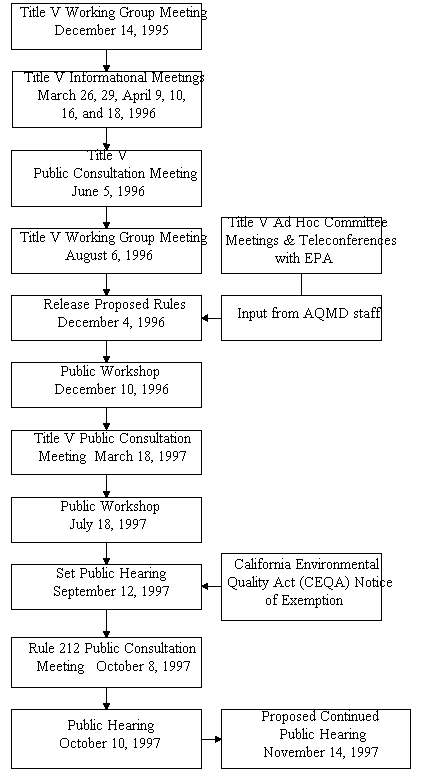
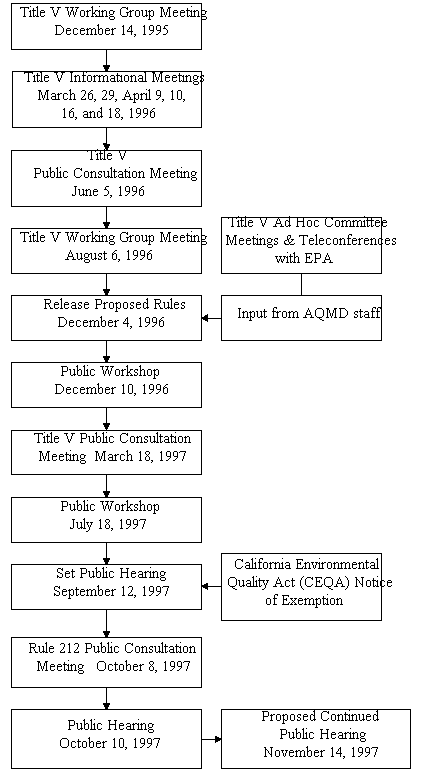
All of the proposed changes to Regulation XXX and Rule 212 were highlighted and discussed in the public workshop and consultation meetings held on December 10, 1996, March 18, 1997 and July 18, 1997. A special public consultation meeting for Rule 212 was also held on October 8, 1997. Staff has reviewed, analyzed, and re-sponded to all comments received by September 26, 1997. To the extent possible, the rules have been revised to address the comments received. Please note that staff has revised language in Proposed Amended Rule 212 as published in the September 12, 1997 Set Hearing Board Package. Based on comments received, staff has re-evaluated the definition of hazardous air emissions as defined in state law, and com-pared it to the current rule language using the term ”air contaminant.” Staff has con-cluded that the definition of air contaminant is adequate and decided to retain the cur-rent requirement that permit units near schools be subject to notification for any air contaminant rather than just hazardous air emissions. The definition of hazardous air emissions is so extensive that essentially notification would be required in every in-stance where permits to construct are issued near schools. AQMD’s responses to all comments are included in the attached staff report.
AQMP and Legal Mandates
The proposed amendments to Regulation XXX and Rule 212 should have no impact on emission limits, and no direct impact on air quality. Title V is a federally mandated permit program to include new permitting, monitoring, reporting, record-keeping, public review, and EPA review requirements and does not include any new emissions limitations.
California Environmental Quality Act (CEQA) and Socioeconomic Impact
Assessment
Pursuant to State CEQA Guidelines Section 15002 (k)(1) and AQMD CEQA Implementation Guidelines Section 1.2 (k)(1), AQMD staff has reviewed the proposed amendments to Rule 212 and Regulation XXX and has determined with certainty that the proposed project is exempt from the requirements of CEQA. The proposed amendments involve administrative updates and do not have the potential to generate significant adverse impacts on air quality or any other environmental area. A Notice of Exemption has been prepared pursuant to State CEQA Guidelines Section 15061 (b)(3) and AQMD CEQA Implementation Guidelines Section 5.1 (b)(3) and will be filed with the county clerks immediately following the adoption of the proposed amendments. In addition, the Socioeconomic Impact Assessment has been prepared to determine the impacts on the regulated communities. The draft Socioeconomic Impact Assessment is included in the Staff Report.
Implementation Plan
The proposed amendments do not appreciably change the process for the approval of permits by the AQMD and the Title V program. Only minor adjustments to the procedures for approving permits, issuing public notice, and implementing the Title V program are warranted. As always, staff will be available to assist those facilities affected by the proposed amendments.
Resource Impacts
The proposed Regulation XXX amendments will result in streamlined Title V implementation and reduced the administrative workload burden to facilities. The agency workload involved in Title V implementation has required AQMD to reallocate a significant number of existing resources to focus on this program. These amendments will reduce the number of facilities required to obtain a Title V permit in the first three years (Phase One) from 1,275 to approximately 900. Therefore, the workload will be reduced proportionately during the first three years.
Even with the reduction in Title V sources during Phase One, a large number of staff is still required to prepare customized Title V application packages, process Title V permits, conduct public hearings, and interface with EPA, affected States and the public. Federal laws currently requires AQMD to issue permits for one-third of Title V facilities each year during the first three years of the program. To meet the first deadline of March 31, 1998, staff haswill been reallocated from the normal permitting program to process Title V permits. This action iswill resulting in delayed processing time for pending and new requests for permits to construct and permits to operatee beyond the current timeline of 7-/30-/180-days.
During the third year of the program, additional resources will also be required to identify facilities subject to the Phase Two Title V program, issue and review applicability determination documents, and prepare Title V application packages for all Phase Two facilities. Furthermore, there may be a large number of applications submitted by industry to limit their potential to emit to below the threshold levels in order to be excluded from the Title V program. If the expected permit modification requests are submitted, additional resources must be dedicated to this effort as well.
The proposed amendments to Rule 212 will have some impact on AQMD’s workload and resources. The increased notification radius from 750 feet to 1000 feet will increase the possibility of receiving public comments such that additional engineering effort may be needed to address the public’s concerns.
Summary of Proposed Amendments
Rule Development Flow Chart
Key Contacts
Notice of Exemption
Permit Hearing Request Form
Public Participation Brochure
Resolution
Rule Language
Staff Report
ATTACHMENT A
SUMMARY OF PROPOSED AMENDMENTS TO
REGULATION XXX AND RULE 212
The proposed amendments to Title V Rule 3000 - General:
The proposed amendments to Title V Rule 3001 - Applicability:
The proposed amendments to Title V Rule 3002 - Requirements:
The proposed amendments to Title V Rule 3003 - Applications:
The proposed amendments to Title V Rule 3004 - Permit Types and Content:
The proposed amendments to Title V Rule 3005 - Permit Revisions:
The proposed amendments to Title V Rule 3006 - Public Participation:
The proposed amendments to Rule 212 - Standards for Approving Permits:
ATTACHMENT B
RULE DEVELOPMENT PROCESS
PROPOSED AMENDMENTS TO
REGULATION XXX - TITLE V PERMITS AND
RULE 212 - STANDARDS FOR APPROVING PERMITS
AND REGULATION XXX - TITLE V PERMITS
Total Time Spent in Rule Development: 22 months
ATTACHMENT C
KEY CONTACTS
Title V Working Group
Title V Ad Hoc Committee
United States Environmental Protection Agency
/ / /