
BOARD MEETING DATE: April 10, 1998 AGENDA NO. 38
PROPOSAL:
Amend Rule 1150.1 - Control of Gaseous Emissions From Municipal Solid Waste Landfills and Rescind Rule 1150.2 - Control of Gaseous Emissions From Inactive Landfills
SYNOPSIS:
Proposed amendments address SIP changes recommended by EPA; implement the requirements of 40 CFR, Part 60, Subpart Cc - Emission Guidelines and Compliance Times for Municipal Solid Waste Landfills; include the requirements of Rule 1150.2 - Control of Gaseous Emissions From Inactive Landfills; and embody the Guidelines for Implementation of Rule 1150.1 as an attachment to the proposed rule.
COMMITTEE:
Stationary Source, January 23, 1998, Reviewed
Technology, February 27 and March 27, 1998, Reviewed
RECOMMENDED ACTION:
Adopt the attached resolution (1) Certifying the Notice of Exemption for Proposed Rule 1150.1 - Control of Gaseous Emissions From Municipal Solid Waste Landfills; (2) Amending Rule 1150.1 - Control of Gaseous Emissions From Municipal Solid Waste Landfills; and (3) Rescinding Rule 1150.2 - Control of Gaseous Emissions From Inactive Landfills.
Barry R. Wallerstein, D.Env.
Acting Executive Officer
Background
Rule 1150.1 was originally adopted April 5, 1985 for landfills that received waste on or after January 1, 1982 and are referred to as "active landfills." Rule 1150.2 was originally adopted October 18, 1985 for landfills that received waste before January 1, 1982 and are referred to as "inactive landfills."
The purpose of both rules is to prevent public nuisance and possible detriment to public health caused by exposure to landfill gas (LFG) emissions.
Both rules essentially require the installation of a gas collection and control system, unless the landfill operator can show that they meet the exemption requirements. Rule 1150.2 has not been fully implemented.
To help landfill operators comply with Rule 1150.1, staff developed "Guidelines for Implementation of Rule 1150.1" in October 1985 and subsequently revised the Guidelines in May 1987 and October 1989. The Guidelines were not submitted as part of the original SIP package.
After the adoption of the AQMD landfill rules, EPA announced in 1988 the decision to regulate landfills under the authority of the Clean Air Act (CAA). Therefore, New Source Performance Standards (NSPS) were proposed in 1991 and promulgated in March 1996. The federal rule is separated into two parts: Emission Guidelines (EG) pertaining to emission standards for existing landfills, and NSPS pertaining to emissions standards for new landfills. Each state is expected to implement the standards for applicable landfills.
On June 13, 1997 the AQMD received a limited disapproval for both Rules 1150.1 and 1150.2 to be implemented in the SIP, because of findings of similar deficiencies in each rule.
During the public hearing on February 13, 1998 two individuals requested clarification regarding which operator is responsible for controlling landfill gas emissions. They also requested that the gas collection system operator not be held responsible, commenting that they would have no control over adequacy of the cover soil. Both the NSPS and State EG regulations for MSW landfills place responsibility on both the MSW landfill operator and on the gas collection system operator. Rule 1150.1 as adopted in 1985 places responsibility with the "owner/operator" of an active landfill and past practice has been to hold all parties including all operators responsible to comply with the requirements of the rule.
Most AQMD rules and regulations when making reference to an operator are referring to the operator of permitted equipment. However, landfills may have several operators. Some may not be required to apply for a Permit to Operate from the AQMD. Operators may be: (a) the person receiving, depositing, and burying solid waste, also known as the landfill operator, and (b) the person operating the gas collection and/or control system. The landfill owner may be the operator of the landfill and equipment and in other cases the owner may contract with another person to operate the gas collection system and yet another person to operate the control equipment.
The regulatory concern for AQMD is the responsibility of each person involved in the landfill operation to limit the emissions of landfill gas at the surface and perimeter of the landfill from exceeding the requirements of the rule. It is not uncommon for the landfill operator to place daily cover over the solid waste and maintain the cover thickness to prevent LFG emissions. The operator of the gas collection system must extract sufficient LFG to reduce emissions on the landfill surface and yet not start fires. The operator of the control system must be able to receive and dispose of all of the supplied LFG. Unless all of these operators work in conjunction with each other, LFG emissions may escape from the landfill and each may claim that the other caused the failure. Therefore, both the landfill operator and the person operating the gas collection and/or control system directly impact surface emissions and so bear compliance responsibility for Rule 1150.1.
At the February 13, 1998 Board Hearing, proposed amended Rule 1150.1 was withdrawn from the agenda and sent to the Technology Committee because of a concern over the definition of "Operator." Andrew Washington, representing Ogden Power Pacific and Tudor Williams, with Cambrian Energy Development both spoke against the proposed definition of "Operator" since it placed legal responsibility on the operator of the gas collection and control system of the landfill, and then subsequently, the owner of the landfill, to comply with the rule.
On February 18, 1998 staff met with Mr. Washington and Mr. Williams and discussed their concerns. Mr. Williams negotiates financial contracts with landfill owners and operators and believes financing would be hindered by placing any responsibility on the equipment operator. Mr. Williams said he would like staff to use owner or operator of the MSW landfill in rule language and not define operator. This rule language would allow persons to interpret the rule in their own way.
The Governing Board must find that the AQMD rules are written or displayed so that its meaning can be easily understood by the persons directly affected by it. The raising of this issue illustrates that there is some question about the meaning of the term "operator."In response to concerns presented at the Board meeting, staff recommends that "Operator" be defined to place responsibility on all operators associated with the MSW landfill operation including operators of equipment requiring Permits to Operate, consistent with the current regulation and state and federal law.
Proposal
After evaluation of the above events, it is recommended that proposed Rule 1150.1 be amended to address the SIP changes recommended by the U.S. EPA; to implement the requirements of the NSPS in 40 CFR, Part 60, Subpart Cc - Emission Guidelines and Compliance Times for Municipal Solid Waste Landfills; to include the requirements of Rule 1150.2 for inactive landfills and to embody the Guidelines for Implementation of Rule 1150.1 as an attachment to the proposed rule.
AQMP and Legal Mandates
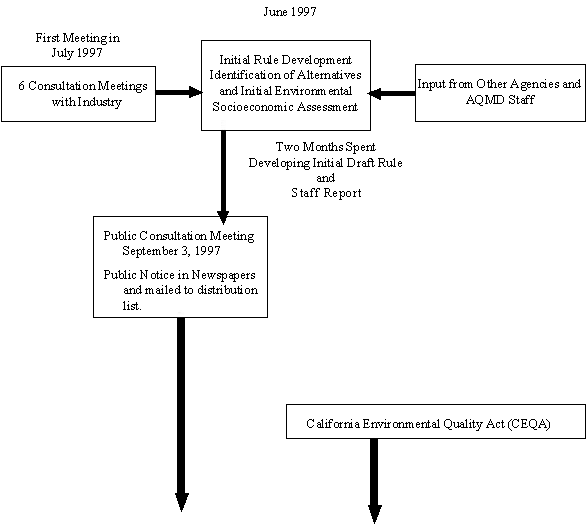
District Counsel has determined that since the proposed amendments do not significantly affect air quality or emission limitations, the proposed amendments only need to be placed on the Board agenda with a 30-day public notice. A noticed public consultation meeting was held on September 3, 1997.
CEQA & Socioeconomic Analysis
The AQMD has reviewed the proposed project pursuant to State CEQA Guidelines §15002 and SCAQMD CEQA Implementation Guidelines §1.2, which involves a three step process for determining the appropriate CEQA document. The first step involves a determination of whether CEQA applies at all. If the project is exempt, the process does not need to proceed any further, and a Notice of Exemption may be prepared (State CEQA Guidelines §15002 (k)(1).
Proposed amendments to Rule 1150.1 and the rescission of Rule 1150.2 will address SIP changes and implement federal requirements. Therefore, the proposed rule amendments and rule rescission are exempt from the requirements of CEQA because it can be seen with certainty that the proposed actions have no effect on air quality or any other environmental category as all existing landfills required to install controls have done so [State CEQA Guidelines §15061 (b)(3) and SCAQMD CEQA Implementation Guidelines §5.1 (b)(3)].
A Notice of Exemption has been prepared in accordance with State CEQA Guidelines §15062 and SCAQMD CEQA Implementation Guidelines §5.2, - Notice of Exemption and a copy has been included in the Public Hearing agenda item. The Notice of Exemption will be filed with the county clerks of the Basin counties immediately following the adoption of the proposed rule amendments and rule rescission at the Public Hearing.
The proposed amendments do not require additional controls or result in emission reductions and therefore, are not expected to impose cost or other socioeconomic impacts. Since there will be no additional compliance costs, consideration of cost-effectiveness and an incremental cost-effectiveness analysis is not applicable.
Implementation Plan
Municipal solid waste (MSW) landfill operators must comply with the requirements of the rule or submit alternatives to the rule in a Rule 1150.1 Compliance Plan within ninety days after adoption of the proposed amendments to the rule. The alternatives must be approved by the Executive Officer. During the ninety days after the adoption of the rule or during the approval period for the Compliance Plan, the existing Rule 1150.1 Compliance Plans will remain in effect.
Resource Impacts
Not applicable.
Summary of Proposed Amendments
Rule Development Process
Key Contacts
Resolution
Notice of Exemption
Proposed Rule Language
Draft Staff Report
ATTACHMENT A
|
Summary of Proposed Amendments to Rule 1150.1 - Control Of Gaseous Emissions From Municipal Solid Waste Landfills |
|
The proposed amended rule contains: |
|
· Requirements for active and inactive landfills, consolidated in one rule. |
|
· A change in the date separating the classification of landfills as either active or inactive from January 1, 1982 to November 8, 1987 to correspond with the date for existing landfills as used in the federal and state emission guidelines. |
|
· Operational requirements for the gas collection and control system to prevent subsurface perimeter probe concentrations from exceeding 5%, integrated surface samples from exceeding 50 ppmv and instantaneous surface monitoring from exceeding 500 ppmv total organic compounds (TOC), measure as methane. |
|
· Operational requirements for all control equipment to meet a control efficiency of 98% or 20 ppmv as hexane. |
|
· Sampling and monitoring requirements to determine if the gas collection and control system is operating in compliance. |
|
· The requirement to submit a landfill closure report prior to closing a landfill. |
|
· The requirement to submit an equipment shutdown, capping or removal report providing necessary documentation for approval before eliminating any system components. |
|
· Requirements for inactive landfills with and without gas collection and control systems. |
|
· Remediation requirements for inactive landfill (without a gas collection and control system) operators to control exceedances of the instantaneous 500 ppmv TOC standard. |
|
· A provision for alternatives to the requirements of the rule to be submitted in a Rule 1150.1 Compliance Plan for approval by the Executive Officer. |
|
· Temporary exemption from all or any portion of the requirements of the rule provided that the operator can demonstrate a landfill meets the three emission standards for TOC, produces less than 55 tons of nonmethane organic compounds (NMOC) per year and is not a health risk. |
|
Other amendments: |
|
· Attachment A of the rule incorporates the revisions to "Guidelines to Implement Rule 1150.1." |
ATTACHMENT B
RULE DEVELOPMENT PROCESS
PROPOSED AMENDED RULE 1150.1 - Control Of Gaseous Emissions From
Municipal Solid Waste Landfills
| Date for Set Hearing: | January 9, 1998 |
| Date of Hearing: | April 10, 1998 |
Total Time Spent in Rule Development
Pre-Board Hearing: Nine Months
ATTACHMENT C
KEY CONTACTS LIST
• Environmental Agencies
- Environmental Protection Agency, Region IX
- California Air Resources Board
• Public Agencies
- County Sanitation Districts of Los Angeles County
- County of Orange Integrated Waste Management Department
- Riverside County Waste Resources Management District
• AQMD Committees
- Rule Team Development
- Stationary Source Compliance
• Industry
- BKK Corporation
- BFI
- RES Environmental Inc.
- Cambrian Energy Development
/ / /