
BOARD MEETING DATE: December 11, 1998 AGENDA NO. 27
REPORT:
Permit Streamlining Task Force Status Report
SYNOPSIS:
The Permit Streamlining Task Force, composed of AQMD Board Members, industry and environmental/community group representatives, was formed in April 1998. Since its formation, it has identified and discussed a wide variety of permitting related issues. This report provides a listing and status of various permit-streamlining issues discussed by the Task Force.
COMMITTEE:
Administrative, November 20, 1998, Discussed Permit Streamlining Task Force, November 6 and December 4, 1998, Discussed
RECOMMENDED ACTION:
Receive & File the Permit Streamlining Task Force Status Report.
Barry R. Wallerstein, D.Env.
Executive Officer
The Permit Streamlining Task Force (Task Force) was formed in April, to help develop specific recommendations that would expedite processing of permits for conventional, Title V and RECLAIM facilities and operations. The Task Force chaired by Vice-Chair Glover, and includes Board Members Mayor Loveridge and Supervisor Silva as well as eight other members, which include industry and environmental/community group representatives. Also, Mohsen Nazemi, the AQMD's Permit Streamlining Ombudsman, has been working with the Task Force to assist in implementation of various streamlining initiatives.
Since its kick-off meeting on April 28, 1998, the Task Force has examined many permit-streamlining issues and discussed potential solutions. A Permit Streamlining Study contract has also been awarded to a consulting firm in order to provide its independent review of the AQMD's permitting programs and recommendations for consideration by the Task Force. The Task Force intends to bring before the Governing Board a set of specific, consolidated permit-streamlining recommendations in the first quarter of 1999.
Key Streamlining Issues and Status Summary
The Permit Streamlining Task Force has reviewed a wide variety of permitting related issues. The resolution of some of the issues is being implemented while others will be incorporated into the final recommendations, which is due to be presented to the Governing Board in early 1999. The following provides a summary and status of key streamlining issues discussed by the Task Force:
PERMIT PROCESSING FEE PAYMENT
Since incorrect permit fee payments were identified as one of the major reasons for rejection or delays in accepting of applications, the Task Force recommended, and the Governing Board approved in June 1998, the establishment of systems for payment of permit-processing fees electronically and by credit cards. These actions are important in that they not only provide convenient ways for applicants to pay permit fees and not having their applications rejected or delayed due to incorrect fees, but also facilitate several permit streamlining proposals including filing of permit applications electronically through the Internet, Modem, or fax. Staff has been working with AQMD’s bank and treasurer (Los Angeles County) to establish a credit card payment system for permit applications. Currently, the treasurer's office is evaluating our unique needs and the changes necessary to implement credit card payments through the treasurer. In addition, the new finance system currently being implemented will have the ability to process electronic payments (Electronic Data Interchange) with vendors as well as applicants. Both of these capabilities are expected to be on-line for implementation in early 1999.
Additionally, the Board also approved another Task Force recommendation, on a six-month trial basis, a program to accept and process applications initially filed with 85% or more of permit processing fees. This action will significantly reduce the number of applications being delayed for processing due to minor fee errors. Implementation of this program is being incorporated into a system designed to better track the application status and is expected to begin in early 1999.
PERMIT STREAMLINING STUDY BY CONSULTANTS
AVES, an Affiliate of ATC Associates, has been retained since September 1998, to provide an independent comprehensive review of the AQMD’s permit system and to recommend specific steps for permit streamlining. The consultant has studied the entire permitting processes, interviewed applicants and AQMD’s permitting staff, as well as surveyed various permitting agencies and non-governmental organizations nationwide for ideas. A compilation of all of the permit streamlining ideas collected as a result of this exercise was presented in an interim report to the Task Force on November 3, 1998. The list of ideas covered potential solutions to problems in all permitting aspects including permit fees, support systems, work flow, tracking, application forms, in-house coordination and management.
AVES also proposed a set of evaluation criteria and a ranking method during the meeting, seeking input from the Task Force members. The evaluation criteria included system efficiency, responsiveness to external customers, effectiveness in meeting air quality mandates, provision of information to other AQMD programs, and ease of implementation. The consulting firm will conclude its study and present a final report with their recommendations to the Task Force in December 1998. In doing so AVES is also coordinating their work with the Fee Structure and Equity Study contractor to ensure that impacts of any recommendation set forth by the fee study contractor is also considered.
STREAMLINED STANDARD PERMITS
The Task Force reviewed and approved this staff proposal in September 1998. As proposed, the streamlined standard permit will provide an accelerated alternative for applicants to receive a permit within a very short time frame. The standard permit may be designed for a given equipment category using either the conventional two-step process (i.e., Permit to Construct followed by Permit to Operate) or the combined one-step Permit to Construct/Operate process, depending on the complexity and potential compliance status of the equipment category. Staff will begin selecting appropriate equipment categories and, for each selected category, develop a specific permit application form and a pre-determined, standardized permit description and conditions. Each set of application forms permit conditions will clearly spell out the criteria for approving such accelerated permits. Examples of these criteria may include limitations on equipment and facility emissions or equipment location so that BACT/LAER, offsets, health risk analysis, and public notice are pre-determined or not required.
The concept of the streamlined standard permit may be applied to many equipment categories. However, staff intends to prioritize the efforts by developing the packages for most frequently permitted categories first. Among the first group of equipment categories being evaluated are boilers, dry cleaning, special spray coating, printing press, and fuel storage and dispensing.
CPP PROGRAM ENHANCEMENT
The Certified Permitting Professional (CPP) program was instituted as part of the AQMD's "New Directions" in 1993, to create a mechanism where trained individuals prepare and submit complete and accurate permit application packages to the AQMD to facilitate the approval process. The Task Force initially identified a need to enhance the program to improve its effectiveness and formed a Subgroup to develop a specific work plan. On November 6, 1998, the Task Force approved the CPP Program Enhancement Work Plan, a copy of which is attached for information.
The CPP Program Enhancement Work Plan was developed with the consideration of the following key elements:
The work plan basically includes the following enhancements:
Staff's best estimate is that it would take approximately three to four months to organize and distribute the minimum amount of information, thus the work plan is expected to be implemented in April 1999.
TITLE V FACILITY PERMIT
One of the issues discussed early on by the Task Force members related to the AQMD's approach in preparation of the Title V facility permits and user-friendliness of the final permits. The Task Force was concerned that:
I. FACILITY PERMIT CONCEPT
In order to address these concerns the Task Force formed a Facility Permit Subgroup consisting of some of the Task Force members and AQMD staff. The Subgroup was tasked to identify potential alternatives that would reduce the cost of permit preparation, minimize the need for staff’s resources, and improve user-friendliness of the permit format, while still complying with the Title V federally-mandated requirements. The Subgroup identified and discussed several alternatives. As part of the evaluation of various alternatives, AQMD staff conducted a limited time study to determine the time differences for preparing the initial Title V permits under various options, and identified the pros and cons associated with each option.
During the November 6, 1998, Task Force meeting, the alternatives were discussed and the Task Force recommended to proceed with one of the alternatives for the Title V Groups B and C facilities (i.e., groups for which Title V facility permits have not yet been prepared). The recommended alternative will allow the AQMD to maintain a single conventional equipment-based permitting system for both Title V and non-Title V sources. With this alternative the main body of a facility permit will be the compilation of the photocopies of the original conventional equipment-based permits. Any additional element that is necessary to fulfill Title V requirements can then be built around the conventional equipment-based permits. This approach will avoid having to break up existing equipment-based permits to devices and to reword permit conditions in order to generate a Title V permit. However, by using this approach, the facility permit equipment description and permit conditions will not be in a database structure. Changes to the permits or conditions may require additional time for revisions or re-issuance of the permits.
The limited time study conducted by AQMD staff showed that there may be significant time savings in producing the initial Title V permits using the recommended alternative. However, the difference in time required for subsequent revisions or re-issuance of permits is not clear at this time. Staff is evaluating other means to minimize or eliminate any such additional time requirements. Staff is also in discussion with EPA Region IX regarding the recommended alternative approach for Title V permits.
II. FACILITY PERMIT FEES
During the May 1998 Governing Board meeting, a resolution was passed for adoption of amendments to Regulation III - Fees, which asked staff to report back to the Board, among other things, "future improvements under consideration based on recommendations from the District's Permit Streamlining Task Force," related to Title V permit processing. The resolution further asked for recommendations for any adjustments to Title V permit fees.
The fees for initial Title V permit as specified in Rule 301(p)(3)(B) are based on the minimum time required to prepare the facility permits under the present approach with additional time charged on a time-and-material basis. At this time, since staff has not yet embarked on the implementation of the Task Force's recommended Title V permitting alternative, it is premature to recommend any changes to the fee rule. Nevertheless, based on the preliminary time study, it is anticipated that the Task Force's recommended alternative will most likely reduce the amount of time necessary to produce the initial Title V permits, and thus reduce the overall additional time-and-material fees to industry, without a need to adjust Rule 301(p)(3)(B) at this time. Staff will report back to the Governing Board, upon implementation of the Task Force's recommended alternative, if any fee adjustments are found to be needed.
A prototype permitting web page is to be developed for both internal and external users. The web page will be designed as a central location to provide not only the basic permitting information and application forms for general permit applicants, but also for in-house permitting staff and outside experts (e.g., CPPs) in-depth technical guidelines and references such as permitting policies and procedures, permit evaluation protocols and templates for specific equipment categories, etc. The web page can also be a resource center providing links to programs such as health risk analysis, emission factors, and BACT/LAER determinations, etc.
Attachments
CPP Program Enhancement Work Plan
CPP PROGRAM ENHANCEMENT WORK PLAN
The South Coast AQMD’s Certified Permitting Professional (CPP) program is designed and instituted to create a mechanism where trained individuals prepare and submit complete and accurate permit application packages to the AQMD. The program is intended to expedite processing of applications by avoiding delays in the engineering review process as often experienced with applications that are incomplete or contain insufficient information to determine compliance with permitting requirements. The proposed enhancement of the CPP program should further implement the original intent of the program and conform to the ongoing permit streamlining efforts as well as other general policies. In addition, this draft Work Plan proposes an expedited permit processing procedure for CPP applications (if so identified) at various processing stages. Further priority processing by permit processing teams could also occur if the applications qualify under the "Green Carpet" priority program, the "Optional Express Permit Processing" program, or other designated priorities. Therefore, the key elements necessary for the CPP program enhancement are as follows:
NEAR TERM IMPROVEMENTS
LONGER TERM IMPROVEMENTS
(The following proposed improvements are specific to the CPP program. Others that are being evaluated as part of the ongoing permit streamlining activities are not included.)
Attachments
Alternative Access to Specific AQMD Records
Record Access Authorization Form
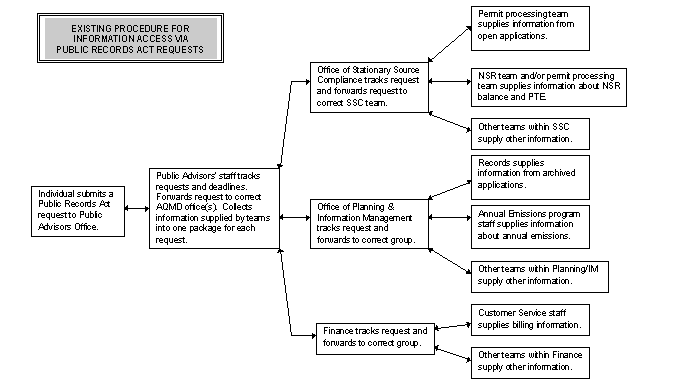
Existing Procedure for Information Access (flow chart)
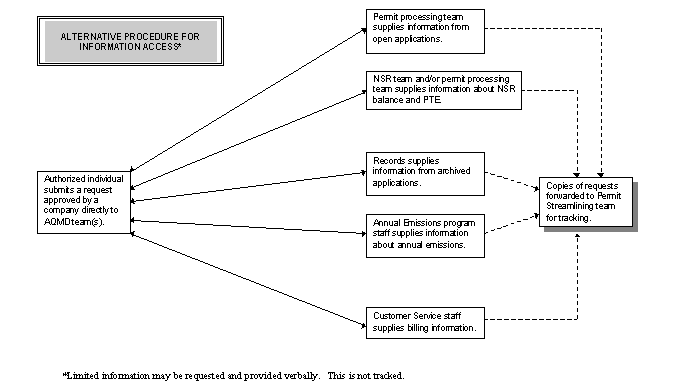
Alternative Procedure for Information Access (flow chart)
Expedited Procedure for Handling CPP Applications (flow chart)
CPP Application Deficiencies
Issue:
In order for companies to submit complete applications for permits, and conduct other routine business with the AQMD, company representatives sometimes need specific information about their own facilities. In the past, companies in some cases have been requested to submit a Public Records Act request to obtain such information. As a Public Records Act request, the requested information is supplied by the appropriate AQMD groups, gathered and tracked "cradle-to-grave" by the Public Advisor’s office. This has resulted in delays and excessive paperwork and has been resource intensive. To alleviate this issue, the following proposal has been prepared for consideration by the Permit Streamlining Task Force.
Proposal:
As an alternative to the Public Records Act process, companies could authorize individuals (i.e. company employees or consultants) to have direct access to their own company information at the AQMD. This proposal is intended to streamline access to information, while minimizing administrative burden on the AQMD. The AQMD may provide limited types of information directly to companies, without coordination and tracking by the Public Advisors’ office. The procedure for companies to authorize individuals to access information is as follows:
Access to Application Files
For an open application, the authorized individual will submit a copy of the letter and Authorization form and will make an appointment with the permitting team supervisor for that application to review the hard copy file.
Access to Permit Database & Other Systems
South Coast Air Quality Management District
Records Access Authorization
| Facility Name: | ||||
| Facility ID: | Facility Contact: | |||
| Facility Address: | ||||
| City: | State: | Zip Code: | ||
| Specify Equipment by Application | No(s): | |||
| Access Authorized: | From: | To: | ||
| (if no date is specified; authorization valid for six months from date of company approval) | ||||
| Other restriction(s): | ||||
| Authorized Records Access (State "Yes" to allow access or state "No" to disallow access in front of each numbered item) |
||||||
| 1. Complete Engineering File(s)* | 5.New Source Review Balance | |||||
| 2. Application Forms | 6. Potential to Emit (PTE) | |||||
| 3. Permits | 7. Accounts Receivable | Year: | ||||
| 4. Equipment List | 8. Annual Emissions | Year: | ||||
| 9. Other (specify): | ||||||
*Complete Engineering File includes Application Forms, Permits, Final Engineering Evaluation(s) and related information
| To Be Completed by Authorized Company Representative
(after information above is completed): By authorizing _____________________________ to access only the specified SCAQMD files for the facility identified above, I hereby waive any claim of confidentiality based upon trade secret information or other privilege which I may have claimed for materials contained in any such file(s) for purposes of this request only for only the above authorized individual. _____________________________________________ ________________________ (Name & Title of Authorized Company representative) (Telephone Number) |
|
| ___________________________________ | ___________________ |
| (Signature) | (Date) |
| To Be Completed by Person to be granted access: I attest under penalty of perjury that I have been hired by the above identified company to represent this facility. I further agree to reimburse the SCAQMD for all expenses related to producing the information requested in accordance with Govt. Code Section 6257. |
|
| _____________________________________________ | ________________________ |
| (Name & Title) | (Telephone Number) |
| _____________________________________________ | |
| (Company name) | |
| _____________________________________________ | ________________________ |
| (Signature) | (Date) |
*Limited information may be requested and provided verbally. This is not tracked.
CPP APPLICATION DEFICIENCIES
To qualify for the Expedited Permit Processing Procedure, each permit application filed by the Certified Permitting Professional (or CPP application) shall meet the following prerequisite:
A. MAJOR DEFICIENCIES REQUIRING ENGINEERING REVIEW & WRITTEN NOTICE
General
Forms & Supplemental Information
A. MAJOR DEFICIENCIES (cont'd)
Emissions, Evaluations & Recommendations
B. MINOR DEFICIENCIES TO BE RESOLVED BY PERMIT SERVICES STAFF AND/OR ENGINEERING TECH
(Deficiencies will be considered major if a CPP application contains more than three of the following minor deficiencies.)
Forms & Supplemental Information
B. MINOR DEFICIENCIES (cont'd)
Emissions, Evaluations & Recommendations
/ / /