ATTACHMENT C
RULE DEVELOPMENT PROCESS
Proposed Rule 1118 - Refinery Flare Emissions
JUNE, 1995

BOARD MEETING DATE: January 9, 1998 AGENDA NO. 44
PROPOSAL:
Adopt Proposed Rule 1118 - Emissions from Refinery Flares
SYNOPSIS:
Proposed rule will take a stepped approach to potential flare emissions reduction by gathering data on flaring operations at petroleum refineries to assess the need for, or the level of, any future controls to reduce flare emissions. The first step will require refineries to monitor flaring activities for the amount and composition of gases being flared. If the data demonstrates a need to control flaring operations, step two of the rule will be to develop specific control requirements to reduce flare emissions.
COMMITTEE:
Stationary Source, November 21, 1997, Reviewed and Discussed
RECOMMENDED ACTION:
Adopt Proposed Rule 1118 - Emissions from Refinery Flares.
Barry R. Wallerstein, D.Env.
Acting Executive Officer
Background
Reducing emissions from petroleum refinery operations was originally conceptualized and formalized in the 1982 Air Quality Management Plan (AQMP) as Measure A15. This measure has been carried over through subsequent AQMPs and is now Control Measure #97CMB-07 in the 1997 AQMP. Measure A15 proposed increasing the use of blowdown and vapor recovery systems to reduce emissions from flares. Consideration of adoption of Measure A15 in 1985 was postponed to provide additional time to collect background information with the knowledge that CARB was in the process of conducting a study regarding refinery flares.
In 1984, the Citizens for a Better Environment (CBE) petitioned CARB to make a determination of the technological feasibility, availability and economic reasonableness of continuous emission monitors for refinery flares. CARB granted the CBE request and contracted a study with an engineering firm to evaluate the feasibility of continuously monitoring flaring operations at petroleum refineries. The study found that no refinery in California accurately monitored flow rates to its flares. Several types of flow meters had been installed on refinery flares, but the instrumentation could only provide relative flow information because the gas density varies and gas constituent data is necessary to calculate flow accurately. The study concluded that continuous monitoring of flare gas flow rates, gas composition and remote monitoring of flare plumes were practicable but required substantial development before they would be ready to use and be relatively inexpensive.
In 1986, based on the study and public testimony, CARB determined that monitoring devices were technologically feasible, available and economically reasonable for limited applications to identify and record continuously the on/off status of refinery flares in order to better quantify flare emissions. This finding was formalized and adopted by CARB as Resolution No. 86-80. CARB also encouraged local air pollution control districts to adopt rules requiring refineries to install on/off status monitors and collect flare gas composition data so that a suggested control measure for the control of emissions from refinery flares could be developed.
In 1987 through 1988, refineries in the South Coast Air Basin participated in a flare study resulting from CARB Resolution No. 86-80. The results of this study met with limited success. Staff’s review of the available data has determined that the results of the study are insufficient to quantify the emissions from petroleum refineries, especially in light of the recent refinery modifications to produce reformulated fuel.
Since 1988, staff has tracked the development of available technology that could accurately monitor gas flare parameters which would result in sufficient data to quantify emissions. Recent advances in technology have resulted in devices that can now accurately monitor gas flare parameters. Staff has found that these monitoring devices are currently being used in various industries that use gas flares with favorable results.
In 1993 and 1994, staff required two refineries to conduct flare system studies as a result of frequent odor complaints due to emissions associated with their gas flaring operations. Recommendations based on these studies were implemented and resulted in a significant reduction in violations of Rule 402 - Nuisance. These studies and subsequent implementation of recommendations showed that each refinery flare system is complex, unique, and opportunities potentially exist to reduce nuisance problems associated with refinery flare systems.
Currently, all existing facilities affected by the proposed rule are subject to Regulation XX - RECLAIM. It is unlikely that any new refineries will be built in the South Coast, however any such new facility will also be subject to RECLAIM. Nevertheless, gas flares are exempt from Regulation XX - RECLAIM and consequently are not subject to the declining emission caps and monitoring, recordkeeping and reporting requirements for each RECLAIM facility. In addition, flare emissions are not subject to any emission caps or limits under Regulation XIII - New Source Review (NSR) rules and are generally exempt from offsets because they are considered as air pollution control systems. New flares are subject to the Best Available Control Technology (BACT) requirements of NSR. However, recent modifications to existing flares, in general, have not resulted in any new BACT requirements and there are very few new flares built which have required BACT. Furthermore, the sulfur content in the gases being burned in flares is exempt from the limits and monitoring requirements of Rule 431.1 - Sulfur Content of Gaseous Fuels with the exception of pilot and purge gases. Therefore, flare emissions are not being monitored or reduced accordingly under any of the above rules. The only rules that apply to flares are general prohibitory rules such as Rule 401 - Visible Emissions and Rule 402 - Nuisance. However, in cases where flaring activities are associated with breakdowns in process units vented to the flares the facilities have sought relief from rules (i.e. Rule 401) under breakdown provisions.
Presently, flare emissions are reported using emission factors which are a function of the number of barrels of crude oil processed or tons of elemental sulfur recovered at each refinery. This estimation is not a good representation of actual emissions due to the various operational differences at each refinery. EPA has developed "default" emission factors for flares; however, in order to use them one needs to know the type, quantity and quality of the gases being flared.
Proposed Rule 1118 - Emissions from Refinery Flares will require petroleum refinery operations to monitor, record and report data on gas flaring operations. This data will then be evaluated in order to assess the need for, or the level of, any future controls required in order to minimize flare emissions. Proposed Rule 1118 is the first step of a two-step approach specified in Control Measure #97CMB-07 of the 1997 AQMP. The first step will require refineries and other related facilities to monitor gas flaring activities for the amount and composition of gases being flared and to report emissions information from refinery flares. This information will be used to enhance the emission inventory from gas flares. If the data demonstrates a need to control flaring operations, the second step will be to develop specific control requirements to minimize flare emissions.
Proposal
The proposed rule will require refineries and other related facilities to submit a Flare Monitoring and Recording Plan to the AQMD within 90 days of the rule adoption date for AQMD approval. The plan will contain information regarding: the gas flare system; vapor recovery system and other process units vented to flares; how the quantity and quality of flared gas will be determined, monitored and recorded; how criteria pollutants will be quantified; and, a schedule for the installation of flare monitoring systems. Within six months from the date of the plan approval, each facility will be required to complete the installation of a flare monitoring system and to start to monitor and record the flow rate, higher heating value and total sulfur content of vent gases and the circumstances that result in vent gases being flared. Each facility must then submit quarterly reports that include the above information and quantification of emissions resulting from gas flaring operations.
The two basic elements of the monitoring requirements relate to the vent gas quantity and quality. Vent gas quantity will be monitored with continuous flow monitors; however, in order to determine vent gas quality, sampling is required for each flare event. Affected facilities have expressed concerns associated with potentially burdensome sampling requirements and based on recent discussions with affected facilities staff has made minor changes to the proposed rule language presented in the Set Public Hearing package.
The proposed Rule 1118 now provides affected facilities with an option to choose an alternative sampling program for the initial interim period of monitoring and recording of flare events. The alternative sampling program is necessary to account for the uniqueness of each refinery’s flare system and lack of any previous monitoring data and allows a facility to establish a sampling program that will provide basic information for interim emission estimation and at the same time will not be overburdening to the facility. Furthermore, based on the concerns expressed by facilities which have experience with the continuous flare gas monitoring systems, staff made changes to the rule language to simplify monitor specifications and to allow for an additional 14 days every 18 months for planned maintenance and calibration of the monitors. Additional minor changes have been made to the rule language for clarity based on comments received. All changes made to the rule language are indicated by strikeout and underline.
District staff will review and analyze the data from the quarterly reports to enhance the gas flare emission inventory and categorize circumstances that result in the flaring of gases. If the data demonstrates a need to control flaring operations, rule development for the second step of the control measure will be recommended to determine specific control requirements to minimize flare emissions.
Policy Issues
To date, public comment on Proposed Rule 1118 has been from the affected facilities and environmental community and has focused on the following concerns:
• Use of memorandums of understanding (MOUs) between the affected facilities and the AQMD in lieu of Proposed Rule 1118;
• Exemption of the Clean Service and Emergency Service Flares from the monitoring requirements and limiting the monitoring to General Service Flares only;
• The higher cost of new state of the art gas flow meters and the lack of flexibility to use other types of meters;
• Waiver of the requirements to identify Flare Events;
• Limitation of the frequency of sampling for total sulfur compounds and BTU content to a periodic interval rather than per event;
• Allowing additional time for installation of monitoring systems;
• Identification of air toxics in vent gases to flares;
• Continuous measurement of vent gases to flares and improvement of emission factors; and
• Expeditious implementation of Proposed Rule 1118 and initiation of the second phase of the control measure.
AQMP & Legal Mandates
Proposed Rule 1118 meets the 1997 AQMP commitment in Control Measure
#97CMB-07 by implementing step one (the gathering of data on gas flaring operations at petroleum refinery operations) of a two-step process, to assess the need for, or the level of, any future controls required in order to minimize flare emissions.
CEQA & Socioeconomic Analysis
The AQMD has reviewed the proposed project pursuant to State CEQA Guidelines § 15002, which involves a three-step process for determining the appropriate CEQA document. The first step involves a determination of whether CEQA applies at all. If the project is exempt, the process does not need to proceed any further, and a Notice of Exemption may be prepared (State CEQA Guidelines § 15002 (k)(1)).
The proposed rule involves collecting emissions data from refinery flares. Pursuant to CEQA Guidelines Section 15262, the proposed project is considered a feasibility or planning study, and would be statutorily exempt from the requirements of CEQA. A Notice of Exemption has been prepared in accordance with State CEQA Guidelines § 15062 Notice of Exemption, and a copy will be included in the Public Hearing agenda item. The Notice of Exemption will be filed with the county clerks following the adoption of the proposed rule at the Public Hearing.
A Socioeconomic Assessment is included as an addendum to the staff report. The assessment estimates that the proposed rule would impose an annual potential maximum cost of approximately $4 million, in total, on all the affected facilities for meeting the proposed rule’s monitoring, recording and recordkeeping requirements. The overall maximum potential cost for an individual facility depends on the number of flares at the facility, and ranges from approximately $280,394 to $321,568 annually per facility.
Implementation Plan
• After the date of adoption, staff will notify affected facilities of the Flare Monitoring and Recording Plan requirements.
• Staff will work with the affected facilities to approve plans, considering the unique characteristics of each facility.
• Staff will review and analyze the data in the quarterly reports to refine the gas flare emission inventory and determine if the data demonstrates a need to control flaring operations.
• If the data demonstrates a need to control flaring operations, staff will develop recommendations to initiate rule development for the second step to determine specific control requirements to minimize flare emissions.
Resource Impacts
Sufficient resources have been budgeted in the AQMD Three-Year Budget Forecast.
A. Summary of Proposed Rule
B. Key Issues and Responses
C. Rule Development Process
D. Key Contacts List
E. Resolution
F. Notice of Exemption
G. Proposed Rule Language
H. Final Staff Report
I. Socioeconomic Assessment
ATTACHMENT A
SUMMARY OF PROPOSED RULE
Proposed Rule 1118 - Emissions from Refinery Flares
• Purpose - Determine if flares are a significant source of emissions.
1. Flares are currently not required to be monitored by any rule;
2. Phase I - PR 1118 requires monitoring and recording of flare operations;
3. Phase II - Require flare emissions controls, if necessary.
• Applicability
The proposed rule applies to all gas flares used at petroleum refineries and other petroleum-related facilities.
• Requirements
1. Plan Submittal:
a. Submit a Flare Monitoring and Recording Plan;
b. Classify flares as Clean, Emergency or General Service;
c. Propose alternative sampling program.
2. Monitoring and Recording:
a. Conduct limited monitoring/recording for Clean Service Flares, but more
extensive monitoring/recording for Emergency and General Service Flares, respectively;
b. Calculate Pilot and Purge Gas quantity and quality;
c. Continuously monitor Vent Gas quantity and sample for sulfur and BTU for each Recordable Flare Event, with a choice to use an interim sampling program initially;
d. Monitor and Record Vent Gas with a Continuous Flow Monitor (CFM) or a
combination of CFM and On/Off Switches.
3. Recordkeeping and Reporting:
a. Calculate and report criteria emissions quarterly;
b. Maintain records for two years.
4. Schedule:
a. Submit Plan 90 days after adoption’
b. Begin monitoring flares approximately 6 months after AQMD decision on Plan approval.
ATTACHMENT B
KEY ISSUES AND RESPONSES
Proposed Rule 1118 - Emissions from Refinery Flares
• Industry has requested that a memorandum of understanding be signed between AQMD and each affected facility in lieu of the proposed Rule 1118.
The proposed rule will provide a more equitable and consistent set of requirements that would apply to each facility, yet it provides adequate flexibility to consider each facility’s unique flare system design and operation.
• Industry representatives have requested that the rule only require monitoring of General Service Flares because the use of Emergency and Clean Service Flares can’t be restricted or controlled.
All flares should be monitored to first determine if flares are a significant source of
emissions; however the proposed rule provides flexibility for lesser monitoring requirements for Clean Service and Emergency Service Flares, respectively, compared to General Service Flares.
• Industry representatives have requested to use existing meters due to the high cost of new more accurate state-of-the-art ultrasonic meters ($67,000 initial cost and $8,200 amortized over 10 yr. @ 4% real interest rate).
The rule has been changed to allow other meters to be used provided they can accurately measure flow in order to provide adequate information. However, staff has determined that meters using ultrasonic technologies are much more accurate over a greater range of flow rates, require less maintenance and are more reliable at a reasonable cost.
• Industry representatives have stated that the identification of all flare events will create compliance assurance problems and should be eliminated.
The rule has been changed to identify Recordable Flare Events only.
• Industry representatives have expressed concern regarding the frequency of sampling of vent gases for total sulfur compounds and BTU content and suggested that periodic (e.g. weekly) sampling would give an accurate picture over time.
ATTACHMENT B (Continued)
Sampling on a periodic basis will not result in an accurate picture of emissions
especially during Recordable Flare Events. However, rule language has been added that allows a facility to propose an interim sampling and an alternative sampling program, if necessary, and will relieve a facility of potentially burdensome sampling requirements.
• Industry representatives have safety concerns with sampling during an Emergency Event. Taking a sample during an emergency may not be possible because operators are focused on controlling the emergency.
The rule has been changed to allow sampling at alternative locations and to allow for
engineering estimates for catastrophic emergencies that preclude the refinery staff from taking representative samples due to safety concerns.
• Environmental Community representatives have requested identification of air toxics in vent gases to flares.
The proposed rule will require sampling for total sulfur hydrogen sulfide and BTU contents of the vent gases. Since toxic compounds in the flare vent gases will be subject to combustion and destruction during burning in flares, monitoring of flare vent gases does not provide accurate emission estimates and is excessively costly. However, the monitored data required to be collected in the proposed rule will provide estimates on sulfur compound emissions and other criteria pollutants, some of which are considered to be air toxics, as well.
• Environmental Community representatives have requested that continuous measurement of vent gases to flares be required and emission factors be improved.
The proposed rule requires continuous monitoring of the quantity and flare event sampling for the quality of vent gases. The information gathered from this rule allows one to estimate emissions from flares for all criteria pollutants with much greater certainty than the method presently used. Emission factors for sulfur oxides emissions will also be significantly improved over any factors used today.
• Environmental Community representatives have requested expeditious implementation of the second phase of the control measure.
The proposed rule requires expeditious implementation of the data gathering phase recognizing the uniqueness of each faci lity flare’s design and operation. Also the data to be used for phase II should cover a period representative of full flaring operations considering turnaround times associated with various process units, before making recommendations on phase II requirements.
ATTACHMENT C
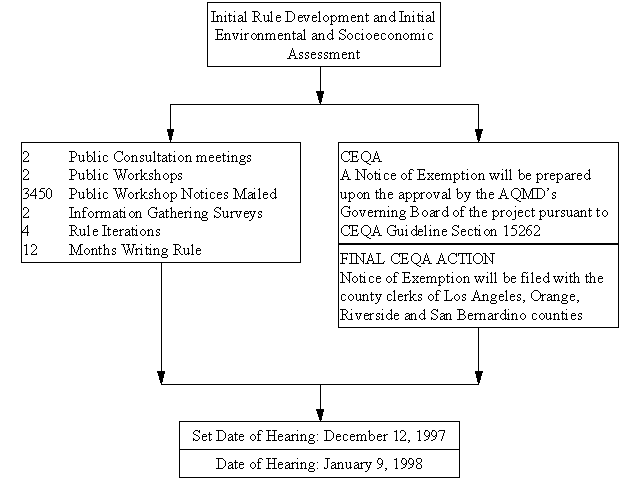
RULE DEVELOPMENT PROCESS
Proposed Rule 1118 - Refinery Flare Emissions
JUNE, 1995
2 Public Consultation meetings
2 Public Workshops
3450 Public Workshop Notices Mailed
2 Information Gathering Surveys
4 Rule Iterations
12 Months Writing Rule
CEQA
A Notice of Exemption will be prepared upon the approval by the AQMD’s Governing Board of the project pursuant to CEQA Guideline Section 15262
FINAL CEQA ACTION
Notice of Exemption will be filed with the county clerks of Los Angeles, Orange, Riverside and San Bernardino counties
Set Date of Hearing: December 12, 1997
Date of Hearing: January 9, 1998
ATTACHMENT D
KEY CONTACTS LIST
Industry
Air Products and Chemicals, Inc.
Arco Products Company
Chevron USA, Inc.
Fletcher Oil Company, Inc.
Mobil Oil Corp.
Paramount Petroleum Corp.
Powerine Oil Company
Texaco Refining and Marketing, Inc.
Tosco Corp.
Ultramar Inc.
Industry Associations
Western Independent Refiners Association (WIRA)
Western States Petroleum Association (WSPA)
Environmental Organizations
Citizens for a Better Environment
Government Agencies
California Air Resources Board (CARB)
United States Environmental Protection Agency, Region IX (USEPA)
Equipment Manufacturers/Suppliers
Instromet Ultrasonic Technology, Inc.
Panametrics, Inc.
West Mark Sales, Inc.
ATTACHMENT E
RESOLUTION
ATTACHMENT F
NOTICE OF EXEMPTION
ATTACHMENT G
PROPOSED RULE LANGUAGE
ATTACHMENT H
FINAL STAFF REPORT
ATTACHMENT I
SOCIOECONOMIC ASSESSMENT
/ / /