BOARD MEETING DATE: September 11, 1998 AGENDA NO. 19
PROPOSAL:
New Public Awareness and Education Programs to Reduce VOC Emissions
SYNOPSIS:
Public awareness and education programs proposed in AQMP Control Measure CTS-04 will reduce VOC emissions significantly from small source categories through cooperative efforts with the affected industries and others.
COMMITTEE:
Stationary Source, August 28, 1998, Recommended for Approval
RECOMMENDED ACTION:
Approve proposed outreach measures.
Barry R. Wallerstein, D.Env.
Acting Executive Officer
Background
The 1998 Air Quality Management Plan (AQMP) requires the development of a series of public awareness and education programs for reducing VOCs from small source categories. The concept behind this element of the plan is to create a dialogue between the AQMD, industries and the general public, whereby information can be exchanged on alternative or lower-emitting products, techniques, processes and/or equipment modifications. This information can spur voluntary, innovative and cost-effective investments in cleaner technologies that reduce air pollution and improve compliance.
In developing this new element of the AQMP in 1997, the AQMD selected regulated and unregulated stationary source categories throughout the air basin. Control measure CTS-04 listed the following industries to be targeted for this outreach:
beauty salons
nail salons
laboratories (fume hoods)
service stations (dispensing alternative fuels)
ceramic coating operations and leather repair and finishing operations
Proposal
The Office of Public Affairs was assigned responsibility for developing the implemen-tation plan for the CTS-04 control measure. After consulting with the ARB, EPA, af-fected trade associations and individuals, staff proposes the following for implementa-tion.
Develop and provide a fact sheet on low VOC products to operators and customers of beauty and nail salons, and seek to distribute information through associations and libraries.
Provide senior high school, college and university administrators with pollution pre-vention information on small-scale chemistry. Improved industrial laboratory tech-niques have significantly reduced pollution potential from large laboratories since CTS-04 was first proposed in the 1994 AQMP. Advanced analytical practices have emerged as a preferred alternative to reduce the quantities of hazardous substances traditionally used in school chemistry labs.
Support current AQMD efforts to: (a) make more information on alternative fuels available to the public; (b) develop a system of easily accessed maps to refueling and recharging locations; (c) promote the development of surface street and freeway signs in conjunction with the MSRC; and (d) conduct a series of workshops to en-courage the development of alternative fuel infrastructure. These programs will en-hance the market penetration of clean fuel vehicles.
Ceramic coating and leather repair operations will not benefit significantly from education programs since, by and large, the cleanest materials available are currently in use in these industries. Therefore, no AQMD action will be taken.
Fiscal Impacts
Current AQMD resources are sufficient to implement the proposed outreach measures with no budget impact.
Attachments
Discussion of Public Education/Outreach Programs as Proposed in CTS-04
Key Contacts List
"All About Methyl Methacrylate Monomers" Brochure
/ / /
ATTACHMENT 1
DISCUSSION OF PUBLIC EDUCATION AND OUTREACH PROGRAMS AS PROPOSED IN AQMP CONTROL MEASURE CTS-04
Beauty Salons
Hair spray, mousse and styling gel are consumer products now regulated by the ARB. Hair spray is the largest source of VOC emissions in this industry category.
In 1994, ARB established standards for reformulated mousse and styling gels. The resultant products are widely accepted by the industry and consumers. In a similar action in 1997, the agency required a 45 percent reduction in the VOC content of hairspray by June 1, 1999.
Based on recommendations from the affected industry and ARB, staff proposes that the District and ARB jointly author an article in the most widely circulated industry newsletters to highlight the clean products that are now available and the need for further research to develop acceptable substitutes. This article would be presented as a fact sheet and staff will seek to enlist the support of the California Cosmetology Board for assistance with wide distribution to hair and nail salon owners and their customers. We also intend to contact Modern Salon, Salon News and American Salon publications for additional distribution of this article. Timely and accurate updates of this information can increase demand for cleaner products among business consumers and their clients.
The American Lung Association (ALA) has begun an outreach program to the Korean businesses in the city of Los Angeles as a pilot project to assess awareness of upcoming requirements within an ethnic community. They will do a baseline study, outreach to the community by phone interviews, local cable television, etc., and complete a project assessment by August 31.
Nail Salons
When EPA removed acetone from its list of ozone precursors several years ago, reducing VOC emissions at nail salons became less critical. No additional consumer product regulations for nail salons (i.e., nail polishes) are being considered for regulation at this time by ARB.
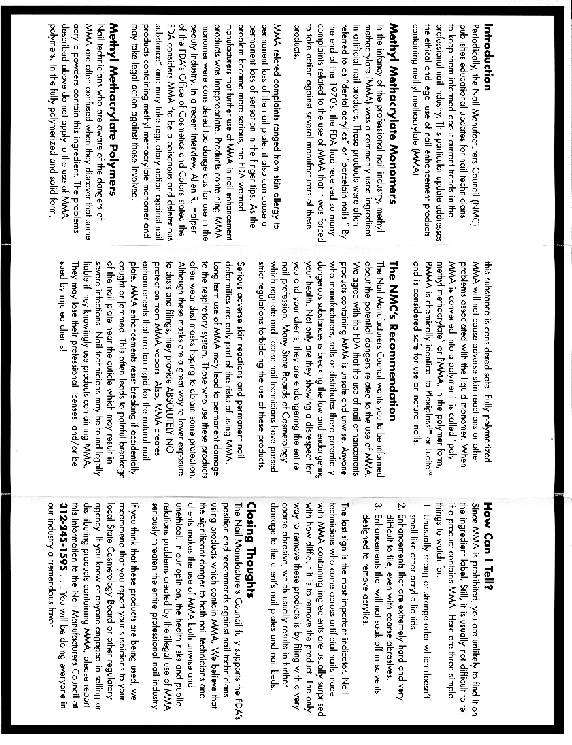
The CTS-04 control measure cited odors as a justification for the development of a public education program. Methyl methacrylate (MMA) monomer in nail products has been linked to most of the salon-related odor complaints received in past years. The Food and Drug Administration (FDA) has restricted or prohibited the use of MMA since 1995. The California Cosmetology Board, which conducts annual inspections of nail salons, states that their inspectors rarely encounter facilities that use MMA and will cite them when they do. Last year, the District received only two odor complaints for nail salons.
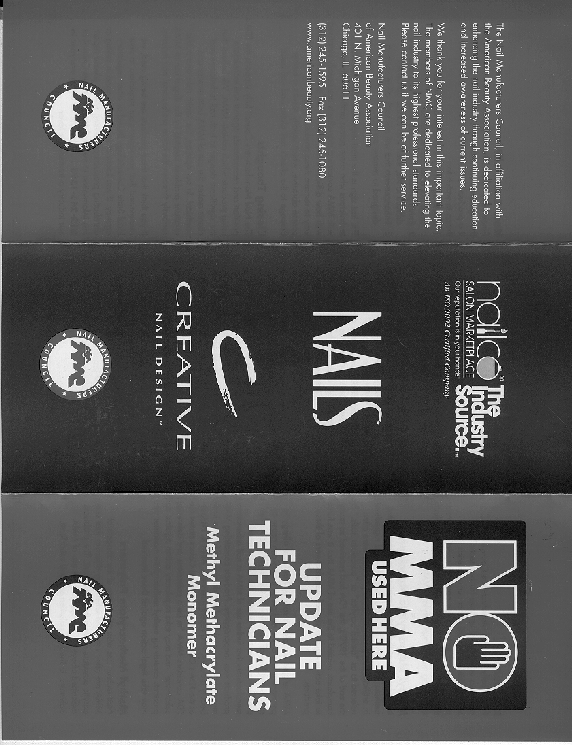
FDA recently sent a bulletin to nail salons throughout the U.S. warning salons not to use MMA. The Nail Manufacturers Council produced a brochure supporting the FDA’s position (see Attachment 3). Staff has reviewed these documents and considers them adequate to inform salons about MMA.
Staff proposes that the District’s complaint-handling staff have copies of the brochure available to salons that are found to be using MMA. Staff also proposes that careful records of all complaints continue to be kept by Stationary Source Compliance to identify any future regulatory or outreach need.
Laboratory Fume Hoods
CTS-04 initially proposed that laboratories be encouraged to use carbon canister technology to control VOC emissions. According to a recent U.S. EPA investiga-tion, however, pollution prevention practices in today's large laboratories are effec-tive enough to make the use of carbon canisters to clean exit gases unnecessary. EPA has gone on to recognize that chemistry labs in most public schools should be-gin to use new "micro-chemical" and advanced analytical practices to significantly reduce and eliminate student exposure.
In the last decade, laboratories have made across-the-board improvements in labo-ratory practices to minimize worker exposure to air contaminants. Present-day chemical analysis requires much smaller samples and reagents. Also, standard in-dustrial laboratory practices recover and reuse many chemicals. Recent U.S. EPA technical reports on a proposed NESHAP category have recognized these improve-ments in laboratory technology as cost-effective in reducing air pollution. These draft reports support the use of pollution prevention practices currently in place in most large laboratories and staff anticipates that, should laboratories be proposed as a major NESHAP category, the control measures will entail improved laboratory techniques and pollution prevention practices. The EPA's Small Business Ombuds-man's office will also be completing an environmental assistance guide by late summer that will be useful in helping small chemical labs establish and maintain the environmental aspects of their operations.
Staff proposes that the District monitor the progress of the potential identification of a new NESHAP category for laboratories and also:
a. Survey high schools, colleges and universities to determine the extent of wet chemical analysis and other outdated practices still being performed in their chemis-try labs.
b. Develop a focus group consisting of teachers, administrators and representatives of large industrial laboratories to discuss remaining issues and possible solutions.
c. Provide an informational mailing to academic laboratories on pollution preven-tion practices through focus groups including U.S. EPA, large industrial laboratories, associations, and local colleges and universities.
Information Dissemination of Alternative Fuel Dispensing Sites
There are many service stations that dispense alternative fuels but the owners of clean-fueled cars must be able to easily locate fueling sites. The availability of this information will also be valuable in attracting future purchasers of clean-fueled vehi-cles. The following is proposed:
a. The District will promote the development of comprehensive web sites to provide detailed maps of fueling sites and other information on alternative fuels. This will include information on fueling site locations, stations hours and days of operation, and technical information relevant to the refueling or recharging of each of the alter-native fuels.
b. At its August meeting, the Governing Board approved an MSRC project to fund the installation of freeway signs directing motorists to publicly accessible electric vehicle charging stations. Staff will continue to support dissemination of this infor-mation.
c. Because much of the information on clean vehicle refueling sites is fragmented, staff will regularly recommend necessary improvements to the information network. Staff will urge that this be a joint effort of many interested parties.
Ceramic Coating Operations
Most of the coatings and glazes used in ceramic coating operations are water-based. Since these products are widely used and accepted by the industry, staff recommends that no further education or outreach is necessary.
Leather Finishing Operations
Many of the shoe and handbag repair facilities are small businesses that use VOC-containing products including leather conditioners, polishes, cleaners, dyes and ad-hesives. Most of the VOC emissions are found in the adhesives and are regulated under Rule 1168. No education or outreach is necessary due to the negligible levels of emissions found in these widely used products.
ATTACHEMENT 3 "ALL ABOUT METHYL METHACRYLATE MONOMERS" BROCHURE