
BOARD MEETING DATE: September 11, 1998 AGENDA NO. 37
PROPOSAL:
Adopt Proposed Rule 222 - Filing Requirements for Specific Emission Sources Not Requiring a Written Permit Pursuant to Regulation II; and amend Rules 219 - Equipment Not Requiring a Written Permit Pursuant to Regulation II, and 401 - Visible Emissions.
SYNOPSIS:
Proposed Rule 222 - Filing Requirements for Specific Emission Sources Not Requiring a Written Permit Pursuant to Regulation II, will establish a permit streamlining pilot program removing two categories of equipment from the permit system and placing them under a minimal reporting filing system. This action will remove approximately 5,500 pieces of equipment from the permit system. Amendments to Rule 219 - Equipment Not Requiring a Written Permit Pursuant to Regulation II, will add approximately 600 pieces of equipment to the permit system. Proposed Amended Rule 401 - Visible Emissions, will set the visible emissions standard for currently uncontrolled under-fired charbroilers to Ringelmann 2, the state standard, for no more than three years.
COMMITTEE:
Stationary Source, July 24, 1998, reviewed and discussed.
RECOMMENDED ACTION:
Adopt the attached resolution:
- certifying the Final Environmental Assessment for Proposed Rule 222 - Filing Requirements for Specific Emission Sources Not Requiring a Written Permit Pursuant to Regulation II, and Proposed Amended Rules 219 - Equipment Not Requiring a Written Permit Pursuant to Regulation II, and 401 - Visible Emissions; and
- adopting Rule 222 - Filing Requirements for Specific Emission Sources Not Requiring a Written Permit Pursuant to Regulation II, and amending Rules 219 - Equipment Not Requiring a Written Permit Pursuant to Regulation II, and 401 - Visible Emissions.
Barry R. Wallerstein, D. Env.
Acting Executive Officer
Background
The AQMD has initiated several programs over the past few years to implement the Air Pollution Control Permit Streamlining Act of 1992 (Article 1.5 of Chapter 4 of the Health and Safety Code) while maintaining the commitment to protect public health. Rule 219 is an administrative rule which identifies certain equipment categories for exemption from AQMD written permit. Since this rule’s adoption in 1976, it has been amended several times. The last amendment was on December 13, 1996. In addition to the permit streamlining components of this rule package, staff is addressing some remaining issues from the last amendment.
Proposal
The amendment to Rule 219 proposes to remove two equipment types from the permitting system and place them under Proposed Rule 222. Equipment considered for inclusion in the Rule 222 pilot program are small sources with straightforward compliance conditions and minimal recordkeeping requirements. Express filing under Proposed Rule 222 reduces fees and simplifies the administrative process for participants. The two equipment types identified for the pilot program are commercial charbroilers and negative air machines used for asbestos removal. These two types of equipment are regulated under source-specific rules (Rules 1138 and 1403, respectively) and will be required to continue compliance with applicable source-specific requirements.
Additional types of equipment with negligible emissions are proposed for exemption from written permits in Proposed Amended Rule 219. They include: phosphoric acid anodizing, copper sulfide plating, plastic and nylon laser sintering, and UV/EB coating operations using low VOC cleanup solvents. Even though toxic emissions may be associated with the anodizing and plating operations, calculations show that the emissions do not exceed the risk assessment screening levels in Rule 1401. Language concerning cleaning equipment has been clarified and rule sections applicable to this equipment have been consolidated to facilitate understanding. Furthermore, the exemptions were revised to be consistent with recently amended Rules 1122 - Solvent Degreasers, and 1171 - Solvent Cleaning Operations, by setting the VOC solvent content at 50 grams per liter or less.
Two equipment types are proposed for inclusion in the permitting system, rubber molding and curing operations processing more than 200 pounds per day of rubber and motion picture film processing wet gate printers using perchloroethylene. These sources are associated with public nuisance complaints and/or toxic air contaminants, and have the potential to cause significant emissions.
Finally, as an administrative action, Rule 401 - Visible Emissions, has been proposed for amendment to temporarily allow under-fired charbroilers, currently operating without controls, to meet the state opacity standard of Ringelmann 2. The AQMD is currently working with a contractor to identify cost-effective control technology for under-fired charbroilers. It is anticipated that a technology will be identified and installed within the next three years. These charbroilers would be then required to meet the more stringent AQMD standard of Ringelmann 1.
AQMP and Legal Mandates
The Air Pollution Control Permit Streamlining Act of 1992 (Article 1.5 of Chapter 4 of the Health and Safety Code), requires air pollution control districts to "institute new, efficient procedures which will assist businesses in complying with regional, state, and federal air quality laws in an expedited fashion, without reducing protection of public health and the environment." Chapter 6 of the Health and Safety Code, section 40701(g) grants districts the power "to require any owner or operator of any air pollution emission source, except a noncommercial vehicular source to provide: (1) a description of the source, and (2) disclosure of the data necessary to estimate the emissions of pollutants for which ambient air quality standards have been adopted, or their precursor pollutants."
CEQA & Socioeconomic Analysis
Pursuant to the California Environmental Quality Act (CEQA) (Public Resources Code §§ 21000 et seq.) and the AQMD’s Certified Regulatory Program (Rule 110), the AQMD has prepared a Draft Environmental Assessment (EA) with no significant adverse environmental impacts. The analysis indicates that though the proposed project may result in adverse air quality impacts, they will not be significant. The Draft EA was released for a 30-day public review period. All comments received on the Draft EA have been responded to in the final document which is attached to this letter.
A Socioeconomic Assessment is included as an addendum to the staff report. The assessment indicates a net annual cost savings to industry over $300,000. Some facilities will have increased costs for permitting equipment that was previously exempt.
Implementation Plan
Resource Impacts
Moving 5,500 pieces of equipment from permitting to filing under Proposed Rule 222 and removing a number of types of equipment from the permitting system will decrease workload for AQMD resources. Simplified filings under Proposed Rule 222 will create less of an administrative burden. Proposed amendments to Rule 219 will, however, add approximately 600 pieces of equipment to the permitting system.
Attachments
Summary of Proposal
Key Issues and Responses
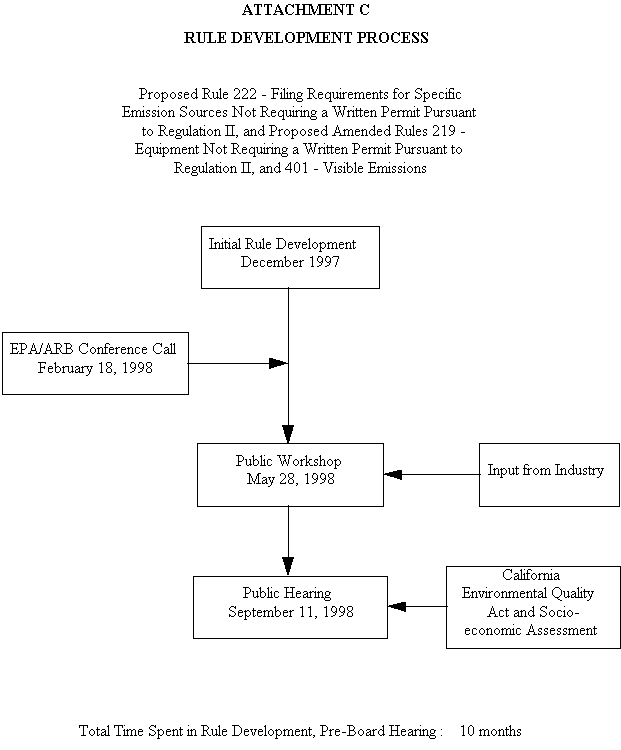
Rule Development Process
Key Contacts List
Resolution
Proposed Rule Language
Staff Report
Socioeconomic Assessment
Final EA
ATTACHMENTS A
SUMMARY OF PROPOSAL
|
Proposed Rule 222 - Filing Requirements for Specific Emissions Sources Not Requiring a Written Permit Pursuant to Regulation II, and Proposed Amended
|
|
|
|
|
|
KEY ISSUES AND RESPONSES
|
Proposed Rule 222 - Filing Requirements for Specific Emission Sources Not Requiring a Written Permit Pursuant to Regulation II, and Proposed Amended
|
|
Key Contacts List
Industry
The Boeing Company
Burger King Corporation
Carl Karcher Enterprises, Inc.
Deluxe Hollywood
International Seal
Kirkhill Rubber
Martin Rubber
Northrop Grumman Corporation
Pacific Molding, Inc.
Parco, Inc.
Rad Tech International, North America
Santa Fe Rubber Products, Inc.
Technicolor Film Services
VIP Rubber Company
Industry Associations
California Restaurant Association
Los Angeles Rubber Group
Consultants and Others
Institute for Research and Technical Assistance
Government Agencies
California Air Resources Board (CARB)
United States Environmental Protection Agency, Region IX (USEPA)
/ / /