
BOARD MEETING DATE: May 14, 1999 AGENDA NO. 19
PROPOSAL:
Report on Feasibility of Emission Reductions from Under-fired Charbroilers
SYNOPSIS:
This report fulfills a requirement in Rule 1138 – Control of Emissions from Restaurant Operations. The rule, which was adopted in November 1997, requires a report to the Board by May 1999 regarding the feasibility of emission reductions from under-fired charbroilers and other commercial cooking equipment. This report provides a status of technology development work and staff recommendations for further efforts.
COMMITTEE:
Stationary Source, April 23, 1999, Reviewed
RECOMMENDED ACTION:
1. Receive and file the attached reports.
Barry R. Wallerstein, D.Env.
Executive Officer
Background
Beginning in 1991, staff has been working extensively with industry to develop a cost-effective and technically feasible rule to control restaurant emissions. Restaurants emit particulate matter (PM) & VOC which can cause adverse health impacts, and they are also a source of nuisance complaints. Significant resources were spent in improving test methods and developing emission factors. In November 1997, the Governing Board (Board) adopted Rule 1138 – Control of Emissions from Restaurant Operations. This rule is the first AQMD rule which reduces directly emitted PM 2.5, fine particulate matter.
Particulate matter primarily affects the respiratory system and may cause coughing, wheezing, and physical discomfort in breathing. It may also alter the immune system. Elevations in the level of ambient PM have been linked to increased mortality, respiratory infections, asthma attacks, and aggravation of pre-existing respiratory and cardiovascular diseases.
Rule 1138 reduces VOC and PM emissions from chain-driven charbroilers through the installation of catalysts. As of March 1999, approximately half of the sources have installed the required catalyst, with a compliance date of November 1999 approaching. Chain-driven charbroilers are currently the only restaurant equipment controlled through this rule because no other cost-effective control technology was commercially available for other restaurant equipment when the rule was adopted.
Subdivision (f) of the rule directed staff to report to the Board, no later than 18 months from the November 14, 1997 adoption date, on "….the feasibility of emission reductions and whether cost-effective control devices or other methods are available for the control of emissions from under-fired charbroilers and potentially other commercial restaurant cooking equipment." This report fulfills the requirements of subdivision (f).
Other Restaurant Operations
Restaurant operations include charbroilers, griddles, deep fat fryers, ovens, and other equipment. Griddles account for approximately 13 percent of the total PM restaurant emissions inventory and 13 percent of the total VOC emissions. Emissions from deep-fat fryers are negligible for PM and comprise just six percent of the VOC emission inventory for this category. Oven emissions appear to be negligible. Under-fired charbroilers are responsible for 83 percent of PM and 69 percent of VOC from this category’s emission inventory. Based on their contribution of emissions, under-fired charbroilers were chosen as the next logical piece of basic equipment for which to seek cost-effective controls. If controls are positioned on the roof and process the entire restaurant effluent, they could appreciably reduce emissions from griddles and fryers also.
The emission factors and inventory for these categories have changed over the past nine years. The 1994 AQMP contained a control measure, PRC-03 – Emission Reductions from Restaurant Operations, which listed the inventory for these sources as 18.6 tons/day of VOC emissions and 9.4 tons/day of PM emissions. The control measure projected an emission reduction of 9.5 tons/day of VOC emissions by the year 2000, and a reduction of 4.8 tons/day in PM emissions. Additional reductions were projected for the year 2010 in the amounts of 11.8 tons/day for VOC and 5.6 tons/day for PM. These numbers were based in part on a survey conducted in 1991 by staff in cooperation with the California Restaurant Association. The 1997 AQMP relied on an updated survey performed by an outside contractor and a newly developed source test protocol. The baseline inventory was revised to 1.6 tons/day for VOC emissions and 11.6 tons/day of PM. The control measure projected emission reductions in VOCs of 1.2 tons/ and 8.2 tons/day in PM emissions day by the year 2006. The year 2010 projection was that the emissions would remain stable. These numbers will likely be refined for the 2000 AQMP to reflect results of a survey of the restaurant industry conducted by a contractor in 1998, and any new emission factor development. Figures 1 and 2 show the current estimated PM and VOC inventories.
Estimated Emission Inventory
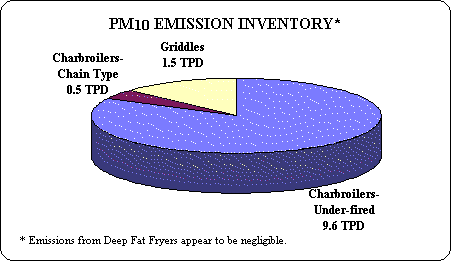
The total PM10 emissions from these equipment are 11.6 tons per day.
Figure 1
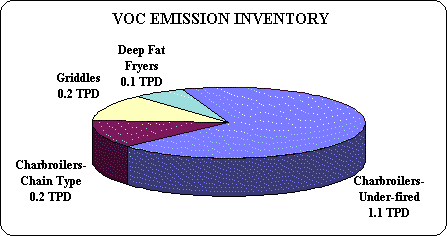
The total VOC emissions from these equipment are 1.6 tons per day.
Figure 2
Technology Review
In response to the Board’s directive, staff selected the University of California, College of Engineering, Center for Environmental Research and Technology (CE-CERT) to conduct a search for, and testing of, possible cost-effective controls for under-fired charbroilers. The results of this study were provided in a March 1999 report to the Board’s Technology Committee. This report includes excerpts from the final CE-CERT report on "Efficient and Cost-effective Control Technologies for Underfired Charbroilers, Development and Demonstration of Emission Control Technologies for Commercial Underfired Charbroilers." (See Attachment). Copies of the full document are available from the AQMD Public Advisors Office by calling (909) 396-3600.
CE-CERT investigated a number of potential commercial cooking emission control technology systems, including: specialized hood/grease extraction; ceramic filtration incineration; dedicated hood/catalytic incineration; filtration/absorption; electrostatic precipitation; scrubbers; and process design. An advisory committee, the Restaurant Emissions Technical Advisory Committee, was formed, consisting of members of the regulated community, CE-CERT, AQMD, energy service corporations, and academia. This committee selected three technologies to be tested from fourteen prospective technologies. Criteria included the ability to reduce both PM and VOC emissions, cost, commercial availability, maintenance and operational requirements, and safety.
The three technologies chosen were microwave ceramic filter, catalytic converter hood system and SmoklessTM broiler. The microwave ceramic filter works on the concept of filtering out the harmful emissions in the ventilation system and periodically regenerating the loaded filters using microwave energy. This process is the least developed of the three technologies. The dedicated hood system reduces air flow required for exhausting charbroiler effluent by enclosing the charbroiler on three sides, thus reducing volumetric flow required for total exhaust capture. The system uses catalytic technology to reduce emissions. The SmoklessTM broiler is designed to prevent grease from the broiling food from dripping onto hot burner components. This results in a reduced amount of PM and VOC pollutant formation. Table 1 summarizes the results of the testing and provides capital costs.
Table 1
Emission Reductions and Technology Cost
| Technology | % PM Emission Reductions | % VOC Emission Reductions | Cost |
| Microwave ceramic filter | 54 | 22 | $20,000 |
| Catalytic converter hood system | 40 | 36 | $15,000 |
| SmoklessTM Broiler | 75 | 71 | $5,600 |
The technology which showed the greatest decrease in emissions of both PM and VOCs and was commercially available was the SmoklessTM broiler. The other two types of equipment tested were emission control prototypes and may, with further work by the manufacturers, yield better results. In December 1998, the Board allocated additional funds for the investigation of cost-effective controls for restaurant operations. This and other projects are under development in support of rulemaking activities.
The technology assessment concluded that "some reductions of emissions from commercial charbroiling operations are possible through the use of currently available, prototype and experimental control technologies. Further refinement of these technologies will likely lead to cost-effective and energy efficient commercial charbroiling processes that will provide both quality and environmental benefits to the industry and the public." Staff believes, based on the consultant’s work and its independent analysis, that technological advances are occurring rapidly in this area.
AQMP and Legal Mandates
Rule 1138 is a partial implementation of Control Measure PRC-03 in the 1997 AQMP. Cost-effective control technology is evolving rapidly in this sector to allow further reductions in emissions from the equipment with the largest portion of restaurant emissions, the under-fired charbroilers. On this basis, staff is ready to initiate the rulemaking process.
Staff Recommendations
Significant advances have been made in the development of potential controls for charbroiling operations. The CE-CERT report indicates that "some reductions of emissions from commercial charbroiling operations are possible through the use of currently available, prototype and experimental control technologies." In particular, the Smokless™ broiler shows promise for use by new or modified restaurants. Other options are also being developed that will help address individual restaurant preferences for the type of food cooked, appearance and taste, and preparation time. Further assessment of the cost-effectiveness of these technologies, and additional investigation of these technologies will occur as part of the rulemaking process. Thus, staff recommends starting the rulemaking process for cost-effective control technologies for commercial under-fired charbroilers. This effort should require up to an additional 12 months.
Staff therefore recommends initiating a rulemaking program, and reconvening the working group. Staff will consider encouraging and/or requiring new equipment to meet emission limits similar to the Smokless™ broiler where feasible.
Excerpts from "Efficient and Cost-effective Control Technologies for Underfired Charbroilers, Development and Demonstration of Emission Control Technologies from Commercial Underfired Charbroilers," CE-CERT, March 1999
/ / /