BOARD MEETING DATE: November 5, 1999 AGENDA NO. 29
REPORT:
Technology Committee
SYNOPSIS:
The Technology Committee met on October 22, 1999. Major items discussed included presentations on ARB's proposed bus and truck regulations and the California Fuel Cell Partnership, Technology Advancement items reflected in the regular Board Agenda for the November Board meeting the appointment of new members to the Technology Advancement Advisory Group, and written-only presentations on monthly updates of Environmental Justice Initiatives 2, 7, and 10. A summary of these topics with the Committee's comments is provided, together with an attendance roster. The next Technology Committee meeting will be in November at a date yet to be determined.
RECOMMENDED ACTION
Receive and file.
Leonard Paulitz, Vice Chair
Technology Committee
Attendance: Present were Committee Members Leonard Paulitz and Jon Mikels. William Burke and Roy Wilson participated by video-teleconference.
Technology Advancement Feature Presentations
ARB's Proposed Bus and Truck Regulations - Paul Weubben of Science and Technology Advancement gave an overview of the ARB emission reduction goals announced at the Technology symposium: to reduce emissions from new on-road and off-road diesel engines by 75% beginning in 2007. The technologies proposed to reach these emission reduction goals are alternative fuels, low-sulfur diesel fuel with catalysts, and fuel cell technology. ARB's proposed transit bus emission standards provide two compliance options: the traditional path and the incentive path. AQMD staff comments at the workshop recommended: a single compliance path only; standards based on the lowest achievable emission rates which are technically feasible; availability of Carl Moyer funds for compliance; and that school bus regulations should be considered now rather than delayed as proposed by
ARB.
Presentation on California Fuel Cell Partnership - Joseph Irvin, representing the California Fuel Cell Partnership, presented an overview of the Partnership. Its goals are: to demonstrate vehicle technology; demonstrate alternative fuel infrastructure; explore the path to commercialization and increase public awareness. The AQMD has been invited to join the California Fuel Cell Partnership.
Dr. Burke expressed a concern, shared by the other Committee members, that the
AQMD had not initially been considered for membership and the expectation placed on
the District with the current invitation. Mr. Paulitz indicated that if the AQMD decided
to become a member, that bus demonstration projects be included in the Southern California area.
The Committee asked that ARB return before the next Technology Committee meeting
with more information, and that this item not be brought to the Governing Board until its
December or January meeting.
November Board Agenda Items
Execute Contracts for Technical Assistance for Advanced Transportation and Stationary Source Pollution Control Technologies - In July 1999, the AQMD issued a Request for Qualifications to obtain qualifications from potential consultants who could provide technical assistance pertaining to advanced, low- and zero-emission transportation technologies for the Clean Fuels Program. This action is to request approval to award six contracts under the RFQ. Total amount of funding requested will not exceed $145,000. Moved (Burke), seconded (Mikels) and unanimously recommended for approval.
Execute Contract to Cosponsor Evaluation of Methanol Fuel Quality specifications for Proton Exchange Membrane Fuel Cells - On May 14, 1999, the Board approved execution of a contract with dbb Fuel Cell Engine Corporation to cosponsor an evaluation of fuel quality requirements and recommendation for a proton exchange membrane fuel cell and its associated methanol reformer under the FY 1998-99 Budget. The required contracts were not fully executed prior to end of FY 1998-99 due to procedural delays. This action will allow the contract to be fully executed. Total direct project cost is $220,000. Total AQMD funding shall not exceed $205,000. Moved (Mikels), seconded (Paulitz) and unanimously recommended for approval.
Amend Contract to Cost-Share Project to Refine Fuel-Cycle Emissions Analyses - At the March 1998 meeting, the Board authorized a $75,000 contract with the ARB to co-sponsor a $150,000 contract entitled, "Refinement of Selected Fuel-Cycle Emissions Analyses," between the ARB and California State Polytechnic University, Pomona. Recently, the university indicated that it would be unable to complete this project. ARCADIS Geraghty and Miller has submitted a proposal to ARB for a sole-source award to complete the project. It is recommended that the agreement between AQMD and ARB be modified to specify that ARB will contract with ARCADIS Geraghty and Miller for completion of this project. Moved (Wilson), seconded (Mikels) and unanimously recommended for approval.
Execute Contract to Demonstrate an Increased-Horsepower Natural-Gas Engine in On-Road Delivery Trucks - Cummins Engine Company has initially introduced its 8.3-liter natural gas engine into the transit sector. Cummins has now developed a higher horsepower (280 hp), higher torque version of this engine to meet medium, heavy-duty trucking applications. Cummins, in conjunction with The Gas Company, has proposed testing the engine in an on-road application before commercial release. The Gas Company will have overall project management responsibilities and coordinate and fund vehicle emission testing. Total project cost is approximately $292,200 with AQMD funding not to exceed $105,800. Moved (Mikels), seconded (Wilson) and unanimously recommended for approval.
Execute Contract to Co-sponsor Development and Demonstration of Advanced Safety Inspection Methods for NGV Tanks - During normal operations of NGVs, the compressed natural gas tanks can endure adverse conditions, which over time, could potentially compromise the safety of these tanks. Current methods of visual inspection are inadequate to reliably detect damage to the tanks. The Gas Research Institute, in conjunction with Battelle Memorial Institute, has proposed to develop and demonstrate an advanced damage indicator coating system and an advanced ultrasonic acoustic detection system to significantly improve the accuracy and ease with which structural damage to an NGV tank can be detected. Total cost of this project is $2.303 million. AQMD cost-share will not exceed $325,000. Moved (Mikels), seconded (Burke) and unanimously recommended for approval.
Appointment of New Members to Technology Advancement Advisory Group (TAAG) - The TAAG charter requires that "members shall be appointed by the Governing Board's Technology Committee." There is no longer representation from the American Auto Manufacturers Association, as this group has been dissolved. To strengthen the representation from industry sectors using solvents and coatings, and to broaden the potential for cosponsorship from the federal government, staff proposes the following three individuals be appointed to the Technology Advancement Advisory Group: Shang Hsiung, Department of Transportation Program Manager; Daniel Moran, State Board representative and Legislative Committee vice chair of the Glendale/Foothill chapter of the California Autobody Association; and Gary Stafford, partner, Vice President and Chief Financial Officer of Terra Furniture. Moved (Paulitz), seconded (Mikels) and unanimously recommended for approval.
Reports on Completed Technology Advancement Projects
There were no reports presented at this time.
Monthly Report on Environmental Justice Initiatives 2, 7 and 10
Written only monthly status reports were received and filed. Copies of these reports are attached hereto as Attachments B, C and D.
Other Business - There was no other business.
Public Comment Period - There was no public comment.
The meeting was adjourned at 12:50 p.m.
Attachments
Attachment A - Attendance
Attachment B - Environmental Initiative # 2 Status Report
Attachment C - Environmental Initiative # 7 Status Report
Attachment D - Environmental Initiative #10 Status Report
/ / /
Attachment A - Attendance
Douglas Kim, Board Assistant
AQMD
Sandy Winger, Board Consultant
AQMD
Richard Alexander, Board
Consultant
AQMD
Chung Liu, DEO, S&TA
AQMD
Jill Whynot, Stationery Source
Compliance
AQMD
William Wong, District
Counsel's Office
AQMD
Sam Atwood, Public Affairs
AQMD
Paul Wuebben, S&TA
AQMD
Chris Abe, S&TA
AQMD
Mike Bogdanoff, S&TA
AQMD
Larry Watkins, S&TA
AQMD
Dory Kilgour, S&TA
AQMD
Bob Barham
ARB
Ruch Duncan
Battelle
John Harper
Small Business Coalition
Attachment B
Environmental Justice Initiative No. 2
Monthly Status Report
September – October 1999
PRELIMINARY MATES-II SUMMARY
(Note: Many of the following items are derived from a preliminary evaluations of the complete MATES-II data base. Since final analyses are still undergoing internal review, some of the numbers may be subject to minor changes.)
MATES-II Fixed Sites
1)
At the fixed sites, sampling occurred on a 1-in-6 day basis over a one-year period at 10 locations:
Anaheim
Burbank
Compton
Fontana
Huntington Park
Long Beach
Los Angeles
Pico Rivera
Rubidoux
Wilmington
2)
Toxic risk levels were determined for MATES-II sites using risk factors
for toxic pollutants developed by the Office of Environmental Health Hazard
Assessment, and procedures for estimating diesel particulates using elemental
carbon as a surrogate, as reported by the ARB.
3)
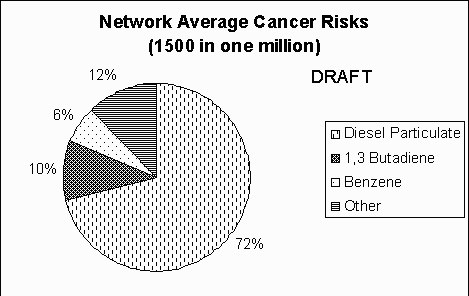
Using these techniques, the average overall carcinogenic risk in the
South Coast Air Basin is about 1500 in a million.
4)
The cumulative risk varies from about 1150 in a million to about 2050
in a million on a site specific basis.
5)
About 70% of the risk is ascribable to diesel particulates. (See
attached chart.)
6)
About 10% of the risk is contributed by stationary (including area)
sources; and about 90% of the risk is contributed by mobile sources.
7)
The highest risk levels occurred in Compton, Huntington Park, and Pico
Rivera. The contributions from mobile sources are the dominant toxic influences
at these sites.
8)
The lowest risk levels occurred in Anaheim, Long Beach, and Fontana.
Environmental Justice Initiative No. 2
(Continued)
9)
Variability of risk from one community to another is much greater for toxic pollutants from mobile sources than for toxic pollutants from stationary sources.
10)
There is strong seasonal variability in risk levels, with the highest levels occurring in the late fall and early winter months, and the lowest levels occurring in the late spring and early summer months.
11)
By far, the seasonal variability is dominated by contributions from mobile sources. Risk levels ascribed to stationary sources do not vary much by season.
12)
Modeling efforts, nearing completion, will present a more spatially complete assessment of risk across the Basin.
Microscale Sites
1)
Three mobile platforms were used to sample for one-month periods at 14 additional communities. These are:
Anaheim
Pacoima*
Boyle Heights
Rialto
Corona
Riverside
Costa Mesa
San Pedro
Hawthorne*
South El Monte
Montclair
Torrance
Norwalk
Van Nuys
*Sites with monthly sampling in each of the four seasons.
2)
Microscale sites show greater influence from mobile sources at 12 of 14 sites. (Torrance and Costa Mesa have greater influence from stationary sources due primarily to very low mobile source contributions at these sites. At these sites, stationary source contributions are not much different than is observed at other sites.)
General Carcinogenic Risk Considerations
1)
Risk estimates are based on continuous outdoor exposure over a 70-year lifetime.
2)
Risk estimates vary considerably between USEPA and California criteria. USEPA has not as yet assigned risk values to diesel particulates, and has recently proposed lowering the risk ascribed to 1,3 butadiene. Therefore USEPA risk estimates are much lower than California estimates (especially in regard to mobile sources). For purposes of this study, California criteria are used.
Attachment C
Environmental Justice Initiative No. 7 - Cleanup Incentives for Diesel
Monthly Status Report
August - September 1999
The Governing Board will pursue a set of Initiatives at the local, state, and federal level to incentivize the early clean-up or removal of diesel engines in the Basin. Research indicates that low-income communities and communities of color experience disproportionate air quality impacts associated with diesel engine use.
Support Funding Incentives
The heavy-duty vehicle incentive program, known as the Carl Moyer Air Quality Incentive Program, is progressing.
The first AQMD Moyer Program RFP closed July 1, 1999. A total of 51 proposals for a total of 848 vehicles and equipment were received by the AQMD, totaling $52.3 million in requested funding. Twenty-one projects totaling $12,345,736 were awarded from this first RFP, $11,273,020 from the Moyer Program and $1,072,716 from the Clean Fuels Program, supporting 360 clean heavy-duty vehicles and other equipment that will reduce NOx emissions by 6,741 tons over the lives of the projects. The overall cost-effectiveness was $2,191/ton.
Another AQMD RFP for the Moyer Program, based on a second anticipated allocation from the ARB of $8.55 million, was released September 10, 1999 with proposals due January 11, 2000.
AB 1571, authored by Villaraigosa and Senator Brulte, was introduced to put the Moyer Program into state law. AB 1571 passed through the Senate, with amendments, as follows: Senate Committee on Environmental Quality on August 24 (9 Ayes / 0 Noes); Senate Appropriations on September 2 (11 Ayes / 0 Noes); and the Senate Floor on September 7 (40 Ayes / 0 Noes). The Senate amendments were concurred in the Assembly on September 10 (77 Ayes / 2 Noes). AB 1572 now awaits consideration by Governor Davis. The current form of the bill does not identify the source of revenues to continue the Moyer Program funding incentives.
Coordination with MSRC and Local Government
The AQMD Governing Board approved $17.6 million in awards from the MSRC's heavy-duty vehicle work program at its September 10, 1999 meeting. The awards included $7.4 million for 147 on-road heavy-duty alternative fuel trucks and $10.2 million funding for 398 alternative fuel transit buses.
Attachment D
Environmental Justice Initiative #10
Public Comment, Rules 1401 and 1402
Status Report
October 1999
Initiative: The Governing Board will re-open for public comment the toxics significant thresholds for cancer and non-cancer impacts contained in Rule 1402 - Control of Toxic Air Contaminants from Existing Sources, and consideration of adding additional compounds and non-carcinogenic impact prevention into Rule 1401 - New Source Review of Toxic Air Contaminants.
Status of Efforts:
Rule 1402
– Proposed amendments in March 2000
3combined previous 2 phases in response to public comments
– Consider lowering threshold
– Consider risk and technology-based approaches
– Consider less time for reductions
– Include technology & economic considerations
– Require information from specific facilities above usage levels for key industries or
compounds
– Additional public notice
– Public workshop in November
Rule 1401
– Continue to update rule as OEHHA finalizes chronic risk factors
– Expect 3 more updates in next year
Air Toxics Control Plan
– At the September Board meeting, the Board approved the concept and directed staff
to develop the plan
– Plan will include:
3introduction/purpose
3background
3current air toxics levels
3future projected toxics levels
3control strategies
3federal and state requirements
3implementation and resource impacts
– Comprehensive, multi-source plan under development
3MATES II preliminary data indicates risks predominantly from diesel and
mobile sources
3reductions needed from all sources
3on-going federal, state and local programs.
3variety of control strategies in both short- and long-term
measures
3enhanced public outreach/public education programs
3identify the most effective strategies
3prioritize resources
3cooperation from federal, state, and local agencies will be required
– Public participation will include:
3public workshops in Dec. or Jan.
3work with AQMP Advisory Group
3coordination with other agencies
– Plan scheduled for March 2000 Board meeting
/ / /
This page updated:
September 03, 2004
URL: http://www.aqmd.gov/hb/1999/991129a.html