
BOARD MEETING DATE: April 21, 2000 AGENDA NO. 28
Approve Monitoring, Recordkeeping, and Reporting Task Force Recommendations to Streamline RECLAIM Monitoring and Reporting
SYNOPSIS:
The Monitoring, Recordkeeping, and Reporting Task Force has developed a consensus proposal to streamline RECLAIM monitoring and reporting. It is recommended that the Board direct staff to develop rule amendments and implement the proposal, to reduce or eliminate unnecessary recordkeeping requirements while maintaining the enforceability of AQMD’s RECLAIM program.
COMMITTEE:
Not Applicable
RECOMMENDED ACTION:
Approve the Monitoring, Recordkeeping, and Reporting Task Force Recommendations to streamline RECLAIM monitoring and reporting as contained in the Board letter.
Barry R. Wallerstein, D.Env.
Executive Officer
Background
The AQMD Governing Board established the Monitoring, Recordkeeping, and Reporting (MRR) Task Force in April 1999 to develop specific recommendations to the Board on how to streamline the MRR requirements for facilities subject to Regulation XI – Source Specific Rules, Regulation XX – RECLAIM, and Regulation XXX – Title V, while maintaining the air quality objectives and business needs of AQMD’s customers. AQMD Vice-Chair Norma Glover was designated as the Task Force Chair and Board Member Ron Loveridge was appointed to the Task Force, to provide guidance and direction to the Task Force activities. The Task Force included representatives from industry, state and federal government, and businesses that are directly or indirectly impacted by the AQMD MRR requirements. (Attachment A provides a complete list of Task Force members’ names and affiliations.)
The Task Force directed its first effort towards reviewing AQMD MRR requirements and policies for facilities using VOC-containing materials such as coating, inks, adhesive, and graphics art materials. This effort produced a Task Force Progress Report with specific recommendations to streamline VOC recordkeeping, which was approved by the AQMD Governing Board on January 21, 2000. In the course of developing the proposal for VOC sources, the Task Force also explored streamlining MRR requirements for Perchloroethylene (Perc)1 dry cleaning operations. On February 18, 2000, the AQMD Governing Board approved the Task Force recommendations to streamline recordkeeping for Perc dry cleaning operations.
After developing specific recommendations on how to streamline VOC and Perc recordkeeping requirements, the Task Force directed its effort to examining the MRR requirements for RECLAIM facilities2, and anticipates reviewing the MRR requirements for Title V sources in the future.
1Perc is not a Volatile Organic Compound
(VOC) but a toxic air contaminant, which is regulated under AQMD Rule 1421 to
control its emissions from dry cleaning operations.
2RECLAIM
facilities are facilities that, in 1990 or subsequent year, reported 4 or more
tons per year of NOx or SOx emissions, excluding emissions from on-site,
off-road mobile source and other equipment categories listed in AQMD Rule 2000.
Monitoring, Recordkeeping and Reporting Requirements for RECLAIM Sources
Monitoring, recordkeeping, and reporting provisions are needed in air pollution control programs to confirm the exemption or compliance status of a facility with applicable federal, state or local rule requirements and permit conditions. California Air Resources Board (CARB) and United States Environmental Protection Agency (U.S.EPA) play an oversight role in ensuring the enforceability and effectiveness of the AQMD compliance program. The recordkeeping requirements for RECLAIM sources are contained in Rule 2004 – Requirements, Rule 2011 – Requirements for Monitoring, Reporting, and Recordkeeping for Oxides of Sulfur (SOx) Emissions, and Rule 2012 - Requirements for Monitoring, Reporting, and Recordkeeping for Oxides of Nitrogen (NOx) Emissions, and protocols for Rules 2011 and 2012. The Task Force recognizes that revisions to these rules must meet with the approval of CARB and U.S.EPA, for further implementation.
The AQMD MRR requirements generally take into consideration the type and size of regulated source, the type and amount of fuel burned by the source, the amount and type of regulated air contaminants, and cost and practical feasibility issues. Because of the uniqueness of emission sources and the degree of emissions reductions that need to be confirmed with records, the MRR requirements vary widely. Such requirements may range from retaining records at the facility on a daily, monthly, quarterly or annual basis to recording data on a 15-minute basis with a Continuous Emissions Monitoring System (CEMS) and transmitting them electronically to AQMD on a daily, monthly or quarterly basis.
RECLAIM sources are grouped into five categories: major SOx sources, major and large NOx sources, and SOx and NOx process units. The grouping is done by the amount of emissions, and the criteria for these classifications are specified in paragraphs (c) and (d) of Rule 2011 for SOx sources and paragraphs (c), (d), and (e) of Rule 2012 for NOx sources. Because of the differences among these categories, the MRR requirements for RECLAIM sources differ considerably from one category to another. The MRR requirements for RECLAIM sources are summarized in Tables 1, 2, and 3, respectively, of Attachment B.
Task Force Perspective on RECLAIM Monitoring and Reporting
A facility’s measure of compliance in air emissions trading market such as RECLAIM depends on its ability to match actual emissions with annual allocations or RECLAIM trading credits. Therefore, industry representatives and public agencies both recognized the need to ensure that actual emissions are accurately monitored, recorded, and reported. This recognition by regulated industry and public agencies was reflected in a set of consensus monitoring, recordkeeping, and reporting rules for RECLAIM sources, adopted by the AQMD Governing Board in 1993 and subsequently approved by both CARB and U.S. EPA. However through the years, concerns have been raised about the impact of these requirements on businesses. While MRR requirements are necessary to determine actual emissions, they may, in some instances, also create an administrative and financial burden on businesses. Recognizing this, the AQMD RECLAIM rules have evolved over the years to reduce such burdens, while maintaining rule enforceability. Therefore, the Task Force recommendations are not to overhaul these overarching requirements, but rather to fine-tune them to:
It may be noted that California Health and Safety Code Section 40440.3 requires AQMD to provide facilities with the option of using an electronic or computer data storage system for the purpose of complying with emission monitoring requirements. Furthermore, it allows AQMD to require that the electronic or computer data storage system have the same degree of signal path security as the existing strip chart recorder.
Task Force Proposal
The Task Force recognizes that the key to successful emissions trading market lies in the strength of the legal and enforcement tools. While these tools are important gatekeepers for the RECLAIM program, they must be carefully designed to prevent creating an undue administrative and financial burden on RECLAIM sources. The Task Force therefore proposes to streamline MRR requirements for RECLAIM sources by implementing the following three concepts based on new technologies available today.
Alternative Recording System to Strip Chart Recorder
Rules 2011 and 2012 require facilities to install, maintain, and operate a Continuous Emission Monitoring System (CEMS) to continuously measure data necessary for calculating SOx/NOx mass emissions from individual major sources. In addition, all data gathered by the CEMS is required to be recorded both by strip chart recorders and computer printout. These data are also stored in a Data Acquisition System (DAS), and the total daily, monthly, and quarterly SOx/NOx emissions are calculated and transmitted via a Remote Terminal Unit (RTU) to the District Central Station on a daily, monthly, quarterly, and annual basis.
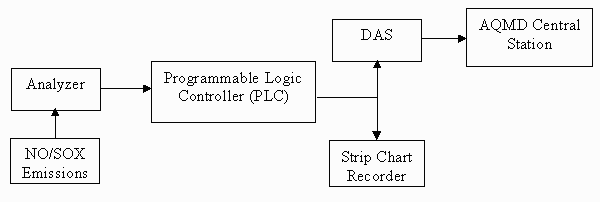
Strip chart recorders serve as compliance tools to verify reported SOx/NOx emissions independently. To comply with RECLAIM rules, strip chart recorders are generally located in parallel with the DAS, and therefore receive the same information as the DAS. Figure 1 is a typical schematic arrangement of a NOx/SOx analyzer, Programmable Logic Controller (PLC)3, DAS, and AQMD central station.
Figure 1: Typical RECLAIM Major Source Reporting Scheme
3Although the PLC is depicted in Figure 1 as separate hardware, it could also be an integral part of the analyzer or strip chart recorders.
Strip chart recorders receive data from the PLC, after the analog data is converted to digital format, and maintain a redundant backup source for data retrieval, if necessary. Electronic recording systems are comparable to strip charts and should provide all the enforcement and legal measures currently embodied in strip chart recorders. However, the alternative system must be located in parallel to the DAS such that it receives data independent of the DAS, and serves as an independent tool for verifying data archived by the DAS or sent to the AQMD Central Station. In addition, the information gathered by this system must be:
Option of Substituting Electronic Report in Lieu of Paper Reports
Rules 2011 and 2012 require SOx/NOx emissions data to be sent electronically to the AQMD Central Station on a daily, monthly, and quarterly basis depending of the RECLAIM source category (See Attachment B, Table 3). Because these rules also require quarterly and annual reports to be certified by the highest ranking management official of the operating company, facilities are also required to submit paper reports to AQMD on a quarterly and annual basis.
Electronic reporting provides capabilities for complete automation, control, management, and security of information. It reduces the time and cost associated with traditional paper-based reporting processes and allows end to end transfer of electronic information among different entities such as affected sources and public agency. The RECLAIM program requires facilities to report most of the monitoring and recordkeeping data, except those requiring certifications, electronically to the AQMD. However, the benefits of electronic reporting would be fully realized when paper-based quarterly and APEP reports may be submitted electronically as an option. In order to accomplish this, these reports must be certified electronically prior to submission. Electronic signature is therefore being considered as a viable option of validating the reports.
The signing of a document, either electronically or by hand on paper, is an act of taking responsibility for a document and its content. Hand signatures were considered important to the certification of a demand, because it is:
- an integral part of the document content rather than just its representation.
- practically impossible to be altered without physically damaging the document.
- legally binding as acceptable evidence for both civil and criminal proceedings
in a court of law.
In today’s world of electronic commerce, many current technologies have made it possible for electronic signatures to meet the criteria stated above. Some examples of such technologies are:
The U.S. EPA legal staff is concerned about the adequacy of electronic signature to support criminal case proceedings. The Task Force therefore proposes to provide options for facilities to submit quarterly and annual reports electronically to the AQMD Central Station, subject to acceptance by U.S. EPA legal staffs.
Consolidation of 4th-Quarter Report with the APEP Report
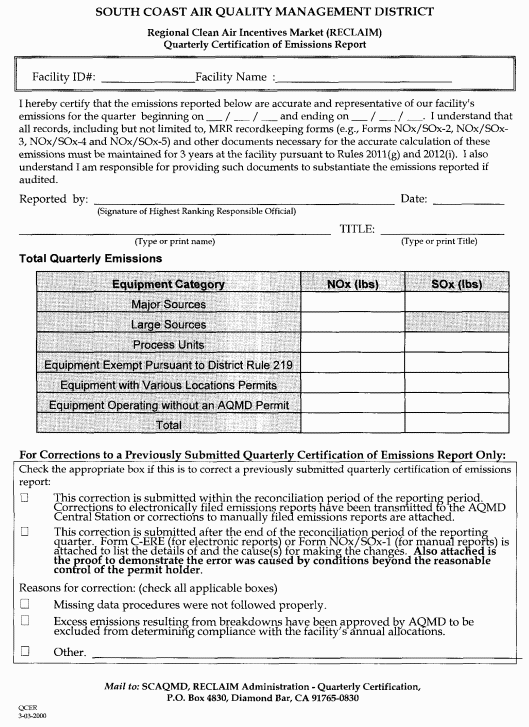
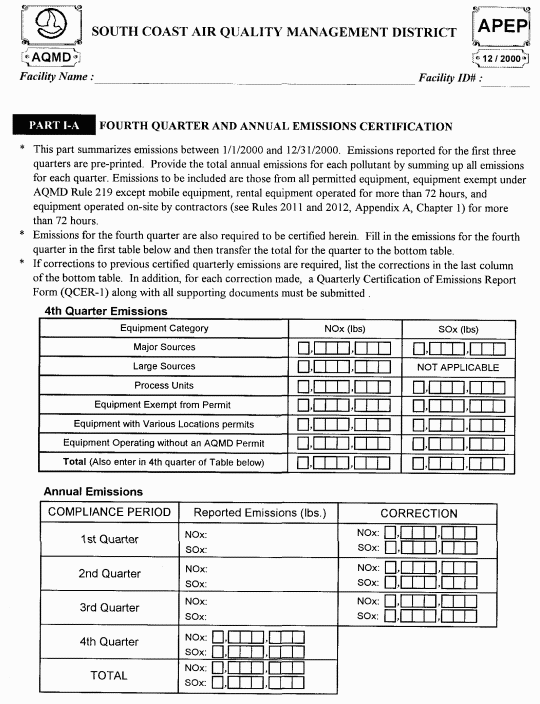
The APEP is a comprehensive report used for reporting the facility’s compliance status, reviewing the facility’s permit and fees, and for reporting information specified under Rule 2015 – Backstop Provisions. Although Part I-A of the APEP report includes total quarterly NOx/SOx emissions, the report does not have a means of certifying and segregating quarterly emissions on the basis of equipment category as required by Rules 2011 and 2012. To provide facilities with the option of paper-based or electronic reporting of quarterly and annual reports, and consolidate the 4th-quarter report with the APEP report, the quarterly forms and Part I-A of the APEP are proposed to be modified. Specifically, Part I-A of the APEP report may be enhanced by itemizing the 4th-quarter NOx/SOx emissions on the basis of following six categories (see Attachments C and D):
- Major source
- Large source
- Process units
- Equipment exempt pursuant to District Rule 219
- Equipment with various-location permits
- Equipment operating without an AQMD permit
Additionally, amendments to the quarterly and APEP forms are necessary for consistency between paper-based and electronic reporting.
Table I lists the RECLAIM rules that need to be amended if this proposal is approved by the Board. It is important to note that CARB’s and U.S. EPA’s approval of these rules as SIP revisions are critical for the integrity and stability of the RECLAIM program.
Table I: Anticipated RECLAIM Rule Amendments
| Rule |
Title |
| 2011 | Requirements for Monitoring, Reporting, and Recordkeeping, for Oxides of Sulfur (SOx) Emissions |
| Appendix A | Protocol for Monitoring, Reporting, and Recordkeeping, for Oxides of Sulfur (SOx) Emissions |
| 2011 | Requirements for Monitoring, Reporting, and Recordkeeping, for Oxides of Nitrogen (NOx) Emissions |
| Appendix A | Protocol for Monitoring, Reporting, and Recordkeeping, for Oxides of Nitrogen (NOx) Emissions |
Task Force Recommendations
The Task Force therefore recommends that the Board direct staff to:
Resource Impact
Computerized systems will need to be developed or modified to allow for electronic reports to be certified electronically. Funds for the system development work will be included in the FY #2000-01 Budget. Existing AQMD resources are sufficient to implement other part of the proposal to streamline MRR requirements for RECLAIM sources.
Attachments
Attachment A: Task Force Member List
Attachment B RECLAIM Monitoring, Recordkeeping, and Reporting Requirements
Attachment C: Quarterly Certification of Emissions Report
Attachment D: Part I-A Fourth Quarter and Annual Emissions Certification
ATTACHMENT A
MONITORING, RECORDKEEPING AND REPORTING TASK FORCE
MEMBER LIST
AQMD Governing Board
(Chair) Norma Glover, AQMD Governing Board Vice-Chair
Ronald Loveridge, AQMD Governing Board Member
State and Federal Regulatory Agency
Andrew Steckel, U.S. Environmental Protection Agency
Stephanie Trenck, California Air Resources Board
Other Members
Greg Adams, Sanitation Districts of Los Angeles County
Gerald Benetto, Printing Industries Association
Dale Botts, Steelcase/Orange County Business Council
Mike Carroll, Latham & Watkins Regulatory Flexibility Group
Curt Coleman, California Manufacturers Association
Gene Lopez, California Auto Body Collision Association
David Price, Western States Petroleum Association
Jackie Smith, California Cleaners Association
Jeb Stuart, Construction Industry Air Quality Coalition
Ron Thompson, B. F. Goodrich Aerospace (Rohr)
AQMD Staff Liaison
Dr. Barry Wallerstein, Executive Officer
Dr. Anupom Ganguli, Planning & Rules Manager
Peter Mieras, District Prosecutor
Monitoring, Recordkeeping, & Reporting Team
Adewale Oshinuga, Air Quality Engineer II
Marian Coleman, Air Quality Inspector III
ATTACHMENT B
RECLAIM MONITORING, RECORDKEEPING AND REPORTING
REQUIREMENTS
Table 1: RECLAIM Monitoring Requirement
|
Source Category |
Requirement |
|
Major SOx/NOx |
|
|
Large NOx |
|
|
Process Unit |
Install, maintain, and operate a totalizing fuel meter and/or timer or any AQMD-approved device to measure quarterly fuel usage or other applicable variables specified in the Protocol for Rule 2012. |
Table 2: RECLAIM Recordkeeping Requirement
|
Source Category |
Requirement |
|
All Source Category |
All monitoring data gathered, computed, or reported pursuant to Rules 2011 and 2012, and the Protocol to Rules 2011 and 2012 must be retained for three years after each APEP report is submitted to AQMD |
Table 3: RECLAIM Reporting Requirement
|
Electronic Reporting |
|||
|
Source Category |
Frequency |
NOx/SOx Emissions Reported By: |
Paper Reporting |
|
Major |
Daily |
Individual NOx/SOx Equipment |
|
|
Monthly |
Aggregating all NOx/SOx Equipment |
||
|
Quarterly |
Aggregating all NOx/SOx Equipment in Major Source Category |
||
|
Large |
Monthly |
Individual NOx/SOx Equipment |
|
|
Quarterly |
Aggregating all NOx/SOx Equipment in Large Source Category |
||
|
Process Unit |
Quarterly |
 Individual
NOx/SOx EquipmentAggregating
all NOx/SOx Equipment Individual
NOx/SOx EquipmentAggregating
all NOx/SOx Equipmentin Large Source Category |
|
Attachment C: Quarterly Certification of Emissions Report
Attachment D Part I-A Fourth Quarter and Annual Emissions Certification
/ / /