 South Coast Air Quality Management District
South Coast Air Quality Management District
South Coast Air Quality Management District
BOARD MEETING DATE: August 18, 2000 AGENDA NO. 20
Status Report on Controlling Particulate Matter and Volatile Organic Compound Emissions from Restaurant Operations.
SYNOPSIS:
For the past fourteen months, to develop Proposed Rule 1138.1, staff has been evaluating methods to control emissions from under-fired charbroilers. The 1999 amendment to the 1997 AQMP requires staff to report to the Board, at a public meeting, when cost-effectiveness for a draft rule/amendment exceeds $13,500 per ton of VOC reduced. The report must be presented at least 90 days prior to rule adoption and include viable control alternatives within the industry source categories intended to be regulated. This report fulfills this obligation and provides an update on recently completed source tests, potential control technologies, cost-effectiveness, and recommended actions to reduce emissions from under-fired charbroilers.
COMMITTEE:
Stationary Source, July 28, 2000, Reviewed
RECOMMENDED ACTION:
Receive and file this report.
Barry R. Wallerstein, D.Env.
Executive Officer
Introduction
This report fulfills a requirement established by the 1999 Amendments to the 1997 Ozone State Implementation Plan for the South Coast Air Basin (AQMP). The amended Plan requires that staff report to the Governing Board, when the cost-effectiveness for a draft rule or amendment exceeds $13,500 per ton of volatile organic compound (VOC) reduced. The report must be at a public meeting at least 90 days prior to rule adoption and include viable control alternatives within the industry source categories that a rule is intended to regulate. This report to the Board fulfills this obligation and provides an update on recently completed source tests, potential control technologies, cost-effectiveness, and recommended actions to reduce emissions from under-fired charbroilers.
While significant progress has been made and several parties are continuing to develop cost-effective solutions for reducing emissions from under-fired charbroilers, options are somewhat limited at this time, and the cost for only VOC reductions is above $13,500 per ton. This rule is primarily a particulate matter (PM) rule, with a side benefit of VOC reductions. Previous cost-effectiveness analysis for Rule 1138 was based on the combination of PM and VOC reductions. The combined VOC and PM cost-effectiveness for Rule 1138 was calculated to be $1,680 per ton. The cost-effectiveness calculated based on VOC alone, was $6,875/ton of VOC reduced for Rule 1138. The combined VOC and PM cost-effectiveness for one control technology (the scrubber system) for under-fired charbroilers with completed test data currently available is $18,600 per ton. There is a pollution prevention technique that changes the cooking process and may be an option for some restaurants. However, the cooking method varies from that of an under-fired charbroiler and thus, the cooking time, taste, or appearance may also differ. The Smoklessä broiler has a combined cost-effectiveness of $4,650 per ton.
Staff recommends continuing development of technologies. A subsequent Board letter may request funding for additional tests of promising control equipment. Staff will return to the Board with a proposed rule next year if cost-effective controls are identified.
Background
Restaurants emit PM and VOCs which can cause adverse health impacts, and they are also a source of complaints. Particulate matter primarily affects the respiratory system and may cause coughing, wheezing, and physical discomfort in breathing. It may also alter the immune system. Elevations in the level of ambient PM have been linked to increased mortality, respiratory infections, asthma attacks, and aggravation of pre-existing respiratory and cardiovascular diseases. VOCs emitted from this source are precursors to ozone and contain toxic air contaminants.
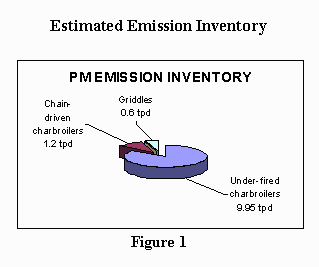
Restaurant operations include charbroilers, griddles, deep fat fryers, ovens, and other equipment. Griddles account for approximately five percent of the total PM restaurant emissions inventory and four percent of the total VOC emissions. Emissions from deep-fat fryers are negligible for PM and are only two percent of the VOC emission inventory. Oven emissions appear to be negligible. Based on the contribution of emissions from under-fired charbroilers, they were chosen as the next logical piece of basic equipment for which to seek cost-effective controls. If controls are positioned on the roof and process the entire restaurant effluent, they could appreciably reduce emissions from other cooking equipment such as griddles and fryers.
The AQMP includes a control measure for Emission Reductions from Restaurant Operations, PRC-03. Projected emission reductions from the 1999 amendment to the 1997 AQMP are 7.0 and 0.9 and tons per day of PM and VOC, respectively. Phase I of implementation for this control measure was initiated with the Board’s adoption of Rule 1138 - Control of Emissions from Restaurant Operations, in November 1997. Chain-driven charbroilers are the only restaurant equipment controlled through this rule because no other cost-effective control technology was commercially available for other restaurant equipment when the rule was adopted. Control technology is evolving in the under-fired charbroiler sector to allow further reductions in emissions. Proposed Rule 1138.1, which would require controls on under-fired charbroilers, will implement the remaining portion of Control Measure PRC-03.
Rule 1138 was the first AQMD rule which reduced directly emitted PM 2.5, fine particulate matter. The current rule requires controls on all chain-driven charbroilers cooking over 875 pounds of meat per week or emitting one pound or more per day of any criteria pollutant. Sources subject to this rule were required to be in compliance with rule requirements no later than November 14, 1999.
A 1999 report1 to the AQMD identified approximately 29,000 restaurants in the AQMD’s jurisdiction. The use of various cooking equipment at these locations results in the emissions of approximately 11.8 tons per day of PM and 1.7 tons per day of VOCs. The implementation of Rule 1138 resulted in a reduction of 1 ton per day of PM emissions and 0.3 tons per day of VOC emissions.
1 A Detailed Survey of Restaurant Operations in the South Coast Air Basin, Pacific Environmental Services, Inc. February 5, 1999; Contract Number 98089.
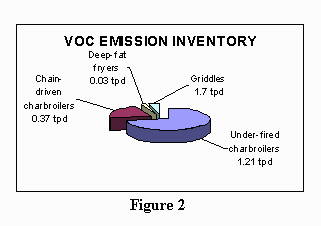
Under-fired charbroilers are responsible for the majority of emissions from this source category (84 percent of PM emissions, and 71 percent of VOC emissions). The Governing Board received a report on emerging control technologies for under-fired charbroilers in May 1999. This report pointed out that a continuing effort to find cost-effective and technologically feasible controls for the restaurant industry has been ongoing since 1991. The earlier phases of this effort included significant resources in improving test methods and developing emission factors.
Technology Review
The University of California, College of Engineering, Center for Environmental Research and Technology (CE-CERT), under contract with the AQMD conducted a control technology assessment, and tested possible cost-effective controls for under-fired charbroilers. A Restaurant Advisory Committee formed by CE-CERT, consisting of members representing academia, AQMD, industry and manufacturers, chose several technologies to be investigated. The results of this study were presented in a May 1999 report to the Board. This report included excerpts from the final CE-CERT report on "Efficient and Cost-effective Control Technologies for Under-fired Charbroilers, Development and Demonstration of Emission Control Technologies for Commercial Under-fired Charbroilers. Copies of the full document are available from the Public Advisors Office by calling (909) 396-3600.
CE-CERT investigated several potential commercial cooking emission control technology systems, including: microwave ceramic filter, cyclonic air scrubbing device and process design. Criteria for testing included the ability to reduce both PM and VOC emissions, cost, commercial availability, maintenance and operational requirements, and safety.
The microwave ceramic filter is based on the concept of filtering out the harmful emissions in the ventilation system and periodically regenerating the loaded filters using microwave energy. This process, revised after several initial tests, will be tested again this summer at CE-CERT under contract with CARB.
The cyclonic air scrubbing device employs water and filters to remove PM and carbon beds to remove the VOC. The SmoklessTM broiler is designed to prevent grease from the broiling food from dripping onto hot burner components. This redesign results in a reduced amount of PM and VOC pollutant formation. Table 1 summarizes testing, and capital and operation/maintenance (O&M) costs results for the various technologies.
Table 1
Emission Reductions and Technology Cost*
|
Technology |
Percent Reduction |
Cost |
||
|
PM |
VOC |
Capital |
O&M*** |
|
|
Cyclonic air scrubber |
88 |
44** |
$9,290 |
$3810 |
|
SmoklessTM Broiler |
75 |
71 |
$5,600 |
$290 |
*
The microwave ceramic filter results are not presented because this technology initially performed poorly but has been redesigned and will be re-tested later in 2000.Staff believes, based on the consultant’s work and its independent analysis, that technological advances are occurring in this area. The AQMD and entities with interest in this type of technology will be conducting future testing on other processes/equipment. Further commercial production of these and other technologies will likely lead to more cost-effective and energy efficient commercial charbroiling processes. Several reputable equipment manufacturers are actively pursuing a variety of control strategy options.
Staff has formed a Working Group consisting of members from the affected industry, equipment manufacturers, and the energy industry. This Group met initially in May 2000 and again in July 2000. Testing continues at CE-CERT and independently from companies developing possible control options. Further assessment of the cost-effectiveness of these technologies and additional investigation of these technologies will continue.
AQMP and Legal Mandates
The 1999 Amendments to the 1997 Ozone State Implementation Plan for the South Coast Air Basin states that, in response to concerns regarding costs raised by the regulated community, a threshold above $13,500 per ton of VOC reduced would require additional analysis and public process. The document directs staff to develop viable control alternatives to be presented to the Board no less than 90 days prior to rule adoption.
The 1999 AQMP commitments require development of viable control alternatives relative to under-fired charbroilers. It states: "Specifically, proposed rules with an average cost-effectiveness above the threshold will trigger a more vigorous average cost-effectiveness, incremental cost-effectiveness, and socioeconomic impact analysis. A public review and decision process will be instituted to seek lower cost alternatives. In addition, no less than 90 days prior to rule adoption, the District staff, with input from stakeholders, will attempt to develop viable control alternatives within the industry source categories that a rule is intended to regulate. If it is determined that control alternatives within the industry source category are not feasible, staff will perform an evaluation of the control measure as described in paragraph (B) below……." (i.e., obtain committed emission reductions from a substitute measure).
Currently, assessing the control options available for under-fired charbroilers, staff believes that a cost-effective solution is not feasible for the majority of sources using under-fired charbroilers. Staff further believes that the Smoklessä broiler offers an option for some restaurant owners but does not present a universal solution to the source-category. Although it is similar to an under-fired charbroiler, the cooking method varies and may change cooking time, taste, or appearance.
Rule Options Considered
Staff considered various regulatory options. Based on the information currently available, these options are as follows:
Retrofit
A standard rule development approach would propose to require the retrofit of existing equipment with add-on controls and require that all new equipment be constructed with these controls. To date, the only tested and commercially available control technology is the cyclonic air scrubber, although other options are being developed. This equipment’s cost-effectiveness is estimated to be $325,000/ton of VOC reduced and $19,700/ton of PM reduced. The combined cost-effectiveness (VOC + PM) is $18,600 per ton. The manufacturer indicated that a high sales volume would reduce the equipment cost by 30 – 50 percent. On this basis, the cost-effectiveness would be $260,000/ton of VOC reduced. There are approximately 13,300 under-fired charbroilers operating in the Basin. Depending on cost and availability of technology, the rule options under this scenario would cover varying numbers of restaurants. Capital costs for restaurant controls or cooking options could range from approximately $2,000 to $12,000 (estimates based on technologies not yet tested).
Replacement with Smoklessä broiler
An alternative consideration would be the replacement of under-fired charbroilers as they are retired from service, with a SmoklessTM broiler. The SmoklessTM broiler is commercially available and is in use by approximately seventy restaurants in the United States. The SmoklessTM broiler is not a control device but rather basic equipment similar to an under-fired charbroiler. However, the SmoklessTM broiler is not a direct-flame cooker and it may result in a product that differs in appearance and/or taste. Cooking methods, taste, and appearance are very critical to a restaurant’s operation. The SmoklessTM broiler capital cost is approximately $5,550 compared to a similarly sized under-fired charbroiler which costs about $3,100. One possible rule approach would be to require the replacement of retired under-fired charbroilers with SmoklessTM broilers. Under-fired charbroilers typically do not require replacement for approximately fifteen years. The calculated cost-effectiveness of this scenario is approximately $3,550/ton of PM reduced, about $31,200/ton of VOC reduced, and $4,650 for VOC and PM combined.
Reduction Requirements
The AQMP estimated a 70 percent reduction in PM and VOC emissions. A lower emission reduction requirement might reduce the cost for some technologies being developed, if less expensive controls or less chemicals were required.
PM Control Only
The control measure in the 1999 Amendment to the 1997 AQMP includes both VOC and PM. Excess VOC emission reductions from other adopted AQMP measures could be substituted to satisfy the VOC emission reduction requirement for PRC-03 in the 1999 Amendment to the 1997 AQMP. The rule could then focus on PM reductions. This would reduce the cost of many of the control devices and may make the rule more cost-effective. Additional time for rule development may result in more options for controls and lower cost. VOC emissions from charbroilers include some carcinogenic polycyclic aromatic hydrocarbons (PAHs), which would be foregone under this alternate proposal.
Future Effective Date
The 1999 AQMP commits Control Measure PRC-03 to a 70 percent reduction from under-fired charbroilers in both VOC and PM emissions. An emission reduction requirement with a future effective date could be established to allow for technology to develop, with an interim technology assessment prepared to monitor progress. The lead-time would be longer than projected in the 1999 AQMP (e.g., a four to five year lead-time). For this scenario, cost-effectiveness would be difficult to estimate at this time.
Staff Recommendations
Significant advances have been made in the development of potential controls for charbroiling operations. Identification of a specific cost-effective strategy to reduce emissions from under-fired charbroilers is anticipated by early next year for a combination of VOC and PM. Any such proposal will likely be cost-effective on a PM control basis only. Some control options reduce both VOC and PM for the same cost.
The 1999 Amendments to the 1997 Ozone State Implementation Plan for the South Coast Air Basin makes specific emission reduction commitments for the year 2000. PR 1138.1 is assigned to reduce 0.9 tons/day of VOC emissions by the year 2003. The amendment allows substitution of emission reductions when another rule results in more emission reductions than planned. Staff recommends substituting 0.9 tons/day of the emissions from another control measure that achieves excess VOC emission reductions, for PR1138.1, to satisfy its emission reduction requirement. These reductions will be achieved by rules adopted this calendar year.
Staff recommends continuing development of technologies. A subsequent Board letter may request funding for additional tests of promising control equipment. Staff will return to the Board with a proposed rule early next year as cost-effective controls are finalized.
/ / /