 South Coast Air Quality Management District
South Coast Air Quality Management District
South Coast Air Quality Management District
BOARD MEETING DATE: July 21, 2000 AGENDA NO. 30
Annual Status Report on Rule 1113 - Architectural Coatings
SYNOPSIS:
At its August 13, 1999 meeting, the Board approved a workplan for implementing the amendments to Rule 1113. This report summarizes the activities of District staff, the Working Group, Averaging/Niche Markets Sub-Group, and the Technical Advisory Committee; and the progress made relative to the Essential Public Service Coating technology assessment. The report also includes staff’s recommendations as a result of the technology assessment for flat coatings. Both technology assessments are either requirements contained in the rule or part of the Board’s resolution.
COMMITTEE:
Not applicable
RECOMMENDED ACTION:
Receive and file.
Barry R. Wallerstein, D.Env.
Executive Officer
Background
On May 14, 1999, the Board approved the amendments to Rule 1113 – Architectural Coatings, with a direction to staff to work with industry to address certain concerns raised at the public hearing, and to report back to the Board in 90 days. Subsequently, in June 1999, three lawsuits were filed challenging the amendments, brought by Sherwin-Williams, the National Paint Coatings Association ("NPCA"), and the California Paint Alliance (incorporated as EL RAP) which are currently ongoing. On August 13, 1999, the Board approved staff’s workplan to implement the Board’s directive.
This report highlights staff’s efforts in executing the workplan to implement the amendments. Specifically, it summarizes the activities of the various work groups formed, provides a status report on the ongoing technology assessment for essential public service coatings, and presents staff’s findings on the technology assessment conducted for flat coatings that was part of the Rule 1113 amendments adopted in November 1996.
Meetings
Working Group
Pursuant to the workplan approved by the Board, the objective of the working group was to provide a forum for discussion of technological advancements in coatings material, market trends, and product performance related to Rule 1113 – Architectural Coatings. With regards to implementation of the workplan, staff held four meetings with the working group on October 12, 1999, November 3, 1999, January 19, 2000, and May 17, 2000. In these meetings, staff provided updates to the Phase II Assessment Study for Architectural Coatings, developed and finalized the implementation clarifications to the amended rule, and discussed the flat coatings technology assessment. Various other topics, such as the Settlement Agreement pertaining to the SIP litigation brought by several environmental organizations and the 1999 Amendments to the 1997 Air Quality Management Plan and their impact on the architectural coatings industry, were also discussed at these meetings. Lastly, staff presented the potential impacts of EPA’s Draft Economic Incentive Program Guidance Document on the averaging program.
Averaging/Niche Market Subgroup
Pursuant to the workplan approved by the Board, the objective of the averaging/niche market subgroup is to implement the averaging compliance option program, as well as monitor and address issues related to niche markets. Staff met with the averaging/niche market subgroup on September 9, 1999, October 12, 1999, November 3, 1999, December 15, 1999, and January 20, 2000. In these meetings, staff worked with interested industry members on developing an enforceable program, as well as the averaging implementation guidance document. This subgroup was placed on hold in February 2000, in response to the CARB’s interest in developing an alternative averaging program for their Suggested Control Measure (SCM). However, this subgroup continued to work with CARB staff on the concept of a statewide averaging program. CARB has yet to finalize the averaging program to be included in the SCM. Nonetheless, in response to industry requests, staff has agreed to reconvene this subgroup to complete the averaging implementation guidance document.
Technical Advisory Committee (TAC)
Pursuant to the workplan approved by the Board, the objective of the technical advisory committee was to provide technical oversight of the Phase II Assessment Study and future technology assessments, including selection of coatings, relevant testing, and the report formats. Additionally, the TAC will evaluate data to identify links between performance characteristics and emission potential of architectural coatings.
In conjunction with the TAC, staff has thoroughly reviewed the results of the laboratory portion of the Phase II Assessment Study for Architectural Coatings. In response to concerns expressed by some members of the TAC, National Technical Systems (NTS), the contracted laboratory, re-evaluated the dry time test based on a protocol developed by the TAC. This review did not result in changes to the final data, but did clarify the deviation from a standardized test method. The TAC has also reviewed the actual panels for numerous laboratory tests during a site visit to the NTS laboratory in Sacramento. Additionally, based on comments by the TAC, NTS re-evaluated the ranking for the leveling analysis based on an agreed modification to the test method. This re-evaluation also did not result in any modifications to the conclusions derived from the original laboratory test data. Furthermore, the TAC reviewed the protocol and subsequent results of the accelerated outdoor weathering data. This data paralleled the results of the accelerated laboratory weathering. In early April, NTS initiated the real-time exposure study by placing coated panels on exposure racks in Saugus and El Segundo to obtain exposure data in the cooler, more humid marine environment, and a hotter, drier climate.
Currently, the TAC is developing the protocol for a thorough evaluation of application characteristics for the coatings included in the NTS study. Although the protocol has been finalized by the TAC, a contractor has not yet been selected. The TAC is currently evaluating three potential approaches for selecting the contractor.
Essential Public Service Coating – Technology Assessment
During the rule development phase of the May 14, 1999 amendments to Rule 1113 – Architectural Coatings, the Board directed staff to provide technical oversight and funding to the Essential Public Service Agency technology assessment. In response to this direction, as of September 1999, staff formed a committee to accomplish the separate technology assessment for the Essential Public Service Agencies. This committee is comprised of representatives from Metropolitan Water District (MWD), Department of Water Resources, Cal Trans, Department of Water and Power, as well as the Southern California Association of Publicly Owned Treatment Works (SCAP). Over the past eight months, the committee has met on a regular basis to identify service environments of concern, and has developed a list of coatings to be tested, based on a mutually-agreed upon testing protocol. The Committee has selected MWD as the primary contractor for the assessment, since they have an active corrosion testing laboratory and already conduct such assessments for some of the participating agencies. Of the agencies listed above, SCAP may choose to conduct a separate study to address specific service conditions found in wastewater treatment facilities. The committee has developed a Letter of Understanding, which is an agreement-in-principle to participate in this joint analysis, as well as a workplan to define the scope and commitments made by the signatory agencies. Actual laboratory testing is scheduled to start over the next few weeks. Each individual agency will sign engineering service agreements with MWD to conduct the studies. The District plans to co-fund this technology assessment with the listed agencies.
Flat Coatings – Technology Assessment
During the November 1996 amendments to Rule 1113, the Board approved a staff proposal to include a provision for a technology assessment for flat coatings prior to implementation of future limits. This technology assessment is to assess the technical feasibility of implementing the 100 g/l VOC limit, scheduled for implementation in July 2001.
In conducting this technology assessment for flats, staff relied on two sources that provided a wealth of information:
1998 CARB Survey
As a first step of the technology assessment, staff evaluated the 1998 CARB Survey of Architectural Coatings. This comprehensive survey, used for establishing an emissions baseline, relied upon sales of architectural coatings in 1996 from over 150 manufacturers.
The following summary highlights data extracted from the CARB survey, as well as staff’s analyses of the data for flat coatings.
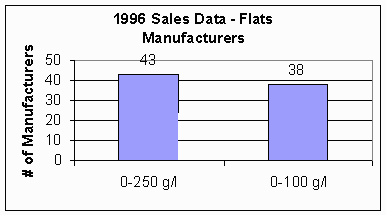
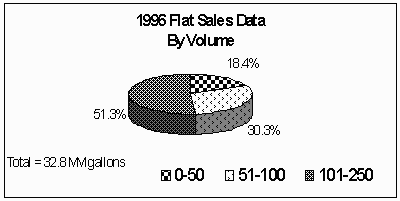
A total of 43 manufacturers submitted information on flat coatings, of which 38 (88%) have formulations that have a VOC level at or below 100 g/l. (Figure 1) Total flat coating sales in California were 31,777,127 gallons, of which 15,475,461 gallons were for flat coatings with a VOC level of 100 g/l or less. This equates to approximately 49% of all flat coatings sold in 1996. (Figure 2)
A more detailed review of flat sales data shows reporting by interior, exterior, dual (both interior and exterior), and unidentified uses. For the coatings with a VOC content between 0 and 100 g/l (549 products), interior flats accounted for approximately 47% of the total products, and exterior flats represented a little over 21% of the products.
Figure 1
Approximately 10% accounted for dual use, and 22% were unidentified. An additional analysis for the products with a VOC content between 101-250 g/l (611 products) shows that 29% are for interior use, and 40% are for exterior use. The dual use coatings represented 9% of the products and 23% were unidentified. Figure 3 summarizes this analysis by illustrating the data and comparing it to overall flat products with a VOC content of 0-250 g/l.
Figure 2
Additionally, this data was further analyzed by assessing the volume of product sold for exterior and interior use. A total of 13,005,301 gallons of interior flat coatings was sold in 1996, as compared to 13,436,722 gallons of exterior coatings. Of the total volume of interior coatings, 71% of the total volume was for flats with a VOC content between 0-100 g/l. In contrast, approximately 30% of the total volume of the exterior flats represented coatings with a VOC content between 0-100 g/l. Figure 4, below, represents this data in a graphical manner.
In summary, the CARB survey clearly shows the availability and use of flat coatings that meet the future 100 g/l VOC content limit. The District recognizes that a larger percentage of interior flats (both in terms of number of products and volume) that comply with the future limit were sold in 1996.
Figure 3
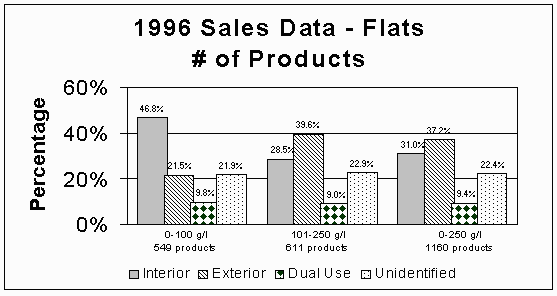
Figure 4
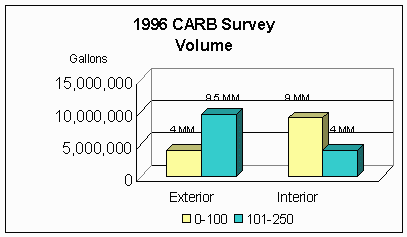
However, the CARB survey also shows the sale of almost 4,000,000 gallons of exterior flats that comply with the future VOC limit. The volume figures for low-VOC interior and exterior flats is significant and clearly demonstrates that the low-VOC formulations are technologically and commercially achievable and acceptable by the public. Nonetheless, the Averaging Program included in the rule, also to be implemented in July 2001, would allow the manufacturers to average their emissions from sale of interior and exterior flat coatings.
MPI Data
In order to supplement the information extracted from the CARB survey, the District researched and contacted various groups that are working on developing performance standards for architectural coatings. One such group is Master Painters Institute® (MPI), founded in 1996. MPI, in conjunction with paint manufacturers and paint technologists, has developed universal performance-based standards. Additionally, MPI conducts all laboratory testing to assess the performance characteristics of the different paint categories. Products that meet the performance standards are included in the approved products list, which is made available via the internet or hardcopy. The approved products list is updated periodically, as manufacturers submit their paint samples for analyses. As of August 1999, 33 manufacturers had submitted their products, for possible inclusion into the approved list. MPI indicates that not all available products from all manufacturers are included in their analyses.
Recently, the U.S. Navy announced their intention to use MPI Product Standards and the approved products list for all of their architectural and industrial maintenance coatings use. The U.S. Air Force and General Services Administration are currently evaluating the universal performance based standards for inclusion into their coatings program.
Following a request by staff during a working group meeting in January 2000, Dunn Edwards suggested, in a letter dated January 28, 2000, that the flat coatings be evaluated using the current federal specifications for exterior and interior flat coatings. The current federal specification for exterior flat coatings is TT-P-19, entitled Paint, Acrylic Emulsion: Exterior and the current federal specification for interior flat coatings is TT-P-29, entitled Paint, Latex.
An evaluation of MPI’s universal performance based standards indicates that MPI specifications are equivalent to the federal specifications discussed above. Specifically, MPI Specification Reference #10 is equivalent to Federal Specification TT-P-19 (exterior), which includes testing for gloss, consistency/viscosity, dry time, fineness of grind, hiding power, reflectance, flexibility, water resistance, and accelerated weathering. MPI Specification Reference #53 is equivalent to Federal Specification TT-P-29 (interior), which includes testing for gloss, consistency/viscosity, dry time, fineness of grind, hiding power by contrast ratio method, reflectance, flexibility, scrubbability, alkali resistance, and sealing properties. MPI’s Detailed Performance specifications for both interior and exterior flats are included as an attachment to this letter. It should be noted, however, that MPI does not conduct the VOC analysis, but records the VOC information as reported by the manufacturer.
Staff has also included the approved products list for interior and exterior flats, as of May 26, 2000. For interior flats, 19 products have met the standards for performance characteristics summarized above. Of these 19, 8 products have a regulatory VOC content less than 101 g/l. This equates to 42% of the products tested. For exterior flats, a total of 26 products have met the standards, with 7 products (27%) having a regulatory VOC content of less than 101 g/l.
During the January 19, 2000 and May 17, 2000 working group meetings to discuss the assessment for flat coatings, staff requested industry to submit specific issues related to flat coatings with a VOC content at or below 100 g/l, as well as to identify specific problematic substrates and uses. To date, three comment letters have been received. All three letters indicate that the 100 g/l limit is not appropriate for all flat coating applications, but fail to discuss the specific substrates or uses where the use of compliant products may not be appropriate due to performance concerns. One of the three letters does suggest concern that flat coatings below 100 g/l may have a limited color-palette, shorter lap times, and other limited performance properties when compared to their higher-VOC counterparts.
Staff’s technology assessment, as well as a review of product data sheets from various manufacturers, shows availability of a variety of flat coatings that have a VOC content of or less than 100 g/l. These flat coatings, including some zero-VOC flat coatings, have a full range of colors and scrub resistance equal to or greater than their higher-VOC counterparts. Additionally, as discussed above, MPI’s specifications include testing for scrub resistance and hiding power. Overall, the commentators failed to provide any specific information or any empirical data to refute the availability and acceptance of the lower-VOC flat coatings.
This data clearly shows availability of flat coatings, both interior and exterior, that meet or exceed the performance standards established by paint manufacturers, paint technologists, and end-users.
In conclusion, based on the CARB survey data and the laboratory analyses by MPI, staff recommends maintaining the 100 g/l for flat coatings, effective July 1, 2000.
Future Assessments
Staff will shortly initiate the technology assessment to be conducted for other categories, to be presented to the Board in July 2001. Staff will work with the Working Group and the TAC to determine the scope of the study, and will include a thorough product-availability assessment, a review of the NTS Study results, continued efforts in evaluating data generated by MPI, as well as additional laboratory evaluation, as necessary.
MPI 10 – Performance Standard for Exterior Latex White and Tints
MPI 53 – Performance Standard for Interior Flat Latex White and Tints
Approved Product List – MPI #53 – Interior Latex, Flat
Approved Product List – MPI #10 – Exterior Latex, Flat
/ / /