 South Coast Air Quality Management District
South Coast Air Quality Management District
South Coast Air Quality Management District
BOARD MEETING DATE: November 17, 2000 AGENDA NO. 29
Report on Control Technologies for Medium-Duty Diesel-Powered Vehicles
(Continued from the October 20, 2000 Governing Board Meeting)
SYNOPSIS:
In the Rule 1191 – Clean On-Road Light- and Medium-Duty Public Fleet Vehicles, adopting resolution, the Board directed staff to report on the state-of-science of control technology for diesel-powered medium-duty vehicles and to compare emissions from engines powered by diesel and other transportation fuels. The staff has summarized the necessary technical information on medium-duty vehicles. Although significant progress has been made in diesel engine and control technology, these vehicles are still emitting more NOx and PM emissions than other transportation fuels. Low sulfur diesel fuels and further advancements in engine design and control devices will be necessary for these vehicles to comply with LEV II emission requirements. No changes are recommended for Rule 1191, subject to technological development in the future.
COMMITTEE:
Technology, September 22, 2000, Reviewed
Mobile Source, October 27, 2000, Reviewed
RECOMMENDED ACTION:
Receive and file.
Barry R. Wallerstein, D.Env.
Executive Officer
Background
Rule 1191 – Clean On-Road Light- and Medium-Duty Public Fleet Vehicles, adopted in June 2000, requires public fleet operators with 15 or more fleet vehicles to purchase California Air Resources Board (CARB) certified low-emission vehicles when adding, replacing or forming a new fleet of light- and medium-duty vehicles. During rule development, affected operators were concerned with availability of compliant medium-duty vehicles. Consequently in the adopting resolution, the Governing Board directed staff to prepare a report to the Board on the state-of-science of control technology for diesel-powered medium-duty vehicles and compare emissions from engines powered by diesel, gasoline, liquefied petroleum gas (LPG), and compressed natural gas (CNG).
Introduction
Diesel engines are commonly used in trucking, service, and delivery industries, and, generally, among businesses and individuals requiring vehicles with larger carrying capacities and capable of handling a more rigorous operating environment. There is, however, growing public concern about diesel emissions from trucks and buses, including:
The AQMD, CARB, and U.S. EPA are aware of the potential health risks posed by diesel particulate matter (PM) emissions, and the significant contribution of mobile sources to the Basin’s NOx emissions inventory. As a result, the U.S EPA, followed by CARB, established technology-forcing requirements for controlling emissions from mobile sources. These requirements are generally the basis of the AQMD program for mobile sources.
AQMD Program Authority
The AQMD is an extreme nonattainment area for ozone. Under the California Health and Safety Code (HSC) Section 40919(a)(4), "serious" or worse ozone attainment areas may require "the use of a significant number of low-emission motor vehicles by operators of motor vehicle fleets." In addition, under HSC Section 40447.5 the AQMD may adopt rules requiring public and private fleets with 15 or more vehicles to acquire vehicles which are capable of operating on "methanol or other equivalently clean burning alternative fuel" when adding to or replacing vehicles in an existing fleet or purchasing vehicles to form a new fleet and to require that these vehicles be operated substantially on alternative fuels. Based on these legislative authorities, the AQMD also developed specific short- and long-term emission reduction measures to address air pollution problems from mobile sources, and recently adopted clean on-road fleet vehicle rules to reduce mobile sources emissions within the AQMD's regulatory authority.
State Program
In 1990, CARB adopted a low-emission vehicle (LEV I) program establishing a different set of tailpipe emission standards for passenger cars (PCs), light-duty trucks (LDTs), and medium-duty vehicles (MDVs), beginning with the 1994 model year. (Light-duty passenger cars and trucks have total weight of less than 6500 pounds. Medium-duty vehicles or engines have total vehicle weight or gross vehicle weight ratings from 6500 to 14,000 pounds.) In addition to the tailpipe emission standards (commonly known as "chassis emission standards"), CARB established a set of engine emission standards. An automobile manufacturer can produce vehicles with a specific engine family for sale in California. These vehicles would be subject to the LEV I chassis emission certification process. Engines produced for use in various applications would be subject to the LEV I engine emission certification process. CARB recognized that heavier light-duty trucks (HLDT) and MDVs emit more because they have larger capacity, and are generally used in more strenuous work activities. Consequently under this program, HLDTs and MDVs are subject to less stringent emission standards than PCs or smaller light-duty trucks (SLDTs). An example of these differences is shown in Table 1.
Table 11:
LEV I Exhaust Emission Standards
(a) Chassis Certification Standards
|
|
Mileage for |
Vehicle |
Emission Standard ( g/mi) | |||
|
NMOG |
CO |
NOx |
PM |
|||
|
PC’s/SLDT |
120,000 |
LEV |
0.180 |
5.0 |
0.60 |
0.08 |
|
HLDT (3751 – 5750 lbs) |
120,000 |
LEV |
0.230 |
6.4 |
0.60 |
0.10 |
|
MDV (5751-8500 lbs) |
120,000 |
LEV |
0.280 |
7.3 |
0.90 |
0.12 |
|
MDV (8501-10,000 lbs) |
120,000 |
LEV |
0.330 |
8.1 |
1.00 |
0.12 |
|
MDV (10,001-14,000 lbs) |
120,000 |
LEV |
0.43 |
10.3 |
1.50 |
0.12 |
1 A complete listing of LEV I and LEV II emission standards is contained in Title 13 of the California Code of Regulations.
(b) Engine Certification Standards
|
Engine Certification |
Mileage for |
Emission Standards | ||
|
NMHC+NOx |
CO |
PM |
||
|
Gm/bhp-hr
|
90,000 |
3.0 |
14.4 |
0.10 |
|
ULEV |
90,000 |
2.5 |
14.4 |
0.10 |
|
Gm/mi*
|
90,000 |
7.5 |
36.0 |
0.25 |
|
ULEV |
90,000 |
6.25 |
36.0 |
0.25 |
| * A conversion factor of 2.5 is used to convert gm/bhp-hr to gm/mi as recommended by CARB. | ||||
In November 1998, CARB established LEV II regulations to continue the progress of reducing mobile source emissions, beginning with the 2004 model year. This regulation tightened emission standards for most vehicle emission category (i.e., LEV, ultra low-emission vehicles-ULEV, super ultra low-emission vehicles-SULEV) and extended PC emission standards to heavier sport utility vehicles, minivans, and LDTs which were formerly regulated under less stringent emission standards. Specifically, under this program, the LDT category include SUV and trucks under 8,500 pounds (Gross Vehicle Weight Rate - GVWR) such as Toyota RAV4, Ford Ranger, Jeep Grand Cherokee, all minivans, Ford Explorer, Ford F150, Ford Expedition, Chevrolet Suburban, and Dodge Ram 1500. The MDV category (8500 – 14000 GVWR) includes Ford Excursion, Ford F250 and F350 Super-Duty trucks, Dodge Ram 2500 and 3500 trucks, and many full size vans. Table 2 lists the corresponding LEV II emission standards for PCs, LDTs, and MDVs.
Table 21: LEV II Exhaust Emission Standards
|
Vehicle Type |
Mileage for |
Vehicle |
Emission Standard ( g/mi) | |||
|
NMOG |
CO |
NOx |
PM |
|||
|
PC’s/LDT |
120,000 |
LEV |
0.090 |
4.2 |
0.07 |
0.01 |
|
MDV (8501-10000 lb) |
120,000 |
LEV |
0.195 |
6.4 |
0.20 |
0.12 |
1 A complete listing of LEV I and LEV II emission standards is contained in Title 13 of the California Code of Regulations.
Strategies to Reduce Diesel Emissions
In response to CARB and U.S. EPA tighter emission standards, vehicle and engine manufacturers, emission control manufacturers, fuel suppliers, and researchers have continued to direct considerable efforts and resources to developing strategies to reduce NOx and PM emissions from diesel engines. These efforts have resulted in many options available for (1) improving engine design and (2) developing exhaust aftertreatment devices to achieve higher emission reductions.
Diesel Engine Design
Engine manufacturers have improved or are improving their engine designs to meet low-emission standards. Generally, these improvements involve electronic engine controls, changes in fuel injection systems, handling of intake air, combustion chamber modifications, exhaust gas recirculation systems, and reducing oil consumption. Engine manufacturers are implementing combinations of these improvements to achieve low-emission levels under the CARB LEV I program. So far, five diesel-powered medium-duty engine families are LEV certified under the CARB LEV I program. There is no current LEV II-certified diesel-powered medium-duty engine.
Exhaust Aftertreatment Devices
Under LEV I and LEV II programs, diesel-powered engines are required to comply with the same emission standards as engines powered by other transportation fuels. Gasoline-, LPG-, and CNG-powered engines are equipped with existing technologies that are already capable of achieving much lower emission levels than most LEV I and some LEV II emission standards. Based on Tables 1 and 2, NOx and PM emissions from a certified LEV 6,000-lb diesel-powered MDV would have to be reduced by at least 92% for the vehicle to meet LEV standards under the LEV II program. To meet these targets, manufacturers of diesel-powered medium-duty engines and vehicles must to (1) implement most of the demonstrated options for improving engine performance, (2) use improved diesel fuel quality, and (3) develop exhaust control devices, capable of reducing at least 92% of NOx and PM engine-out emissions.
Several NOx and PM emission control devices are being developed and tested for use with diesel engines in the United States. Most of these aftertreatment devices can be used for controlling NOx and PM emissions from medium-duty diesel engines, but those control technologies require diesel fuels with sulfur levels below 30 ppm or 10 ppm in most cases. Emerging diesel aftertreatment technologies are briefly discussed below.
Emissions from Engines Powered by Diesel Compared to Other Transportation Fuels
The AQMD staff had discussions with CARB staff, engine and vehicle manufacturers, and other organizations working on projects involving comparing emissions from engines powered by diesel, gasoline, CNG, and LPG. Based on these discussions, staff reviewed extensive emissions data, including the CARB LEV I and LEV II certification list. This analysis is based solely on emission data from the CARB certification list because most of the technologies used in past or present projects on diesel fuels are either still in the developmental stage or not available for commercial applications. Table 3 provides emission data and other information, as contained in the CARB certification list, for medium-duty engines (8,501 – 14,000 GVWR) considered in this analysis. There are currently five diesel-powered LEV-certified engine families and over eleven gas (gasoline, CNG, and LPG) powered LEV/ULEV-certified engine families under the CARB LEV I program. Currently, there are no light- or medium-duty diesel engines certified in a vehicle for sale in California. As such, the analysis presented in this report examines engines that have been certified under the engine certification process. Table 3 provides hydrocarbon (NMOG) and NOx emission levels separately for each engine as part of this analysis. However, engine certification standards are based on a combined hydrocarbon and NOx value as shown in Table 1(b).
Table 3: LEV I Exhaust Emission Engines Certification Levels
|
Executive Order |
Fuel |
HP |
Vehicle |
Emissions* ( g/bhp-hr) | |||
|
NMHC
|
CO |
NOx |
PM |
||||
|
A-4-242 |
Diesel |
275 |
LEV |
3.100 |
1.30 |
3.000 |
0.08 |
|
A-4-223 |
Diesel |
250 |
LEV |
3.300 |
1.10 |
3.180 |
0.09 |
|
A-4-231 |
Diesel |
235 |
LEV |
3.300 |
1.10 |
--** |
0.093 |
|
A-4-212 |
Diesel |
250 |
LEV |
3.400 |
3.70 |
3.320 |
0.08 |
|
A-4-238 |
Diesel |
235 |
LEV |
3.400 |
1.30 |
3.300 |
0.09 |
|
A-10-986 |
Gasoline |
310 |
ULEV |
0.603 |
6.96 |
0.485 |
n/a+ |
|
A-10-987 |
Gasoline |
310 |
ULEV |
0.600 |
6.96 |
0.485 |
n/a+ |
|
A-10-913 |
Gasoline |
310 |
ULEV |
0.603 |
6.96 |
0.485 |
n/a+ |
|
A-10-991 |
Gasoline |
255 |
ULEV |
0.760 |
1.29 |
0.660 |
n/a+ |
|
A-325-22 |
Gasoline |
310 |
ULEV |
0.700 |
2.40 |
--** |
n/a+ |
|
A-10-926 |
Gasoline |
255 |
ULEV |
0.760 |
0.660 |
n/a+ |
|
|
A-330-11 |
CNG |
245 |
LEV |
1.300 |
5.90 |
1.300 |
n/a+ |
|
A-330-13 |
CNG |
245 |
LEV |
1.300 |
5.90 |
1.300 |
n/a+ |
|
A-330-7 |
CNG |
245 |
ULEV |
1.300 |
5.90 |
1.300 |
n/a+ |
|
A-330-9 |
CNG |
211 |
ULEV |
1.300 |
5.90 |
1.300 |
n/a+ |
|
A-330-11 |
Gasoline |
245 |
LEV |
1.500 |
1.50 |
1.300 |
n/a+ |
|
A-330-13 |
Gasoline |
245 |
LEV |
1.500 |
1.50 |
1.300 |
n/a+ |
|
A-325-21 |
LPG |
310 |
ULEV |
1.6572 |
4.10 |
1.300 |
n/a+ |
|
* As discussed previously, engine certification standards for medium-duty engines are set for a combined | |||||||
As shown in Table 3, NOx and PM emissions from gasoline-, CNG-, and LPG-powered engines are consistently lower than diesel-powered engines because they are equipped with commercially available technologies that are capable of reducing NOx and PM emissions to low levels. The control strategies for these engines generally involve combination of sequential multiport fuel injection, one or two heated oxygen sensors, three-way catalytic converters, engine control modules, and EGR systems. Generally, these technologies with some refinements are used in two gasoline- and one CNG-powered PCs, which have been SULEV-certified under the CARB LEV II program.
NOx and PM emissions from diesel-powered engines are higher than those from other transportation fuels because oxidation catalysts are the only applicable aftertreatment currently used to control diesel engine exhaust. There are many promising technologies which are capable of achieving lower NOx and PM emissions that are still being developed and optimized for diesel applications, but are not yet available for commercial applications.
As shown in Table 3, hydrocarbon (NMOC) and carbon monoxide (CO) emission levels from gasoline and alternative-fueled engines are generally higher than diesel engines. Public comments were raised that the greater use of gasoline and alternative-fueled engines over diesel engines would exacerbate the ozone and carbon monoxide attainment progress. Staff evaluated the impacts of the fleet vehicle rules on the total hydrocarbon and carbon monoxide emission inventories provided in the 1997 AQMP. Figure 1 shows the contribution to hydrocarbon and carbon monoxide emissions from all on-road diesel mobile sources provided in the 1997 AQMP.
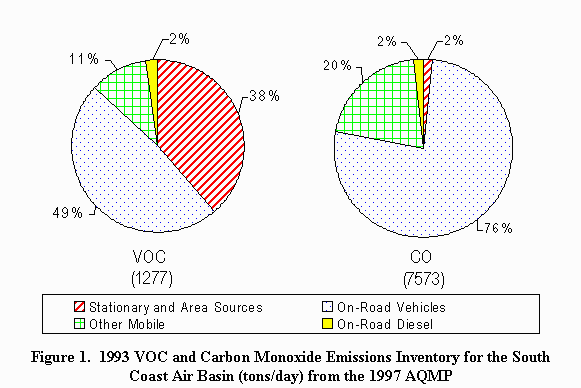
As shown in Figure 1, on-road diesel sources contribute about 2 percent to the total emissions inventories of VOC and carbon monoxide, respectively. Relative to carbon monoxide, staff projects that the federal carbon monoxide air quality standard would be achieved in the 2001- 2002 timeframe through natural vehicle turnover. Based on CARB’s EMFAC7G on-road mobile emissions estimation model, carbon monoxide emissions are projected to decrease by about 200 tons/day on a yearly basis. Staff analyzed the carbon monoxide emissions of the vehicles impacted by the fleet vehicle rules. It is estimated that of the approximately 138,000 light- and medium-duty diesel vehicles in the emissions inventory, about 1,000 light- and medium-duty diesel vehicles would be subject to Rule 1191. The 1,000 vehicles represent about 0.7 percent of the total light- and medium-duty diesel vehicle population or about 0.05 tons/day of carbon monoxide emissions. Based on the carbon monoxide emission levels shown in Table 3, gasoline and alternative-fueled engines could have about six times more carbon monoxide emissions compared to diesel engines. If all 1,000 diesel vehicles subject to Rule 1191 were to convert to gasoline or alternative-fueled vehicles, the carbon monoxide emissions would be about 0.30 tons/day.
Relative to heavy-duty vehicles impacted by the fleet vehicle rules, it is projected that up to 20,000 diesel vehicles out of an estimated 123,300 diesel vehicles could be impacted. About 20 tons/day of carbon monoxide emissions are associated with the 20,000 vehicles. If all of these vehicles are converted to alternative-fueled or gasoline vehicles, the estimated carbon monoxide emissions foregone is about 120 tons/day. This represents the maximum number of vehicles converted to alternative fuel usage. However, the fleet vehicle rules provides a significant number of exemptions that would allow for the purchase of diesel-powered vehicles. Therefore, the number of diesel vehicles actually impacted by the fleet vehicle rules would be much smaller than the 20,000 vehicles used in this analysis. In conclusion, by the time Rule 1191 and the other fleet vehicle rules begin implementation, it is expected that carbon monoxide emission levels would drop by another 200 to 400 tons/day. Therefore, the amount of carbon monoxide emission increase due to the implementation of the fleet vehicle rules would not hinder the progress towards achieving the federal carbon monoxide air quality standard.
Conclusion
With tighter regulations and the efforts of engine and vehicle manufacturers, and researchers, today’s diesel engines are much cleaner than when they were first regulated in 1960. However, diesel-powered MDVs are still emitting much more NOx and PM emissions than gasoline-, CNG-, and LPG-powered vehicles. In conclusion,
/ / /