 South Coast Air Quality Management District
South Coast Air Quality Management District
South Coast Air Quality Management District
BOARD MEETING DATE: December 21, 2001 AGENDA NO. 22
Report on Ambient Air Quality Evaluation to Determine Relative Contribution of Internal Combustion Engines Used for Manufacture of Snow or Operation of Ski Lifts to Potential PM2.5 Violations
SYNOPSIS:
Rule 1110.2 – Emissions from Gaseous- and Liquid-Fueled Engines, requires the Executive Officer to report to the Board by December 31, 1999 on the relative contribution of engines which operate for the manufacture of snow and/or operation of ski lifts to potential PM2.5 violations. The report was submitted and accepted by the Board in November 1999, at which time a resolution was adopted requiring the report to be updated every two years. The current report fulfills the update requirement.
COMMITTEE:
Not Applicable
RECOMMENDED ACTION:
Receive and file.
Barry R. Wallerstein, D. Env.
Executive Officer
Background
This report is an update to a report to the Board in November 1999 on the relative contribution of diesel engines which operate for the manufacture of snow and/or operation of ski lifts, to potential PM2.5 violations; it fulfills a requirement for an update to the original report every two years. This report is limited to PM2.5 ambient levels and does not address any other topics. The 1999 report concluded that the PM2.5 concentrations in the Big Bear area where the engines operate were well below the federal standards. Over the past two years, the concentrations have remained below the standards and no violations have occurred.
Rule 1110.2 – Emissions from Gaseous- and Liquid-fueled Internal Combustion Engines sets limits for oxides of nitrogen, carbon monoxide, and volatile organic compounds from internal combustion engines. A 1997 amendment to the rule exempted diesel engines used for snow manufacturing and ski lift operation in the Big Bear area. It also required a report to the Board on the relative contribution of these engines to potential PM2.5 violations. There are approximately 55 diesel engines ranging from 400 to 1400 brake horsepower operated by Bear Mountain Inc. and Snow Summit Inc. These engines typically operate from 12 to 24 hours per day, seven days per week during ski season (November 1 of one year through April 15 of the following year).
PM2.5 samples from a monitoring station near the ski areas were studied and a report to the Board was made in November 1999. While concentrations during the ski season were found to be slightly higher than in the off-season, it was noted that other factors must also be considered. Increased diesel truck and automobile traffic during the ski season and the use of wood-burning stoves and fireplaces during cold weather also produce PM2.5 emissions. The report concluded that PM2.5 concentrations in the area were below the National Ambient Air Quality Standard (NAAQS) for PM2.5 for both the 24-hour and the annual arithmetic mean. The report recommended no changes to Rule 1110.2, continued PM2.5 monitoring in the Big Bear area to assure compliance, and updates on the report to the Board every two years.
Current Status of PM2.5 Compliance in the Big Bear Area
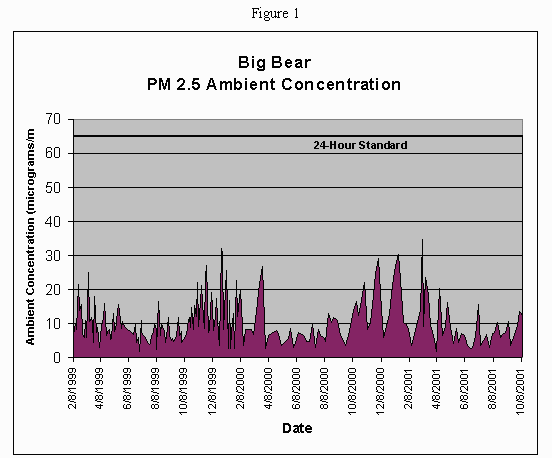
The 1999 report was based on analysis of PM2.5 samples from the Big Bear monitoring station located at the Big Bear Airport. The ski areas are located south and southeast of the airport within two to four miles of the monitoring station. The original report studied eight months of data because the sampling station was installed in early 1999. This update includes nearly three years of data, from February 1999 through October 2001. As with the original assessment, no violations of the federal 24-hour or annual arithmetic mean for PM2.5 were recorded. The highest concentration recorded at Big Bear was 34.68 micrograms per cubic meter (ìg/m3), and only four samples exceeded 30 ìg/m3, two in 1999 and two in 1999. All samples were well below the federal 24-hour standard of 65 ìg/m3. The arithmetic means at Big Bear for 1999 (11 months of data), 2000, and 2001 (10 months of data) were 10.3, 10.5, and 10.5, respectively. Again, these are below the annual arithmetic mean standard of 15 ìg/m3.
Figure 1 shows the PM2.5 ambient concentration at the Big Bear monitoring station from February 1999 through October 2001. The exemption for snow manufacturing/ski lift engines extends from November 1 of one year through April 15 of the following year. PM2.5 concentrations are somewhat higher during that period than during the off-season. However, as noted in the original report, many factors contribute to increased PM2.5 during the ski season, including internal combustion engines, increased truck and automobile traffic, and the use of wood-burning ovens and fireplaces in cold weather. The line at 65 ìg/m3 represents the NAAQS for PM2.5 over a 24-hour period. All readings during the sampling period are below the standard. (There is no state standard for PM2.5.)
Other Considerations
This report focuses on the PM2.5 emissions from the snow manufacture/ski lift diesel engines, and does not address any other compliance issues related to these engines or any pending regulations regarding diesel engines in general. There are a few other issues involving diesel engines which should be noted, however. The 1997 amendment to Rule 1110.2 is still under review by U.S. EPA. Pending the outcome of that review, additional changes to the rule may be required. CARB has classified diesel exhaust as a toxic air contaminant and is working on standards for all diesel-fueled internal combustion engines which will likely affect all diesel engines in the SCAQMD.
Conclusions
No PM2.5 exceedences of federal ambient air quality standards were found over the past three years in the Big Bear area. All 24-hour samples were below the federal standard and the yearly averages were also lower than the standard for annual arithmetic mean. Many factors contribute to increased PM2.5 concentrations during ski season, including internal combustion engines at ski resorts, increased truck and automobile traffic during the ski season, and the use of wood-burning stoves and fireplaces during cold weather. No violations of the PM2.5 standards were observed and no such violations are anticipated based on the sampling data.
Staff Recommendations
No change to Rule 1110.2 is recommended at this time based on continuing compliance with NAAQS for PM2.5 in the Big Bear area. Continued PM2.5 sampling is recommended to assure continued compliance in the area. Updates on this subject will be provided to the Board every two years, with the next report scheduled for 2003.
/ / /