 South Coast Air Quality Management District
South Coast Air Quality Management District
South Coast Air Quality Management District
BOARD MEETING DATE: December 21, 2001 AGENDA NO. 33
Adopt Rule 1178 - Further Reductions of VOC Emissions From Storage Tanks At Petroleum Facilities
SYNOPSIS:
Proposed Rule 1178 will further reduce evaporative VOC emissions from storage tanks at petroleum facilities with annual VOC emissions greater than 20 tons. Facilities subject to PR1178 will be required to upgrade rim seals and dome tanks that store higher vapor pressure materials; use vapor-tight pressure-vacuum vents; vent fixed roof tanks to vapor control or convert to internal or external floating roof tanks; and conduct a self-inspection/maintenance program to increase compliance. The proposal implements Control Measures FUG-03, portions of FUG-04 and phase I of FUG-05 of the 1999 AQMP Amendments.
COMMITTEE:
Stationary Source, October 26, 2001, and December 7, 2001, Reviewed
RECOMMENDED ACTION:
Adopt the attached resolution:
- Certifying the Final Environmental Assessment (EA) for Proposed Rule 1178 - Further Reductions of VOC Emissions From Storage Tanks At Petroleum Facilities; and
- Adopting Rule 1178 - Further Reductions of VOC Emissions from Storage Tanks At Petroleum Facilities.
Barry R. Wallerstein, D.Env.
Executive Officer
Background
In 1999, the AQMD settled a litigation initiated by three environmental organizations, the Natural Resources Defense Council (NRDC), the Coalition for Clean Air and Communities for a Better Environment (CBE) concerning implementation of the 1994 AQMP. The settlement agreement committed the AQMD to develop and implement several stationary source control measures. Three of these control measures are applicable to petroleum facilities and other fugitive VOC emission sources. The control measures are FUG-03 - Further Emission Reductions from Floating Roof Tanks, FUG-04 - Further Control of Emissions from Fugitive Sources, and FUG-05 - Further Emission Reductions from Large Fugitive VOC Sources. Specifically, FUG-05 calls for a three-phase rule development, starting in 2001, and achieving 3 tons per day emission reductions by 2008. Phase 1 should achieve at least1 ton per day emission reductions by 2006 as specified in the AQMP.
In an effort to support the implementation of the control measures, the settlement agreement specifically directed the AQMD to (1) conduct a study on emission inventories associated with tanks and pressure relief devices (PRDs) at the refineries; (2) review Bay Area AQMD amendments in December 1999 to Regulation 8 - Organic Compounds; Rule 5 - Storage of Organic Liquids; and (3) proceed with amendments to existing rules or development of new rules in the event the studies identify meaningful emission reduction potentials and technologically feasible and cost-effective controls.
AQMD staff worked closely with refineries and environmental organizations and developed two survey questionnaires in order to collect emission information associated with tanks and PRDs at the refineries. The first survey focused on information for storage tanks, and the second survey for PRDs. After carefully reviewing the information submitted as part of the tank survey and the Bay Area AQMD 1999 amendments to their storage tank rule, staff concluded that further emission reductions from storage tanks are technically feasible and cost effective and proceeded with rule development of PR1178.
Affected Facilities
PR1178 affects approximately 41 facilities including 11 petroleum refiners, 11 petroleum bulk terminals, 5 petroleum storage facilities, and 14 oil/gas production facilities located in Los Angeles, Orange, and San Bernardino counties. There are approximately 1,400 storage tanks at these 41 facilities with a total VOC emission inventory of 3.32 tons per day from the storage tanks.
Public Process
During the rulemaking process, AQMD staff formed a Refinery Working Group to develop PR1178. The Refinery Working Group included representatives of affected facilities, CARB, manufacturers of domed roofs, and the California Energy Commission. The Refinery Working Group met eight times during the course of the rule development process. AQMD staff had the opportunity to visit several refineries during the same time. A public workshop was held on September 5, 2001 and a consultation meeting was held on December 12, 2001.
Proposal
The primary objective of PR1178 is to further reduce VOC emissions from storage tanks, i.e external floating roof tanks, internal floating roof tanks and fixed roof tanks, at petroleum facilities. Following are the proposed rule requirements of PR1178.
Facilities with Annual Emissions > 20 tons for Emission Inventory Year 2000
|
— |
External Floating Roof Tanks Containing Materials With True Vapor Pressure (TVP) < 3psia |
|
|
By July 1, 2003, retrofit each deck opening with covers that are gasketed and/or bolted, and with sleeves and wipers; and retrofit each rim seal system with the best available rim seal system. The best available rim seal system is a liquid mounted or mechanical shoe primary seal and a rim mounted secondary seal. |
|
— |
External Floating Roof Tanks Containing Materials with TVP
|
|
|
By January 1, 2008, retrofit each tank with a domed roof and upgrade rim seal systems and deck fittings. |
|
— |
Internal Floating Roof Tanks |
|
|
When the tank is scheduled for emptying and degassing, but no later than January 1, 2007, retrofit each deck opening with covers that are gasketed and/or bolted, and with sleeves and wipers to further reduce evaporative losses. |
|
— |
Fixed Roof Tanks |
|
|
No later than January 1, 2007:
|
Facilities with Annual Emissions > 20 tons for Any Emission Inventory Year Subsequent to 2000
These facilities shall comply with the requirements for 1) external floating roof tanks containing materials with TVP < 3psia no later than one year after becoming subject to this rule, 2) domed external floating roof tanks no later than six years after becoming subject to this rule, and 3) internal floating roof tanks and fixed roof tanks no later than five years after becoming subject to this rule.
Monitoring
|
— |
External floating roof tanks containing materials with TVP < 3psia: Semiannually and each time the tank is emptied and degassed inspect the rim seal system and all roof openings. |
|
— |
Domed external floating roof tanks containing materials with TVP
|
|
— |
Fixed roof tanks: Perform quarterly monitoring of the pressure-vacuum vents using EPA Method 21. In addition, conduct an initial and annual performance tests to determine the overall efficiency of the emission control system and monitor and record applicable operating parameters on a weekly basis to ensure that the emission control system is achieving 95% overall control efficiency. |
Exemptions
Several exemptions are allowed in the rule. The most important exemptions are: 1) crude oil tanks shall be exempt from the doming requirements, 2) facilities that elect to obtain an emission cap equal to or less than 20 tons per year shall be exempt from the rule requirements, and 3) tanks with true vapor pressure limits less than 3 psia shall be exempt from the doming requirements.
PR1178 will result in 1.4 tons per day VOC reductions. The overall cost effectiveness of the proposed rule is estimated at $9,600 -$11,000 per tons per VOC emissions reduced.
Key Issues
Staff has worked diligently with the impacted industry and resolved most of the issues raised during the rule development process. However, there are two remaining issues that industry continues to express concern about: 1) the implementation schedule for installing domes on external floating roof tanks containing materials with TVP
 3psia and 2) the cost effectiveness of the rule.
Implementation Schedule
AQMD staff's initial proposal was a 3-year implementation plan: At least 1/3 of the tanks subject to this requirement at each facility was to be retrofitted each year starting July 1, 2002. By July 1, 2005, all 241 tanks, including crude oil tanks, were expected to be equipped with domed roofs to achieve 0.95 ton per day VOC reductions.
Based on comments received after the Public Workshop on September 5, 2001 from the affected facilities, AQMD staff modified the initial proposal to provide a 4-year implementation plan: At least 25% of the tanks was to be retrofitted by January 1, 2003; 50% by January 1, 2004; 75% by January 1, 2005; and 100% by January 1, 2006.
AQMD staff derived a 4-year implementation schedule based on the total tank capacity, installation turnaround time (approximately 30 days), and the availability of the dome manufacturers. However, comments were provided to staff that not all tanks are interchangeable, therefore staff analysis could not sufficiently reflect the capacity impacts based on product type.
In turn, industry proposed an 8-year implementation plan for the tanks to ease the potential supply concern. California Energy Commission (CEC) staff, with their contractor, performed a follow-up analysis for the 8-year scenario. They concluded that the installation of domes within 8 years was workable based on an average of 350,000 barrels of capacity removal.
AQMD staff believes that a 6-year implementation schedule is feasible. Such a schedule provides time at the front end for engineering and scheduling along with the potential removal of approximately 450,000 barrels, on average, of storage capacity. Such removal is feasible and would not cause disruption to product deliveries and refinery production during tank outages. The staff proposal represents an additional 100,000 barrels of capacity removed beyond the amount removed under the 8-year scenario. This is well within the historical market fluctuation. CEC’s analysis is reporting that during the previous five years, the available gasoline inventory in California has fluctuated between 8,000,000 to 16,000,000 barrels. The Los Angeles spot market for unleaded gasoline supply has experienced a plus or minus 1,000,000 barrel fluctuation in gasoline inventory during the last couple of years. It should also be noted that a 6-year implementation schedule would allow this rule to be fully implemented prior to 2008, the first year of the three-year period needed to demonstrate ozone compliance by 2010.
Industry has also argued for a longer compliance schedule claiming the short supply of dome vendors/contractors to fulfill the impacted facilities dome construction needs. Staff identified several manufacturers of domes; three of them specializing in aluminum domes. Manufacturers of aluminum domes informed AQMD staff that they have a current capacity to fabricate and install approximately 100 domes per year, which is expandable upon demand. Under the proposed compliance schedule, less than 33 tanks will have to be domed in any one of the six compliance years. Therefore, there is more than adequate fabrication and installation capability to fulfill industries’ demand for domes due to PR1178.
Cost Effectiveness Determination
Industry argued that the rule is not cost effective and that staff has underestimated the actual cost of the rule. Furthermore, industry argued that crude oil tanks and large diameter tanks should be exempt from the rule based on poor cost effectiveness. Staff has conducted a very detailed cost analysis that factors in the cost of all requirements of the rule including the cost of installing domes for each of the applicable tanks. Staff’s cost effectiveness analysis includes equipment cost, permit cost, project management cost, loss-of-use cost, annual maintenance cost, annual insurance and property taxes, annual emission savings, product savings, and inspection savings. Several refineries indicated that they need to install foam fire protection systems on domed roof tanks. Therefore, AQMD staff has provided two sets of cost effectiveness, one without the costs of installing foam fire protection system, and one with the costs of installing foam fire protection systems. The table below provides a summary of the tank count, emission reductions, and cost effectiveness associated with each group of tanks at petroleum facilities. While AQMD staff is proposing to exempt crude oil tanks due to unfavorable cost effectiveness (approximately $60,000 per ton), installing domes on the remaining tanks proposed under PR1178 appears to be cost effective. The industry has proposed to dome only tanks less than 95 feet in diameter and seek equivalent reductions from yet-to-be specified source categories.
|
Tank Size |
No of Tanks |
Estimated |
Cost Effectiveness |
Cost Effectiveness |
|
<95 ft |
57 |
0.23 |
3,556 to 5,126 |
4,591 to 7,735 |
|
95 - 144 ft |
113 |
0.58 |
7,686 to 9,310 |
10,161 to 10,788 |
|
>144 ft |
15 |
0.08 |
16,938 to 22,002 |
18,794 to 24,640 |
|
Overall |
185 |
0.89 |
9,144 |
11,332 |
Note: Crude oil tanks are proposed to be excluded from the doming requirements due to the high cost effectiveness factor which is in the range of $60,000 per ton. Tank count of 185 does not include 10 tanks at small refiners; currently some are not in operation. Ranges of cost effectiveness are provided for gasoline and other gasoline components.
AQMP and Legal Mandates
PR1178 will implement Control Measures FUG-03, portions of FUG-04 and phase I of FUG-05. Implementation of PR1178 will result in emission reductions that are needed to meet federal and state standards for ozone. At full implementation, PR1178 would result in a 42 percent emission reduction, achieving approximately 1.40 tons per day of VOC emission reductions. The settlement agreement and AQMP call for 1 ton per day of VOC reduction by 2006. A 6-year implementation plan would achieve a 1.04 ton per day reduction by 2006. In addition, any emission reduction achieved beyond 2006 requires an infeasibility finding.
As discussed in the Implementation Schedule, the compliance schedule for doming the external floating roof tanks that store liquids with a vapor pressure equal to or greater than 3 psia has been extended to beyond 2006. Doming of all applicable external floating roof tanks by 2006 is not technologically feasible since the construction of the domes will necessitate the removal of these tanks from service during construction. Since we do not foresee any technological advances to install domes without removing the tank from service or installing domes in a shorter timeframe, staff is proposing to extend the implementation schedule beyond 2006.
California Environmental Quality Act
Pursuant to California Environmental Quality Act (CEQA) Guidelines §15252 and AQMD Rule 110, the AQMD has prepared an Environmental Assessment (EA) for PR1178. The Draft EA identified NOx emissions from construction activities as a potential significant adverse impact that cannot be mitigated below significance. Three comment letters were received on the Draft EA, which was released for a 45-day public review and comment period. Responses to the comments are included in the Final EA, included as Attachment H of this Governing Board package.
Socioeconomic Analysis
The proposed rule will affect 11 refineries and 30 non-refinery facilities. The non-refinery facilities belong to the industries of crude petroleum and natural gas, special warehousing and storage, refined petroleum pipelines, and petroleum bulk stations & terminals. The proposed rule requirements may include upgrade of rim seal systems, the installation of gaskets and seals on guidepoles and other fittings, ensuring vapor-tight conditions on all openings, domed roofs, and pressure-vacuum vents. The total annualized cost of the proposal that included the requirement to dome the crude oil tanks was projected to be $8.2 million. Exempting the crude oil tanks from the doming requirement will further reduce these costs by 10 to 25% depending on whether a fire suppression system is needed or not. Refineries will incur the majority of the cost. The proposed rule is projected to result in 42 jobs forgone annually in the entire four-county economy. It is estimated that implementation of the proposed requirements will impact product prices by less than three hundredth of one percent in any given industry and year within the four-county area.
Implementation and Resources
To facilitate implementation uniformity, the provisions for recordkeeping, reporting, and self-inspection for PR1178 are designed in a similar fashion to AQMD Rule 463 and Title V. It is expected that there will be a temporary workload increase due to applications submitted for retrofitting external floating roof tanks with domes. No additional AQMD resources are required to implement the proposed amendments.
ATTACHMENT A - SUMMARY OF PROPOSAL
|
PR1178 – Further Reductions of VOC Emissions From Storage Tanks |
|
— External Floating Roof Tanks (EFRTs) Containing Materials with TVP
Internal Floating Roof Tanks (IFRTs) — Fixed Roof Tanks Facilities with Annual Emissions >20 tons for Any Emission Inventory Year Subsequent to 2000 Monitoring — For EFRTs containing materials with TVP < 3psia: Inspect rim seals and all roof openings semiannually and each time the tank is emptied and degassed. — For domed tanks and IFRTs: 1) visually inspect rim seals and roof openings and measure the LELs semiannually; and 2) perform a complete inspection of rim seals and roof openings each time the tank is emptied and degassed but no less than once every ten years. — For fixed roof tanks: 1) quarterly monitor pressure vacuum vents; 2) conduct initial and subsequent annual testing, and 3) weekly monitor applicable operating parameters to ensure that the add-on control system meets 95% overall control efficiency. Exemption The most important exemptions are 1) exempt crude oil tanks from doming requirements, 2) exempt facilities with an annual emission cap
|
ATTACHMENT B
RULE DEVELOPMENT PROCESS
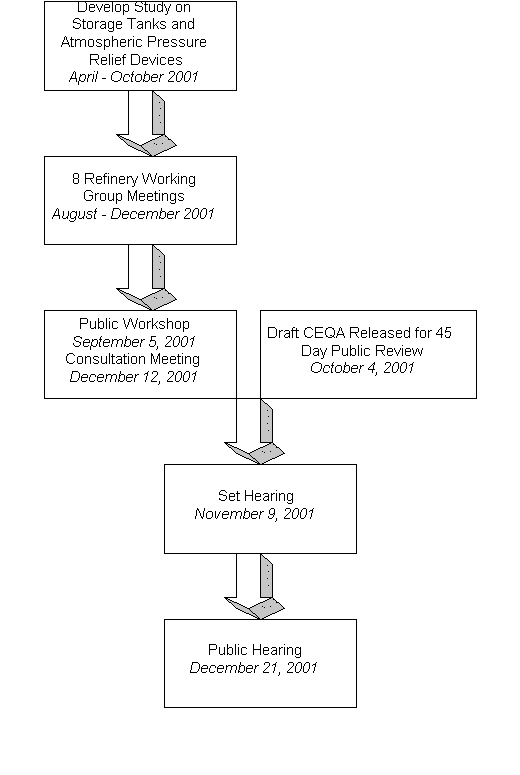
Total Time Spent in Rule Development: 9 months
ATTACHMENT C
KEY CONTACTS LIST
|
Affected Facilities |
|
|
BP Arco |
Chevron Products Co. |
|
Equilon Enterprises, LLC |
Exxon Mobil |
|
Edgington Oil |
Cenco |
|
Ultramar |
Tosco Refining Co. |
|
Paramount Petroleum Corp. |
Kinder Morgan (GATX) |
|
Valero Wilmington Asphalt Plt. |
SFPP, LLP. |
|
Chemoil Terminals Corp. |
Berry Petroleum Co. |
|
AERA Energy |
Medallion California Properties |
|
Petro Diamond |
Signal Hill Petroleum |
|
Global Oil Co. |
Stocker Resources Inc. |
|
Saba Petroleum |
Torch Operating Co. |
|
The Termo Co. |
Westway Terminal Co. |
| Domed Roof Manufacturers | |
| Temcor | |
| Conservatek | |
| Ultraflote | |
| Others | |
|
California Energy Commission |
|
|
California Independent Petroleum Association |
|
|
Western States Petroleum Association |
|
|
Western Independent Refiners Association |
|
|
HMT Inc. |
|
|
TARSCO |
|
RESOLUTION NO. 2001-xx
A Resolution of the South Coast Air Quality Management District Governing Board (Governing Board) certifying the Final Environmental Assessment for Proposed Rule 1178 – Further Reductions of VOC Emissions From Storage Tanks At Petroleum Facilities.
A Resolution of the Governing Board adopting Rule 1178 – Further Reductions of VOC Emissions From Storage Tanks At Petroleum Facilities.
WHEREAS, the AQMD Board has determined with certainty that Proposed Rule 1178 – Further Reductions of VOC Emissions From Storage Tanks At Petroleum Facilities, is a "project" pursuant to the terms of the California Environmental Quality Act (CEQA); and
WHEREAS, the AQMD has had its regulatory program certified pursuant to Public Resources Code §21080.5 and has conducted CEQA review pursuant to such program (AQMD Rule 110); and
WHEREAS, AQMD staff has prepared a Draft Environmental Assessment (EA) pursuant to its certified regulatory program and state CEQA Guidelines §15252 setting forth the potential environmental consequences of Proposed Rule 1178 – Further Reductions of VOC Emissions From Storage Tanks At Petroleum Facilities; and
WHEREAS, the Draft EA was circulated for public review, comments received were responded to, and a Final EA has been prepared; and
WHEREAS, the adequacy of the Final EA, including responses to comments, has been determined by the AQMD Governing Board prior to its certification; and
WHEREAS, it is necessary that the AQMD prepare a Statement of Findings and Statement of Overriding Considerations pursuant to state CEQA Guidelines Section 15091 and 15093, respectively, regarding adverse environmental impacts that cannot be mitigated to insignificance; and a Mitigation Monitoring Plan pursuant to Public Resources Code Section 21081.6, regarding the mitigation included in the Final EA; and
WHEREAS, the AQMD Board voting on Proposed Rule 1178 – Further Reductions of VOC Emissions From Storage Tanks at Petroleum Facilities, has reviewed, considered, and hereby certifies the Final EA and approves the Statement of Findings, the Statement of Overriding Considerations, and the Mitigation Monitoring Plan; and
WHEREAS, the AQMD Board has determined that the Socioeconomic Impact Assessment of the Proposed Rule 1178 – Further Reductions of VOC Emissions From Storage Tanks At Petroleum Facilities, is consistent with the Governing Board March 17, 1989 and October 14, 1994 resolutions and the provisions of Health and Safety Code Sections 40440.8, 40728.5 and 40920.6; and
WHEREAS, the AQMD Board has determined that the Proposed Rule 1178 – Further Reductions of VOC Emissions From Storage Tanks At Petroleum Facilities, will result in increased costs to industry, yet is considered cost-effective with a cost-effectiveness as described in the Socioeconomic Impact Assessment and Staff Report; and
WHEREAS, the AQMD Board has actively considered the Socioeconomic Impact Assessment and has made a good faith effort to minimize such impacts; and
WHEREAS, the AQMD Board has reviewed and considered the staff's findings related to cost and employment impacts of the Proposed Rule 1178 – Further Reductions of VOC Emissions From Storage Tanks At Petroleum Facilities set forth in the Socioeconomic Impact Assessment made public with the agenda package for this meeting, and hereby find and determines that cost and employment impacts are as set forth in that assessment; and
WHEREAS, the AQMD Board has determined that a need exists to adopt the Proposed Rule 1178 – Further Reductions of VOC Emissions From Storage Tanks At Petroleum Facilities to implement the SIP Settlement Agreement and Control Measures FUG-03, FUG-05 and portions of FUG-04 of the Amendments to the 1999 AQMP to reduce VOC from storage tanks at petroleum facilities and to achieve federal PM10 and ozone standards in 2006 and 2010 respectively; and
WHEREAS, the AQMD Board has determined that doming all external floating roof tanks containing organic liquids equal to or greater than 3 psia is not technologically feasible without significant advances in onsite construction methods to minimize the amount of time the impacted tanks are taken out service; and
WHEREAS, the AQMD Board of the South Coast Air Quality Management District obtains its authority to adopt this proposed rule referencing to Sections 40000, 40001, 40440, and 40727 of the California Health and Safety Code; and
WHEREAS, the AQMD Board has determined that Proposed Rule 1178 – Further Reductions of VOC Emissions From Storage Tanks At Petroleum Facilities, as proposed to be adopted is written or displayed so that its meaning can be easily understood by the persons directly affected by it; and
WHEREAS, the AQMD Board has determined that Proposed Rule 1178 – Further Reductions of VOC Emissions From Storage Tanks At Petroleum Facilities, as proposed to be adopted is in harmony with, and not in conflict with or contradictory to, existing federal or state statutes, court decisions, or regulations; and
WHEREAS, the AQMD Board has determined that Proposed Rule 1178 – Further Reductions of VOC Emissions From Storage Tanks At Petroleum Facilities, as proposed to be adopted does not impose the same requirements as any existing state or federal regulation and the proposed rule is necessary and proper to execute the powers and duties granted to, and imposed upon, the District; and
WHEREAS, the AQMD Board has determined that Proposed Rule 1178 – Further Reductions of VOC Emissions From Storage Tanks At Petroleum Facilities, as proposed to be adopted, references the following statutes which the AQMD hereby implements, interprets or makes specific: Title 42 U.S.C. Section 7411 (performance standards for new stationary sources); Health and Safety Code 40001(a) and (b) (air quality standards and air pollution episodes); 40702 (adoption of rules and regulations), and 40440 (rules and regulations retrofit control technology); and
WHEREAS, a public hearing has been properly noticed in accordance with the provisions of Health and Safety Code Section 40725; and
WHEREAS, the AQMD Board has held a public hearing in accordance with all provisions of law; and
WHEREAS, the AQMD Board directs staff to form a working group comprised of representatives from the petroleum industry subject to Proposed Rule 1178 to explore the development of an alternative compliance mechanism that results in equivalent level of emission reductions to those generated through the installation of domes and report back to the AQMD Board no later than January 1, 2003; and
NOW, THEREFORE, BE IT RESOLVED, that the AQMD Board hereby certifies, pursuant to the authority granted by law, the Final EA for Proposed Rule 1178 – Further Reductions of VOC Emissions From Storage Tanks at Petroleum Facilities.
BE IT FURTHER RESOLVED, that the AQMD Board hereby approves the Statement of Findings and Statement of Overriding Considerations pursuant to state CEQA Guidelines Sections 15091 and 15093, respectively, regarding adverse environmental impacts that cannot be mitigated to insignificance; and the Mitigation Monitoring Plan pursuant to Public Resources Code Section 21081.6, regarding the mitigation included in the Final EA, which are included in Attachment 1, attached and incorporated herein by reference.
BE IT FURTHER RESOLVED, that the AQMD Board does hereby adopt, pursuant to the authority granted by law, Proposed Rule 1178 – Further Reductions of VOC Emissions From Storage Tanks At Petroleum Facilities, as set forth in the attached and incorporated herein by reference.
_____________
________________________________
Date
Clerk of the District Board
/ / /
 20 tons from the rule, and 3) exempt tanks with TVP limits < 3psia from the doming requirements.