 South Coast Air Quality Management District
South Coast Air Quality Management District
South Coast Air Quality Management District
BOARD MEETING DATE: December 21, 2001 AGENDA NO. 34
Amend Rule 518.2 – Federal Alternative Operating Conditions
SYNOPSIS:
Rule 518.2 provides a mechanism for EPA to recognize and approve variances issued under state law. Without Rule 518.2, facilities may be subject to federal or citizen enforcement even though they have received a variance. Rule 518.2 was designed to allow Title V facilities to obtain Alternative Operating Conditions granted by the Hearing Board, which will shield them from federal and citizen enforcement under circumstances where they are entitled to a variance under state law. On December 17, 1999, EPA proposed disapproval of Rule 518.2 citing several concerns, including equivalent/contemporaneous emission reductions, alternative operating scenarios (variances), and Lowest Achievable Emission Reduction (LAER) requirements. The Home Rule Advisory Group and AQMD staff have worked with EPA to resolve these issues. Proposed Amended Rule 518.2 addresses these concerns.
COMMITTEE:
Stationary Source, October 26, 2001, Reviewed
RECOMMENDED ACTION:
Adopt the attached resolution:
- Certifying the attached Notice of Exemption, and
- Amending Rule 518.2 – Federal Alternative Operating Conditions.
Barry R. Wallerstein, D.Env.
Executive Officer
Background
State law provides that a person subject to rules of a local air pollution control district may apply to the AQMD’s Hearing Board for a variance from applicable rules. A variance may only be issued if the Hearing Board finds that noncompliance is "due to conditions beyond the reasonable control" of the source, and that requiring compliance would result in either an arbitrary or unreasonable taking of property or the practical closing and elimination of a lawful business. Variances are commonly sought for breakdowns, malfunctions, and inability to comply with deadlines in "technology-forcing" rules. Variances are allowed under state law and protect a source from enforcement through civil or criminal actions. However, they do not protect a source from actions by EPA or citizens pursuant to the federal Clean Air Act (CAA). In order to protect against EPA or citizen enforcement, a variance must be approved by EPA.
When the AQMD developed its Title V program rules, adopted in October 1993, a variance rule was included in the program. EPA stated that including the variance rule would prevent EPA approval of the AQMD’s Title V program. If AQMD’s Title V program were disapproved, EPA would be required to step in and implement a Title V program itself. Therefore, AQMD agreed to program approval without the variance rule.
Public/Rule Development Process
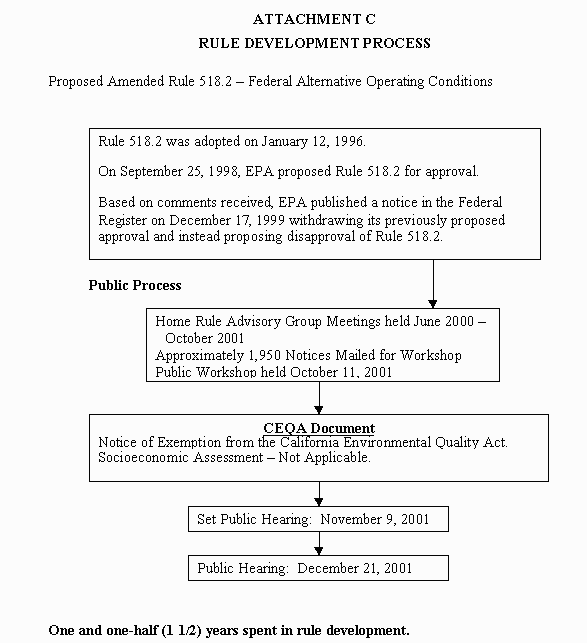
Rule 518.2 was designed to allow Title V facilities to obtain Alternative Operating Conditions granted by the Hearing Board, which would shield them from federal and citizen enforcement under circumstances where they are entitled to a variance under state law. In developing Rule 518.2, AQMD worked closely with EPA, industry, local government, and environmental group representatives. EPA participated fully in the development of the rule and sent letters of support to AQMD. The rule was adopted by the AQMD on January 12, 1996, and forwarded to EPA. EPA originally proposed approval of Rule 518.2, but reversed its position and proposed disapproval after receiving two unfavorable comments, both from environmental groups outside the AQMD’s jurisdiction.
As a result of EPA’s proposed disapproval of Rule 518.2, the Home Rule Advisory Group and AQMD staff initiated negotiations with EPA in an attempt to resolve the concerns raised by EPA. This group participated in an extensive year-and-a-half discussion process. Proposed Amended Rule 518.2 now addresses each of EPA’s concerns identified in the proposed disapproval. EPA has indicated support for the proposed amended rule. The rule would become effective once it is approved into the SIP by EPA. Under a previous agreement, this would occur within six months of submittal of the rule to EPA by AQMD.
Staff conducted a Public Workshop on October 11, 2001. Most comments were requests for clarifications on the proposal. However, one issue was raised as to the possibility of short-term transfers of emission reduction credits (ERCs) between facilities. Two comment letters were received, one reiterating comments made at the workshop and the second, a letter of "no comment" from the California Air Resources Board.
Proposal
EPA raised several issues in its proposed disapproval of Rule 518.2. Most of EPA’s concerns have been addressed by modifying the rule to provide that any excess emissions resulting from an Alternative Operating Condition (AOC) would be fully offset by contemporaneous emission reductions.
Other amendments to address EPA’s concerns include: 1) incorporating into the rule the state law prohibition on AOCs which result in a public nuisance; 2) specifying additional criteria for approval of AOCs which are necessary because of a breakdown in technology; and 3) prohibiting AOCs which would allow a violation of best available control technology (BACT) or lowest achievable emission rate (LAER), except in the case of emergency or breakdown of technology. Several definitions are proposed to be added to the rule to support the amendments.
EPA’s first issue with Rule 518.2, as originally adopted, was that Section 193 of the federal Clean Air Act provides that no rule in effect prior to the 1990 Amendments may be modified unless the modification ensures equivalent or greater reductions. To ensure that this requirement was met, the proposed amended rule requires any excess emissions resulting from a variance to be fully offset by an actual emission reduction credit or other type of reduction approved by EPA. The proposed amended rule allows three ways to offset excess emissions: 1) alternative operating condition credits (mobile and area source credits generated by the new credit generation rules), 2) emission reduction credits generated pursuant to Rule 1306, or 3) intra-facility offsets.
The second issue was that the criteria for obtaining an AOC should match the requirements of EPA’s Excess Emissions Policy. This, however, would not allow AOCs for situations where anticipated technology failed to develop. The issue was resolved by EPA agreeing that the proposed rule could be used to resolve problems implementing technology-forcing rules and by AQMD adding additional criteria for issuing an AOC for a technology breakdown.
The third issue was EPA’s concern that Rule 518.2 would allow a source to violate the CAA requirement for new or modified major sources to use technology resulting in the lowest achievable emission rate. The issue was resolved by specifying that no AOC may be granted from the BACT/LAER requirement, except in the case of emergency or breakdown of technology with "emergency" being defined the same as in EPA Title V regulations.
The fourth issue was EPA’s concern that Rule 518.2 did not require offsets when major sources exceeded NSR caps. Although most sources obtaining variances are not likely to exceed their NSR caps, the proposed amendments require any excess emissions under an AOC to be offset by EPA-approved credits or reductions regardless of the NSR offset threshold.
The fifth issue was an EPA interpretation of Title V regulations that a Title V permit could not allow a facility to receive a federally-recognized variance unless the facility made up for any excess emissions by obtaining emission reductions from that same facility. As a practical matter, very few facilities would be able to provide offsetting emission reductions from within the same facility. EPA agreed to allow the excess emission to be offset by reductions from other sources.
The sixth issue was a concern raised by a San Diego environmental group regarding environmental justice. Their concern was that Rule 518.2 would allow sources to exceed their otherwise-applicable emission limits, and the sources may tend to be located in low-income or minority areas. State law already contains a prohibition against variances which would result in a public nuisance. EPA agreed that this would adequately address the issue, but wanted it in Rule 518.2 so it would be federally enforceable. This provision has been added to the proposed amended rule.
The final EPA issue was a concern with toxics. Rule 518.2 provided that an AOC may not be granted from any federally-promulgated rule, regulation, or permit condition. EPA pointed out that under Section 112(l) of the Clean Air Act, EPA is authorized to approve locally adopted air toxics rules as substitutes for federal air toxics rules where local rules are found to be equivalent. EPA wanted to ensure that no AOC could be granted from a locally-adopted substitute rule which had been approved by EPA. A prohibition has been added to the proposed amended rule to resolve this issue.
Key Issues
The issues discussed above were identified by EPA relative to their proposed disapproval of Rule 518.2. All of the issues addressed during rule development have been resolved under the proposed amended rule. They include:
One issue raised during the Public Workshop remains. That is the need for some mechanism for the short-term transfer of emission reduction credits to be used as offsets during the term of an alternative operating condition. The rule allows ERCs to be used for this purpose so long as they have not expired. Staff has discussed this issue with EPA and is continuing to work with EPA and interested parties on development and implementation of such a mechanism.
California Environmental Quality Act (CEQA)
The AQMD has reviewed the proposed project pursuant to state CEQA Guidelines §15002(k)(1). The proposed amendments to Rule 518.2 will involve some administrative changes, thus no effect on emissions, and since it can be seen with certainty that there is no possibility that the proposed project in question has the potential to have a significant adverse effect on the environment, the proposal is exempt from CEQA pursuant to CEQA Guidelines Section 15061(b)(3) - Review for Exemption. A Notice of Exemption, in accordance with CEQA Guidelines Section 15062, has been prepared for the proposed project and will be filed with the county clerks immediately following the adoption of the proposed amendments to the rule.
Socioeconomic Assessment
Proposed Amended Rule 518.2 is an administrative rule. The rule is not a control measure in the 1997 Air Quality Management Plan (AQMP) and thus, was not ranked by cost-effectiveness relative to other AQMP control measures in the 1997 AQMP. Although Rule 518.2, as proposed for amendment, would ensure equivalent and contemporaneous emission reductions relative to emissions allowed under the alternative operating conditions, cost-effectiveness in terms of dollars per ton of pollutant reduced is not applicable. This likewise applies to Health and Safety Code Section 40920.6, which requires an incremental cost-effectiveness analysis when there is more than one control option which would achieve the emission reduction objective of the proposed amendments, relative to ozone, CO, SOx, NOx, and their precursors. Since the proposed amendments to Rule 518.2 are relative to administrative requirements for approving variances, the incremental cost-effectiveness analysis requirement does not apply.
Resource Impacts
A tracking system will need to be developed per the rule to facilitate accounting of AOC credits coming into and leaving the AOC Credit Bank and for tracking ERCs used for AOC offsets. This tracking system will provide the data necessary for the annual audit required under the rule. Development of the necessary computer programs may entail some additional costs to be determined. Also, the Hearing Board will have to consider additional information to determine that all criteria for AOCs are met. Existing resources are sufficient to accommodate these impacts.
Summary of Proposal
Key Issues and Responses
Rule Development Process
Key Contacts List
Resolution
Proposed Rule Language
Staff Report
Notice of Exemption
|
Proposed Amended Rule 518.2 – Federal Alternative Operating Conditions |
|
The proposed amendments to Rule 518.2 include:
|
|
Proposed Amended Rule 518.2 – Federal Alternative Operating Conditions |
|
There were several issues that prevented EPA from approving the Proposed Rule 518.2 amendments. The Home Rule Advisory Group and AQMD staff have worked with EPA to resolve these issues and EPA has indicated support for the proposed amendments. Following is a list of EPA’s issues:
Most of EPA’s concerns were addressed by modifying the rule to provide that any excess emissions resulting from an Alternative Operating Condition (AOC) would be fully offset by contemporaneous emission reductions generated under EPA-approved programs. Other amendments to address the concerns include: 1) incorporating into the rule the state law prohibition on AOCs which result in a public nuisance; 2) specifying additional criteria for approval of AOCs which are necessary because of a breakdown in technology; and 3) prohibiting AOCs which would allow a violation of lowest achievable emission rate (LAER) or best available control technology (BACT), except in the case of emergency or breakdown of technology. One additional issue was raised during the Public Workshop. That is the need for some mechanism for the short-term transfer of emission reduction credits to be used as offsets during the term of an alternative operating condition. The rule allows ERCs to be used for this purpose so long as they have not expired. Staff has discussed this issue with EPA and is continuing to work with EPA and interested parties on development and implementation of such a mechanism. |
ATTACHMENT D
KEY CONTACTS LIST
Home Rule Advisory Group
U.S. Environmental Protection Agency
California Air Resources Board
RESOLUTION NO. 01-XX
A Resolution of the Governing Board of the South Coast Air Quality Management District (AQMD) certifying that Proposed Amended Rule 518.2 – Federal Alternative Operating Conditions is exempt from the requirements of the California Environmental Quality Act (CEQA).
A Resolution of the AQMD Governing Board amending Rule 518.2 – Federal Alternative Operating Conditions.
WHEREAS, AQMD staff has conducted a public consultation meeting regarding the proposed amendments to Rule 518.2; and.
WHEREAS, AQMD staff reviewed the proposed project and determined that it is exempt from the requirements of the California Environmental Quality Act (CEQA); and
WHEREAS, California Health and Safety Code Section 40727 requires that prior to adopting, amending or repealing a rule or regulation, the AQMD Governing Board shall make findings of necessity, authority, clarity, consistency, non-duplication, and reference based on relevant information presented at the public hearing and in the staff report; and
WHEREAS, the AQMD Governing Board has determined that a need exists to amend Rule 518.2 - Federal Alternative Operating Conditions; and
WHEREAS, the AQMD Governing Board obtains its authority to adopt, amend, or repeal rules and regulations from Sections 39002, 40000, 40001, 40440, and 40702 of the California Health and Safety Code; and
WHEREAS, the AQMD Governing Board has determined that Rule 518.2 - Federal Alternative Operating Conditions is written and displayed so that the meaning can be easily understood by persons directly affected by it; and
WHEREAS, the AQMD Governing Board has determined that Rule 518.2 - Federal Alternative Operating Conditions as proposed to be amended, is in harmony with, and not in conflict with, or contradictory to, existing statutes, court decisions, or state or federal regulations; and
WHEREAS, the AQMD Governing Board has determined that Rule 518.2 - Federal Alternative Operating Conditions does not impose the same requirement as any existing state or federal regulation, and the proposed amended rule is necessary and proper to execute the powers and duties granted to, and imposed upon, the AQMD; and
WHEREAS, the AQMD Governing Board has determined that Section 40727.2 of the Health and Safety code is not applicable because the amended rule does not impose or make more stringent any emission limit, or monitoring, reporting, and recordkeeping requirement; and
WHEREAS, the AQMD Governing Board has determined that a socioeconomic impact assessment is not required under state law, because the proposed amendments are administrative in nature and do not impose any additional mandatory requirements on affected sources; and
WHEREAS, a public hearing has been properly noticed in accordance with all provisions of Health and Safety Code Section 40725; and
WHEREAS, the AQMD Governing Board has held a public hearing in accordance with all provisions of law; and
WHEREAS, the AQMD specifies the Manager of Rule 518.2 as the custodian of the documents or other materials which constitute the record of proceedings upon which the adoption of this proposed amendment is based, which are located at the South Coast Air Quality Management District, 21865 E. Copley Drive, Diamond Bar, California.
NOW, THEREFORE BE IT RESOLVED that the AQMD Governing Board does hereby certify the Notice of Exemption for Proposed Amended 518.2 - Federal Alternative Operating Conditions, completed in compliance with state CEQA Guidelines Sections 15002(k)(1), 15061(b)(3), and 15062, and that it has been presented to the Governing Board, whose members reviewed, considered, and approved the information therein prior to acting on Proposed Amended 518.2 - Federal Alternative Operating Conditions; and
BE IT FURTHER RESOLVED, that the AQMD Governing Board hereby amends, pursuant to the authority granted by law, Rule 518.2 - Federal Alternative Operating Conditions, as set forth in the attached, and incorporated herein by this reference.
Attachments
DATE:_____________
______________________________
CLERK OF THE BOARD
/ / /