 South Coast Air Quality Management District
South Coast Air Quality Management District
South Coast Air Quality Management District
BOARD MEETING DATE: December 21, 2001 AGENDA NO. 35
Amend Rule 444 - Open Burning
Amend Rule 208 - Permit and Burn Authorization for Open Burning
SYNOPSIS:
Proposed amendments to Rule 444 - Open Burning address issues of limited disapproval by U.S. EPA, incorporate the Smoke Management Guideline requirements of recently amended California Code of Regulations, Title 17, clarify requirements for certain burn activities and implement 1999 AQMP Control Measure WST-03. The proposed amendment to Rule 208 - Permit and Burn Authorization for Open Burning is for consistency with Proposed Rule 444 -Open Burning.
COMMITTEE:
Mobile Source, October 26, 2001; Stationary Source, October 26, 2001, Reviewed
RECOMMENDED ACTION:
Adopt the attached Resolution:
- Certifying the Notice of Exemption from CEQA for Rule 444 - Open Burning and Rule 208 - Permit and Burn Authorization for Open Burning; and
- Amending Rule 444 - Open Burning and Rule 208 - Permit and Authorization for Open Burning.
Barry R. Wallerstein, D.Env.
Executive Officer
Background
Rule 444 - Open Burning (previously "Open Fires") defines the scope and extent of the AQMD’s open burning program. On October 7, 1987, the Board amended Rule 444 to incorporate the newly adopted vegetative management burning requirements of California Code of Regulations, Title 17. The Rule was submitted to CARB which incorporated its provisions as part of the California State Implementation Plan (SIP) and then forwarded it to EPA. Rule 208 - Permit and Burn Authorization for Open Burning (previously "Permit for Open Burning") is the companion rule to Rule 444 that provided the requirement for burners to obtain permits to burn. Over the past two years, three major issues have arisen that directly address the need to amend Rule 444 and with it Rule 208.
As noticed in the Federal Register, Vol. 65, No. 144, Wednesday, July 26, 2000, EPA determined that Rule 444 was deficient in that it did not meet the requirement of Reasonably Achievable Control Measures (RACM) for prescribed burning because the rule did not base approval of a burn on an evaluation of the airshed's capacity to disperse PM10 emissions from all types of open burning. The ruling further cited the lack of incentives to both encourage burner training and implement emission reduction techniques. While the meteorological criteria and air quality restrictions identified in Title 17 and Rule 444 provide a framework for estimating PM10 pollution carrying capacity, specific acreage limits and criteria for authorizing burn priority are absent. EPA's notice of limited disapproval set forth a sanction clock that requires the AQMD to address the deficiencies in Rule 444 by January 2002.
Second, the 1997 revision to the AQMP identified Control Measure WST-03 as a means of controlling precursor emissions of ozone and direct emissions of PM10 on days when the 1-hour California ozone air quality standard was predicted to be exceeded. The design of the control measure was to shift emissions from burning activities to days that have more favorable dispersion. No net annual emissions reductions were envisioned from the implementation of the control measure. The 1999 revision to the AQMP reaffirmed WST-03 as a viable control measure and targeted October of 2002 as a proposed implementation period.
The third major issue addressing the need to amend Rule 444 is the recently approved revision to the California Code of Regulations Title 17, Smoke Management Guidelines for Agricultural and Prescribed Burning. At its March 14, 2000 meeting, CARB revised Title 17 to provide statewide guidance to air districts to develop and enhance programs to manage smoke from open fires. While Rule 444 addresses the general scope of revised Title 17, selected requirements, such as defining the timing of the burn window for field crops, needed to be specified in the rule.
Finally, amendments to Rule 444 are needed to clarify rule applicability, delineate AQMD open burning policy not explicitly stated in rule language and make the rule consistent with the current AQMD format.
The proposed amendments to Rule 208 are needed to clarify the permitting responsibility and to explicitly define the requirement to have daily burn authorization.
Proposal
The staff proposes to amend Rule 444 as follows:
Furthermore, staff proposes to amend Rule 208 as follows:
The proposed amendments to Rule 444 and Rule 208 do not have a significant impact on annual emissions. The proposed amendments to Rule 444 will shift precursor emissions of ozone from days having poor dispersion to days not predicted to exceed the California 1-hour ozone standard (0.09 ppm).
The proposed amendments to Rule 444 will provide a nominal reduction in particulate emissions through the implementation of smoke management plans and encouragement to use alternatives to burning where applicable. However, the implementation of these smoke reduction techniques is dependent upon the actual methods used for each burn, the number of burns and potential obstacles encountered in the field but not identified in the smoke management plan; thus, it is not possible to quantify the net annual tonnage of particulate emissions reduced. Because of this uncertainty, no net annual reductions of particulate emissions will be claimed for SIP purposes.
California Environmental Quality Act (CEQA) and Socioeconomic Assessment
Pursuant to the California Environmental Quality Act (CEQA) Guidelines, AQMD is the Lead Agency. The AQMD has reviewed the proposed project pursuant to the CEQA Guidelines §15002 (k)(1), and has determined that the proposed project has no potential to adversely impact air quality or any other environmental area. Staff concluded that the proposed project is exempt from CEQA pursuant to state CEQA Guidelines Section 15061(b)(3) - Review for Exemption.
A Notice of Exemption has been prepared pursuant to state CEQA Guidelines Section 15062 - Notice of Exemption. The Notice of Exemption will be filed with the county clerks of Los Angeles, Orange, Riverside and San Bernardino counties immediately following the adoption of the proposed project.
The AQMD has conducted a Socioeconomic Impact Assessment (included as part of the Staff Report) concluding that only minor cost impacts would result to agricultural operations.
AQMP and Legal Mandates
The proposed amendments to Rule 444 address EPA's limited rule disapproval, implement 1999 AQMP Control Measure WST-03, and implement selected requirements specified in the California Code of Regulations, Title 17. The proposed amendments to Rule 208 are administrative and are not a result of any legal mandates.
Resource Impacts
Implementation of the proposed amendments is not expected to have any additional impacts on AQMD staff or fiscal resources.
SUMMARY OF PROPOSED AMENDMENTS
Proposed Amended Rule 444
Proposed Amended Rule 208
ATTACHMENT B
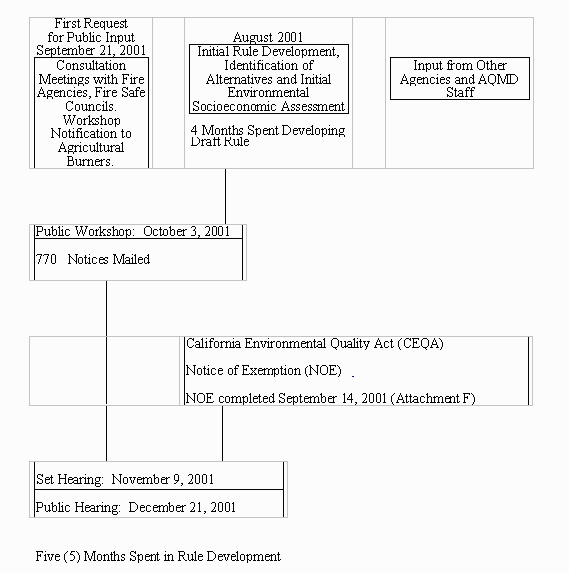
RULE DEVELOPMENT PROCESS
Proposed Amended Rule 444 - Open Burning
Proposed Amended Rule 208 - Permit and Burn Authorization for Open Burning
ATTACHMENT C
KEY CONTACTS
Government Agencies
California Air Resources Board
U.S. Environmental Protection Agency
California Department of Forestry and Fire Protection
U.S. Department of Agriculture, Angeles National Forest
Los Angeles County Fire Department
Multi-Agency Councils
Wildland Fire Council
Air and Smoke Council
Industry and Agriculture
Allison Kuang, Chevron Oil (Fire Training and Suppression)
Charles Peltzer, Peltzer Ranch (Tree Growers)
/ / /