
BOARD MEETING DATE: April 5, 2002
AGENDA NO. 6
Execute Contract for Construction and Implementation of Fuel Cell Exhibit at the California Science Center and Amend Contract with Children's Museum
SYNOPSIS:
Staff has worked with local museums to develop programs to educate children about air pollution and air quality issues. The exhibit at the California Science Center in Los Angeles incorporates a working fuel cell demonstration and a full-size model fuel cell car. The exhibit will explain car components and fuel cell operation and offer interactive links to fuel cell technology via a computer kiosk. This project will be cofunded by $100,000 from CARB, with AQMD contribution from the Clean Fuels Fund not to exceed $226,000. Staff also requests Board approval to supplement funds allocated for the Children’s Museum of Los Angeles project by an additional $1,500 available from the Advanced Technology, Outreach and Education Fund to cover administrative costs.
COMMITTEE:
Technology, February 22, 2002, Recommended for Approval
RECOMMENDED ACTION:
- Authorize the Chairman to execute a contract with California Science
Center Foundation for construction and implementation of a Fuel Cell
Exhibit in an amount not to exceed $226,000 from the Clean Fuels Fund,
contingent upon CARB co-funding of $100,000 directly to the Center.
- Authorize the Chairman to amend the existing contract with the Children’s Museum of Los Angeles in an amount of $1,500 from the Advanced Technology Outreach and Education Fund.
Barry R. Wallerstein, D.Env.
Executive Officer
Background
California Science Center Exhibit
On December 10, 1999, the Board authorized $75,000 from the Clean Fuels
Fund for design services for an interactive fuel cell museum exhibit at the
California Science Center Foundation. In part, this action was in response
to a study conducted in 1998 by Breakthrough Technologies Institute, a
non-profit educational organization, which determined that less than one
third of museum visitors were familiar with fuel cells and none knew how
they worked. The Exhibit Development Team consisted of:
David Bibas, Curator of Technology, California Science Center
Meghan Lee, Exhibit Designer, California Science Center
Beth Redmond-Jones, President, Redmond-Jones & Associates
Penny Jennings, Exhibit Developer, Redmond-Jones & Associates
Gordon Chun, Principal, Gordon Chun Design
Andy Stacklin, Exhibit Designer, Gordon Chun Design
Robert Rose, President, Rose Communications, Inc.Technical Advisory Committee
Ranji George, Program Supervisor, Science & Technology Advancement, SCAQMD
Randall Brown, Technology Development Consultant, Southern California Gas Company
Dave Hermance, Executive Engineer, Toyota Technical Center USA, Inc.
Selim Senkan, Professor and Chairman, Department of Chemical Engineering, UCLA
The California Science Center, AQMD and the members of the Technical Advisory Committee also provided in-kind support for the design effort. This collaboration resulted in a project design (Attachment) that depicts fuel cell vehicles and hydrogen fuel in common terms. The growing interest in fuel cells as a power source for motor vehicles supports the concept of a fuel cell museum exhibit.
Children’s Museum Project
On September 15, 2000 the Board authorized a contract with the
Children’s Museum of Los Angeles to develop and implement a project entitled
"Storytelling in Theater Format" in which an air quality related children’s
book would be adapted to a theater presentation and presented to school
children to help teach them about air pollution and air quality issues.
Additional copyright costs have been incurred in the amount of $1,500. Staff
recommends this additional funding to allow the project to complete
development and begin the presentations to visiting student classes.
Proposal
The proposed fuel cell exhibit design represents the culmination of the earlier design phase of the project, and staff recommends the approval and funding of the implementation/construction phase.
Some of the features of the proposed Fuel Cell Exhibit are:
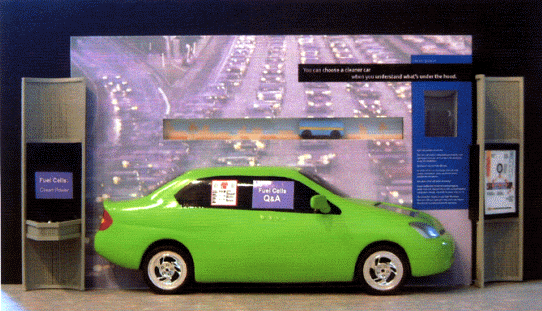
- Display of an actual car body with simulated fuel cell components
- Interactive video with questions and answers about fuel cells
- Comparative vehicles information sheets
- A live, working fuel cell demonstration
- An interactive mechanical model
- A computer kiosk offering links to fuel cell internet sites and information
Visitors will "see" the simulated fuel cell and engine components through a plexiglas hood. Questions and answers in Spanish and English will be available via a computer screen in the front passenger window. The comparison sticker in the rear window compares the performance and environmental benefits of fuel cell, hybrid and conventional gasoline vehicles. The live fuel cell uses hydrogen to power a model bus which a visitor can "drive" back and forth across the exhibit wall. The mechanical model is an animated fuel cell showing how hydrogen and the fuel cell can generate power and then combine with oxygen to form water. The interactive computer kiosk will provide the latest fuel cell news articles, monthly updates from the web and a "what do you think" visitor talk-back option. The exhibit is a well-designed multi-faceted approach to teach the children about fuel cells, their uses and operation.
The fuel cell project specifically targets students in the 4th through 7th grades; however, the material is presented in an interesting and varied format to appeal to visitors of all ages and levels of technical sophistication. The design goals have been met through an interdisciplinary approach to achieve an exhibit that combines sensory, cognitive, aesthetic, social, symbolic and physical elements of the technology in order to effectively communicate with the public. In addition, the exhibit will involve the visitor to reinforce the learning experience. The kiosk’s internet links will provide the means to obtain additional information and data for visitors of all ages and backgrounds.
Benefits to AQMD
Initiative No. 8 of the Children’s Air Quality Agenda directs staff to work with local museums to develop education programs to educate children about air pollution and other air quality issues. The AQMP relies upon the expedited implementation of advanced technologies and clean-burning fuels to achieve air quality standards in Southern California. Educating the public about fuel cells, their operation, uses, and other air quality issues will help the commercialization of fuel cells and improve the general understanding of air quality issues by the public.
AQMD’s Clean Fuels Program has been active in funding the development and demonstration of low emission, alternative fuel technologies within its Technology Advancement Office. The AQMD has also supported a number of activities directed to commercialization of low-emission alternative fuel technologies. The design phase of this project is included in the 2002 Update of the Technology Advancement Plan under category 2002 CFT-1, Assessment and Technical Support of Advanced Technologies and Information Dissemination. The proposed exhibit will assist in the commercialization of fuel cell vehicles by providing the public with reliable information and familiarity with fuel cells and their technology. For the commercialization of fuel cell vehicles to be successful, public knowledge and support is essential for fuel cells and the vehicles that they will power. The exhibit will help young people and their families take a first step toward that understanding.
Sole Source Justification
The proposed contract is for the construction and implementation of an interactive fuel cell exhibit in the Transportation Gallery of the Creative World Exhibition in the California Science Center. Section VIII.B.2. of the Procurement Policy and Procedure identifies four major provisions under which a sole source award may be justified. This request for a sole source award is made under provision B.2.d.(3): Projects involving a commitment to multiple project phases. In addition, other circumstances exist which in the determination of the Executive Officer require such waiver in the best interest of the AQMD. Specifically, these circumstances are B.2.d.(1): Projects involving cost sharing by multiple sponsors. This project will be cofunded by CARB ($100,000).
Resource Impacts
Total cost for the proposed project, Phase 2-Construct and Implement the Fuel Cell Exhibit as Part of the Transportation Gallery of the Creative World Exhibition at the California Science Center Los Angeles, is $326,000. CARB is cofunding $100,000 directly to the California Science Center. Total AQMD cost will not exceed $226,000.
Cost for the contract amendment with the Children’s Museum of Los Angeles will be $1,500.
Sufficient funds are available from the Clean Fuels Fund, established as a special revenue fund resulting from the state-mandated Clean Fuels Program. The Clean Fuels Program, under Health and Safety Code Sections 40448.5 and 40512 and Vehicle Code Section 9250.11, establishes mechanisms to collect revenues from mobile sources to support projects to increase the utilization of clean fuels, including the development of the necessary advanced enabling technologies. Funds collected from motor vehicles are restricted, by statute, to be used for projects and program activities related to mobile sources that support the objectives of the Clean Fuels Program.
Sufficient funds are also available in the Advanced Technology Outreach and Education Fund for the supplemental contract of $1,500.
Attachment
California Science Center Fuel Cell Exhibit
/ / /