
BOARD MEETING DATE: February 1, 2002
AGENDA NO. 18
Authorize Executive Officer to Request Bureau of Automotive Repair to Change SMOG CHECK Program Designation of Certain Areas in Riverside and San Bernardino Counties from "Basic" to "Partially Enhanced"
SYNOPSIS:
On September 6, 2001, the Bureau of Automotive Repair (BAR) informed the AQMD that the Inspection and Maintenance (I/M; SMOG CHECK) Program in Temecula will change from Basic to Enhanced due to an increase in population. The AQMD was further asked if there was interest in changing the program designation of the remaining areas of Riverside and San Bernardino counties to Partially Enhanced pursuant to Health and Safety Code Section 44003. This action is to authorize the Executive Officer to request BAR to implement such a program at the same time that an Enhanced Program is implemented in Temecula.
COMMITTEE:
Mobile Source, October 26, 2001, Reviewed
RECOMMENDED ACTION:
Authorize the Executive Officer to request the Bureau of Automotive Repair (BAR) to change the SMOG CHECK Program Designation of the zip codes listed in Table 3 from "Basic" to "Partially Enhanced."
Barry R. Wallerstein, D.Env.
Executive Officer
Current Issue
On September 6, 2001, the Bureau of Automotive Repair (BAR) informed the AQMD that the population of Temecula, in Riverside county, has exceeded 50,000; thus the area will become subject to the Enhanced Program SMOG CHECK designation starting on or about October 1, 2002. The BAR also asked the AQMD if there was any interest in requesting a Partially Enhanced Program for the remaining areas of San Bernardino and Riverside counties in the South Coast Air Basin. If so, the BAR would prefer to implement the change on the same time schedule as the inclusion of the Temecula area in the Enhanced Program. The BAR also informed the AQMD that other air districts (such as Ventura, Sacramento, Yolo/Solano) have requested BAR to expand the Partially Enhanced Program to most of the areas currently in the Basic Program.
Background
The SMOG CHECK Program began in 1984 in most populated areas of California, and has been altered and amended many times since then. Currently, the SMOG CHECK Program, as defined in Health and Safety Code Section 44000 and its subsequent sections, is made up of four program types: Enhanced, Basic, Change of Ownership, and Partially Enhanced.
- The Enhanced Program, begun in 1997, is a biennial inspection that uses a BAR-97 analyzer with a dynamometer (a treadmill-like device) to measure HC, CO, and NOx. The Enhanced Program also has a component called Test-Only which directs 15 percent of vehicles to special Test-Only stations which can only test, and not repair the vehicles. This program is implemented in all urbanized areas (population greater than 50,000) classified as serious or above for ozone, or Moderate or Serious Non-Attainment for CO. Note: Only CARB/BAR have authority to decide this classification.
- The Basic Program is also a biennial inspection, that began in the year 1984; and in 1990, began using the BAR-90 analyzer to measure HC and CO at two idle speeds. The Basic Program is applicable for all other areas where SMOG CHECK existed since 1984.
- The Change of Ownership Program only requires an inspection when a used vehicle is sold, and also uses a BAR-90 analyzer to measure HC and CO; and is applicable to the remainder of the State.
- The new Partially Enhanced Program is the same as the Enhanced Program except it does not have the Test-Only component of the program. The Partially Enhanced Program is authorized pursuant to Health and Safety Code Section 44003, which established an enhanced motor vehicle inspection and maintenance program in urbanized areas throughout the State.
Section 44003 further states that air districts classified as Basic Program non-attainment areas may request the implementation of test procedures and equipment required for Partially Enhanced Program areas in those areas. Table 1 describes the difference between Basic and Enhanced programs in more detail.
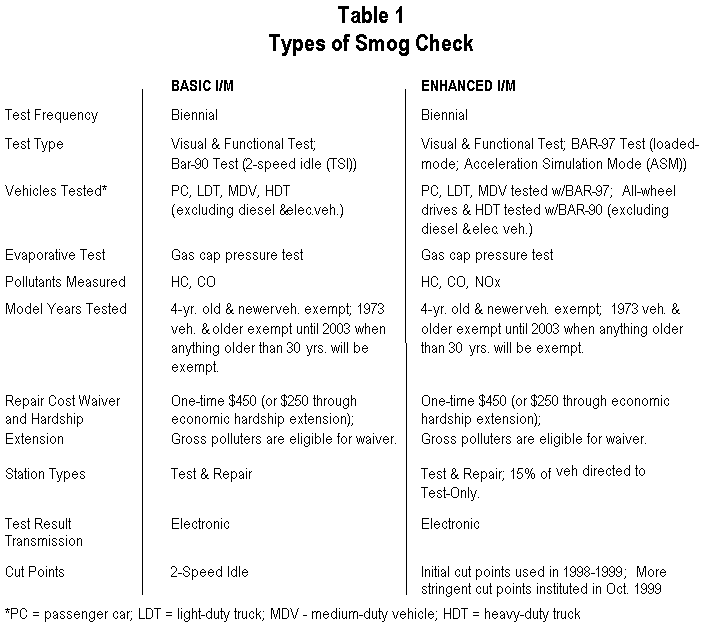
Table 2 shows the number of vehicles in each county in the South Coast Air Basin currently subject to the three types of programs.
Table 2
|
County |
Enhanced |
Basic |
Change of |
|
|
|
|
|
|
| 1,852,000 |
|
|
|
|
|
36,000 |
6,950 |
|
|
|
|
|
Staff analyzed the potential impacts of converting most of the remaining areas of SCAB (non-mountain areas) from Basic to Partially Enhanced. With assistance from BAR and CARB, analyses were conducted on the feasibility of implementing a Partially Enhanced SMOG CHECK Program in the remaining areas of Riverside and San Bernardino counties. The topic was presented to the Mobile Source Committee on October 26, 2001. Additionally, two consultation meetings were held; one in Lake Elsinore on December 12, 2001 and one in Big Bear Lake on December 13, 2001. Based on the analyses conducted and the feedback received from the consultation meetings, staff has reached the overall conclusion that the proposal to convert most of the remaining areas currently in the "Basic" Program to a Partially Enhanced SMOG CHECK Program is warranted. The reasons are:
- The shortfall in mobile source emission reductions as delineated in the AQMP needs to be reduced.
- The proposal is cost-effective (approximately $3,800/ton of ozone precursors), and is considerably less expensive than most stationary source controls.
- The dynamometer and the analyzers will also be used for detecting defective components for other than SMOG CHECK tests/repairs.
- The proposal would reduce the number of false registrations, therefore increasing program effectiveness.
Table 3 contains the zip codes of these new areas, along with the corresponding vehicle populations.
Table 3
|
Cities and ZIP Codes for which Partially Enhanced SMOG CHECK Program is Proposed |
|||
|
Riverside County |
|||
|
City – Zip Code |
Vehicle Population |
City – Zip Code |
Vehicle Population |
|
Aguanga – 92536 |
1,529 |
Menifee -- 92584 |
8,401 |
|
Anza – 92539 |
2,259 |
Mountain Center -- 92561 |
949 |
|
Banning – 92220 |
14,899 |
Murrieta -- 92562–92564 |
33,779 |
|
Beaumont – 92223 |
10,793 |
No. Palm Springs -- 92258 |
601 |
|
Cabazon -- 92230 |
1,143 |
Perris -- 92570-92572, 92599 |
31,448 |
|
Desert Hot Springs – 92240, 92241 |
14,049 |
Sun City -- 92585-92587 |
27,741 |
|
Homeland – 92548 |
2,814 |
Thousand Palms -- 92276 |
3,965 |
|
Idyllwild – 92549 |
2,992 |
Wildomar -- 92595 |
12,331 |
|
Lake Elsinore -- 92530-92532 |
23,643 |
Winchester -- 92596 |
2,567 |
|
Mecca – 92254 |
3,624 |
|
|
|
|
|
Total |
199,527 |
|
San Bernardino County |
|||
|
City – Zip Code |
Vehicle Population |
City – Zip Code |
Vehicle Population |
|
Angelus Oaks – 92305 |
411 |
Lytle Creek -- 92358 |
546 |
|
Forest Falls – 92339 |
789 |
Running Springs -- 92382 |
3,935 |
|
|
|
Total |
5,681 |
Emission Reductions
The estimated emission reductions from implementation of a Partially Enhanced Program for the 205,208 vehicles in 2002 will be:
ROG: 0.50 tons/day; NOx: 0.72 tons/day; CO: 3.6 tons/day
These emission reductions were calculated by the California Air Resources Board (CARB) using the EMFAC 2000 model. CARB then discounted the reductions by 31 percent because the Partially Enhanced Program does not contain the Test-Only provision, which requires 15 percent of vehicles to be tested at Test-Only stations.
Cost and Cost Effectiveness
There are two sets of costs associated with the conversion of SMOG CHECK from Basic to Partially Enhanced: cost to consumers; and cost to testing stations. The BAR provided data on the average cost of the two programs. It is estimated that the total annual cost to consumers will be approximately $1.8M. The average cost effectiveness will be approximately $3,800/ton of ozone precursors (HC & NOx). It is anticipated that the test cost will increase by $12.00, and that the repair cost will increase by $23.00. The average cost of a system upgrade (dynamometer, plus converting the analyzer from a BAR 90 to BAR 97, and all other auxiliary equipment) is estimated to be $30,000-50,000. However, as currently proposed, the BAR estimates that by 2003, all Basic stations currently equipped with BAR 90 analyzers will have to convert to BAR 97 analyzers, the type of analyzer required for the Enhanced Program. Therefore, the calculated total cost would be reduced to one-half or two-thirds at most.
Staying in the SMOG CHECK Program, or not, will be a business decision to be made by each station. Higher volume stations will benefit, while the low volume stations that perform SMOG CHECK as a side business may decide to leave the program.
Policy Issues
The original staff proposal was to change the SMOG CHECK Program from Basic to Partially Enhanced for the entire remaining portions of the South Coast Air Basin. Pursuant to the consultation meetings and based on information provided, staff has modified the initial proposal to exclude the mountain areas of San Bernardino county (Big Bear and Lake Arrowhead areas) from the Partially Enhanced Program at this time.
The main reasons for reaching this conclusion are:
- A high percentage of the vehicles are all-wheel drive, and cannot be tested on the dynamometers;
- Most of the air pollution of these areas is transported from the metropolitan areas below; thus making the additional emission reductions (from Partially Enhanced) less effective;
- Most of the vehicles registered in these areas do not travel down the mountain areas on a routine basis; thus they do not significantly impact the air pollution situation at the base of the mountain areas.
As currently proposed, the mountain areas of San Bernardino County will continue to be in the Basic Program.
Resource Impacts
No AQMD staff resources would be needed to implement this program.
Proposal
Staff recommends that the Board authorize the Executive Officer to request the Bureau of Automotive Repair (BAR) to change the SMOG CHECK Program Designation of the zip codes listed in Table 3 from "Basic" to "Partially Enhanced."
///