
BOARD MEETING DATE: February 1, 2002
AGENDA NO. 19
Recommendation to Continue Developing Localized Significance Thresholds
SYNOPSIS:
The Guiding Principles and Environmental Justice Initiatives adopted by the Board in 1997 established strategies to ensure that clean air benefits accrue to all citizens and communities within the district by addressing local areas where residents may be disproportionately affected by air pollution. In conjunction with revising the CEQA Air Quality Handbook and furthering the Board’s goal of addressing localized air quality, staff recommends developing localized significance thresholds for subregions in the district as another indicator of CEQA significance. One policy implication is that different localized significance thresholds (primarily for NO2, PM10, and CO) by geographical area may be developed based on existing levels of air quality. Staff seeks approval to continue developing localized significance thresholds, solicit public input, and report the final staff proposal back to the Board for consideration and possible incorporation into the Handbook.
COMMITTEE:
Mobile Source, September 28, October 26 and December 7, 2001, Reviewed
RECOMMENDED ACTION:
Direct staff to continue developing localized significance thresholds, solicit public input, and report the final staff proposal back to the Board for consideration and possible incorporation into the revised Handbook.
Barry R. Wallerstein, D.Env.
Executive Officer
Background
At the October 10, 1997 Board meeting, the Governing Board adopted the Guiding Principles and Workplan to Implement Environmental Justice Initiatives. Environmental Justice (EJ) Initiative #4 – CEQA Commenting, directs the AQMD to reconstruct its CEQA commenting function, called intergovernmental review (IGR). As specified in the Workplan, EJ Initiative #4 included updating the CEQA Handbook by working with and creating a stakeholders’ review group.
Consistent with EJ Initiative #4 staff began the formal Handbook revision process by creating a Handbook revision working group of stakeholders comprised of local government planners; representatives of local councils of government (COG), environmental groups, the building and construction industries; and other interested individuals. The first Handbook revision working group meeting was held January 14, 1998. At the first Handbook revision working group meeting, one of the issues identified by the stakeholders was a request to address localized air quality impacts. The existing Handbook only discussed localized impacts as part of focused carbon monoxide (CO) "hotspots" analyses prepared for mobile sources.
To assess localized air quality impacts requires using complex dispersion models. Therefore, to address the issue of localized significance, yet be sensitive to the fact that other public agencies might not have the expertise or financial resources to perform complex dispersion modeling, CEQA staff began developing a proposal to establish localized significance thresholds in a form similar to the regional significance thresholds, that is, the number of pounds per day generated by a proposed project that would cause or contribute to localized air quality impacts.
In the fourth quarter of 2001, staff presented preliminary proposals to several Mobile Source Committee meetings and a number of associated policy issues (see "Policy Issues" discussion below) were identified. Because of the issues associated with the preliminary staff proposals, the Mobile Source Committee recommended that staff seek approval from the Governing Board before proceeding with development of the localized significance thresholds.
Proposal
Based upon staff’s understanding of the intent of the Governing Board’s EJ initiatives, that is, to ensure that clean air benefits accrue to all citizens and communities within the district by addressing local areas where residents may be disproportionately affected by air pollution; the specific direction in the EJ Workplan to update the Handbook; and to address the Handbook revision working group stakeholders’ request to address localized impacts staff is proposing to develop localized significance threshold lookup tables for nitrogen dioxide (NO2), CO, and particulate matter less than 10 microns (PM10) that show, in pounds per day, the emission contribution from a project that would create significant localized air quality impacts. Localized air quality impacts are considered to be significant if emissions from a project cause or contribute to an exceedance of any health based ambient air quality standard (AAQS) at the nearest sensitive receptor. Lookup tables would not be created for sulfur dioxide (SO2) or volatile organic compounds because these pollutants are primarily of regional concern1.
1 Although VOCs are generally considered to be an ozone precursor and, therefore, of regional concern, VOCs that are also toxic could contribute to localized air toxic impacts. Air toxics, however, are not included as part of this proposal, but are addressed elsewhere in the existing Handbook.
Methodology
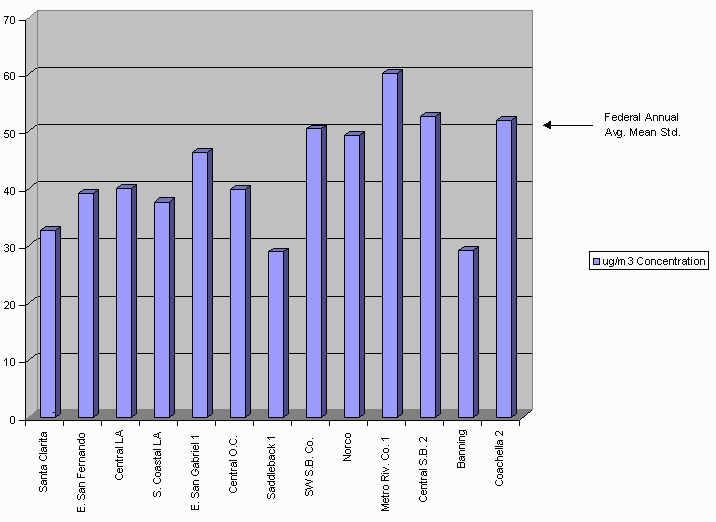
Lookup tables would be derived using one of three methodologies depending upon the pollutant. For attainment pollutants (NO2 and CO in all but two SRAs), the lookup tables would be derived using an air quality dispersion model to back-calculate the emissions per day that would cause or contribute to a violation of any AAQS for a particular source receptor area (SRA). Localized significance threshold lookup tables would be developed based upon the size or total area of the emissions source, the ambient air quality2 in each source receptor area in which the emission source is located, and the distance to the sensitive receptor. Sample SRAs showing pollutant concentrations relative to the appropriate ambient air quality standards for NO2, CO, and PM10 are illustrated in attached Figures 1 through 3. For example, NO2 tends to be emitted in greater quantities in the western portion of the district than the eastern portion of the district. As a result, new NO2 emissions sources might locate preferentially in the eastern portion of the district in response to the localized thresholds proposal for NO2, thus, potentially increasing NO2 emissions in the Inland Empire. In figures 1 through 3 each bar represents the ambient concentration of the specified criteria pollutant for the SRA noted. Short bars on the graph represent areas with low ambient concentrations compared to areas with higher ambient concentrations, i.e., taller bars. As a result, projects located in SRAs represented by short bars could have higher NO2 emissions without exceeding the localized significance thresholds than projects located in SRAs represented by taller bars.
2 Ambient air quality information is based on the pollutant concentrations measured at the SCAQMD’s monitoring stations in or near the specified SRA.
For CO in the two SRAs in which CO levels still exceed an AAQS, lookup tables would be derived using an air quality dispersion model to back-calculate the emissions necessary to make an existing violation in the SRA worse, using the allowable change in concentration thresholds in Table A-2 in Rule 1303. For PM10 lookup tables, staff is evaluating developing localized significance thresholds that would be consistent with control requirements in Rule 403 – Fugitive Dust.
The above staff recommendations are consistent with the modeling requirement in AQMD Rule 1303(b)(1), which states that the Executive Officer shall deny a Permit to Construct for any new or modified source with an emission increase unless, "The applicant substantiates with modeling that the new facility or modification will not cause a violation, or make significantly worse an existing violation… of any AAQS at any receptor in the District."
Policy Issues
Staff believes that addressing localized air quality impacts in the CEQA process, in addition to addressing regional air quality impacts, provides a more complete understanding of potential effects to nearby residences as well as downwind receptors. In addition, pollutants selected for localized air quality analyses typically have their emission sources within a five-mile radius, not transported from distant upwind areas. Existing air quality for various subregions has to be considered in order to conduct a meaningful localized impact evaluation, which inevitably would create different significance thresholds for different areas. A number of issues have been identified with the staff proposal that will require additional evaluation.
Geographic – Localized air quality significance thresholds generated for attainment pollutants would be developed based on ambient concentrations of the specific pollutant in that SRA. As a result, the localized air quality significance thresholds would differ for projects located in different geographical areas. This means that projects in SRAs with cleaner air quality (i.e., low pollutant concentrations) would be allowed to generate higher emissions without triggering CEQA significance than projects located in SRAs with higher pollutant concentrations although still within the health-based standards.
Increased Costs – Applying the localized significance thresholds in the CEQA evaluation in addition to the current regional significance thresholds could require implementing mitigation measures or trigger preparation of environmental impact reports for land use projects that would have otherwise required a negative declaration. This is because projects that are not significant regionally and, therefore, could be processed under a negative declaration could be significant under the localized thresholds approach, thus, requiring an EIR and possibly implementation of feasible mitigation measures. As a result, the length and cost of the CEQA process could increase. Staff is currently in the process of evaluating the potential for more projects triggering significance based on localized significance thresholds and compiling associated cost and resource impacts.
Siting Decision – The net effect of both of the preceding policy issues is that there could be a disproportionate amount of development in SRAs with relatively good air quality compared to SRAs with relatively poor air quality. As a result, siting and related project decisions could be affected. Ultimately, however, proposed project siting decision approvals remain the responsibility of local public agencies with general land use authority, i.e., cities or counties.
Recommendation
It is recommended that the Board approve the following items.
- Approve staff’s proposal to continue developing localized significance thresholds. The localized significance thresholds would be developed based on the current air quality in respective SRAs by pollutant and would likely result in different significance thresholds in different parts of the region.
- Continue to solicit input on the revised Handbook from stakeholders (Handbook revision working group) and other interested parties regarding development of localized significance thresholds and the policy issues identified above.
- Bring the final staff proposal back to the Board for consideration.
Figure 1
Year 2000 1-hour NO2 Concentrations by Source Receptor Area
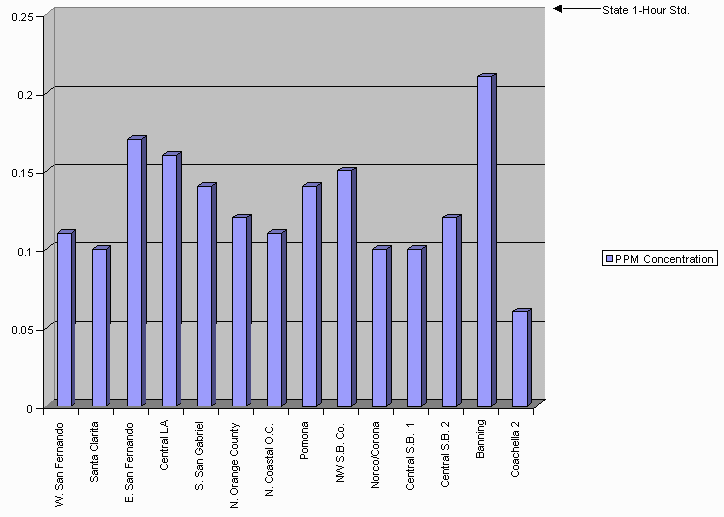
Figure 2
Year 2000 8-hour CO Concentrations by Source Receptor Area
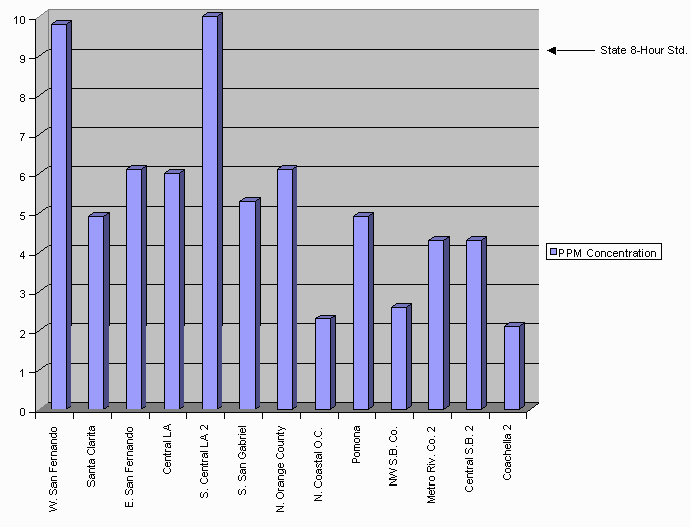
Figure 3
Year 2000 Annual Average PM10 Concentrations by Source Receptor Area
///