
BOARD MEETING DATE: January 11, 2002
AGENDA NO. 17
Adopt Proposed Amendments to Rules 481 – Spray Coating Operations and 1141.2 – Surfactant Manufacturing
SYNOPSIS:
Staff is proposing to amend Rules 481 – Spray Coating Operations and 1141.2 – Surfactant Manufacturing by adding test methods in order to determine compliance with rule requirements. These additional test methods are currently used by AQMD to determine transfer efficiency and compliance with VOC limits. Proposed amendments also include the addition of an exemption from Rule 481 for extreme high gloss coatings used in the pleasure craft industry and the deletion of an exemption from Rule 1141.2 for equipment using exclusively very low vapor pressure materials. Definitions and other clarifying language are also proposed.
COMMITTEE:
Stationary Source, December 7, 2001, Reviewed
RECOMMENDED ACTION:
Adopt the attached resolution:
- Certifying the Notice of Exemption for Proposed Amended Rule 481 – Spray Coating Operations and Proposed Amended Rule 1141.2 – Surfactant Manufacturing;
- Amending Rules 481- Spray Coating Operations and 1141.2 – Surfactant Manufacturing.
Barry R. Wallerstein, D.Env.
Executive Officer
Background
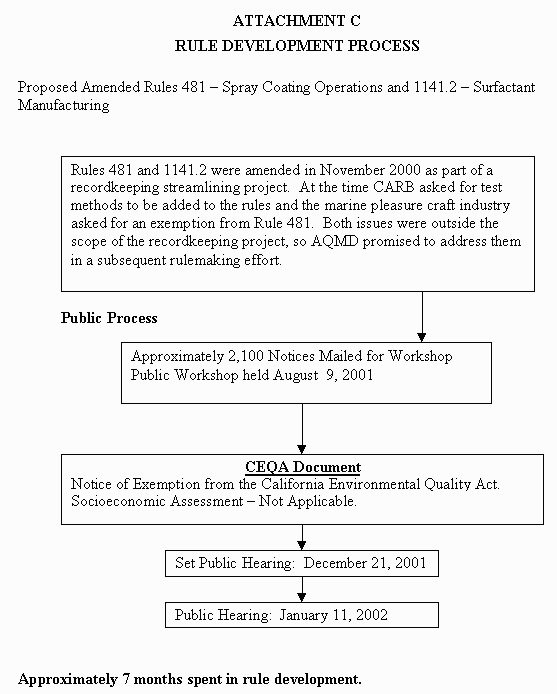
Rules 481 – Spray Coating Operations and 1141.2 – Surfactant Manufacturing were amended in November 2000 as part of a project to streamline recordkeeping for volatile organic compound (VOC) emissions. At that time, CARB asked that test methods be added and AQMD agreed to add them later, allowing adequate public notification. CARB made additional comments following the public workshop for the current amendments. They requested that the rules be updated by adding headings, definitions, and clarifying recordkeeping requirements. The main purpose of the current project is to address CARB’s concerns.
At the time of the November 2000 recordkeeping amendments to Rule 481 a comment was received asking for an exemption from the rule for the pleasure craft industry. The main concern was that the industry was not able to produce acceptable finishes using the coating application methods specified in Rule 481 and, in many cases, spray enclosures are not feasible due to the size of the boats being painted. This issue is also being addressed in the current proposal.
Public/Rule Development Process
Staff conducted a Public Workshop on August 9, 2001 to solicit comments on the proposed rules. Comments at the workshop were primarily questions and requests for clarification of the proposal. Written comments were received from CARB, EPA, and the pleasure craft industry. CARB suggested the addition of headings, definitions, and recordkeeping clarifications to update the rules. EPA commented on the proposed test methods and the pleasure craft industry reiterated and clarified its request for exemption from Rule 481. All comments have been addressed in the attached staff report.
Proposal
The purpose of Rule 481 is to control particulate emissions from spray coating operations either by the use of a spray enclosure, specific coating application method, or some equivalent method. CARB commented that the rule should include a test method to determine transfer efficiency so equivalency can be verified for alternative application methods. The test method currently used by the AQMD to determine transfer efficiency is proposed for addition to the rule. In addition, the proposal adds high-volume, low-pressure (HVLP) spray equipment as one of the acceptable application methods, making it consistent with current technology and other Regulation XI source-specific coatings rules. The proposal also includes updating the rule by adding new sections, definitions, and clarification of recordkeeping requirements for some exemptions, in response to CARB comments.
An additional change proposed for Rule 481 is an exemption for extreme high gloss topcoats used in the marine pleasure craft industry. Rule 1106.1 – Pleasure Craft Coating Operations was amended in 1999 to address product variances for coatings that could not comply with technology-forcing VOC limits in the original rule and issues with finishes due to application methods. The 1999 amendments temporarily raised the VOC content limit for extreme high gloss topcoats and finish primers, raised the VOC limit for antifoulants, and removed the requirement that sprayed coatings be applied using specific application methods. The changes allowed the industry to operate without variances. An amendment to Rule 481 for extreme high gloss coatings used in marine pleasure craft coating operations is proposed to allow the industry to use other coating application methods which provide an acceptable finish for the extreme high gloss topcoats and produce finishes that are competitive with those produced outside the AQMD. It also addresses an equity issue raised by the industry that there are other exemptions in the rule for industries which coat large objects where spray enclosures are not feasible. Extreme high gloss coatings represent only a small amount of the coatings used in the industry and although the proposed amendments would exempt them from the requirements of Rule 481, these coatings are regulated under Rule 1106.1.
The purpose of Rule 1141.2 is to reduce VOC emissions from surfactant manufacturing operations, but the rule includes no test methods for determining compliance with the VOC limits. At CARB’s request, test methods are proposed to be added to determine the capture efficiency of emission control systems and control equipment efficiency as well as a method for calculating the overall efficiency of the control system. They are methods currently in use by the AQMD. The addition of headings, definitions, and a recordkeeping clarification for one exemption are also proposed. The removal of an exemption for equipment that uses exclusively organic material with very low vapor pressures is also proposed due to the difficulty of accurately determining the vapor pressures. The current exemption remains for facilities that emit less than five pounds per day or 110 pounds per month of VOC from surfactant manufacturing. This exempts small producers from Rule 1141.2 requirements.
Key Issues
CARB requested several changes to the two rules for clarification and enforceability. The primary issue was the addition of test methods to verify compliance with existing rule requirements. The proposed amendments add the required test methods.
The other key issue was the request by the marine pleasure craft industry for an exemption from Rule 481. The proposed amendments exempt extreme high gloss coatings used in the marine pleasure craft industry from the requirements of Rule 481.
California Environmental Quality Act (CEQA)
Pursuant to state CEQA Guidelines §15002 (k)(1), staff has reviewed the proposed amendments to Rules 481 and 1141.2 and has determined with certainty that the proposed project does not have the potential to significantly adversely impact air quality or any other environmental area. Staff has concluded the proposed project is exempt from CEQA pursuant to State CEQA Guidelines §15061 (b)(3) - Review for Exemption. A Notice of Exemption has been prepared pursuant to State CEQA Guidelines §15062 - Notice of Exemption and will be filed with the county clerks of Los Angeles, Orange, Riverside and San Bernardino counties immediately following the adoption of the proposed amended rules.
Socioeconomic Assessment
No adverse socioeconomic impacts are expected as a result of the proposed amendments to Rules 481 and 1141.2. Most of the proposed changes are administrative in nature. The proposal to exempt extreme high gloss topcoats used in marine pleasure craft coating operations from requirements of Rule 481 will allow the industry to use coating methods that produce competitive finishes and does not place added requirements on the industry. The removal of the exemption for equipment using exclusively low vapor pressure organic materials is not expected to cause any impact since it is unlikely that the exemption was used by surfactant manufacturers due to the problems of measuring the extremely low vapor pressures.
Resource Impacts
No resource impacts are expected from the proposed amendments. Many of the proposed changes are administrative only and the proposed test methods are currently used by AQMD staff to determine compliance with various rules. No additional resources will be required.
Summary of Proposal
Key Issues and Responses
Rule Development Process
Key Contact List
Resolution
Proposed Rule Language
Staff Report
Notice of Exemption
ATTACHMENT A
SUMMARY OF PROPOSAL
|
|
|
The proposed amendments to Rule 481 – Spray Coating Operations include:
The proposed amendments to Rule 1141.2 – Surfactant Manufacturing, include:
|
ATTACHMENT B
KEY ISSUES AND RESPONSES
|
|
|
|
ATTACHMENT D
KEY CONTACTS LIST
DETCO
U.S. Environmental Protection Agency
California Air Resources Board
ATTACHMENT E
RESOLUTION NO. 01-XX
A Resolution of the Governing Board of the South Coast Air Quality Management District (AQMD) certifying that Proposed Amended Rules 481 – Spray Coating Operations and 1141.2 – Surfactant Manufacturing are exempt from the requirements of the California Environmental Quality Act (CEQA).
A Resolution of the AQMD Governing Board amending Rules 481 – Spray Coating Operations and 1141.2 – Surfactant Manufacturing.
WHEREAS, AQMD staff reviewed the proposed project and determined that it is exempt from the requirements of the California Environmental Quality Act (CEQA); and
WHEREAS, AQMD staff has conducted a public workshop regarding the proposed amendments to Rules 481 and 1141.2; and
WHEREAS, the AQMD Governing Board has determined that a need exists to amend Rules 481 - Spray Coating Operations and 1141.2 - Surfactant Manufacturing to address comments from CARB; and
WHEREAS, the AQMD Governing Board obtains its authority to adopt, amend, or repeal rules and regulations from Sections 39002, 40000, 40001, and 40702 of the California Health and Safety Code; and
WHEREAS, the AQMD Governing Board has determined that Rules 481 - Spray Coating Operations and 1141.2 - Surfactant Manufacturing are written and displayed so that the meaning can be easily understood by persons directly affected by it; and
WHEREAS, the AQMD Governing Board has determined that Rules 481 - Spray Coating Operations and 1141.2 - Surfactant Manufacturing as proposed to be amended, are in harmony with, and not in conflict with, or contradictory to, existing statutes, court decisions, or state or federal regulations; and
WHEREAS, the AQMD Governing Board has determined that Rules 481 - Spray Coating Operations and 1141.2 - Surfactant Manufacturing do not impose the same requirement as any existing state or federal regulation, and the proposed amended rules are necessary and proper to execute the powers and duties granted to, and imposed upon, the AQMD; and
WHEREAS, the AQMD Governing Board in amending the regulations, references the following statutes which the AQMD hereby implements, interprets or make specific: California Health and Safety Code Sections 40000, 40001, and 40725 through 40728; and
WHEREAS, a comparative analysis, as required by Section 40727.2 of the Health and Safety code; has been performed and it has been determined that the proposed amendments to Rule 481 and 1141.2 do not impose a new emission limit or standard, make an existing emission limits or standard more stringent, or impose new or more stringent monitoring, reporting, or recordkeeping requirements; and
WHEREAS, proposed amended Rules 481 and 1141.2 are not control measures in the 1997 Air Quality Management Plan (AQMP) and thus, were not ranked by cost-effectiveness relative to other AQMP control measures in the 1997 AQMP; and
WHEREAS, the AQMD Governing Board has actively considered the socioeconomic impacts of the proposed amendments to Rules 481 and 1141.2 and has determined that there are no socioeconomic impacts; and
WHEREAS, a public hearing has been properly noticed in accordance with all provisions of Health and Safety Code Section 40725; and
WHEREAS, the AQMD Governing Board has held a public hearing in accordance with all provisions of law; and
WHEREAS, the AQMD specifies the Manager of Rules 481 and 1141.2 as the custodian of the documents or other materials which constitute the record of proceedings upon which the adoption of this proposed amendment is based, which are located at the South Coast Air Quality Management District, 21865 E. Copley Drive, Diamond Bar, California.
NOW, THEREFORE BE IT RESOLVED that the AQMD Governing Board does hereby certify the Notice of Exemption for Proposed Amended Rules 481 – Spray Coating Operations and 1141.2 – Surfactant Manufacturing, completed in compliance with state CEQA Guidelines Sections 15002(k)(1), 15061(b)(3), and 15062, and that it has been presented to the Governing Board, whose members reviewed, considered, and approved the information therein prior to acting on Proposed Amended Rules 481 – Spray Coating Operations and 1141.2 – Surfactant Manufacturing; and
BE IT FURTHER RESOLVED, that the AQMD Governing Board hereby amends, pursuant to the authority granted by law, Rules 481 - Spray Coating Operations and 1141.2 - Surfactant Manufacturing, as set forth in the attached, and incorporated herein by this reference.
DATE:_____________
______________________________
CLERK OF THE BOARD
///