 South Coast Air Quality Management District
South Coast Air Quality Management District
South Coast Air Quality Management District
BOARD MEETING DATE: July 12, 2002 AGENDA NO. 37
Clean Air Act Policy Interpretations White Paper
SYNOPSIS:
At the February 1, 2002 Board meeting, the AQMD's Governing Board approved eight strategic initiatives introduced by Chairman Norma Glover. The objective of Strategic Alliance Initiative #2 - Clean Air Act Policy Interpretation Issues is to achieve fair, reasonable, and consistent interpretation/implementation of the Clean Air Act (CAA) and to expedite clean air. In the past, the U.S. EPA has established numerous interpretations of the CAA, some of which may not reflect underlying statutes. AQMD staff has been working with a Steering Committee and has developed a White Paper - Clean Air Act Policy Interpretations that identifies key CAA policy interpretation issues, recommendations, and an action plan that seeks resolution of these key issues.
COMMITTEE:
Stationary Source, June 28, 2002, Reviewed
Mobile Source, June 28, 2002, Reviewed
RECOMMENDED ACTION:
Barry R. Wallerstein, D.Env.
Executive Officer
Background
The objective of Strategic Alliance Initiative #2 – Clean Air Act Policy Interpretations, is to review the effects of EPA interpretations of federal CAA requirements and suggest recommendations that would increase the effectiveness of AQMD’s clean air programs. The policy interpretation issues identified are those that will address issues that are needed to achieve air quality goals and can be implemented in the near-term without reopening the CAA. The recommendations relative to these issues would not weaken the CAA or the clean air efforts of the AQMD, but increases the overall effectiveness of AQMD’s clean air programs and expedite clean air progress.
A Work Plan for implementation of Initiative #2 was approved at the February 1, 2002, Governing Board meeting. The work plan included (1) the preparation of a white paper that reviews various areas of concern and provide recommendations, (2) establishing a Steering Committee of stakeholders to provide guidance to the process, (3) developing outreach programs and solicit partners in an action plan to implement the white paper, and (4) conduct public workshops and/or public consultation meetings to seek comments on items to be identified as priorities for re-examination and possible change.
Public Process
Throughout the development of the White Paper, the AQMD staff worked with a Steering Committee (see Attachment A) that provided input on the identification of CAA policy interpretation issues, recommendations, and implementation prioritization. In addition to five Steering Committee meetings, two sets of public consultation meetings were held during the preparation of this White Paper in March and June 2002. In addition, AQMD staff conducted a survey that sought public input on Initiative # 2 and the prioritization of the identified issues (see Appendix B of the White Paper).
White Paper
The White Paper identifies key CAA policy interpretation issues and provides an analysis and recommendation for each issue with the objective that they lead to fair, reasonable, and consistent interpretation/implementation of the CAA. The policy interpretation issues identified and included in the White Paper are those that will solve problems and are supported by specific examples. For each of the identified issues, the White Paper includes (1) the CAA requirement for the air quality program in question, (2) the mechanism by which EPA implements the pertinent CAA requirement (e.g., rule, policy, guidance, etc.), (3) an analysis of the issue, and (4) recommended action(s) to address the identified issue.
Key Policy Interpretation Issues
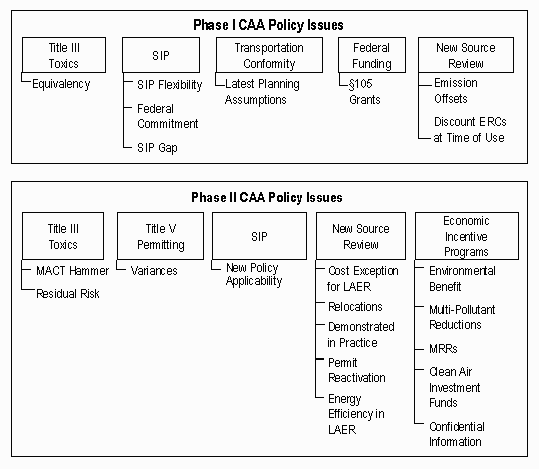
AQMD staff, in conjunction with the Steering Committee, identified 22 key CAA policy interpretation issues within seven air quality program categories. These seven air quality programs are:
Recommendations
The recommendations for resolving the 22 policy interpretation issues have been prioritized for implementation into two phases – immediate (six to nine months) and near-term implementation (nine to 18 months). Four criteria have been established to prioritize the implementation of the recommendations: (1) implementation timeframe, (2) clean air progress, (3) broad-base applications, and (4) stakeholders support. A survey and public comments also aided the prioritization of the issues. In general, public comments support the recommended approaches contained in the White Paper. However, a number of environmental and community groups have raised concern with the majority of recommendations set forth herein. These comments and staff responses are contained in Appendix C of the White Paper. As shown in the figures below, there are eight Phase I and fourteen Phase II CAA Policy Issues.
Action Plan
An Action Plan to implement the recommendations, including a formal "Policy Resolution Process," is included in the White Paper. The Action Plan includes four items:
The four action items described above are intended to provide a formal and effective mechanism to resolve the policy interpretation issues identified herein and future policy issues as well (see Attachment B). The mechanism includes participation by stakeholders and a means to resolve policy interpretation issues at the agency staff level. The AQMD staff will work with EPA and other stakeholders to implement the Action Plan.
Recommendation
The AQMD staff recommends implementing the Action Plan for Initiative #2 as set forth in the White Paper.
Chairman
Ms. Norma Glover - South Coast Air Quality Management District Governing Board Member
Co-Chairman
Dr. Roy Wilson - South Coast Air Quality Management District Governing Board Member
Members
Mr. Greg Adams - L.A. County Sanitation District
Ms. Dee Allen - City of Los Angeles **
Ms. Barbara Baird - South Coast AQMD
Mr. Howard Berman - Environmental Mediation, Inc.
Mr. Jack Broadbent - EPA - Region IX
Mr. Tim Carmichael - Coalition for Clean Air*
Dr. Elaine Chang - South Coast AQMD
Mr. Curt Coleman - California Manufacturers Association
Mr. Eric Haley - Riverside County Transportation Commission*
Mr. Bob Kanter - Port of Long Beach Administration
Mr. Mike Lewis – CIAQC *
Ms. Julie Masters – NRDC *
Mr. Jeff Muffat – 3M
Ms. Emily Nelson – CVAG
Mr. Bill Quinn - California Council for Environment and Economic Balance
Mr. Jeff Shockey - Copeland, Lowery and Jacquez *
Ms. Lynn Terry – CARB **
Mr. Lee Wallace - Sempra Energy
Dr. Barry Wallerstein - South Coast AQMD
Mr. Bob Wyman - Latham & Watkins
* Invited, but did not participate.
** Alternate sent.
ATTACHMENT B
SUMMARY OF ACTION PLAN
ATTACHMENT C
SUMMARY OF KEY ISSUES
|
FEDERAL POLICY |
ISSUE |
EXAMPLE |
RECOMMENDATION |
| Title III � Federal Toxic Program | |||
|
1.1. Equivalency:
(CAA § 112[l]) |
|
|
|
|
1.2. MACT Hammer:
(CAA �112[j]) |
Recent EPA action (April 2002) extended the due date of part 2 of the MACT Hammer application from May 2002 to May 2004, effectively alleviating the key issue. | Without extending the filing date from May 2002 to May 2004, facilities would have been asked to propose controls without knowing the specific top 12 percent control level for a source category. |
|
ATTACHMENT D (CONTINUED)
SUMMARY OF CAA ISSUES AND RECOMMENDATIONS
|
FEDERAL POLICY |
ISSUE |
EXAMPLE |
RECOMMENDATION |
| 1. Title III � Federal Toxic Program (Continued) | |||
|
1.3. Residual Risk: EPA is required to assess the risk to public health remaining after the implementation of each NESHAP. (CAA �112 [f]). | MACT standards are technology-based and do not take into account remaining risk after full implementation, or provide for a risk-based de minimis level or exemption threshold. |
|
|
| 2. Title V � Federal Operating Permits | |||
|
The CAA establishes nationwide major source federally enforceable operating permit program. Title 40 – Code of Federal Regulations, Part 70, establishes minimum requirements for state and local programs. AQMD Regulation XXX implements the Title V requirements. (CAA §§ 501-506) |
|
No major recommendations other than monitoring and providing support for SIP approval of Rule 518.2 - Federal Alternative Operating Conditions. | |
ATTACHMENT D (CONTINUED)
SUMMARY OF CAA ISSUES AND RECOMMENDATIONS
|
FEDERAL POLICY |
ISSUE |
EXAMPLE |
RECOMMENDATION |
| 3. State Implementation Plan (SIP) | |||
|
3.1. New Policy Applicability: EPA applies new policies to previously submitted rules and SIP revisions. (CAA §110[l]) |
When EPA has not acted on plans or rule submittals in a timely manner, these submittals are judged on policies adopted well after submittal dates, resulting in further delay of the federal approval process and thus extending the SIP Gap. |
|
Request EPA to judge SIP revisions and rules by policies in effect at time they are submitted. |
|
3.2. SIP Flexibility: EPA policy prohibits revising the SIP to become less stringent; i.e., "anti-backsliding" (CAA §110[l]) |
|
|
|
|
3.3. Federal Control Measure Commitment: EPA interprets CAA as not allowing states to "assign" part of clean air efforts to EPA, and will only commit to a "consultative process." (CAA §301) |
EPA’s exclusive authority to regulate federal sources (e.g., ships, trains, and airplanes) significantly hampers the attainment demonstration effort. EPA’s exclusive authority to regulate should be coupled with responsibility to assist in achieving attainment. |
AQMD unable to demonstrate attainment without EPA commitment to achieve significantly reductions from federal sources. |
|
ATTACHMENT D (CONTINUED)
SUMMARY OF CAA ISSUES AND RECOMMENDATIONS
|
FEDERAL POLICY |
ISSUE |
EXAMPLE |
RECOMMENDATION |
| 3. SIP (Continued) | |||
|
3.4 SIP Gap:
(CAA §110[k]) |
|
|
|
| 4. Transportation Conformity | |||
(CAA §176(c)(B)[iii]) |
|
Request EPA and DOT to allow conformity determinations using the same assumptions contained in the SIP that establish the applicable emissions budgets if subject to periodic SIP update requirements no later than every five years. | |
ATTACHMENT D (CONTINUED)
SUMMARY OF CAA ISSUES AND RECOMMENDATIONS
|
FEDERAL POLICY |
ISSUE |
EXAMPLE |
RECOMMENDATION |
| 5. Federal Funding | |||
|
CAA § 105 Funding: Pursuant to CAA, grants cannot be more than 10% of the total allocated funds granted for air pollution control programs in any one State (CAA §105(b)[2]). Additionally, no agency can receive any grant when its expenditures for air pollution control programs will be less than the preceding year. (CAA §105[c]). |
|
|
|
| 6. New Source Review (NSR) | |||
|
6.1. Emission Offsets:
(CAA §173(c)[1]) |
|
Offsets unavailable to permit new power producing projects. Rule 1309.1 – Community Bank and Priority Reserve, recently amended to address problem for new power plants. |
Consider Alternative Emission Offset Mechanisms (Refer to White Paper on Modernization of the Emission Reduction Credit System May 2002):
|
ATTACHMENT D (CONTINUED)
SUMMARY OF CAA ISSUES AND RECOMMENDATIONS
|
FEDERAL POLICY |
ISSUE |
EXAMPLE |
RECOMMENDATION |
| 6. New Source Review (NSR) (Continued) | |||
|
6.2. Cost Exception for LAER Determination: EPA’s current policy does not allow cost to be a factor in making a LAER determination. (CAA §173[2]) |
|
|
Request that EPA grant AQMD the flexibility to consider cost as part of the feasibility determination for achieved in practice for a specific source category within the same industry in determining LAER. |
|
6.3. Discount ERCs at Time of Use: Current EPA policy requires the discounting of ERCs to Reasonably Available Control Technology at the time of use. (CAA §172(c)[1]) |
EPA policy is in conflict with federally approved AQMD Regulation XIII. AQMD discounts ERCs at the time of issuance to BACT levels which alleviates uncertainties regarding value of credits, is easier to implement, and generally results in greater discounts. |
Maintain EPA approval of AQMD’s Regulation XIII provision for discounting ERCs to BACT (i.e. federal LAER) at time of generation. |
|
|
6.4. Relocation: EPA’s current policy treats existing sources that relocate and are not expanding as "new" sources for purposes of LAER and offsets, even though such sources are neither new nor modified. (CAA §172) |
|
Facility loses lease and needs to relocate operation. Facility is subject to NSR requirements. |
EPA should interpret LAER as not applying to relocations where the facility previously received a LAER limit and operated under the same ownership for the previous two years and there is no increase in emissions. |
ATTACHMENT D (CONTINUED)
SUMMARY OF CAA ISSUES AND RECOMMENDATIONS
|
FEDERAL POLICY |
ISSUE |
EXAMPLE |
RECOMMENDATION |
| 6. New Source Review (NSR) (Continued) | |||
|
6.5. "Demonstrated in Practice" Determination: To determine whether a control technology has been "demonstrated in practice" EPA uses the criterion of "operating at a minimum 50% of design capacity for six months." (Proposed 40 CFR Parts 51 and 52, 1996) |
The requirement for "demonstrated in practice" based on operation at 50% of design capacity is not a representative figure for a significant number of industry types. |
Sample of industry types operating at greater than 50 percent of design capacity include: Cement manufacturing; aluminum extruded products; motor vehicle parts and accessories; clay refractories; steel works, blast furnaces, and rolling mills; vitreous china plumbing fixtures; cottonseed oil mills; glass containers; and hardware manufacturing. (source: Southern California Gas Co) |
Grant flexibility to use higher capacity level that reflects customary practice of the specific industry of concern. |
|
6.6 Reactivation: EPA’s reactivation policy considers an existing facility that had been shutdown for two years as a new source subject to NSR upon reopening. (CAA §§ 172 and 173) |
|
Facility stops operations and goes bankrupt. A few years later, the facility is financially ready to start operating, but must go through NSR upon reopening. |
|
|
6.7. Incentives for Energy-Efficient Technologies: LAER does not consider emissions on a production per unit basis. (CAA § 171[3]) |
There exist little to no incentives for sources to voluntarily install energy-efficient technologies. While NSR inherently acknowledges energy efficiency by requiring less offsets for operations that emit less due to energy efficiency, it has no further incentives to promote energy efficient technologies. |
A boiler has higher NOx concentration than LAER, but is more energy efficient and has lower overall mass emissions for an equivalent amount of energy produced. |
Request EPA to develop a policy to promote efficiency by incorporating energy efficiency in LAER determinations. |
ATTACHMENT D (CONTINUED)
SUMMARY OF CAA ISSUES AND RECOMMENDATIONS
|
FEDERAL POLICY |
ISSUE |
EXAMPLE |
RECOMMENDATION |
| 7. Economic Incentive Program (EIP) | |||
|
7.1. Environmental Benefit: EPA’s preferred approach for expedited approval is that emission reductions be at least 10 percent lower than would have otherwise occurred. (EPA-42/R-01-001) |
|
|
|
|
7.2. Multi-Pollutant Reductions: Must retire concurrent reductions of other pollutants when generating credits of a particular pollutant. (EPA-42/R-01-001) |
Current policy does not recognize legitimate multi-pollutant emission reduction credits (i.e., real, surplus, quantifiable, enforceable, etc.). |
Federal approval of recently adopted pilot credit generation rules predicated on granting credit only for NOx reductions though other pollutants are concurrently reduced. |
Track credits separately and allow use of all valid credits |
|
7.3. Monitoring, Recordkeeping, and Reporting (MRR): |
| Allow programs to be evaluated holistically, less dictated details. Require reasonable MRR to verify compliance, not necessarily the "best possible" MRR. | |
ATTACHMENT D (CONCLUDED)
SUMMARY OF CAA ISSUES AND RECOMMENDATIONS
|
FEDERAL POLICY |
ISSUE |
EXAMPLE |
RECOMMENDATION |
| 7. Economic Incentive Program (EIP) (Continued) | |||
|
7.4 Clean Air Investment Funds:
Must establish cost threshold based on high end of cost range. Source may only participate in lieu of compliance if their cost is greater than the threshold. (EPA-42/R-01-001) |
|
| Request EPA to let each district develop appropriate criteria. |
|
7.5. Confidential Information:
Facilities participating in EIP cannot have any confidential information. (EPA-42/R-01-001) | The confidential information provision may limit EIP participation unnecessarily. | Manufacturers willing to disclose confidential information (e.g., sales volume for specific architectural coating products only to regulatory agencies, not to be shared with the public or competitors (Rule 1113). | Request EPA to balance needs of preserving trade secrets with public review of appropriate data for compliance verification. |
/ / /