 South Coast Air Quality Management District
South Coast Air Quality Management District
South Coast Air Quality Management District
BOARD MEETING DATE: November 1, 2002 AGENDA NO. 30
Approve Financial Incentives Program to Assist Dry Cleaners Converting Perc Machines to Non-perc Alternatives within the Time Period Six Months Prior to the Compliance Date of July 1, 2004
SYNOPSIS:
Staff is recommending establishment of a financial incentives grant program to assist dry cleaners and accelerate transitioning to non-perc alternative cleaning technologies before the rule compliance dates. This program is independent of proposed amendments to Rule 1421, which will reduce perc from dry cleaning operations through a gradual transition to non-perc alternatives.
COMMITTEE:
Stationary Source, September 27, 2002, Reviewed
RECOMMENDED ACTION:
Direct staff to establish a financial incentive grant program to assist dry cleaners making early transitions to non-perc alternative cleaning technologies using $2 million from the Air Quality Assistance Fund (AQAF).
Barry R. Wallerstein, D.Env.
Executive Officer
Purpose
The objective of this Board letter is to direct staff to transfer funds from the AQAF to create a financial incentive grant program to assist dry cleaners making early transitions to non-perc alternative cleaning technologies. In parallel to this Board letter, is a proposed amendment to Rule 1421 – Control of Perchloroethylene Emissions from Dry Cleaning Systems, requiring a gradual transition to non-perc alternatives. However, this Board item is an independent effort from PAR 1421. Staff believes that a grant program is not a pre-requisite to adopting PAR 1421, but is an appropriate use of the AQAF monies.
Background
There are approximately 2,100 dry cleaners operating in the South Coast Air Basin, the majority of which use perchloroethylene (perc). Perc has been identified as a toxic air contaminant by the US Environmental Protection Agency and a probable human carcinogen by the State of California. The Air Toxics Control Plan, approved by the Governing Board on March 17, 2000, and Rule 1402 – Control of Toxic Air Contaminants from Existing Sources, amended in March 2000, called for the development of source-specific rules for seven industries, including dry cleaning. In an action separate from the financial incentive program, staff is proposing amendments to Rule 1421 – Control of Perchloroethylene Emissions from Dry Cleaning Systems. The amendments would result in a gradual replacement of perc equipment with non-perc alternatives. After a 21-month lead-time, equipment that is or becomes 15 years old would need to be replaced with one of several non-perc options.
Non-perc alternatives currently in operation include wet cleaning, hydrocarbon and silicon-based solvent cleaning and CO2 cleaning. Wet cleaning uses specialized detergents and computerized washers and dryers to minimize clothing exposure to moisture and heat. Wet cleaning equipment costs less than perc equipment and reduces energy costs, but may have increased labor needed for finishing garments. Hydrocarbon and silicon-based cleaning machines operate in a fashion similar to perc machines and cost approximately $10,000 more than a comparable perc machine. CO2 cleaning equipment uses pressurized carbon dioxide as a cleaning agent and costs appreciably more than either hydrocarbon or wet cleaning. However, CO2 cleaning is an emerging technology and the cost is expected to come down with time.
There are over 100 non-perc cleaners currently operating in the Basin – 1 CO2, 10 wet cleaning, 25 Green Earth™, and approximately 75 using a solvent containing VOCs, DF-2000. Of these, approximately 40% are located in areas with a cancer risk of greater than 1,000-in-one-million and where greater than 10% of the population has an income lower than the poverty level.
Proposal
Staff is proposing that $2 million be transferred from the AQAF to create a financial incentive grant program. The funds will be used to assist dry cleaners with the transition to low-emission, non-perc alternatives. The Health and Safety Code (section 40448.6) authorizes the District to increase financial assistance to small businesses subject to District rules.
The AQAF was originally established in 1991, in response to legislation. The legislation has since expired and the monies are no longer restricted in any manner. About 30 loans were approved under the original program. In May 2001, the Governing Board approved replacing the original AQAF bank loan guarantee program with a more cost-effective, established, statewide program called the California Capital Access Program (CalCAP). This program is administered by the California Financing Authority and provides bank loan insurance to help small businesses with marginal credit obtain loans. Through the District’s participation in the CalCAP program, any small business with fewer than 500 employees can obtain a CalCAP insured loan of up to $500,000 for equipment that controls, monitors, or reduces air pollution, and meets or exceeds the requirements of the District. The District pays the borrower’s fee (up to three and one-half percent of the loan value). The AQAF has resulted in 27 loans with 87% of the participation from dry cleaners. Thirty-three percent of these facilities are located in areas with a cancer risk of greater than 1,000-in-one-million and where greater than 10% of the population has an income lower than the poverty level. Staff is proposing a grant program to provide assistance to a larger number of cleaners than have used the loan guarantee program in the past. The CalCAP program offered through AQMD has not been used to date.
If the Governing Board approves this approach, the monies would be distributed to sources presenting purchase orders for new non-perc alternatives, to replace perc machines or be added to a facility at least six months prior to the compliance date of July 1, 2004. Staff recommends that for the first 9 months 50% of the funding be prioritized to fund projects in areas with the highest toxic exposure (1,000-in-one-million and above, based on MATES II estimates) and where greater than 10% of the population has an income lower than the poverty level. A map (Attachment A) has been attached to indicate which communities are identified as having a cancer risk of 1,000-in-one-million and above and where >10% of the population has an income lower than the poverty level. A list of these areas by zip code with the post office name (Attachment B) is also attached. With consideration of the EJ funding priority, first-come-first-served status will be determined by date stamping the applications when they are received. Verification of a non-perc alternative installation is required and monies will be set aside once the application is received and held for a period not to exceed three months, pending proof of installation.
The total monies to be distributed to dry cleaners are not to exceed $2,000,000. The AQAF currently holds approximately $2.3 million. The amount of each grant is not to exceed $10,000, with larger amounts going to non-polluting technologies. Staff recommends grants of $10,000 to wet cleaning and CO2 cleaning, and $5,000 for hydrocarbon technologies or other solvent technologies. The lower amount for hydrocarbon is a reflection of the trade-off of toxic emissions for an increase in VOC emissions. VOCs are a contributor to the formation of ozone for which there are state and national ambient air standards. The lower amount for other solvents reflects a cautious approach by staff where toxicity studies have not been fully completed. Depending on the technology chosen, 200 to 400 dry cleaners could avail themselves of the program. Staff has requested and is continuing to seek additional funding sources to augment the proposed $2 million funding.
After January 1, 2004, if there is any money remaining, staff will report to the Board regarding the use of the fund, the remaining balance and recommendations for its use. The resolution for PAR 1421 directs staff to work with manufacturers/distributors and others to develop opportunities to decrease prices through volume discounts through either AQMD or industry associations.
Staff will work with the professional associations to inform cleaners of the program. Staff will attend professional association meetings, place notices in association newsletters and send letters to dry cleaners (including Korean translations). Providing this financial incentive will benefit 10 to 20 percent of the dry cleaners (depending on options they select). Increasing market penetration of various non-perc alternatives will improve industry’s acceptance of the newer technologies and may lead to reduced costs for these technologies due to volume sales.
Public Process
The concept of a grant program has been discussed at several public meetings, including working groups, public consultation and AQMD committee meetings (i.e., Stationary Source Committee, Local Government and Small Business Assistance Advisory Group, and Ethnic Community Advisory Group).
Resource Impacts
AQMD staff will administer the grant program with existing resources.
Proposed Action
Staff recommends that the Governing Board direct staff to establish a financial incentive grant program to assist dry cleaners making early transitions to non-perc alternative cleaning technologies using $2 million from the AQAF, as described above.
Attachments:
A- Map from MATES II indicating 1,000-in-one-million risk areas with poverty level >10%
B- List of Zip Codes and Post Office Names of areas with 1,000-in-million cancer risk and >10% poverty level
Attachment A
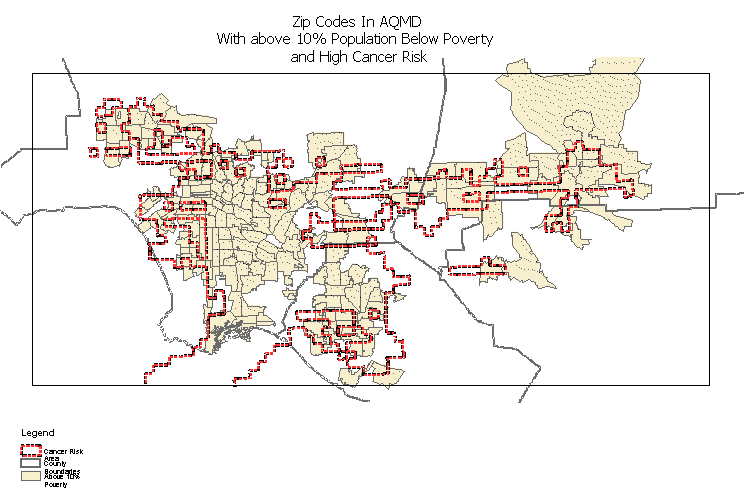
Zip Codes with Risk Greater than 1,000-in-one-million and >10% Population Below Poverty Level
/ / /