 South Coast Air Quality Management District
South Coast Air Quality Management District
South Coast Air Quality Management District
BOARD MEETING DATE: September 13, 2002 AGENDA NO. 7
Execute Contracts to Develop and Demonstrate Hydrogen Fueling Infrastructure Technologies in South Coast Air Basin
SYNOPSIS:
By the middle of this decade, an initial network of compressed-hydrogen fueling stations will be needed in the Basin for the early surge of fuel cell demonstration vehicles that are expected to be introduced by major auto manufacturers. In accordance with the Board-approved Technology Advancement Plan 2002 Update, staff proposes to carry out the initial phase of an effort that would establish a network of fueling sites throughout the Basin. Subsequent phases are outlined, together with a preliminary refueling site map, to give a perspective of the scope of the program. Staff recommends executing contracts with Sunline Services Group, Praxair, Regents of the University of California and BP to develop and install hydrogen refueling infrastructure in various AQMD locations in an amount not to exceed $2,065,000.
COMMITTEE:
Technology, August 23, 2002. Less than a quorum was present during the discussion of this item; the Chairman communicated his concurrence and recommendation that this item be forwarded for Board consideration with no approval or disapproval recommendation from the Committee.
RECOMMENDED ACTION:
Barry R. Wallerstein, D.Env.
Executive Officer
Background
The AQMP has identified the use of alternative clean fuels in mobile sources as a key air quality attainment strategy. CARB has passed regulations that require transit buses to comply with increasingly stringent emission standards including the introduction of zero-emissions transit buses that will most likely be operating on fuel cells. Hydrogen fuel cell vehicles are true zero-emission vehicles, and have the potential to eliminate VOC, NOx, CO and toxic emissions as well as greenhouse gas emissions.
Hydrogen refueling stations are necessary to facilitate the introduction of fuel cell vehicles and the development of an extensive hydrogen fueling network will allow the introduction of hydrogen fueled vehicles throughout the AQMD. Hydrogen can be generated through a variety of technologies. Prominent among these are:
|
a) |
steam reforming of natural gas (STR) |
|
b) |
autothermal catalytic reforming (ATR) |
|
c) |
under-oxidized burner reforming (UOB) |
|
d) |
electrolysis of water using grid power or renewable energy |
Each technology has its relative merits and drawbacks. At this early stage as hydrogen vehicles and the required infrastructure are being introduced, the demonstration of a variety of methodologies and systems will help determine the most effective and efficient methods for hydrogen generation and subsequent fueling. Hydrogen fueling can also be supported by bulk deliveries from an industrial hydrogen plant or direct connection to the Los Angeles Hydrogen Pipeline.
The United States Department of Energy is very actively cofunding many of the projects that apply to AQMD for funding. Once a project has been funded by USDOE, the project concept and contractors are determined, the AQMD must support the project as it was approved by the USDOE. Since many of these project are excellent proposals meeting established AQMD goals as well, Sole Source Justifications are often indicated.
Proposals
Benefits to AQMD
The proposed projects are included in the March 2002 update of the Technology Advancement Plan for the Clean Fuels Program under 2002 CFM4-3, "Development and Demonstration of Distributed Hydrogen Production and Refueling Stations" as key elements in the widespread demonstration and resulting increased use of alternative fuel (hydrogen) vehicles. These projects address the air quality objectives stated in the AQMD’s AQMP, which relies on the expedited implementation of zero-emission vehicles to achieve ambient air quality standards in the South Coast Air Basin. These projects will also assist in ultimately expediting the implementation of fuel cell vehicles, which are advanced zero-emission vehicles. This, in turn, would lead to the direct reductions in NOx, VOC, CO, PM, toxics and global warming emissions from light-duty and medium-duty vehicles
SunLine Transit operations could potentially reduce annual emissions by 17 tons of NOx and 0.14 tons of PM10 if they convert fully to direct hydrogen fuel cell buses assuming a baseline of 40 new natural gas buses with annual average mileage of about 42,000 miles each.
Praxair, Inc. who operates a manufacturing facility in Ontario, produces 30 tons of liquid hydrogen per day. Their support in the development of near-term fueling solutions as well as the augmentation of hydrogen produced using on-site generation techniques will help facilitate the establishment of an effective, comprehensive hydrogen infrastructure.
Air Products and Chemicals (UCI) operates a large (500 tons per day) hydrogen production facility in the industrial sector of Los Angeles and is actively developing various on-site hydrogen fueling systems including mobile fuelers that may be driven from site to site.
BP (DCC) is actively designing and developing a user-friendly hydrogen fueling station with a footprint and appearance similar to modern gasoline fueling stations. Their interest includes codes and permitting issues as well as high customer acceptance.
Sole Source Justification
Section VIII.B.2 of the Procurement Policy and Procedure identifies four major provisions under which a sole source award may be justified. These requests for sole source awards are made under provisions B.2.c.(3): the contractor has ownership of key assets required for project performance; and B.2.d.(1): other circumstances, including projects involving cost-sharing by multiple sponsors. In each of these projects the United States Department of Energy is a sponsor. With this sponsorship, the funding is contingent upon the project design and stated project partners. Alternative contractors may not be considered without express approval from the U.S. DOE. 1) in the SunLine project, the proposed reformer is meant to replace a similar reformer demonstration previously funded by the AQMD. This project could not be completed due to closure of the contractor's business (HbT). The $250,000 of AQMD funds remaining on this previous contract can be reallocated and applied to help fund the proposed project. 2) The partners of the LAX project have concluded land use arrangement with the Los Angeles International Airport for placement of the fueling station in an area that is ideal for the project. 3) The UCI relies upon the participation and cooperation of the ZEV-NET partners. UCI has been the lead in activities of this group and has unique technical skills and resources to implement the project. 4) The BP/Daimler-Chrysler team have proposed an extensive and elaborate multi-year program to develop and demonstrate fuel cell vehicles in the AQMD. The proprietary nature of the vehicles and the fueling systems to be used in the project mandate the selected partners. It is in the best interest of the AQMD to cosponsor the proposed projects, whose participants include: 1. UOP, SunLine Services Group and DOE; 2. Praxair, Los Angeles International Airport, BP and DOE; 3. University of California, Irvine, Air Products and Chemicals and the Cities of Irvine, Anaheim and Huntington Beach as well as the DOE; and 4. BP, Daimler-Chrysler and DOE.
Resource Impacts
|
$125,000 |
|
300,000 |
|
300,000 |
|
350,000 |
|
Total requested funding |
$1,075,000 |
This project is a replacement for an earlier project included in the March 2000 Technology Advancement Plan update for 2001.
|
$500,000 |
|
550,000 |
|
in kind |
|
50,000 |
|
351,000 |
|
Total requested funding |
$1,451,000 |
This project will utilize on-site generation for the initial vehicle demonstration augmented by bulk deliveries as the fleet expands.
|
in-kind |
|
$120,000 |
|
in-kind* |
|
in-kind* |
|
in-kind |
|
$863,400 |
|
Total requested funding |
$983,400 |
| *In-kind contributions estimated to be $55,000 | |
This project will rely on bulk deliveries of hydrogen with possible transition to a biomass reformer at some future time.
|
$1,500,000 |
|
175,000 |
|
200,000 |
|
in-kind |
|
in-kind |
|
500,000 |
|
Total requested funding |
$2,375,000 |
This project will use a combination of on-site generation from a steam/methane reformer and bulk deliveries for hydrogen.
Sufficient funds are available from the Clean Fuels Program Fund, established as a special revenue fund resulting from the state-mandated Clean Fuels Program. The Clean Fuels Program, under Health and Safety Code Sections 40448.5 and 40512 and Vehicle Code Section 9250.11, establishes mechanisms to collect revenues from mobile sources to support projects to increase the utilization of clean fuels, including the development of the necessary advanced enabling technologies. Funds collected from motor vehicles are restricted, by statute, to be used for projects and program activities related to mobile sources that support the objectives of the Clean Fuels Program.
Potential Future Projects
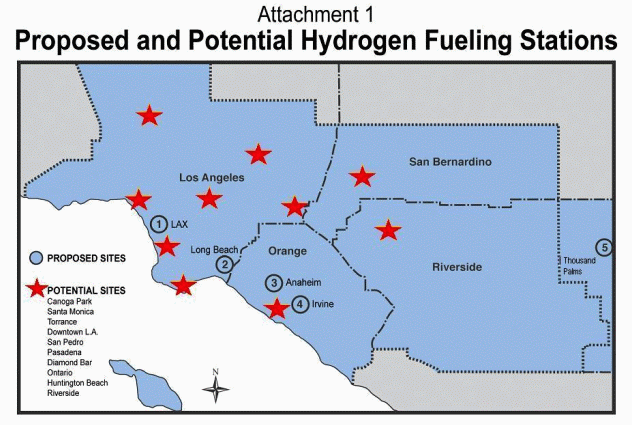
In order to support future hydrogen vehicle demonstration programs and to provide a network of hydrogen fueling locations throughout the AQMD a number of additional projects are being considered. The attached map shows the projects for requested Board action and potential projects (indicated by stars). Staff is currently reviewing these potential sites. Submitted proposals associated with these sites are being developed and finalized while, at the same time, arrangements are being made with vehicle manufacturers to demonstrate hydrogen vehicles in the locations served by these sites. As many of the details of these proposals are highly sensitive until the vehicle manufacturers have finalized their commitments, a brief overview of the potential sites will help clarify future infrastructure projects.
Canoga Park is a site for a mid-size reformer-based hydrogen generation fueling station. This project could provide fuel for 50 to 100 vehicles upon completion.
The City of Santa Monica is developing plans to demonstrate hydrogen vehicles as part of its fleet. The active commitment to convert to clean fuels and feedstocks has motivated the city to develop plans for an electrolyzer-based hydrogen fueling station.
The location of a fueling station in Torrance will support industry-based vehicle demonstrations in that area and allow for maintenance at nearby vehicle manufacturer facilities.
Downtown Los Angeles will provide an integral link in the fueling network and provide a convenient fueling site for Los Angeles fleets.
San Pedro/Wilmington will serve the variety of industries in the area and provide fueling for vehicles operating there but originating elsewhere.
Pasadena/Glendale is being considered as a potential fueling site to help complete the network and to take advantage of many small technology companies in the area as possible fleet locations.
AQMD is consolidating plans for hydrogen fueling at its Diamond Bar headquarters served by bulk deliveries of liquid hydrogen with the potential of fueling vehicles that are designed for liquid hydrogen onboard storage.
The proximity to a large industrial hydrogen production plant and substantial industrial and commercial activities in the area make Ontario a logical location for a hydrogen fueling station.
The City of Huntington Beach is viewed as an expansion of the UC Irvine ZEV-NET program as more vehicles are added.
The City of Riverside has its own utility and a commitment to using clean fuel vehicles and is actively developing plans for hydrogen vehicle demonstrations and the necessary fueling infrastructure for a portion of their fleet.
All of these potential projects are subject to change with the further possibility that new areas and projects will be added later such as fueling stations directly connected to the Los Angeles Pipeline or solar/thermal hydrogen generation.
Attachment
Map of Proposed and Potential Hydrogen Fueling Stations
/ / /