
BOARD MEETING DATE: April 4, 2003
AGENDA NO. 34
Status Report and Public Comments on Draft 2003 AQMP
SYNOPSIS:
On February 25, 2003, staff released the draft 2003 Air Quality Management Plan (AQMP) to address federal and state Clean Air Act requirements. The draft 2003 AQMP incorporates the latest emissions inventory estimates, modeling analysis, demographic forecasts, and control strategies needed for attainment demonstration with federal ambient air quality standards. Since the release of the draft 2003 AQMP, six public workshops have been held throughout the four counties to solicit public comments. This status report presents the key findings, the key issues, and a summary of comments received to date on the draft 2003 AQMP for Board consideration.
COMMITTEE:
Mobile Source and Stationary Source, March 28, 2003, Reviewed
RECOMMENDED ACTION:
- Direct the Executive Officer to present appropriate additional options for the draft 2003 AQMP and its appendices (if necessary) to reflect policy directives by the Board for preparation of the final 2003 AQMP; and,
- Direct the Executive Officer to prepare a revised draft 2003 AQMP for the Board's consideration by summer 2003.
Barry R. Wallerstein, D.Env.
Executive Officer
Background
The purpose of the draft 2003 Air Quality Management Plan (AQMP or Plan) is to set forth a comprehensive program that will lead the South Coast Air Basin (Basin) and those portions of the Salton Sea Air Basin under AQMD's jurisdiction into compliance with all federal and state air quality planning requirements. Specifically, the draft 2003 AQMP is designed to satisfy the California Clean Air Act triennial update requirement and fulfill the AQMD’s commitment to update transportation conformity budgets based on the latest planning assumptions. In addition, the Plan satisfies the requirements of the federal Clean Air Act (CAA) including the attainment demonstration with the federal PM10 standard by 2006 and the federal 1-hour ozone standard by 2010. The Plan will be submitted to U.S. EPA as a SIP revision once it is approved by the AQMD’s Governing Board and the California Air Resources Board (CARB). Timely adoption of the draft 2003 AQMP is also essential for establishing transportation conformity budgets in order to avoid a potential conformity lapse in the region, which could result in the loss of billions of dollars in federal funding for transportation projects.
The draft 2003 AQMP, released on February 25, 2003, incorporates the most recent planning assumptions and the best available information such as revised on-and off-road mobile source emissions inventories based on CARB’s EMFAC2002 and Off-Road Model, respectively; the use of a new 1997 meteorological episode for ozone; expanded air quality modeling analysis; and forecast assumptions based on the 2001 Regional Transportation Plan (RTP) developed by the Southern California Association of Governments (SCAG). The draft Plan also includes an updated control strategy for demonstrating attainment with the federal air quality standards for ozone and PM10; replaces the 1997 attainment demonstration for the federal carbon monoxide (CO) standard; and provides a basis for a CO maintenance plan.
The draft 2003 AQMP builds upon improvements accomplished from the previous plans and incorporates all feasible control measures identified thus far. This Plan revision was developed based on input and suggestions from internal and external brainstorming sessions as well as input from the AQMP Advisory Group and the AQMP Scientific, Technical, and Modeling Peer Review Advisory Group. Development of the draft 2003 AQMP was also coordinated with CARB and SCAG staff.
This status report on the draft 2003 AQMP provides a summary of the key findings, key policy issues, and a summary of the public comments received to date.
Key Findings
- Current Air Quality – The Basin is currently in attainment with the federal ambient air quality standards for nitrogen dioxide, sulfur dioxide, and lead, but is classified as non-attainment with the federal ozone and PM10 standards. The Basin has met the CO standard based on the air quality data in the last two years. Because of existing air quality regulations adopted and implemented by AQMD, CARB, and U.S. EPA, the air quality in the Basin has improved significantly. For example, the total number of days exceeding the federal 1-hour ozone standard decreased to 36 days in 2001 compared to about 130 in 1990. Similarly, the exceedances of the federal 24-hour PM10 standard occurred on only two days in 2001 and were confined to the Riverside/San Bernardino area. However, despite the anticipated trend in air quality improvement due to adopted regulations, the maximum ozone and PM10 concentrations, without additional controls, are estimated to be about 23 percent higher than the federal ozone standard in 2010 and slightly higher than the federal PM10 standard in 2006, if additional reductions are not obtained.
- Base and Future Year Emissions Inventory - The draft 2003 AQMP incorporates the most up-to-date emissions inventory for all source categories including the CARB's latest EMFAC2002 on-road motor vehicle emissions model and new Off-Road Model as well as the most recent point and area source inventories developed by AQMD and CARB. In addition, the latest demographic growth forecasts from the 2001 RTP were used to estimate future emissions. The most notable inventory change is associated with mobile sources because of the use of new inventory models and updated activity and emission factor data. These improvements result in a substantial increase in emissions estimates (i.e., approximately 90 tons per day of VOC and 230 tons per day of NOx in 2010).
The top seven major VOC source categories representing about 75% of the total VOC emissions in 2010 include: passenger cars and light/medium-duty trucks; consumer products; industrial coatings; off-road equipment; recreational boats; architectural coatings; and petroleum marketing. The top seven NOx source categories representing over 80% of the overall NOx emissions in 2010 include: heavy heavy-duty trucks; passenger cars and light/medium-duty trucks; off-road equipment; ships and commercial boats; medium heavy-duty trucks; RECLAIM program; and aircraft. Of the total VOC and NOx emissions in 2010, CARB and U.S. EPA have jurisdiction over approximately 80% of these emissions while the AQMD has responsibility over the remainder of emissions. The increased overall future emission estimates (primarily due to mobile sources) have resulted in more emission reductions needed for attainment demonstration.
- Control Strategy - The overall control strategy proposed in the draft 2003 AQMP is designed to achieve approximately 320 tons per day of VOC and 210 tons per day of NOx in 2010. The strategy consists of four main components: 1) AQMD's Stationary and Mobile Source Control Measures; 2) State and Federal Source Control Measures proposed by CARB; 3) Transportation Control Measures provided by SCAG; and 4) Long-Term Control Strategy. The AQMD’s control strategy in the draft Plan was developed based on the remaining control measures from the 1997/99 SIP, replacement of long-term strategies with more specific short-term control measures (where feasible), and development of new feasible control measures based on current technology assessments. The AQMD’s strategy includes 24 short-term control measures aimed at reducing emissions from source categories under the AQMD’s jurisdiction. These measures are estimated to achieve a total of 21.5 tons per day (t/d) of VOC, 5 t/d of NOx, 2 to 6 t/d of PM10, 2 t/d of SOx, and over 10 t/d of ammonia emission reductions in 2010.
The CARB’s proposed strategy includes 23 short-term control measures targeting source categories that are under state jurisdiction (i.e., on-road and off-road mobile sources, consumer products). The emission reductions associated with CARB’s short-term measures are 71 tons per day of VOC and 46 tons per day of NOx reductions. SCAG’s transportation control measures are based on the 2001 RTP with an estimated emission benefit of about 4 tons per day of VOC reductions in 2010. However, SCAG staff has indicated that emission reductions can be 17 tons per day of VOC if air quality impacts of changes in land use (due to proposals contained in SCAG’s 2001 RTP) are incorporated. These revised estimates would be incorporated into the revised draft Plan. Implementation of all feasible short-term control measures proposed by AQMD, CARB, and SCAG in the draft 2003 AQMP will achieve an estimated 96 tons per day of VOC reductions and 51 tons per day of NOx reductions.
The long-term strategy in the draft 2003 AQMP is proposed because of the significant additional emission reductions required for attainment demonstration beyond the short-term control measures mentioned above. The emission reductions from the long-term strategy (referred to as "black box" control measures), totaling 226 tons per day of VOC and 161 tons per day of NOx, will require development and commercialization of new control technologies or improvement of existing controls and are authorized under the federal CAA.
- Air Quality Modeling and Future Air Quality – Air quality modeling in the draft 2003 AQMP was conducted using the Urban Airshed Model (UAM) with the Carbon Bond IV (CB-IV) chemistry module to demonstrate future year (2010) attainment of the federal 1-hour ozone standard. For PM10, the UAMAERO-LT model was used to demonstrate attainment of the federal PM10 standards in 2006.
The UAM ozone attainment demonstration was based on two meteorological episodes: August 4-6, 1997 and August 27-28, 1987. Model input data supporting the UAM simulations were derived from intensive field monitoring conducted during the 1997 Southern California Ozone Study (SCOS97) and the 1987 South California Air Quality Study SCAQS. The SCOS97 study benefited from state-of-the art upper air wind and temperature monitoring and recently developed advances in particulate and oxides of nitrogen sampling technology. The 1987 SCAQS episode was also retained as a measure of consistency between modeling attainment demonstrations.
The modeling analysis in the draft 2003 AQMP provides for attainment of the federal ozone and PM10 standards in the Basin based on implementation of the proposed control strategies. However, the analysis shows a lower carrying capacity (about 100 tons per day of VOC compared to the 1997/1999 SIP) primarily because of the use of the new more restrictive 1997 meteorological episode. The 2010 carrying capacity in the draft 2003 AQMP is 310 tons per day of VOC and 530 tons per day of NOx emissions and is comparable to the carrying capacity in the 1994 SIP. A carrying capacity is defined as the maximum level of emissions while still allowing the attainment and maintenance of an ambient air quality standard for a pollutant. This means that significant emissions reductions are needed beyond the existing regulations for attainment demonstration with the federal 1-hour ozone standard by 2010. Specifically, 320 tons per day of VOC reductions and 210 tons per day of NOx reductions must be achieved by 2010 if this region is to demonstrate attainment.
- New PM2.5 and Ozone 8-hour Standards - In 1997, U.S. EPA promulgated new federal standards for ozone (8-hour) and fine particulate matter (PM2.5) which are more restrictive than the current standards. Based on preliminary feedback from U.S. EPA, the likely attainment dates for the PM2.5 and ozone standards will be 2014 and 2021, respectively. The state implementation plans that will incorporate attainment demonstrations with these standards are expected to be required by 2007. Although the new standards are not required to be addressed in the draft 2003 AQMP, the modeling analysis indicates that the proposed control strategy in the draft Plan will not be adequate for meeting these standards and additional reductions will be required. The control strategy in the draft 2003 AQMP is, however, designed to make expeditious progress toward attainment of these standards by requiring the maximum reductions feasible.
Key Policy Issues
- Selection of Air Quality Modeling Tool and Meteorological Episode – The air quality models and meteorological episodes are critical in establishing the carrying capacities for attainment demonstration. UAM with CB-IV chemistry was selected as the primary modeling tool due to its ability to recreate the peak ozone concentrations observed during the primary ozone episode. In addition, staff has extensive experience conducting the model and evaluating its simulations. UAM also continues to be U.S. EPA’s recommended model for urban scale attainment demonstrations. In addition to the UAM model, staff has also been evaluating other available air quality models and chemistry modules including the California Photochemical Grid Model (CALGRID) with SAPRC99 chemistry module and the Comprehensive Air Quality Model with Extensions (CAMx). An expert panel of air quality researchers was convened in December 2002 to review the draft 2003 AQMP modeling efforts. Their general recommendation supported the transition to the CALGRID/SAPRC99 modeling system. While the CALGRID/SAPRC99 modeling system has shown promise for its application in the draft 2003 AQMP, uncertainties in model performance, in particular, the model’s inability to simulate peak base year ozone concentrations has restricted its use at this time. In addition, complexities in the speciation of VOC emissions, both anthropogenic and biogenic, are currently being evaluated. However, based on the expert review panel recommendations, the AQMD staff is committed toward using the CALGRID/SAPRC99 modeling system when the technical issues identified here are resolved. Like CALGRID/SAPRC99, CAMx with SAPRC99 chemistry, is also being evaluated as a modeling tool for use in future AQMP attainment demonstrations. CALGRID and CAMx simulations were close in model performance to UAM but each model under-predicted peak ozone concentrations in the base year evaluation. Initial Simulations with CALGRID/SAPRC99 support the UAM attainment demonstration; however, the model performance requires further evaluation. For that reason, staff recommends primary reliance on the UAM model.
Selection of the 1997 meteorological episodes was based on U.S. EPA’s requirement that meteorological episodes and the data supporting the modeling attainment demonstration be no more than ten years old. The meteorological and air quality field data monitored during the August 1997 episode, has been extensively analyzed over a two-year period by the SCOS97 Meteorological Working Group as well as NOAA and contracted air quality consultants. The data has undergone extensive quality assurance and the ensuing meteorological model input developed from the data has been evaluated using the state-of-science meteorological models. Two additional SCOS97 meteorological episodes were considered for potential simulation: (1) September 28-29, 1987 – a weekend episode and (2) October 31-November 1, 1997. Model performance for the September episode did not meet EPA criteria and it was excluded from this analysis. One additional episode was considered, July 14-18, 1998; however, that episode represented meteorological conditions that are severe and rare, occurring less than once in a four-year period. As a consequence, that episode was excluded from the attainment demonstration.
- Assignment of "Black Box" Reductions - The size of the "black box" (i.e., long-term emission reductions which rely on future technology advances) represents a tremendous challenge to the region considering the seven years remaining for attainment demonstration. Therefore, all agencies will have to contribute to achieving a fair share of reductions toward the attainment goal. At issue is the assignment of responsibility to each agency (i.e., AQMD, CARB, U.S. EPA, and SCAG) for reductions needed under the long-term strategy. As of 2002, the AQMD has already exceeded its 1997/99 SIP target by 42 tons per day of VOC emissions by adopting a number of stationary source regulations since October 1996; whereas the CARB and the U.S. EPA have not yet fully achieved their reduction commitments in the 1997/99 SIP. The shortfall in emission reductions is further compounded by the increase in the mobile source inventory due to the revised inventory methodology and the additional reductions needed to meet the lower carrying capacity.
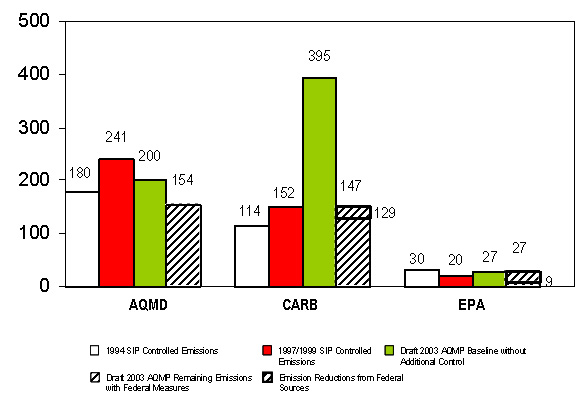
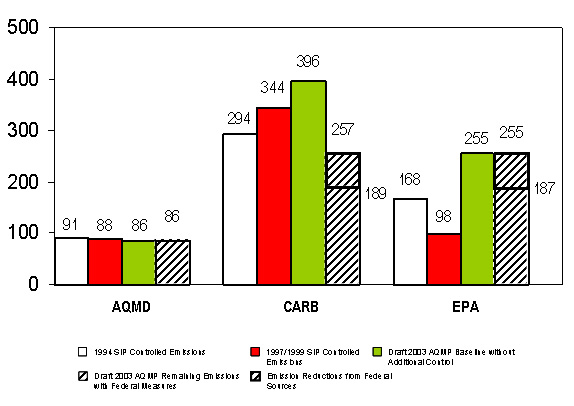
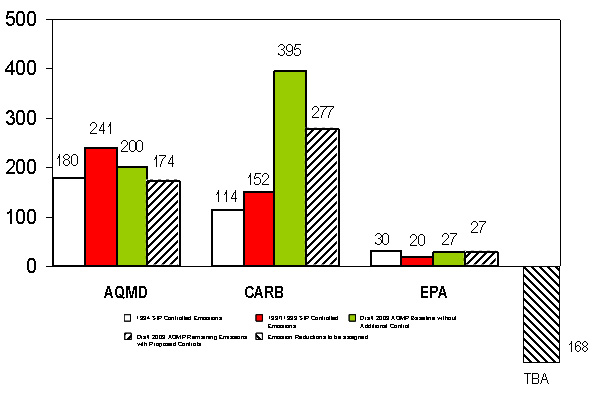
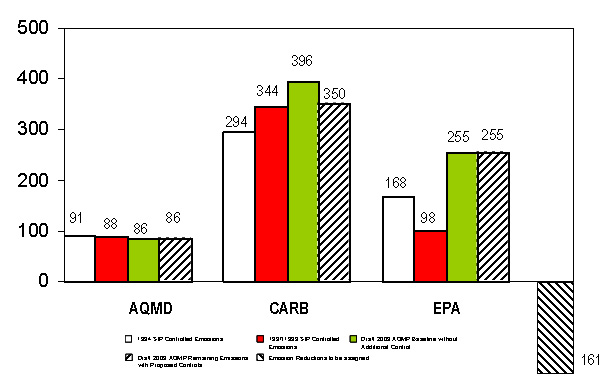
Two scenarios for distributing the long-term reductions are presented in the draft 2003 AQMP for the Board's consideration. Under Scenario 1, the AQMD is committed to achieve an additional 31 tons per day of VOC reductions beyond the short-term measures through technology assessments and implementation of additional feasible control measures identified later. Under this scenario, the responsibility for achieving the remaining emissions reductions is assigned to CARB with contribution by U.S. EPA since they have jurisdiction over about 80% of VOC and NOx emissions combined. Under Scenario 2, the reduction responsibility for the long-term strategy will not be assigned to any agency at this time but will be determined at a later date through a collaborative effort among agencies. AQMD staff believes that the first scenario is more appropriate because it represents a more equitable assignment of reduction responsibility based on the agencies’ commitments in the 1997/99 SIP and contribution to emissions. The following graphs represent the carrying capacities in the 1994 and 1997 SIPs as well as the draft 2003 AQMP baseline (without controls) and controlled emissions for both scenarios by agency.
Comparison of VOC Emission Targets by Agency – 2010
(Scenario 1)
Comparison of NOx Emission Targets by Agency – 2010
(Scenario 1)
Comparison of VOC Emission Targets by Agency – 2010
(Scenario 2)
Comparison of NOx Emission Targets by Agency – 2010
(Scenario 2)
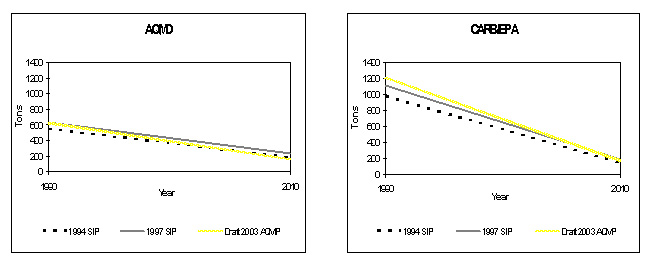
The following graphs depict the overall rate of VOC reduction by agency in the last three plans. As indicated, the AQMD will achieve a higher rate of reduction in this plan (75% vs. 67% reduction) whereas CARB/U.S. EPA will achieve a comparable rate of reductions (87% vs. 85% reduction) primarily because of the increased mobile source emissions inventory estimates.
Comparison of VOC Rate of Reduction Between SIPs
- Federal Responsibility – Federal sources (i.e., aircraft, ships, trains, 49-state vehicles, and farm and construction equipment less than 175 hp) contribute to about 34% of NOx emissions in the Basin in 2010. Although under the CARB's long-term strategy, 18 tons per day of VOC reductions and 68 tons per day of NOx reductions are expected to be achieved from federal sources, the U.S. EPA staff has indicated that emission reductions responsibility should not be assigned to the federal government for these sources. Accordingly, inclusion of federal assignment in the draft Plan would result in the disapproval of the Plan by U.S. EPA. Therefore, the draft 2003 AQMP provides two options for attainment demonstration, with and without reductions from federal sources. Although both options would show attainment with the federal ozone standard, the option excluding emission reductions from federal sources would significantly hamper the continued progress toward attaining the PM2.5 standard since NOx emissions (associated with federal sources) are major contributors to the formation of PM2.5 emissions. (Exceedance of the PM2.5 standard will be about five percent higher without federal NOx reductions.) Without an adequate and fair share level of reductions from federal sources, the emission reduction burden would unfairly be shifted to stationary sources and mobile sources under AQMD and state jurisdiction. Therefore, staff believes that U.S. EPA should make every effort to develop stringent new standards as well as retrofit requirements for federal sources and do its fair share in achieving all feasible reductions, thereby helping the region comply with the federal requirements.
Public Review Process and Comments
Because of the significant policy issues raised by the draft 2003 AQMP, the AQMD released a Preview of the draft 2003 AQMP in January 2003 to identify key issues and solicit public comments at an early stage. The Preview document was presented to the AQMP Advisory Groups and was made available to the Public.
Also, subsequent to the release of the draft 2003 AQMP in February 2003, six public workshops were held throughout the four counties in March 2003, which were attended by over 250 people. A number of oral comments on the draft 2003 AQMP were received at the public workshops, a summary of which is provided in Attachment A.
California Environmental Quality Act
Pursuant to the California Environmental Quality Act (CEQA), staff is preparing a draft Environmental Impact Report (EIR) for the proposed draft 2003 AQMP. The scope of environmental assessment would include measures proposed by SCAG, CARB, and AQMD. A Notice of Preparation/Initial Study was released to the public on August 29, 2002, for a 30-day review and comment period. The six regional public workshops also served as CEQA scoping sessions. The draft EIR will be released for a 45-day review and comment period by early April 2003. Responses to comments received on the draft EIR will be incorporated into the Final EIR for the 2003 AQMP.
Several alternatives will be evaluated as part of the CEQA analysis. These include: 1) No Project Alternative (i.e., remaining 1997/1999 SIP measures); 2) Less NOx Reduction Alternative (i.e., excluding emission reductions associated with federal sources); 3) More VOC Reduction Alternative (i.e., lower VOC carrying capacity to provide additional compliance margin in the event an alternative air quality model/chemistry package is used); 4) Less NOx and More VOC Reduction Alternative; and 5) Least Toxic Alternative (based on electrification of marine hotelling operations and stationary agricultural pumps and PM traps for heavy-duty on-road vehicles).
Analysis of long-term "black box" measures in the EIR will focus on those source categories (e.g., on-road and off-road mobile sources, consumer products, coatings/solvents, etc.) where further emission reductions will be required to demonstrate attainment. The analysis will assume that the types of impacts from short-term control measures that would control emissions from these sources would be similar to impacts for black box measures, so total impacts in the environmental areas under consideration will be of greater magnitude. Since the project alternatives differ primarily by placing greater or lesser emphasis on emission reductions from black box measures, a similar approach will be taken for comparing the relative merits of the project alternatives.
Socioeconomic Analysis
The socioeconomic analysis of the 2003 AQMP will include the cost, benefit, and other socioeconomic impacts of meeting the federal and state air quality standards. The analysis will be presented at the sub-county level (19 regions within the four-county area). This will be the first time such detailed geographic information is systematically presented as part of AQMP development and evaluation. However, since up to 70% of reductions would come from long-term ("black box") measures, the entire benefit of clean air and only measures with cost data will be included for the secondary impact analysis.
Availability of Draft 2003 AQMP Documents
The draft 2003 AQMP main document and the following draft Appendices to the draft 2003 AQMP are available on AQMD's Website at http://www.aqmd.gov/aqmp/03aqmp.htm and are also available upon request from the District’s Public Information Center.
Appendix I - Health Effects
Appendix II - Current Air Quality
Appendix III - Base and Future Year Emission Inventories
Appendix IV-A - District’s Stationary and Mobile Source Control Measures
Appendix IV-B - State and Federal Element of the South Coast State Implementation Plan
Appendix IV-C - Transportation Control Measures
Appendix V - Modeling and Attainment Demonstration
The draft Environmental Impact Report will be available in early April. In addition, the Socioeconomic Impact Report for the draft 2003 AQMP will be available by the end of April.
Summary of Oral Comments on the Draft 2003 AQMP Received at the Public Workshops
/ / /