
BOARD MEETING DATE: August 1, 2003
AGENDA NO. 26
REPORT:
Progress Report on Installation of NOx Control Equipment at RECLAIM Facilities, and RTC Trading Activities
SYNOPSIS:
On May 11, 2001 the Board amended Regulation XX – RECLAIM, to address increased demand for NOx RTCs due to California’s energy crisis. The amendments sought to reduce demand for RTCs from power producing facilities by imposing restrictions on their trading activities and requiring them to install Best Available Retrofit Control Technologies (BARCT). Additionally, the amendments also imposed a requirement for larger RECLAIM facilities to implement plans to ensure compliance with annual NOx allocations either by installing control equipment, making process modifications, or purchasing NOx RTCs. To improve market efficiency, the amendments required additional trade information and more timely disclosure of trade activities. This report summarizes information regarding permit applications received by AQMD since May 2001 for installation of NOx control equipment and quarterly trading activities. This information has been provided to the Stationary Source Committee on a monthly basis.
COMMITTEE:
Stationary Source, July 25, 2003, Reviewed
RECOMMENDED ACTION:
Receive and file.
Barry R. Wallerstein, D.Env.
Executive Officer
Background
On May 11, 2001 the Board amended RECLAIM rules to address increased demand for NOx RTCs due to California’s energy crisis at that time. The amendments sought to reduce the demand for RTCs from power producing facilities by imposing restrictions on their trading activities and requiring them to install BARCT. Additionally, the amendments also imposed a requirement for larger facilities to implement plans to ensure compliance with annual NOx allocations, either by installing control equipment, making process modifications, or purchasing NOx RTCs. To better assess the effectiveness of the program, the Board directed staff to track and report to the Stationary Source Committee and the Board on permit applications received by AQMD for installation of NOx control equipment and RTC trading activities during Compliance Years 2001 and 2002. Since June 2001, monthly reports have been submitted to the Stationary Source Committee on these subjects. This report summarizes air pollution control equipment installation activities and trading activities from January 1, 2001 through June 30, 2002. This period represents Compliance Years 2001 and 2002 for Cycle 1 and Cycle 2 facilities.
Applications for Installation of NOx Control Equipment
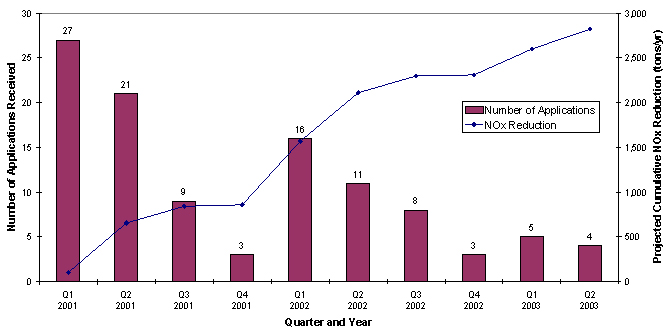
From January 1, 2001 through June 30, 2003, AQMD received 107 applications from 39 RECLAIM facilities for the installation of NOx control equipment. Based on maximum equipment rating, or Compliance Year 2000 emission levels where available, these installations are projected to reduce over 2,800 tons of NOx emissions per year when they become fully operational. Figure 1 shows the number of applications received quarterly and the projected cumulative amount of emissions reduced.
Figure 1 Projected Cumulative NOx Emission Reduction from Applications Received
A large variety of NOx Control equipment was proposed to be installed ranging from selective catalytic reduction (SCR) for utility boilers and Fluid Catalytic Cracking Units (FCCU) at power plants and refineries to process temperature control for drying ovens. Other combustion modification and control technologies proposed or installed include low NOx burners, flue gas recirculation, steam injection, DeNOx catalysts, low temperature oxidation (LoTOx) and Oxy-fuel burners. Among these 39 facilities, 6 are power producing facilities and 15 are larger RECLAIM facilities subject to the compliance plan requirements under Rule 2009 – Compliance Plans for Power Producing Faculties, and Rule 2009.1- Compliance Plan and Forecast Reports for Non-Power Producing Facilities, respectively. Detailed information regarding each of the proposed control projects is listed in Appendix A.
RTC Trading Activities
During California’s energy crisis in the 2000-2001 timeframe, the RECLAIM market experienced a sudden increase in the demand for NOx RTCs. The increased demand was the result of an increase in electricity production in 2000 at power plants in the South Coast Air Basin as compared to the previous years since the start of the RECLAIM program coupled with the general lack of emission control equipment installation at these facilities. The high demand for NOx RTCs caused prices to spike up sharply beginning in calendar year 2000. During 2000, power plants acquired 4,450 tons of NOx RTCs for a total reported purchase price of $111.7 million. The increase in NOx RTC prices continued into calendar year 2001 reaching a record of $62 per pound ($124,000 per ton) in February 2001.
After the RECLAIM rule amendments in May 2001, NOx RTC prices began to decline, and the transaction volume returned to a normal active level as summarized in Table 1 below.
Table 1 Annual RTC Transactions
|
Calendar |
NOx RTCs |
SOx RTCs | ||
|
Quantity Traded |
Total Cost |
Quantity Traded |
Total Cost |
|
|
2001 |
8,597 |
294 |
5,532 |
22 |
|
2002 |
5,526 |
31 |
2,288 |
18 |
|
2003 |
2,162 |
6 |
260 |
2 |
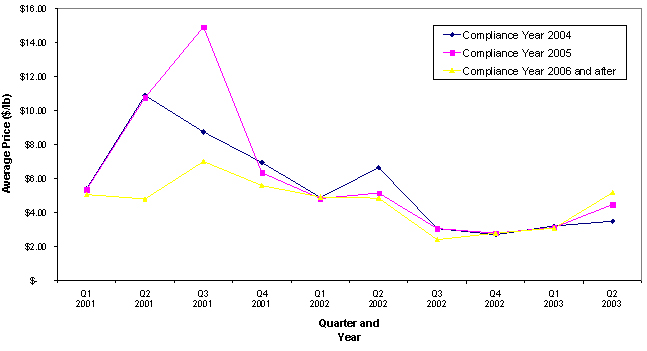
The May 2001 amendments removed from the RECLAIM market the NOx RTC demand from the power producing facilities. This action resulted in an immediate drop in both transaction volume and price. The quarterly summary of NOx RTC transaction volume and price in Figure 2 shows that after the first quarter of 2001, the transaction volume returned to the same level as in the year prior to the year 2000 energy crisis in California. However, trade data summarized in this figure and in Figure 3 reflects a steady drop in NOx RTCs prices from a peak of $62 per pound in the first quarter of 2001 to an average price of less than $1 per pound for Compliance Year 2002 RTCs in the first quarter of 2003. The drop in price was most apparent in NOx RTCs valid for Compliance Year 2003 and earlier. On the other hand, quarterly average prices for RTCs valid for Compliance Year 2004 and later fluctuated between $2 and $7 per pound after 2001 as illustrated in Figure 4. It should be noted that NOx RTCs valid for Compliance Year 2006 and later are traded at essentially the same prices.
Figure 2 Quarterly NOx RTCs Traded
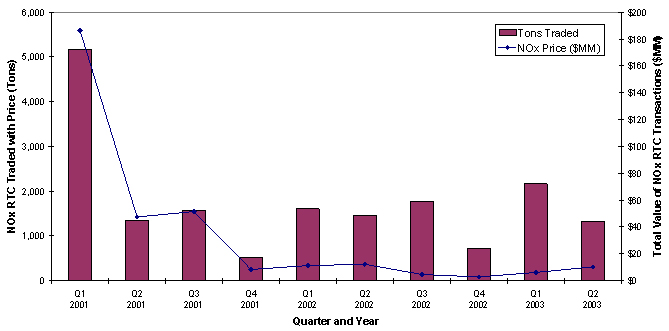
Figure 3 Quarterly Average NOx RTCs for Compliance Year 2003 and Earlier
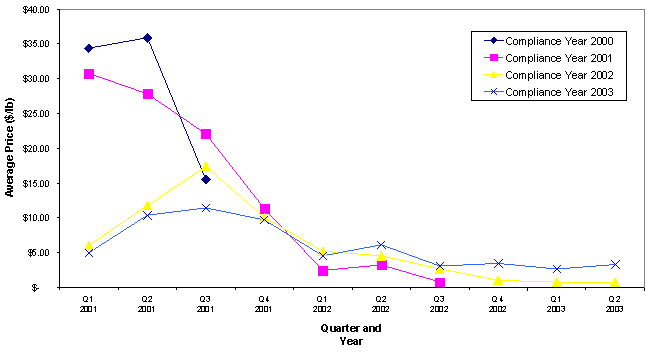
Figure 4 Quarterly Average NOx RTCs for Compliance Year 2004 and Later
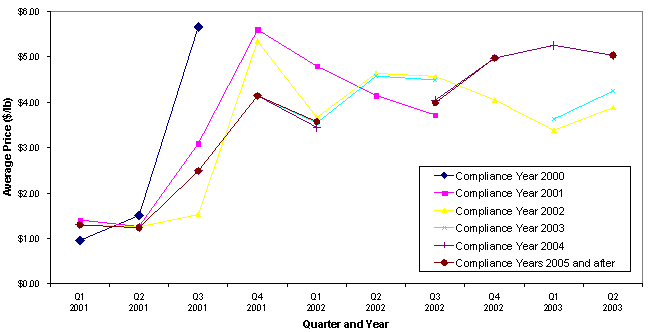
Although the May 2001 RECLAIM amendments focused on stabilizing NOx RTC prices, the SOx market has also benefited from the improved trade disclosure requirements. The additional decline in SOx allocations as originally designed in the program for compliance years 2001, 2002 and 2003 has resulted in the reduction of the RTC supply. The reduced supply resulted in a significant increase in average price per pound of SOx RTCs beginning in the third quarter of 2001. Since then, the average prices have fluctuated between $3.50 and $5.50 per pound. Since the refinery sector is the major emitter of SOx, several refineries have already taken steps using emerging technologies such as DeSOx and advanced SOx scrubbing technologies to reduce SOx emissions at their facilities and a few others are proposing to make further reductions in SOx emissions over the next few years. Figure 5 shows the quarterly average SOx RTC prices. As shown in Figure 5, average prices for SOx RTCs for Compliance Year 2004 and later were essentially the same. Detailed quarterly NOx and SOx RTC trade data are included in Appendices B and C, respectively.
Figure 5 Quarterly Average SOx RTCs
Conclusion
The RECLAIM rule amendments in May 2001 resulted in a number of NOx control projects being proposed, thus reducing the demand for NOx RTCs in the RECLAIM market. Furthermore, additional reporting requirements in the amended rules allowed AQMD to make trade information more readily available to the public, thereby making the market more transparent. The amendments allowed power producing facilities to participate in the RECLAIM Mitigation Fees Program and resulted in reduction in both credit price and activities. After the rule amendments, the credit transaction volume and prices returned to a normal active level prior to California’s energy crisis. RECLAIM facilities submitted permit applications for NOx reduction projects projected to reduce over 2,800 tons per year of NOx emissions when fully implemented. Most power producing facilities have installed NOx control equipment that would allow an increase in electricity production while maintaining emissions well below allocations. At the June 2003 Board meeting, the Board directed staff to initiate the rule amendment process to allow power producing facilities to rejoin the full RECLAIM market at the beginning of 2004 with appropriate safeguards to ensure the market stability.
Attachments (1,109 KB)
| Appendix A | - List of NOx Control Applications Received Between January 2001 and June 30, 2003 |
| Appendix B | - Quarterly NOx RTC Prices Between January 2001 and June 30, 2003 |
| Appendix C | - Quarterly SOx RTC Prices Between January 2001 and June 30, 2003 |
/ / /