
BOARD MEETING DATE: December 5, 2003
AGENDA NO. 29
Amend Rule 1113 - Architectural Coatings
SYNOPSIS:
The proposed amendments to Rule 1113 will further reduce VOC emissions from architectural coatings by setting future effective limits for several specialty coating categories, and will implement the coatings portion of Control Measure CTS-07 of the 2003 Air Quality Management Plan (AQMP).
COMMITTEE:
Stationary Source, September 26, 2003, October 24, 2003, November 21, 2003 Reviewed
RECOMMENDED ACTION:
Adopt the attached resolution:
- Certifying the Final Environmental Assessment (EA) for Proposed Amended Rule 1113 - Architectural Coatings, and
- Adopting proposed amendments to Rule 1113 - Architectural Coatings.
Barry R. Wallerstein, D. Env.
Executive Officer
Background
Architectural coatings are one of the largest non-mobile sources of VOC emissions
in the South Coast Air Quality Management District (AQMD). Rule 1113 is applicable
to manufacturers, distributors, and end-users of architectural coatings. These
coatings are used to enhance the appearance of and to protect homes, office
buildings, factories and other structures, and their appurtenances on a variety
of substrates. The coatings may be applied primarily by brush, roller, or spray
guns; and those applying those coatings include homeowners, painting contractors,
or maintenance personnel. Rule 1113 was first adopted in 1977, and has undergone
numerous amendments since then.
PAR 1113 - Architectural Coatings has been developed to implement Phase III of Control Measure CTS-07 of the 2003 AQMP and the federally approved 1999 Amendment to the 1997 Ozone SIP Revision for the South Coast Air Basin. In addition as part of a federal consent decree between the AQMD and the Natural Resources Defense Council, the Coalition for Clean air and Communities for a Better Environment, the AQMD is required to implement CTS-07 (P3). The control measure proposes to further reduce VOC emissions from various architectural coating categories and thinning and cleanup solvents used in the architectural and industrial maintenance coating industry. The reduction in VOC emissions from the use of cleanup solvents to implement CTS-07 was addressed in a separate amendment to Rule 1171 - Solvent Cleaning Operations on November 7, 2003.
Rule 1113 was last amended on December 6, 2002 to re-adopt court invalidated May 1999 amendments.
Also, following the May 14, 1999 amendments to Rule 1113, CARB developed a suggested control measure (SCM) for architectural coatings that was largely based on the interim VOC limits and the averaging provision of Rule 1113 as adopted in May 1999. The SCM, which has January 1, 2003 as the main compliance date for most coating categories and January 1, 2004 for industrial maintenance coatings, has been adopted by 22 of the 35 local air districts in California that have an architectural coating rule.
Proposal
The proposed amendments will lower the current VOC limit for the following specialty
coating categories: clear wood finishes including varnishes and sanding sealers,
roof coatings, stains, and waterproofing sealers including concrete and masonry
sealers. The proposed VOC limits and effective dates are as follows:
- January 1, 2005 for roof coatings (EPA Energy Star certified roof coatings
of 100 g/l or less can be sold until January 1, 2007)
- July 1, 2006 for clear wood finishes and waterproofing sealers
- July 1, 2007 for exterior stains
The exemption for quart containers or less from having a VOC limit is proposed to be eliminated for the coating category of clear wood finishes, effective July 1, 2006. Based on comments from industry, staff has also included an alternate proposal for your consideration that phases out the exemption in July 1, 2008, and in the interim, establishes maximum VOC limits for clear wood coatings in those containers.
The staff recommendation to eliminate the exemption in 2006 and the alternative proposal to phase it out in 2008 are Version 1 and Version 2, respectively, of the proposed rule in Attachment F. Additional amendments include expansion of coating categories allowed to participate in the Averaging Compliance Option, clarification of coating categorization, an addition of varnish to the technology assessment requirement, expansion of the small manufacturer's exemption and other minor administrative amendments.
Emission Inventory and Emission Reduction
The emission inventory of architectural coatings is calculated from the
CARB 2001 Architectural Coatings Survey. The survey is based on reported sales
of architectural coatings in California. The share of statewide sales in the
AQMD is based upon the percentage of the California population within the AQMD
jurisdiction. The inventory for the AQMD was determined to be 5.53 tons per
day of VOC for the coating categories proposed for amendment.
The emission reductions are also determined from the survey data by calculating the expected emissions on a solids basis as if all coatings comply with the proposed limits and comparing that to the current inventory. The difference is the emission reduction and it is expected to be 3.73 tons per day of VOC.
Cost-Effectiveness
Staff has estimated the cost-effectiveness to be in the range of $4,229
to $11,405 per ton of VOC reduced. The low end of the range was determined based
on the retail cost of compliant coatings reported by coating manufacturers surveyed
by staff. The upper end of the range was derived by estimating the increased
cost at the retail level due to the increase in cost of raw materials, reformulation,
testing and packaging a new product prior to commercialization. The range of
cost-effectiveness is within that for other VOC rules adopted by the AQMD Board.
Issues
There are a number of specific comments that have been addressed in the
Final Staff Report and Attachment D. The issues fall into three major categories.
These are availability of compliant products, time for manufacturers to reformulate
existing products into compliant products and elimination of the small container
exemption. The proposed limits are based upon coatings currently available in
the marketplace. Based upon the CARB 2001 Survey data, there are many compliant
coatings offered by many manufacturers for each category and the current market
penetration based on sales ranges from eleven percent for stains to fifty-one
percent for roof coatings. Notwithstanding, staff is recommending a 2 ½
to 3 ½ year future effective date for most of the categories to allow
other manufacturers time to develop additional compliant products. In addition,
manufacturers will have an additional three-year product sell through period
and the Averaging Compliance Option that can provide additional flexibility
to transition to compliant products.
Regarding the small container exemption for clear wood finishes, there appears to be no justification for such an unlimited exemption and its continuance is actually counter-productive to air quality goals. The CARB Survey data indicates a relatively high percentage of sales of products complying with the proposed limits in the larger containers. However, quite the opposite is true for sales in the smaller containers. A large percentage of products sold in the small containers do not even meet current limits that would otherwise be applicable except for the small container exemption. To further compound the matter more than 40% of total gallonage sold of clear wood finishes is in small containers and, based upon small container sales reported to the AQMD, the volume of these small container sales has increased significantly in the last two years. Elimination of the exemption alone for clear wood finishes will achieve close to a ton per day of emission reductions. Staff has prepared two proposals to deal with this small container exemption. The first proposal eliminates the exemption for small container clear wood finishes effective July 1, 2006. The alternative proposal provides an additional two-years for the phase out of the exemption with interim VOC limits for those clear wood finishes sold in small containers.
CEQA
Pursuant to the CEQA and AQMD Rule 110, AQMD has prepared an EA for the proposed
amendments to Rule 1113. The Draft EA finding no significant impacts was circulated
for a 30-day public review and comment period from September 25, 2003 to October
24, 2003. Three comment letters were received on the Draft EA and responses
to the comment letters have been incorporated into the Final EA for the proposed
project.
Socioeconomic Analysis
Proposed amendments to Rule 1113 would potentially impact manufacturers and
end users of architectural coatings. The former belongs to the industry of chemical
and allied products (SIC 2851 or NAICS 325510), and the latter are a part of
the industry of painting and paper hanging (SIC 1721 or NAICS 235210) and do-it-yourself
consumers and homeowners. The total annualized cost of the proposed amendments
is projected to be $14.76 million using the high-end cost estimate. It is estimated
that approximately 503 jobs could be forgone annually from the future projected
growth in the four-county area between 2005 and 2020.
AQMP and Legal Mandates
The 2003 AQMP estimates architectural coating emissions for the Summer Planning
Inventory at 60.0 tons per day in 1997, reducing to 28.3 tpd by the year 2010
without additional controls on architectural coatings. Control Measure CTS-07
was included in the 1994 and 1997 AQMPs as well as the 1999 amendment to the
1997 Ozone SIP. This control measure proposed to reduce the VOC emissions through
the establishment of lower VOC-limits and the expansion of the applicability
of Rule 1113. At that time, the proposed reduction target for this control measure
was set at 75 percent. Control Measure CTS-07 has been implemented, in part,
with the amendments to Rule 1113 in 1996 and 2002 which have achieved greater
than 50 percent emission reduction from this source category.
These proposed Rule 1113 amendments will implement a portion of Phase III of the control measure. The current proposal primarily relies on commercially available low-VOC formulations for clear wood finishes, roof coatings, stains, and waterproofing sealers already being sold and used in the market place. The currently available resins systems can be used to reformulate existing coatings within the 13 month to 42 month implementation period.
Implementations and Resources
Existing AQMD resources will be sufficient to implement the proposed changes to this rule with minimal impact on the budget.
Attachments (23,260 KB)
- Summary of Proposed Amendment
- Rule Development Flow Chart
- Key Contacts
- Key Issues and Responses
- Resolution
- Rule Language
- Staff Report
Appendix A - List of Available Products
Appendix B - Emissions Calculations
Appendix C - Comparative Analysis
Appendix D - Comment Letters Received and Responses to Comments
Appendix E - Technical Data Sheets and Material Safety Data Sheets - Socioeconomic Report
- CEQA
ATTACHMENT A
| Summary Of Proposed Amendments to Rule 1113 - Architectural Coatings |
|
Staff proposes amending Rule 1113 as follows:
|
ATTACHMENT B
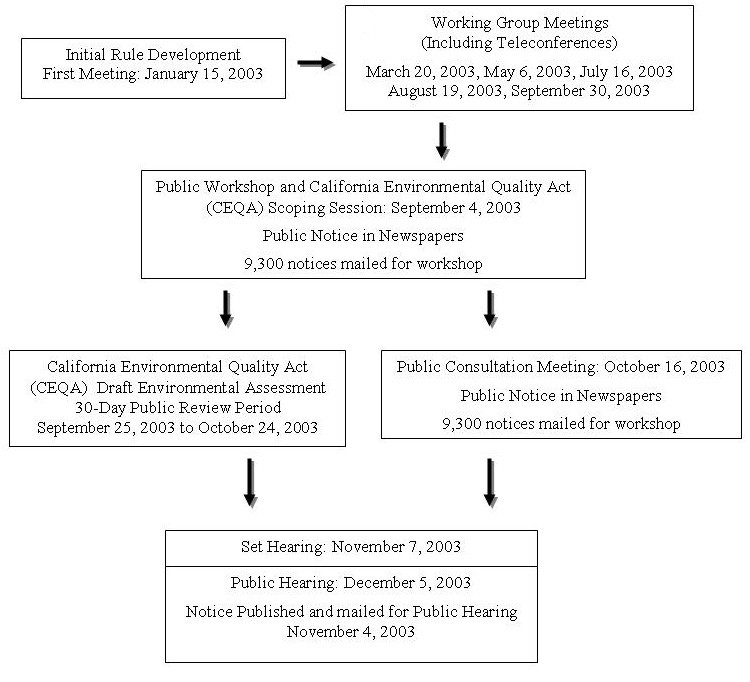
RULE DEVELOPMENT PROCESS
PROPOSED AMENDED RULE 1113 - Architectural Coatings
ATTACHMENT C
|
KEY CONTACTS LIST |
|
| Bert Adams | Glaze N Seal |
| Tony Garcia | Hill Brothers Chemical Company |
| Barry Barman | KTA-TATOR, Inc. |
| Paul Beemer | Henry Company |
| Howard Berman | Environmental Mediation, Inc. |
| Mike Butler | BEHR Process Corporation |
| Larry Cerenzie | FSC Coatings |
| Curtis Coleman | Law Offices of Curtis L. Coleman |
| Bob Dooley | Degussa Corporation |
| David Sibbrel | Life Paint |
| Claude Florent | Rainguard |
| Bob Floriani | ICI Dulux Sinclair |
| Yvonne Fong | USEPA |
| Dave Fuhr | Fuhr International |
| Barbara Fry | CARB |
| Lloyd Haanstra | DEFT |
| Madelyn Harding | Sherwin-Williams Company |
| Richard Hart | JFB Hart Coatings |
| Robert Henderson | EPMAR |
| Tony Hobbs | Tnemec Corporation |
| Mike Jaczola | CARB |
| Barry Jenkin | Benjamin Moore Paints |
| Jim Kantola | ICI Dulux Sinclair |
| John Knox | JFB Hart Coatings |
| Carol Yip Kaufman | MWD |
| Brian Paich | Sierra Performance Coatings/Rust-Oleum |
| John Long | Vista Paint Corporation |
| Tom Marsden | Disneyland Resort |
| John Means | Universal Studios |
| Mike Murphy | Rust-Oleum Corporation |
| Stephen Murphy | Murphy Industrial Coatings |
| Bob Nelson | National Paint & Coatings Association |
| Wayne Nelson | Spectra-Tone Paint Corporation |
| Jim Nyarady | CARB |
| Andy Rogerson | Caltrans |
| Raymond Russell | Smiland Paint Company |
| Jim Sell | NPCA |
| Bob Steel | SICC |
| Gerald Thompson | BonaKemi USA, Inc. |
| John Wallace | MWD |
| Robert Wendoll | Dunn-Edwards Paints |
| Kevin Worrall | Texture Coatings of America, Inc. |
ATTACHMENT D
|
KEY ISSUES AND RESPONSES Rule 1113 |
|
| Issue |
Response |
| Objection to the elimination of the small container exemption for clear wood finishes. | Staff believes there are adequate substitute products currently available for lacquers, sanding sealers and varnishes, that are compliant with the proposed VOC limit. Staff’s proposal is to eliminate the small container exemption effective July 1, 2006. An alternative proposal will eliminate the small container exemption effective July 1, 2008, with interim VOC limits for those coatings beginning July 1, 2006.. |
| Reformulating semi-transparent stains intended for horizontal surfaces and testing them by the proposed implementation date. | Staff has revised the original proposal to make the implementation date effective July 1, 2007 providing for 42 months to reformulate, allow for laboratory testing, real time exposure testing and commercialize the reformulated stains. |
| Stains should be split into horizontal and vertical categories with different VOC limits, since stains applied to horizontal surfaces need to be more abrasion resistant. | Splitting the category into vertical vs. horizontal application with different VOC limits would be practically unenforceable. In addition some people may substitute the lower-VOC stain with a higher-VOC stain. The AVES study for both horizontal and vertical application indicates that clear and semi-transparent stains that comply with the proposed VOC limit can be formulated. Staff has also identified stains for horizontal application, compliant with the proposed VOC limit, that are commercially available and in use. |
| Waterproofing concrete/masonry sealers should remain a separate category with a 400 g/l VOC. The waterborne coatings in this category do not meet the National Cooperative Highway Research requirements. | Low-VOC technology has been developed that meets all the performance requirements for waterproofing concrete and masonry sealers at the proposed VOC limit of 100 g/l. Appendix A of the Draft Staff Report lists penetrating and film-forming waterproofing concrete/masonry sealers that meet or exceed the performance standards listed in the National Cooperative Highway Research Program (NCHRP) 244. The proposed amended rule is not eliminating waterproofing concrete/masonry sealers category, but is simply requiring formulations based on the latest, high performance resin systems currently available, as indicated by the large number of compliant products already in the marketplace. |
| A concern that a product formulated and labeled for a specialty coating category could be required to meet the lower VOC limit of another category such as a flat coating, nonflat coating or a primer-sealer-undercoater. | Language has been modified so that if a coating meets the definition of the specialty coatings, is labeled correctly and is recommended for the intended use, it will be categorized as the specialty coating. |
| Concern with the initially proposed implementation date for lower VOC limits. | To allow for reformulation and testing, the effective dates for implementation of the lower VOC limits are January 1, 2005 for roof coatings, July 1, 2006 for clear wood finishes and waterproofing sealers, and July 1, 2007 for stains providing upto 42 months for compliance. |
| Energy Star certified aluminum containing Roof Coatings currently would require reformulation to meet the proposed lower VOC limit and will need additional time for recertification. | Roof coatings with a VOC content of 100 g/l or less and certified under the USEPA Energy Star Program will be exempt until January 1, 2007. |
| Waterborne aluminum roof coatings can have chemical reactions that produce hydrogen gas. | Additives are available to minimize excessive pressure buildup and oxidation of the aluminum flakes. To alleviate pressure build up some manufacturers equip their containers with pressure relief valves. |
| Field touch-up of prefabricated architectural components should be allowed to use the same coatings applied in shop application. | Staff appreciates the small quantity of coatings needed for these small touch-up and repair applications and encourages the commentator to utilize the Averaging Compliance Option of Rule 1113, which was designed for these types of specific needs for small volume coatings with higher VOC than the current limit. |
| The restriction of industrial maintenance coatings for residential use. | An industrial maintenance (IM) coating is formulated to meet specified extreme environmental conditions that industry has previously raised as a health concern regarding the use of this category by untrained homeowners, which they have not formally retracted. In addition, the federal Architectural Industrial Maintenance rule and the State SCM require an IM coating label to display one of the following: not for residential use, for industrial use only, for professional use only, or not intended for residential use. If a manufacturer has IM products formulated on standard solventborne or waterborne chemistry and the health risks are no different than those for their standard products; then it becomes a labeling issue, not whether an IM coating can be used for residential application. |
/ / /