
BOARD MEETING DATE:
February 7, 2003
AGENDA NO. 3
Execute Contract to Perform Conceptual Engineering Design Study for Integrated Demonstration Project at Diamond Bar Facility Utilizing Renewable and Non-renewable Hydrogen Production for Vehicle Fueling and Electricity Generation
SYNOPSIS:
AQMD staff requests funding for a study to establish an integrated hydrogen energy demonstration at the AQMD Diamond Bar facility to produce hydrogen for vehicle fueling and electricity generation. Hydrogen will be produced from an electrolyzer, powered by an upgraded photovoltaic array, and a natural gas reformer. Electricity will be generated from a hydrogen internal combustion engine and a fuel cell. Staff recommends that Northern Power Systems conduct the conceptual engineering design for the integrated demonstration facility in an amount not to exceed $45,000.
COMMITTEE:
Technology, January 24, 2003, Recommended for Approval
RECOMMENDED ACTION:
Authorize the Chairman to execute a contract with Northern Power Systems to conduct a conceptual engineering design for an integrated hydrogen energy demonstration facility at the AQMD Diamond Bar headquarters to provide hydrogen generation, vehicle fueling, and electricity generation, in an amount not to exceed $45,000 from the Clean Fuels Fund.
Barry R. Wallerstein, D.Env.
Executive Officer
Background
In November 2002, the U.S. Department of Energy (USDOE) unveiled the National Hydrogen Energy Roadmap in support of the National Energy Policy to develop a hydrogen economy and resolve growing concerns about America’s energy supply, security, air pollution, and greenhouse gas emissions. Similarly, the AQMP identifies the use of alternative clean fuels as a key air quality attainment strategy. In this regard, hydrogen fuel cell vehicles and power generators offer great promise since they are near zero-emission and have the potential to vastly reduce or eliminate VOC, NOx, CO, toxics, and greenhouse gas emissions. Providing the hydrogen to fuel these technologies to facilitate their demonstration is therefore an integral part of developing national and local clean air plans.
Furthermore, the National Hydrogen Energy Roadmap states, "Development should continue on advanced production techniques such as …solar-powered thermochemical water-splitting," i.e., the production of hydrogen using electrolyzers powered by photovoltaic technologies. Electrolyzers use electricity to split water molecules into hydrogen and oxygen. The renewably-produced (solar) hydrogen could then be used to provide fuel for ultra-clean fuel cell vehicles, thereby reducing both regional dependence on fossil fuels and improving air quality.
The USDOE is actively co-funding many of these types of hydrogen projects, referred to as "hydrogen power-parks", to establish the inroads to a hydrogen infrastructure through demonstration of hydrogen production, storage, and end-use (as in fuel cells). The proposed conceptual study, if implemented, will allow the AQMD to respond to the USDOE solicitation (DE-SC02-03CH11137, Research and Development for Fuel Cells for Stationary and Automotive Applications) released on January 24, 2003. Proposals to this USDOE opportunity are due on March 27, 2003.
Proposal
Northern Power Systems (NPS), a well-established firm specializing in power generation and system integration, was involved in the original installation of the 20 kW solar power array at AQMD headquarters in 1993. Staff proposes to expand the solar generation capability to 100 kW to provide the renewable capacity to power an electrolyzer/compressor unit that will generate hydrogen from water. The hydrogen will be stored to supply fuel upon demand for (1) hydrogen internal combustion and fuel cell vehicles, (2) a fuel cell for back-up or premium power, and (3) a stationary internal combustion engine power generator for back-up or peaking power. In addition, an on-site natural gas reformer may be included to produce additional hydrogen as required to meet refueling and power generation needs. A possible tie-in to the existing compressed natural gas fueling station will also be considered for supplying Hythane fuel (hydrogen and natural gas) for vehicles. This proposal is to contract with Northern Power Systems to develop a viable plan for this integrated hydrogen-fuel cell demonstration, including the upgrade to AQMD’s photovoltaic power generation capability. A conceptual diagram of the proposed demonstration is shown in Figure 1.
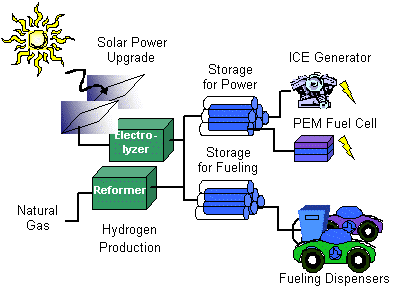
Figure 1. Proposed Integrated Hydrogen Energy Demonstration Facility at Diamond Bar
The conceptual engineering study will address the integration of all these technologies into an operable, flexible, and economically viable system given the AQMD’s layout, fueling, and power requirements. Issues that will be addressed, but are not limited to, include the following:
- Physical placement of technologies and facility integration (conceptual layout)
- Controls strategies, including economical time-of-use considerations for hydrogen production
- Possible budget for implementation
- Interconnection, regulatory, and permitting issues
- Applicable incentives
- Benefits and challenges
Benefits to AQMD
The proposed study lays the groundwork for implementing key clean fuel projects as defined in the March 2002 update of the Technology Advancement Plan for the Clean Fuels Program, namely CFM4-3, "Development and Demonstration of Distributed Hydrogen Production and Refueling Stations," as well as advanced technology projects identified in the June 7, 2002 Advanced Air Pollution Research Plan, item D-12, "Demonstration of Commercial and Large Scale Fuel Cells." The proposed study will help the AQMD determine how best to install these technologies to aid in their commercialization and, more importantly, offer economically viable strategies for their integrated operation. Widespread adoption of such technologies would lead to direct reductions in NOx, VOC, CO, PM, toxics and global warming emissions from light-duty and medium-duty vehicles as well as back-up and premium power generators.
The implementation of the study recommendations will further allow the AQMD to continue in its historic role as an outreach and educational demonstration site for clean energy. The AQMD facility is home to (1) the first-ever commercial fuel cell installation, (2) renewably-powered electric vehicle charging stations, and (3) four microturbine generators, which demonstrate efficient distributed power with heat recovery. Implementation of the integrated hydrogen technologies would allow the AQMD to continue in this legacy.
Sole Source Justification
In the "Procurement Policy and Procedure" document, Section VIII outlines the provisions for awarding a sole source contract, specifically item B.2.c., "(1) The unique experience and capabilities of the proposed contractor or contractor team."
NPS was the original systems integrator for AQMD’s existing PV array/charging station, and they continue to have the same team on-board. NPS designed and installed the PV array, combiners, and electrical distribution system, which have performed to expectations. Their familiarity with the existing system and current technology capabilities in hybrid PV systems (i.e., PV coupled with electrolyzers and distributed generation) makes NPS the only source that could timely complete the study to meet DOE application deadlines and therefore justifies the sole-source award.
Resource Impacts
The total amount of AQMD funding for this program shall not exceed $45,000. Sufficient funds are available from the Clean Fuels Program Fund, established as a special revenue fund resulting from the state-mandated Clean Fuels Program. The Clean Fuels Program, under Health and Safety Code Sections 40448.5 and 40512 and Vehicle Code Section 9250.11, establishes mechanisms to collect revenues from mobile sources to support projects to increase the utilization of clean fuels, including the development of the necessary advanced enabling technologies. Funds collected from motor vehicles are restricted, by statute, to be used for projects and program activities related to mobile sources that support the objectives of the Clean Fuels Program.
/ / /