
BOARD MEETING DATE: June 6, 2003
AGENDA NO. 3
Execute Contracts to Develop and Demonstrate Phase II Hydrogen Fueling Infrastructure Technologies, Fuel Cell Vehicle Demonstrations and Support Maintenance Facilities in the South Coast Air Basin
SYNOPSIS:
At the September 13, 2002 Board meeting, an initial network (Phase I) of compressed-hydrogen fueling stations was approved to accelerate the introduction of fuel cell demonstration vehicles expected to be introduced by major auto manufacturers. To carry out Phase II of this effort, staff recommends executing contracts with Air Products and Chemicals, Stuart Energy, California State University at Los Angeles, Energy Conversion Devices, Inc. and Daimler Chrysler to develop and install hydrogen refueling infrastructure, to demonstrate hydrogen fuel cell vehicles and technologies and develop maintenance support facilities at various locations in the South Coast Air Basin in an amount not to exceed $1,885,280.
COMMITTEE:
Technology, May 23, 2003, Recommended for Approval
RECOMMENDED ACTION:
1. Authorize the Chairman to execute a contract with Air Products and Chemicals, Inc., to install and demonstrate an industrial pipeline-supplied hydrogen refueling station in Torrance, in an amount not to exceed $400,000 from the Clean Fuels Fund. 2a. Authorize the Chairman to execute a contract with Stuart Energy to install and demonstrate an electrolyzer-based hydrogen refueling station integrated with a stationary internal combustion engine power generation unit at AQMD headquarters in Diamond Bar, in an amount not to exceed $497,000 from the Clean Fuels Fund. 2b. Authorize the Chairman to issue an Invitation to Bid (ITB)in order to prepare the Diamond Bar facility for the hydrogen fueling station by removing the existing methanol and gasoline fueling infrastructure in an amount not to exceed $45,000 transferred from the Clean Fuels Fund to Technology Advancement FY 2003-04 Professional & Special Services Account. 3. Authorize the Chairman to execute a contract with California State University Los Angeles to install and demonstrate a PEM electrolyzer in Los Angeles, providing hydrogen fueling for vehicles and utilizing the technology in the Engineering Technology curriculum at the university, in an amount not to exceed $250,000 from the Clean Fuels Fund. 4. Authorize the Chairman to execute a contract with Energy Conversion Devices, Inc. to integrate and develop an internal combustion engine hybrid vehicle utilizing metal hydrides for on-board hydrogen storage, in an amount not to exceed $200,280 from the Clean Fuels Fund. 5. Authorize the Chairman to execute a contract with Daimler-Chrysler, to install and demonstrate fuel cell vehicle maintenance facilities in Long Beach, in an amount not to exceed $253,000 from the Clean Fuels Fund. 6. Authorize the Chairman to execute a contract with Daimler-Chrysler to demonstrate two fuel cell vehicles at AQMD in Diamond Bar, in an amount not to exceed $240,000 from the Clean Fuels Fund. 7. Direct staff to prepare a Request for Proposals for: a) the conversion of internal combustion engine vehicles to use hydrogen as the fuel, and; b) the installation of hydrogen fueling infrastructure at four municipal fleet sites within the AQMD for approval by the Governing Board on July 11, 2003.
Barry R. Wallerstein, D.Env.
Executive Officer
Background
AQMP has identified the use of alternative clean fuels in mobile sources as a key air quality attainment strategy. CARB has passed regulations that require transit buses to comply with increasingly stringent emission standards. Hydrogen fuel cell vehicles are true zero-emission vehicles and have the potential to eliminate VOC, NOx, CO and toxic emissions as well as greenhouse gas emissions.
Hydrogen refueling stations are necessary to facilitate the introduction of fuel cell vehicles and the development of an extensive hydrogen fueling network will allow the introduction of hydrogen fueled vehicles throughout the AQMD. Hydrogen can be generated through a variety of technologies with each technology thus far having relative merits and drawbacks. At this early stage as hydrogen vehicles and the required infrastructure are being introduced, the demonstration of a variety of methodologies and systems will help determine the most effective and efficient methods for hydrogen generation and subsequent fueling.
Phase I of the hydrogen infrastructure program was approved by the Governing Board at its September 12, 2002 meeting and included five fueling stations. Phase II includes the seven proposals presented in this Board Letter.
The cities of Riverside, Santa Monica, Santa Ana and Burbank each offer unique characteristics and potential as hydrogen fuel fleet demonstration sites. Together, these four cities provide a wide range of applications and conditions of use for fleet vehicles. AQMD is actively developing Requests for Proposals to provide hydrogen internal combustion engine (ICE) vehicles and the associated hydrogen fueling infrastructure needed to support these vehicles within each of the four fleets. Our goal is to begin implementation of these projects in the fall of 2003. A Request for Proposals will be prepared and submitted to the Board for consideration for this purpose for the July 11, 2003 Board meeting.
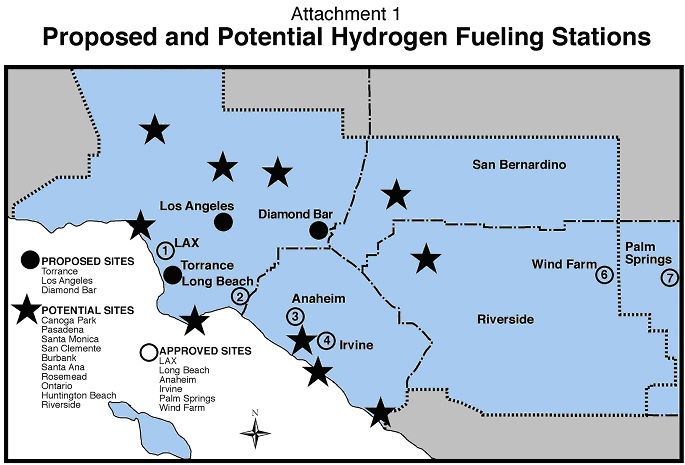
In order to support future hydrogen vehicle demonstration programs and to provide a network of hydrogen fueling locations throughout the AQMD a number of additional projects are being considered. The attached map (Attachment 1) shows the approved projects, projects for requested Board action and potential projects (indicated by stars). These potential sites are currently being reviewed by staff. Submitted proposals associated with these sites are being developed and finalized while, at the same time, arrangements are being made with vehicle manufacturers to demonstrate hydrogen vehicles in the locations served by these sites. Many of the details of these proposals are highly sensitive until the vehicle manufacturers have finalized their commitments; a brief overview of the potential sites will help clarify future infrastructure projects.
Canoga Park is a site for a mid-size reformer-based hydrogen generation fueling station. This project could provide fuel for 50 to 100 vehicles upon completion.
Pasadena/Glendale is being considered as a potential fueling site to help complete the network and to take advantage of many small technology companies in the area as possible fleet locations.
AQMD is consolidating plans for hydrogen fueling at its Diamond Bar headquarters served by bulk deliveries of liquid hydrogen with the potential of fueling vehicles that are designed for liquid hydrogen on-board storage.
The proximity to a large industrial hydrogen production plant and substantial industrial and commercial activities in the area make Ontario a highly credible location for a hydrogen fueling station.
The City of Huntington Beach is viewed as an expansion of the UC Irvine ZEV-NET program as more vehicles are added.
All of these potential projects are subject to change with the further possibility that new areas and projects will be added later such as fueling stations supplied by conversion of hospital waste to hydrogen or solar/thermal hydrogen generation.
Proposals
- Air Products and Chemicals, Inc. (Air Products) owns and operates 17 miles of pipeline in the industrial/commercial districts of Torrance and Wilmington; the only one of its kind in an urban area in North America. Air Products proposes to build and operate a hydrogen fueling station supplied by their pipeline. The proposed hydrogen fueling station in Torrance will utilize the pipeline system to deliver hydrogen to the fueling site. This will allow hydrogen fueling in a very cost-effective manner without the need for on-site hydrogen generation or additional truck deliveries of hydrogen. The goal of the project is to provide hydrogen to the fuel cell cars that are expected to be demonstrated in the future. Several fuel cell auto manufacturers have their headquarters within two miles of the proposed fueling station.
- Stuart Energy plans to install and beta test an electrolyzer hydrogen generation and vehicle fueling station integrated with a Ford hydrogen-powered stationary internal combustion engine and a Ballard electricity generator at AQMD headquarters. As part of this installation, the existing underground methanol and gasoline storage tanks and fueling pumps will be removed and the site cleaned and restored. In their place, the new hydrogen fueling system will serve fuel cell and other hydrogen powered vehicles while maintaining the capability to provide auxiliary, peaking or backup power to AQMD operations. This system will also be further integrated with a 100 kW photovoltaic array that will be part of the planned AQMD Integrated Hydrogen Demonstration Facility currently under development. The hydrogen produced will also be available to support fueling for hydrogen vehicles from other demonstration sites and programs. The California Energy Commission has agreed to provide collateral funding for this project based upon the distributed energy generation component.
- California State University at Los Angeles (CSULA) in partnership with Quantum Technologies, Proton Energy and other corporate partners will develop and demonstrate a grid-powered Polymer Electrolytic Membrane (PEM) electrolyzer hydrogen refueling station near the Engineering Technology Department on the CSULA campus. This equipment will be used to provide fuel for fuel cell and other hydrogen-fueled vehicles. The equipment will also be integrated into the Engineering Technology curriculum to expand the current coursework to include clean fuels technologies and hydrogen as a fuel of the future. The equipment will also be connected to some photovoltaic and wind turbine power sources for students to learn about the viability of renewable power and its link to hydrogen. Power will be supplied by grid electricity and hydrogen will be dispensed to vehicles in a fast-fill mode from a dispenser.
- Energy Conversion Devices, Inc. in partnership with Texaco Ovonic Hydrogen Systems will integrate and demonstrate an electric hybrid/hydrogen internal combustion engine vehicle that uses metal hydrides for on-board hydrogen storage. The vehicle used for this demonstration is a gasoline hybrid vehicle converted to run on hydrogen as fuel that also incorporates metal hydrides for fuel storage on the vehicle. The goals of this program are to demonstrate clean fuels projects using converted internal combustion engine vehicles and to evaluate the viability of using metal hydrides for on-board hydrogen storage. The project developed from the purchase of a gasoline electric hybrid vehicle from a dealer and converting that vehicle to run on compressed hydrogen as the fuel. This vehicle will be further converted to allow the substitution of metal hydrides/hydrogen storage for the compressed hydrogen storage. Once fully integrated, the vehicle will be demonstrated at various sites and under various conditions of use throughout the AQMD.
- Daimler-Chrysler Corporation (DCC) will need a state-of-the-art maintenance and emissions testing facility to support fuel cell vehicle programs in the South Coast Air Basin. Their plan utilizes an existing Mercedes-Benz emissions testing facility in Long Beach which will be upgraded and modified to evaluate, modify and service fuel cell vehicles. This facility will serve all of the Daimler-Chrysler fuel cell demonstration fleets in the South Coast air district. One goal of the facility is to provide local, state-of-the-art equipment and qualified staff to ensure that these vehicles are operating optimally and with minimal defects. The proprietary nature and highly specific design characteristics of current fuel cell vehicles requires that maintenance and testing facilities be designed specifically for the vehicles to be serviced.
- Daimler-Chrysler Corporation (DCC) has planned a series of fuel cell vehicle demonstrations to be phased over several years and as part of this plan, will provide two fuel cell vehicles to be incorporated into the AQMD fleet for a two-year demonstration period. These vehicles will be used in general and high-profile applications to test the performance of the vehicles in the context of AQMD fleet activities. Service and evaluation of the vehicles will be performed by Daimler-Chrysler staff at the Long Beach test center. This facility will serve all of the future Daimler-Chrysler fuel cell demonstration fleets in the South Coast air basin. The fuel cell vehicles provided are highly proprietary with very specific design characteristics and technology. These characteristics will require considerable support from qualified Daimler-Chrysler staff and facilities during the three-year demonstration project. AQMD funding provided for this project will be in addition to funding received from USDOE.
The proposed fueling station will be capable of providing hydrogen based upon demand. As the demand increases, the pipeline is capable of supplying the fuel to meet those needs. Additional goals of this project are to develop a safety and operational training plan for the station that could be adapted to future sites and to provide increased public awareness of hydrogen as a vehicle fuel.
Extensive vehicle testing and evaluation is projected as a future activity as well as comprehensive safety evaluation and program development to support the project.
Benefits to AQMD
The proposed projects are included in the March 2002 update of the Technology Advancement Plan for the Clean Fuels Program under 2002 CFM4-3, "Development and Demonstration of Distributed Hydrogen Production and Refueling Stations" and 2002 CFM4-1, "Demonstration of Fuel Cell Vehicles" as key elements in the widespread use and resulting increased use of alternative fuel (hydrogen) vehicles. These projects address the air quality objectives stated in the AQMP which rely heavily on the expedited implementation of zero-emission vehicles to achieve ambient air quality standards in the South Coast air district. These projects will also assist in ultimately expediting the implementation of fuel cell vehicles, which are advanced zero-emission vehicles. This, in turn, would lead to direct reductions in NOx, VOC, CO, PM, toxics and global warming emissions from light-duty and medium-duty vehicles.
Resource Impacts
| 1. | Air Products and Chemicals, Inc. Hydrogen Pipeline supplied Fueling Station. The total amount of AQMD funding for the proposed project will not exceed $400,000. The total project cost is expected to be $855,170, as shown below (cost share does not include in-kind service and equipment as well as existing infrastructure to be used for the project). | |
• APCI (project management, equip. & support) • AQMD requested funding Total funding |
|
|
| This project is anticipated to be located on property currently owned by Toyota Motors in Torrance. |
||
| 2. | Stuart Energy Electrolyzer Hydrogen Generation and Fueling Station with Stationary Internal Combustion Engine Power Generation. The total amount of AQMD funding for the proposed project will not exceed $542,000 as shown below. This cost share does not include in-kind service and equipment as well as existing infrastructure to be used for the project. The cost does include the anticipated costs of $45,000 (not to exceed) for the removal of the existing methanol and gasoline fueling infrastructure, for which AQMD will issue an ITB. | |
• Stuart Energy (project management, equip. & support) • California Energy Commission (distrib. Power equip.) • AQMD requested funding • Removal of methanol/gasoline station Total funding |
|
|
| This project will be incorporated into a much larger hydrogen-fueled stationary power and hydrogen generation demonstration project located at AQMD headquarters. |
||
| 3. | California State University Los Angeles. The total amount of AQMD funding for this project will not exceed $250,000. The total project cost is expected to be $600,000 as shown below (cost share includes in-kind support as well as engineering, design and development, outreach and regulatory/permit costs). | |
• California State University Los Angeles • Quantum technologies • Proton Energy • AQMD requested funding Total funding |
|
|
| This project will utilize on-site hydrogen generation for support of vehicle fueling and will incorporate the technology into the Engineering Technology Education Program. |
||
| 4. | Energy Conversion Devices, Inc.. The total amount of AQMD funding for this project will not exceed $200,280 for the integration and demonstration of a hydrogen-fueled electric hybrid vehicle using metal hydrides for on-board hydrogen storage. Total project cost is expected to be $400,561 as shown below. | |
• Energy Conversion Devices, Inc. • Texaco Ovonics (converted hybrid vehicle) • AQMD requested funding Total funding |
|
|
| This project will rely on a source of hydrogen at 1500 psi (or less) to regenerate the metal hydrides. |
||
| 5. | Daimler-Chrysler (DCC) maintenance facilities upgrade. The total amount of AQMD funding for this project will not exceed $253,000. The total project cost is expected to be $642,000 as shown below. | |
• DCC (project management and eng.) • Mercedes-Benz Emissions Test Facility • AQMD requested funding Total funding |
|
|
| This project will upgrade the existing Mercedes-Benz Emissions Testing Facility in Long Beach to accommodate the needs of fuel cell vehicle testing, evaluation and maintenance operations to support fuel cell vehicle demonstrations in South Coast. |
||
| 6. | Daimler-Chrysler (DCC) Fuel Cell Vehicle Demonstration. The total amount of AQMD funding for the proposed project will not exceed $480,000. The total project cost is expected to be $980,000, as shown below (cost share does not include in-kind service and equipment as well as separately funded maintenance and evaluations facility to be used to support the project). | |
• DCC (two fuel cell vehicles) • USDOE (Freedom Car Program) • AQMD requested funding Total funding |
|
|
| This project is anticipated to be a two-year demonstration (over a three-year time frame) as part of the AQMD fleet for two fuel cell vehicles headquartered in Diamond Bar. | ||
Sufficient funds are available from the Clean Fuels Program Fund, established as a special revenue fund resulting from the state-mandated Clean Fuels Program. The Clean Fuels Program, under Health and Safety Code Sections 40448.5 and 40512 and Vehicle Code Section 9250.11, establishes mechanisms to collect revenues from mobile sources to support projects to increase the utilization of clean fuels, including the development of the necessary advanced enabling technologies. Funds collected from motor vehicles are restricted, by statute, to be used for projects and program activities related to mobile sources that support the objectives of the Clean Fuels Program. AQMD is actively pursuing cofunding partnerships with the California Energy Commission and the US Department of Energy for these projects.
Sole Source Justification
Section VIII.B.2 of the Procurement Policy and Procedure identifies four major provisions under which a sole source award may be justified. These requests for sole source awards are made under provisions B.2.c.(2): the project involves the use of proprietary technology; B.2.c.(3): the contractor has ownership of key assets required for project performance; and B.2.d.(1): other circumstances, including projects involving cost-sharing by multiple sponsors. For the following reasons, staff believes it is in the best interest of the AQMD to cosponsor the proposed partnership project.
Air Products operates a large (500 tons per day) hydrogen production facility in the industrial sector of Los Angeles, serving that sector with over 17 miles of hydrogen pipeline. As the owner/manager of the pipeline, Air Products has exclusive rights to the use of the pipeline and as such, is the only contractor with authority to build and operate the pipeline-supplied hydrogen fueling station.
Stuart Energy specializes in hydrogen production from electrolysis having developed a system that also compresses and dispenses that hydrogen to vehicles. In partnership with Ford and Ballard, Stuart Energy is integrating a stationary internal combustion engine/electrical power generator that uses the hydrogen as fuel for its electrolyzer system. Stationary power generation using hydrogen results for this project from the combination of proprietary equipment from three partners. This includes the internal combustion engine and its components, the power generation unit as well as the integrated hydrogen generation and compression system.
California State University at Los Angeles is a university recognized as having one of the leading engineering departments within the California State University System. The project will be incorporated into the Technical/Engineering Program curriculum at CSULA. The sole source justification is necessary for this project to allow CSULA to effectively implement the fueling station and associated program to meet their educational program requirements. Their plans to incorporate hydrogen technologies and clean fuels into their engineering curriculum provides an excellent, unique opportunity to demonstrate hydrogen production and fueling using clean power. The hydrogen produced will also provide fueling for vehicles operating in the City of Los Angeles as well as other vehicles in surrounding areas.
Energy Conversion Systems, Inc. has recently partnered with Texaco Ovonic Hydrogen Systems, LLC, developing systems that incorporate metal hydrides into hydrogen storage systems that can be used on-board vehicles or in stationary applications. The proprietary nature of the hydrogen storage technology as well as the previously completed partnership efforts of Energy Conversion Systems and Texaco Ovonic Hydrogen Systems to modify the hybrid vehicle computer and other control systems to allow for the new fuel media and storage justifies the sole source award. This project offers the unique opportunity to evaluate a working hybrid electric vehicle that has been converted to use hydrogen as a fuel and incorporates their metal hydride storage system.
Daimler-Chrysler Corporation (DCC) is actively designing and developing fuel cell vehicles for a variety of uses and applications. The proprietary nature of the fuel cell vehicle technology owned by this manufacturer and the technology necessary for the maintenance and testing of those vehicles is the justification for the sole source award. Their plans include a rapid development pathway to commercialization of fuel cell vehicles, resolution of all codes and standards issues as well as high customer acceptance.
/ / /