
BOARD MEETING DATE: March 7, 2003
AGENDA NO. 34
Authorize the Use of Air Curtain Destructors to Assist in Mitigating Serious Fire Hazard in San Bernardino and Riverside Counties
SYNOPSIS:
Excessive drought and bark beetle infestation, killing millions of pine trees in large tracts of forest land, has led San Bernardino and Riverside Counties to declare a fire emergency. followed by declaring a State of Emergency. Without immediate mitigation measures, an uncontrolled, cataclysmic wildfire, threatening close to 100,000 homes and residents in and near the communities of Lake Arrowhead and Idyllwild, could result. A task force consisting of U.S. Department of Agriculture Forest Service, California Department of Forestry, county governments, elected officials and other representatives of the affected communities was created to mitigate this threat. Air curtain destructors appear to be the most immediate option available to safely dispose of large volumes of rapidly accumulating and unmarketable forest waste. Staff has identified measures to minimize emissions and public nuisance potential from the use of this equipment.
COMMITTEE:
Stationary Source, February 28, 2003, Recommended for Approval
RECOMMENDED ACTION:
- Authorize the Executive Officer to Issue Burn Permits for the Use of Air Curtain Destructors for Fire Hazard Mitigation in San Bernardino and Riverside
Counties
- Certify Notice of Exemption
Barry R. Wallerstein, D.Env.
Executive Officer
Background
An unprecedented, long-term drought and subsequent bark beetle infestation of millions of drought-stressed trees has led to extensive tree mortality in huge tracts of forested land, both public and privately held, in San Bernardino and Riverside Counties. The acreage of dead and dying trees in both counties is currently estimated at 150,000 acres and it is growing exponentially. Faced with a rapidly approaching fire season, this combustible fuel must be rapidly removed to avoid the possibility of an uncontrolled and devastating wildfire affecting communities such as Lake Arrowhead and Idyllwild (see Appendix A - Photos).
Both counties have declared fire emergencies. A task force, consisting of U.S. Department of Agriculture Forest Service (Forest Service), California Department of Forestry, county governments, elected officials and other representatives of the affected communities, was created to address the problem and mitigate the threat. This task force has approached staff with a request to use air curtain destructors to safely burn an estimated 500,000 tons of wood waste after the trees are felled.
The task force believes that burning this material in air curtain destructors is the only means available to safely and rapidly dispose of this enormous volume of material. The California Department of Parks and Recreation currently uses this equipment to dispose of woodwaste in state parks such as the one in Morro Bay. Also, after the devastating fire that destroyed many homes and offices in the community of Los Alamos, New Mexico in 2000, the Los Alamos National Laboratory used this equipment as a fire prevention tool in the forested areas surrounding this community.
District staff has not previously approved the use of this equipment; the reason being that widespread use of air curtain destructors could increase burning at the expense of available no-burn options. To protect air quality, Smoke Management Plans require land managers to identify and pursue suitable alternatives to burning whenever possible. Staff recognizes this emergency and the fact that the peak daily emissions are minimal when compared to the potential emissions and destruction posed by a wildfire. Staff believes that localized effects of the emissions can be minimized in order to avoid public nuisances in the communities. However, the District Governing Board can authorize the use of this equipment under H&S Code Section 41812 for use in these counties. This is warranted under the circumstances.
Consequently, staff is requesting that the Board authorize the Executive Officer to issue open burn permits for 8 air curtain destructors to the U.S. Department of Agriculture Forest Service for use in San Bernardino and Riverside Counties for this two year period. These permits will allow the operation of this equipment for the period of time necessary to abate the fire hazard. In concurrent action, The California Air Resources Board is preparing to approve the 8 accompanying portable internal combustion engines under statewide portable equipment permits. The Forest Service estimates that it will take approximately two years to dispose of the accumulated wood waste from the dead trees.
This report to the Board includes information on the measures to be taken to:
- minimize emissions and public nuisance potential;
- inform the public of the scope and schedule for the increased burning activity;
and - respond to inquiries and potential complaints from local residents, particularly those most sensitive to smoke.
What are Air Curtain Destructors?
There are two types of air curtain destructors:
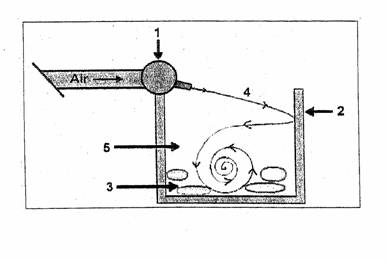
- Above ground portable non-enclosed combustion devices with air curtain control (Figure 1)
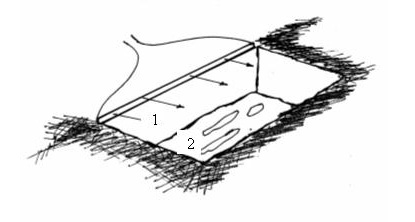
- Underground "trench pits" with air curtain control (Figure 2)
Both types of equipment have diesel-fueled internal combustion engines that run blowers to produce an air curtain. This curtain traps smoke and particulate matter over the combustion area, thus allowing temperatures to remain high and resulting in more complete combustion of emission products (see Appendix B - Air Curtain Destructor Process Description).
|
Figure 1
|
|
Figure 2
|
What are the Estimated Emissions Compared to a Wildfire?
From an emissions standpoint, wildfire emissions would be substantially greater than the properly monitored operation of this equipment. The estimated emissions for wildfires and air curtain destructors are as follows:
Peak Daily Emissions
Wildfire
vs. Air Curtain Destructors
|
Wildfire Emissions* |
Air Curtain Destructor* |
|
|
|
* |
September 2000 Air Resources Board emission factors for forest waste burning (moderate to heavy fuel loading). Assumes 1770,000 acre wildfire over 30 days. Air curtain destructors will be used up to 220 days per year for two years. |
Visible emissions measured up to 35 percent opacity typically occur at start up.and whenever additional fuel is introduced and the air curtain is disturbed.
In addition, staff anticipates localized impacts on visibility and temporary increases in ozone levels in the local area. With respect to the planning emissions inventory, this estimated two year project will contribute an additional:
0.5 percent to the PM-10 inventory
0.15 percent to the VOC inventory
0.5 percent to the CO inventory
NOx emissions are expected to be insignificant.
Were "No-Burn" Options Considered?
Yes. The highest value material (i.e. logs) is being sold to lumber mills. A certain amount of the slash (branches and pine needles) is considered to be waste but can be used as compost. The task force is also investigating the construction of mills on these properties to produce pulp chips, compost, pallets or lumber, as well as shipments to lumber mills in Mexico.
However, the projected volume of the unmarketable waste cannot be processed at this time and is too costly to haul away. The nearest biomass-to-energy plant is over 100 miles away in Mecca. Landfilling the waste is not a feasible option. San Bernardino and Riverside County Solid Waste have not figured this forest waste into the site-life capacity of their landfills and cannot accommodate it. The Smoke Management Plan, however, outlines commitments to utilize no-burn options to the maximum extent possible including seeking additional funds for no-burn alternatives such as the purchase or lease of tub grinders for producing marketable composting material.
Under What Authority Will This Burning Occur?
As stated earlier, H& S Code 41812 allows the District Board to authorize the use of this equipment for disposing of woodwaste. In authorizing the operation of the equipment, the Executive Officer can make the burn permit subject to conditions to assure that its operation protects air quality.
Rule 444 establishes standards to minimize the impact of smoke emissions on the public. Rule 444 also provides that "the Executive Officer may authorize open burning for the abatement of a fire hazard that a fire protection agency determines cannot be abated by an economically, ecologically, and logistically viable option".
How Will Local Communities Be Informed and Protected During this Project?
Mitigation Measures are to be Taken to Minimize the Impact of Emissions
Smoke Management Plans have been developed by the responsible land managers to reflect and address the operation and potential impacts of the use of this equipment. Because of the emissions produced, staff developed a number of mitigation measures to be included in the land managers' Smoke Management Plans (see detail in Appendix C). Mitigation measures include, but are not limited to, operating hours, maximum fuel loading rate, opacity standards, recordkeeping requirements, and measures to abate a public nuisance. In addition, the members of the task force will hold public meetings before each burn project begins and establish effective means of communicating with the most sensitive persons. The Smoke Management Plan for this project will be discussed and made available to the public at public meetings prior to the commencement of the burning program.
It is important to note that the District will conduct source tests to collect emissions data for the air curtain destructors since emissions can be better defined under large volume and actual operating conditions. Staff will use this data to evaluate emissions of criteria and hazardous air pollutants and to determine if this equipment has appropriate fuel reduction uses in the future.
California Environmental Quality Act
AQMD staff has reviewed the proposed project pursuant to state CEQA guidelines §15002(k)(1). The proposed project is exempt from CEQA because it is a specific action necessary to mitigate an emergency (e.g., a severe fire hazard in San Bernardino and Riverside counties likely to cause uncontrolled and devastating wildfires). Further, there is a high probability of wildfires occurring because of lightning strikes, human carelessness from smoking or improperly tended or illegal campfires. Therefore, the project is exempt from the requirements of CEQA pursuant to state CEQA Guidelines §15269(c). A Notice of Exemption will be prepared in accordance with state CEQA Guidelines §15062 for the proposed project and will be filed with the Riverside and San Bernardino county clerks immediately following the approval of the proposed project.
Conclusion
Air curtain destructors are a feasible tool in assisting in the removal of the wood waste that has created a severe fire hazard in these counties. After evaluating several available options including emergency suspension of related district rules, staff proposed that an open burning permit within the context of a Smoke Management Plan, with a limited life, can be used to mitigate emissions, monitor equipment operations, and collect valuable data on the impacts of this equipment. Staff are interested in evaluating the potential for very limited use of air curtain destructors in the future as a fire prevention tool along with numerous no-burn alternatives.
Attachment (1,001 KB)
Attachment A. - Notice of Exemption
Appendix A - Notice of Exemption
Appendix B - Air Curtain Destructors Process Description
Appendix C - Mitigation Measures
///