
BOARD MEETING DATE: May 2, 2003
AGENDA NO. 34
Public Hearing to Amend Rule 1469 – Hexavalent Chromium Emissions from Chrome Plating and Chromic Acid Anodizing Operations, and Public Hearing to Adopt Rule 1426 – Emissions from Metal Finishing Operations
SYNOPSIS:
These rules were developed as a pilot negotiated rulemaking project under the Board’s Strategic Alliance Initiative Number 8. This process has included various stakeholder groups, including environmental groups and industry representatives, agency staff, and a facilitator in an effort to develop consensus-based rules. The purpose of these two rules is to reduce toxic risk from electroplating facilities. Proposed amendments to Rule1469 will establish more stringent emission levels for chrome plating and chromic acid anodizing operations, plus housekeeping practices and other requirements. Proposed Rule 1426 will require facilities conducting specific metal plating operations or using certain toxic materials to report operating information. Housekeeping practices will also be proposed.
COMMITTEE:
Stationary Source, July 26, 2002, November 22, 2002, and February 28, 2003
RECOMMENDED ACTION:
Adopt the attached resolution:
- Certifying the Final Environmental Assessment (EA) for Proposed Rule 1426 – Emissions from Metal Finishing Operations, and Proposed Amended Rule 1469 – Hexavalent Chromium Emissions from Chrome Plating and Chromic Acid Anodizing Operations; and
- Amending Rule 1469 – Hexavalent Chromium Emissions from Chrome Plating and Chromic Acid Anodizing Operations;
- Adopting Rule 1426 – Emissions from Metal Finishing Operations.
Barry R. Wallerstein, D.Env.
Executive Officer
Background
When Rule 1402 was amended in March 2000 and the draft Air Toxics Control Plan was approved, the Board directed staff to evaluate source-specific rules for eight industries, including metal plating. Rather than have many small businesses go through individual evaluations under Rule 1402, the preferred approach was to develop a source-specific rule to reduce cancer risks to neighboring residents and businesses through a rule, based on technically and economically feasible approaches.
This rule development process is part of Governing Board Chairman’s Strategic Alliance Initiative #8 – Negotiated Rulemaking Pilot Program. The two metal plating rules were chosen for negotiated rulemaking since they are not part of the State Implementation Plan that is subject to a federally enforceable adoption and implementation schedule.
The negotiated rulemaking process included industry representatives, environmental and community groups, staff from AQMD and other agencies, technical experts, representatives from the Small Business Alliance and the Ethnic Community Advisory Group, a facilitator, and an independent observer. The Executive Officer has played an active role in the negotiation process. Legal counsel has been present throughout the process to ensure that all statutory requirements for rule adoption are met. A separate report to the Governing Board on the negotiated rulemaking process will be made the month after the public hearing for these rules.
The working group met twelve times. Three subcommittees were formed to address technical issues, evaluate plating alternatives (pollution prevention), and to resolve issues associated with rulemaking. All meetings were open to the public.
Rule 1469, adopted October 1998, addresses emissions of hexavalent chromium from plating and chromic acid anodizing operations. This proposed amended rule will further significantly reduce hexavalent chromium emissions and reduce risk to neighbors and businesses. Proposed Rule 1426 addresses emissions from other electroplating processes that are currently unregulated.
Industry Characterization
Most metal platers are small businesses, and plating is important support for many other industries. The automotive, computer/electronics, machinery/industrial equipment and defense/government are the four largest segments of industry served by all platers. In addition, fasteners are a large industry segment for job shops.
The most common electroplating processes in job shops include nickel, copper, zinc and decorative chromium. In captive shops, the most common processes include nickel, decorative chromium and zinc. Job shops are facilities which own 50 percent or less of the materials undergoing metal finishing, while captive shops are facilities which own more than 50 percent of materials undergoing metal finishing. Other (non-electroplating) finishing processes used in job and captive shops include, anodizing, metal stripping, bright dipping, immersion plating and paint stripping, among others.
Hard chrome plating involves depositing a relatively thick layer of chromium on a part, which imparts to that part corrosion protection, wear resistance, lubricity and oil retention among other properties. Decorative chrome plating involves depositing a much thinner layer of chromium, which gives a decorative and protective finish to the part. Anodizing involves electrolytic oxidation of a surface to produce a wear and corrosion resistant surface, without depositing a metallic chromium layer.
Hexavalent chromium has been designated as a known human carcinogen by the inhalation route. It is one of the most potent toxic air contaminants. Maximum individual cancer risks (MICR) were estimated for plating operations from 131 facilities subject to Rule 1469. Before considering reductions expected from PAR 1469, many facilities had a baseline MICR above the Rule 1402 significant risk level of 100 in a million, based on a Tier 2 Screening Risk Assessment. Using the same analysis, after implementation of the proposed requirements, residual cancer risks from plating operations at most facilities are expected to be reduced below the action risk level in Rule1402 of 25 in a million.
Nickel plating is used for decorative, engineering and electroforming purposes. Decorative plating, where appearance is important, accounts for about 80% of nickel consumed in plating.
Public Input
PAR 1469 and PR 1426 are the direct result of the negotiated rulemaking process and reflect extensive dialog and coordination between AQMD, the metal finishing industry, environmental and community groups, California Air Resources Board (CARB), and an independent facilitator. Parties involved in the negotiated rulemaking process believe that the resulting proposed rules reduce the risk from plating facilities significantly while providing flexibility to industry and maintaining compliance with the state Air Toxics Control Measure (ATCM) and National Emission Standards for Hazardous Air Pollutants (NESHAP) for chrome plating.
A Public Workshop and CEQA Scoping Session was held on October 9, 2002. Additionally, a Public Consultation Meeting was held on March 4, 2003. Approximately 25 people attended each meeting. Public comments were received at both meetings, and all comments responded to in the Staff Report.
Proposed Amendments to Rule 1469
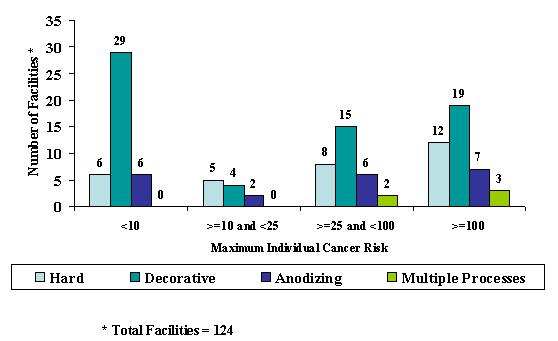
Rule 1469 currently requires facilities performing hard chrome plating to meet emission limits (milligrams/ampere-hour) that increase in stringency with increasing mass emissions and with increasing activity (ampere-hours). It requires facilities performing decorative chrome plating and chromic acid anodizing to meet an exhaust standard (milligrams/dry standard cubic meters), or maintain a surface tension of no more than 45 dynes/cm in the plating bath. Even with these standards, many chrome plating facilities currently exceed Rule 1402 risk levels, based on screening risk assessments. The following figure shows the estimated cancer risk for 124 of the 131 facilities before implementation of proposed controls under PAR 1469.
Figure 1
Estimated MICR for Chrome Plating and Chromic Acid
Anodizing Facilities with Existing Controls
The proposed amendments set general requirements for all facilities and more stringent requirements for facilities for which the nearest residence or sensitive receptor is within 25 meters or for which the nearest school is within 100 meters. These facilities must meet an ampere hour threshold that is based on a calculated cancer risk of 10 in a million, or install controls. In general, facilities must meet emission limitations based on ampere-hour thresholds or demonstrate risk directly through an emissions inventory and health risk assessment. Based on a Tier 2 screening risk assessment, some facilities still exceed the Rule 1402 action risk level of 25 in a million even after installing maximum controls.
All facilities are required to:
- Meet the specific State ATCM and Federal NESHAP requirements; and
- Install an ampere-hour meter on hexavalent chromium and chromic acid anodizing tanks; and
- Use only a certified wetting agent fume suppressant within 1 year, if using a fume suppressant; and
- Air sparging (if allowed by permit) only during plating. No air sparging when adding chromic acid; and
- Meet housekeeping practices; and
- Retain existing add-on control equipment, unless replaced by a control technique meeting equal or higher control efficiency; and
- Use add-on control equipment for hard chrome plating operations, unless an alternative requirement is approved for small facilities; and
- Undergo operator training and certification; and
- Submit a Compliance Plan within 9 months, stating the compliance method used. A Compliance Plan is not necessary for facilities that have submitted an approved risk assessment before the rule adoption date, or have submitted an Emission Reduction Plan, or have open permit applications for the purpose of complying with PAR 1469.
Facilities located more than 25 meters from the nearest residence or sensitive receptor, have several compliance options. In general, they can meet an emission limitation achievable by HEPA or similar controls (0.0015 mg/amp-hr), or remain below an ampere-hour threshold and meet an emission limitation achievable using a certified fume suppressant (0.01 mg/amp-hr). Ampere-hour thresholds are adjustable for increasing distance. In addition, these facilities have several alternative compliance options, including meeting a facility mass emission level, which may be adjusted for distance. Specifics include:
- Comply directly with emission limitations (0.01 mg/amp-hr or 0.0015 mg/amp-hr) within 2 years; or
- Submit an emissions inventory and health risk assessment by January 1, 2004 demonstrating facility-wide risk is less than 25 in a million; or
- Install HEPA or equivalent controls and use a wetting agent chemical fume suppressant; or
- Comply with mass emission rates by submitting calculations in a Compliance Plan, or
- Comply with alternative standards.
Facilities located 25 meters or less from the nearest residence or sensitive receptor, and located 100 meters or less from a school (existing as of rule adoption date) also have several compliance options. They can meet an emission limitation (0.0015 mg/amp-hr), or meet an alternative compliance option. Specifics include:
- Comply directly with emission limitation (0.0015 mg/amp-hr) within 2 years; or
- Submit an emissions inventory and health risk assessment by January 1, 2004 demonstrating facility-wide risk is less than 10 in a million; or
- Submit an Emission Reduction Plan within 1 year, demonstrating that emissions of hexavalent chromium result in a cancer risk of less than 10 in a million; or
- Install HEPA or equivalent controls and use a wetting agent chemical fume suppressant, or
- Comply with alternative standards for small facilities using less than 365,000 ampere-hours/yr
Implementation of PAR 1469 is expected to reduce over 90 percent of current hexavalent chromium emissions, or approximately 48 pounds per year. There could still be about a dozen facilities that have a residual cancer risk greater than 25 in a million with maximum controls. AQMD staff will revisit the rule in three years to perform a technical assessment.
If PAR 1469 is adopted, facilities in South Coast conducting hexavalent chromium electroplating or chromic acid anodizing will be subject to the most stringent requirements in the nation. Many aspects of the rule were designed to give affected facilities flexibility in meeting these stringent requirements.
Proposed Rule 1426
PR 1426 will require facilities that perform nickel, cadmium, lead or copper electroplating operations to collect and submit data on process and receptor information. This rule will also apply to facilities with process tanks containing sodium hydroxide (in a spray process), sulfuric acid, nitric acid, hydrochloric acid and chromic acid (excluding chromic acid used in electroplating tanks), associated with hexavalent chromium, nickel, cadmium, lead or copper electroplating operations. The proposed rule includes housekeeping requirements and specifies restrictions on air sparging of tanks containing chromic acid.
Currently there are limited data available to allow characterization of risks and impacts of these operations. More information is needed on process and activity. Specifically, information on tank parameters, purchase records for plating metal(s), receptor distances, and plating activity records are required under the proposed rule. In addition, staff is working with industry to establish better emission factors. The data will allow staff to assess whether estimated impacts from electroplating operations cause cancer risks or hazard indices that are likely to exceed thresholds in Rule 1402. If warranted, future rule amendments could add control requirements. The data collection requirements sunset after two years. Staff feels this will provide enough data to assess whether future rule control requirements are necessary.
PAR 1469 Key Issues
Many issues were resolved during the rule development process. The proposal reflects considerable efforts by all parties to negotiate an acceptable proposal. Industry representatives since the beginning of the process have questioned the need for PAR 1469. They point out that the hexavalent chromium cancer risk factor in California is more stringent than the risk factor used by the U.S EPA. They suggested that increased enforcement for non-complying facilities would be a better approach than amending the rule. Although consensus has been reached on the uncontrolled emission factor for hexavalent chromium to be used for rule development purposes, it was important to them that the rule provide flexibility and an opportunity to demonstrate their well-controlled operations. This was provided in PAR 1469 in the form of allowing several different compliance options.
Industry representatives have also expressed concern that the majority of costs are borne by a relatively small number of facilities. As a result of comments made by industry representatives, significant clarifications were made to the draft socioeconomic assessment to properly characterize impacted facilities. However, it should be noted that if this rule was not adopted, the majority of these costs would still result as Rule 1402 is implemented. Some facilities would face higher costs due to preparing inventories, risk assessments and risk reduction plans.
Environmental representatives initially proposed requiring all hexavalent chromium plating and chromic acid anodizing tanks to install HEPA add-on controls. They have had past experience with metal finishing facilities in close proximity to homes and schools. They have concerns about the use of fume suppressants without add-on controls due to potential for operator error. As a result of the negotiation process, all facilities will be subject to more stringent requirements. Facilities located closer to sensitive receptors, residences, and existing schools have even tougher standards proposed in order to be more health protective. In addition, facilities with these receptors relying solely on fume suppressants will be subject to more frequent inspections.
California Environmental Quality Act (CEQA)
Pursuant to California Environmental Quality Act (CEQA) Guidelines §15252 and AQMD Rule 110, the AQMD has prepared an Environmental Assessment (EA) for the proposed amendments to Rule 1469 and proposed Rule 1426. The Draft EA concludes that implementation of the proposed project would not result in significant adverse environmental impacts. The Draft EA was released for a 30-day public review and comment period and one comment letter was received. The Final EA has been prepared with responses to the comments and is included as an attachment to this Governing Board package.
Socioeconomic Assessment
A socioeconomic assessment is included as part of the Board package. The socioeconomic analysis indicates an estimated cost of $2.3 million for 2003, decreasing to $2.0 million for 2005 and beyond. At least 95 percent of the costs are associated with PAR 1469, of which more than 98 percent is associated with installation of HEPA or equivalent add-on controls, to be borne by 25 facilities. However, it should be noted that all but 3 facilities are expected to incur similar costs under Rule 1402 (in the absence of PAR 1469). In some instances, facilities complying with Rule 1402 incur costs for completing emissions inventories, health risk assessments and risk reduction plans, in addition to add-on controls. The cost for an emissions inventory and health risk assessment is approximately $10,000. An additional cost of approximately $1,000 would be incurred for preparation of a risk reduction plan. Furthermore, once facilities select their best compliance options under PAR 1469, these costs would be expected to be less than the staff estimates.
For the Basin as a whole, eight jobs per year will be forgone (not created in the future) between 2003 and 2015 from all industry sectors. For the fabricated metal sector, to which the majority of the affected facilities belong, eleven jobs per year will be forgone between 2003 and 2015. The estimated reduction in profits for facilities within the fabricated metal sector is a maximum of 0.017 percent. Industry representatives requested that the socioeconomic assessment clarify that these findings are based on an industry-wide average, not individual facilities and that the cost of add-on controls for the affected businesses can be significant.
AQMP and Legal Mandates
Rule 1469 and PR 1426 are not AQMP requirements or a legal mandate. They are air toxic rules that would implement part of the Air Toxics Control Plan and the source-specific measures the Board directed staff to evaluate as part of the adoption resolution of Rule 1402 in March 2000.
Resource Impacts
Existing AQMD resources will be used to implement PAR 1469. AQMD inspectors routinely inspect metal plating and chromic acid anodizing establishments. Facilities located within 25 meters from a residence or sensitive receptor or 100 meters from a school existing as of the date of rule adoption that are relying on fume suppressants only will be inspected more frequently than in the past. In addition, AQMD resources will be used for training of inspectors and facility personnel, certification of fume suppressants, development and review of test protocols and guidance documents, and to provide technical assistance to facility operators in assessing risks and evaluating compliance options, along with assistance from industry representatives.
Under PR 1426, collection and analysis of information will be undertaken by current staff. Industry representatives will assist AQMD staff in source testing to determine emission factors for PR 1426 compounds and development of source testing protocols.
AQMD staff will make an effort to streamline internal procedures to accommodate the additional work within existing resources. Implementation of the proposed rules is not expected to have an impact on AQMD fiscal resources. No additional staff is requested.
Attachments (3,086 KB)
Summary of Proposal
Key Issues and Responses
Rule Development Process
Key Contacts List
Resolution
Proposed Amended Rule 1469 and Proposed Rule 1426
Staff Report (Includes Final Socioeconomic Report)
Final Environmental Assessment (EA) for Rule 1469 – Hexavalent Chromium
Emissions From Chrome Plating and Chromic Acid Anodizing Operations,
and Rule 1426 – Emissions From Metal Finishing Operations
/ / /