
BOARD MEETING DATE: May 2, 2003
AGENDA NO. 35
Adopt Proposed Amendments to Rule 109 – Recordkeeping for Volatile Organic Compound Emissions
SYNOPSIS:
Proposed amendments to Rule 109 will add an exemption from recordkeeping for super compliant materials, add test methods to determine compliance with VOC content requirements for the exempt materials, and clarify the definition of super compliant materials. The recordkeeping exemption would only apply to materials with a very low VOC content at qualifying facilities.
COMMITTEE:
Stationary Source, March 28, 2003, Reviewed
RECOMMENDED ACTION:
Adopt the attached resolution:
- Certifying the Notice of Exemption for Proposed Amended Rule 109 – Recordkeeping for Volatile Organic Compound Emissions; and
- Amending Rule 109 – Recordkeeping for Volatile Organic Compound Emissions.
Barry R. Wallerstein, D.Env.
Executive Officer
Background
Rule 109 – Recordkeeping for Volatile Organic Compound Emissions was amended in 2000 to streamline recordkeeping for volatile organic compound (VOC) emissions by adding monthly recordkeeping as an option to daily recordkeeping for some facilities. At the time of the 2000 amendment, the Governing Board directed staff to work with suppliers and producers of super compliant materials, CARB, and EPA to determine if all or some usage of super compliant materials could be exempted from recordkeeping. Rule 109 currently allows monthly, rather than daily recordkeeping, for those materials. Qualified sources are required to keep a list of VOC-containing materials and a monthly usage or emission summary, the same requirements as those for equipment exempt under Rule 219 – Equipment Not Requiring a Written Permit Pursuant to Regulation II.
Public/Rule Development Process
The possibility of an exemption for super compliant materials was discussed at several meetings of the Monitoring, Recordkeeping, and Reporting Task Force. Subsequently, staff worked with CARB, EPA, and suppliers and manufacturers of super compliant materials to develop an exemption agreeable to all parties. Staff conducted a Public Consultation Meeting on March 19, 2003 to solicit comments on the proposed rules. All comments have been addressed in the attached staff report.
Proposal
The purpose of Rule 109 is to require recordkeeping for VOC emissions to determine compliance with AQMD rules and regulations and permit conditions. The proposal to amend Rule 109 would add an exemption from recordkeeping for super compliant materials at facilities with 4 tons per year or less total facility VOC emissions. Compliance with the 4 ton per year criteria must be shown by annual records. The original proposal also changed the units in the definition of super compliant to express it in pounds of VOC per pound of solid material. The original definition of 50 grams VOC per liter of material has been restored in response to comments from the public. As with the exemption for low VOC cleaning solvents, if a facility fails to comply with any provision of the rule, monthly records must be kept for the materials exempt from recordkeeping for a period of three years following the violation.
Several new test methods are proposed for addition to the rule to determine VOC content of super compliant materials. Test methods for radiation cured, water-based, and multi-package coatings are proposed. The proposal also adds a provision in the test method section that allows other test methods to be used so long as they are approved by EPA, CARB, and AQMD. Other minor changes are proposed to update and clarify the rule. All proposed changes are administrative in nature and have no effect on emissions.
Key Issues
Two key issues were encountered during rule development. They included the threshold for the exemption and test methods for radiation cured materials. The threshold for exemption for super compliant materials was set at 4 tons per year of total facility VOC to allow smaller facilities to benefit from the exemption. These smaller facilities are treated differently from those that emit more than 4 tons under current AQMD rules such as New Source Review. Facilities with greater than 4 tons of VOC would be required to keep monthly records for their equipment that uses only super compliant materials.
The second key issue was test methods for radiation cured materials such as ultra violet (UV) cured materials. An ASTM method for testing these materials was incorporated in EPA Method 24 in 1995 but cannot be used for testing thin-film UV materials. Industry will continue to work with EPA headquarters to develop a test method for thin-film materials. Until such a test method is approved, thin-film radiation cured materials will be tested using EPA Method 24 even though the method may overstate VOC content. EPA also agreed in principle to the concept of calculating VOC content of thin-film UV/EB coatings providing the method assumes all VOC in the raw materials is emitted. Industry provided suggestions for calculation of VOC content for thin-film materials based on VOC content of raw materials in the coating formulation. Review of the method by EPA and AQMD staff indicated concerns with the assumptions related to the formulas. All parties will continue to work to develop a method of calculating VOCs acceptable to EPA, CARB, and AQMD. The rule recognizes any method approved by all three agencies as an acceptable alternative to the specified test methods.
California Environmental Quality Act (CEQA)
Pursuant to State CEQA Guidelines §15002 (k)(1), staff has reviewed the proposed amendments to Rule 109 and has determined with certainty that the proposed project does not have the potential to significantly adversely impact air quality or any other environmental area. Staff has concluded that the proposed project is exempt from CEQA pursuant to State CEQA Guidelines §15061 (b)(3) – Review for Exemption. A Notice of Exemption has been prepared pursuant to State CEQA Guidelines §15062 – Notice of Exemption and will be filed with the county clerks of Los Angeles, Orange, Riverside and San Bernardino counties immediately following the adoption of the proposed amended rule.
Socioeconomic Assessment
No adverse socioeconomic impacts are expected as a result of the proposed amendments to Rule 109. The proposal would result in less work for facilities qualifying for the exemption which could be a cost-savings for them.
Resource Impacts
No resource impacts are expected from the proposed amendments. Existing AQMD staff can be used to determine compliance with various rules without additional resources.
Attachments
Summary of Proposal
Key Issues and Responses
Rule Development Process
Key Contact List
Resolution
Proposed Rule Language
Staff Report
Notice of Exemption
ATTACHMENT A
SUMMARY OF PROPOSAL
|
Proposed Amended Rule 109 – Recordkeeping for Volatile Organic Compound Emissions |
|
The proposed amendments to Rule 109 – Recordkeeping for Volatile Organic Compound Emissions include:
|
ATTACHMENT B
KEY ISSUES AND RESPONSES
|
Proposed Amended Rule 109 – Recordkeeping for Volatile Organic Compound Emissions |
|
ATTACHMENT C
RULE DEVELOPMENT PROCESS
Proposed Amended Rule 109 – Recordkeeping for Volatile Organic Compound Emissions
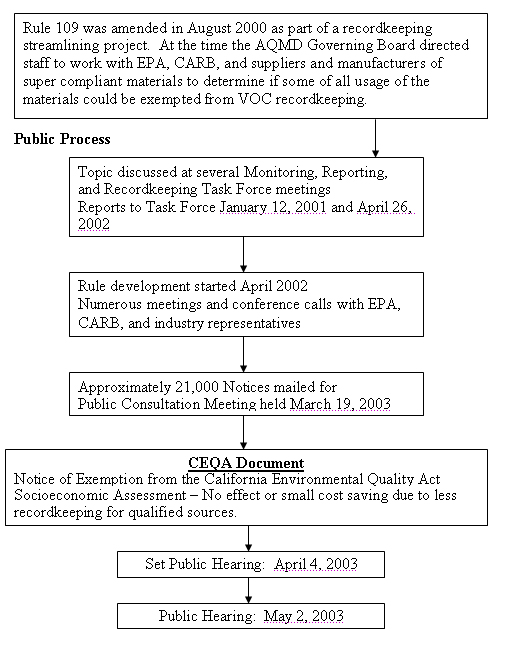
Approximately 13 months spent in rule development.
ATTACHMENT D
KEY CONTACTS LIST
U.S. Environmental Protection Agency
California Air Resources Board
Armstrong Floor Products
CMTA – Southern California Air Quality Alliance
Coates Screen
Ionicorp+
Lesco
Nazdar
RadTech International
Sartomer
Sericol
SGIA International
Sun Chemicals
UCB Chemicals
Wikoff Color Corporation
ATTACHMENT E
RESOLUTION NO. 03-
A Resolution of the Governing Board of the South Coast Air Quality Management District (AQMD) certifying that Proposed Amended Rule 109 – Recordkeeping for Volatile Organic Compound Emissions is exempt from the requirements of the California Environmental Quality Act (CEQA).
A Resolution of the AQMD Governing Board amending Rule 109 – Spray Coating Operations.
WHEREAS, AQMD staff reviewed the proposed project and determined that it is exempt from the requirements of the California Environmental Quality Act (CEQA); and
WHEREAS, AQMD staff has conducted a public consultation meeting regarding the proposed amendments to Rule 109; and
WHEREAS, the South Coast Air Quality Management District Board finds and determines, taking into consideration the factors in Section (d)(4)(D) of the Governing Board Procedures, that the modifications adopted which have been made to Proposed Amended Rule 109, since notice of public hearing was published do not significantly change the meaning of the proposed rule within the meaning of Health and Safety Code Section 40726 and would not constitute significant new information pursuant to CEQA Guidelines Section 15088.5; and
WHEREAS, the AQMD Governing Board has determined that a need exists to amend Rule 109 – Recordkeeping for Volatile Organic Compound Emissions in order to add an exemption for super compliant materials and clarify test methods used to determine compliance with rule requirements in response to a directive from the Governing Board to work with EPA, CARB, and suppliers and manufacturers of such materials to determine if usage of some or all such materials could be exempted from recordkeeping; and
WHEREAS, the AQMD Governing Board obtains its authority to adopt, amend, or repeal rules and regulations from Sections 40000, 40001, 40702, and 40725 through 40728 of the California Health and Safety Code; and
WHEREAS, the AQMD Governing Board has determined that Proposed Amended Rule 109 – Recordkeeping for Volatile Organic Compound Emissions is written and displayed so that the meaning can be easily understood by persons directly affected by it; and
WHEREAS, the AQMD Governing Board has determined that Proposed Amended Rule 109 – Recordkeeping for Volatile Organic Compound Emissions as proposed to be amended, is in harmony with, and not in conflict with, or contradictory to, existing statutes, court decisions, or state or federal regulations; and
WHEREAS, the AQMD Governing Board has determined that Proposed Amended Rule 109 – Recordkeeping for Volatile Organic Compound Emissions does not impose the same requirements as any existing state or federal regulation, and the proposed amend rule is necessary and proper to execute the powers and duties granted to, and imposed upon, the AQMD; and
WHEREAS, the AQMD Governing Board, in amending this proposed amended rule, references the following statutes which the AQMD hereby implements, interprets or make specific: California Health and Safety Code Sections 40000, 40001, and 40440(c); and
WHEREAS, a comparative analysis, as required by Section 40727.2 of the Health and Safety code; has been performed and it has been determined that the proposed amendments to Rule 109 do not impose a new emission limit or standard, make an existing emission limit or standard more stringent, or impose new or more stringent monitoring, reporting, or recordkeeping requirements; and
WHEREAS, proposed amended Rule 109 – Recordkeeping for Volatile Organic Compound Emissions is not a control measure in the 1997 Air Quality Management Plan (AQMP) and thus, was not ranked by cost-effectiveness relative to other AQMP control measures in the 1997 AQMP; and
WHEREAS, the AQMD Governing Board has actively considered the socioeconomic impacts of the proposed amendments to Rule 109 – Recordkeeping for Volatile Organic Compound Emissions and has determined that there are no socioeconomic impacts; and
WHEREAS, a public hearing has been properly noticed in accordance with all provisions of Health and Safety Code Section 40725; and
WHEREAS, the AQMD Governing Board has held a public hearing in accordance with all provisions of law; and
WHEREAS, the AQMD specifies the Manager of Rule 109 as the custodian of the documents or other materials which constitute the record of proceedings upon which the adoption of this proposed amendment is based, which are located at the South Coast Air Quality Management District, 21865 Copley Drive, Diamond Bar, California.
NOW, THEREFORE BE IT RESOLVED that the AQMD Governing Board does hereby certify the Notice of Exemption for Proposed Amended Rule 109 – Recordkeeping for Volatile Organic Compound Emissions was completed in compliance with state CEQA Guidelines Sections 15002(k)(1), 15061(b)(3), and 15062, and that it has been presented to the Governing Board, whose members reviewed, considered, and approved the information therein prior to acting on Proposed Amended Rule 109 – Recordkeeping for Volatile Organic Compound Emissions; and
BE IT FURTHER RESOLVED, the AQMD Governing Board hereby directs staff to work with the regulated industry, EPA, and CARB to develop an acceptable calculation methodology to determine the VOC content of thin-film ultraviolet/electron beam or other radiation cured materials; and
BE IT FURTHER RESOLVED, that the AQMD Governing Board hereby amends, pursuant to the authority granted by law, Rule 109 – Recordkeeping for Volatile Organic Compound Emissions, as set forth in the attached, and incorporated herein by this reference.
DATE:_____________ ______________________________
CLERK OF THE BOARD
/ / /