
BOARD MEETING DATE: October 3, 2003
AGENDA NO. 33
Adopt Rule 1105.1 - Reduction of PM10 and Ammonia Emissions From Fluid Catalytic Cracking Units.
SYNOPSIS:
Proposed Rule 1105.1 will reduce PM10, PM10 precursors, and ammonia emissions from fluid catalytic cracking units in refineries and will implement Control Measure CMB-09 of the Air Quality Management Plan (AQMP). The proposed rule establishes emission limits for filterable PM10 and ammonia and requires periodic source testing to ensure compliance. The proposal also requires monitoring, reporting and record-keeping of PM10 and ammonia emissions as well as equipment operating parameters. At full implementation, the proposed rule will reduce PM10 and ammonia emissions by approximately 2 tons per day.
COMMITTEE:
Stationary Source, March 28, 2003, April 25, 2003, and September 26, 2003, Reviewed.
RECOMMENDED ACTION:
Adopt the attached resolution:
- Certifying the Final Environmental Assessment (EA) for Proposed Rule 1105.1 - Reduction of PM10 and Ammonia Emissions From Fluid Catalytic Cracking Units; and
- Adopting Rule 1105.1 - Reduction of PM10 and Ammonia Emissions From Fluid Catalytic Cracking Units.
Barry R. Wallerstein, D.Env.
Executive Officer
Background
Proposed Rule 1105.1 is being developed based on Control Measure CMB-09 - Emission Reductions from Petroleum Fluid Catalytic Cracking Units (PM10). This control measure was first introduced in the 1989 AQMP, and reintroduced subsequently in the 1991, 1994, 1997 and 2003 AQMPs. Control Measure CMB-09 in the 1997 AQMP has estimated an emission reduction of 0.5 tons per day solid filterable PM10 by December 31, 2006. Control Measure CMB-09 in the 2003 AQMP estimated a range of emission reductions from 2.1 tons per day to 4.7 tons per day total PM10, including approximately 0.3 tons per day to 0.5 tons per day filterable PM10, and an emission reduction of 1.6 tons per day ammonia.1 Implementing Control Measure CMB-09 is vital for completing the implementation of the PM10 attainment strategy of the AQMP and helps make progress towards meeting the ambient PM2.5 standards by reducing PM2.5 emissions and its precursors.
1 The emission reductions of 2.1 tons per day total PM10 and 1.6 tons per day ammonia estimated for the 2003 Control Measure CMB-09 include growth factor, whereas the emission reductions of 2.0 tons per day total PM10 and 1.5 tons per day ammonia estimated in the Staff Report of PR 1105.1 has no growth factor.
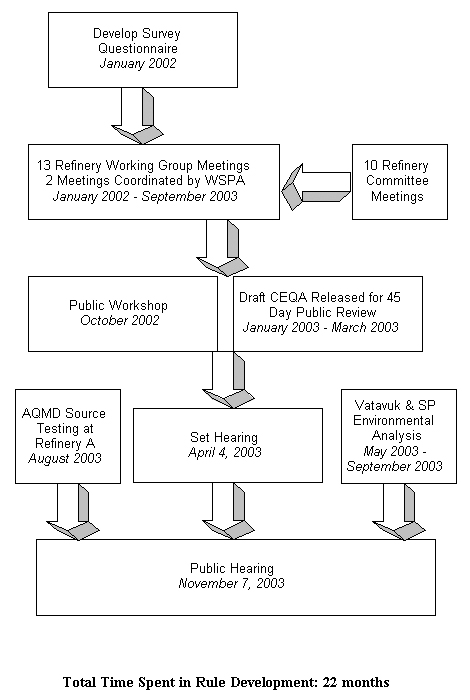
In 1995-1996, the Western States Petroleum Association (WSPA) and staff formed a task force to discuss the control strategy for Proposed Rule (PR) 1105.1. This ultimately led to source testing of the fluid catalytic cracking units (FCCUs) at all six refineries in 1997. Starting in January 2002, staff reconvened the Refinery Working Group including representatives of the six refineries in the area and WSPA to discuss PR 1105.1. Representatives of the environmental community were also invited to participate. To date, staff held thirteen (13) Refinery Working Group Meetings with the refineries and WSPA, and ten (10) Refinery Committee meetings; participated in two (2) meetings coordinated by WSPA to discuss issues related to source testing and monitoring; and held a Public Workshop on October 3rd, 2002.
More recently, staff conducted a survey to collect the most current information from the refineries; conducted field visits at all six refineries; reviewed source test results; conducted research on source testing methodology; collected cost information from control equipment manufacturers; and reviewed cost data submitted by the refineries. WSPA engaged Nexant Inc. to assess the feasibility and cost of PR1105.1. Staff reviewed Nexant study and engaged two experts in the field of cost analysis and control technology, Vatavuk Engineering and SP Environmental, to review staff’s and the WSPA consultant’s cost analysis. SP Environmental also conducted an independent feasibility analysis and cost estimate based upon an inspection of each refinery. Staff also conducted additional source testing at one refinery to confirm that the proposed limits are achievable with little or no ammonia injection.
Air Quality Air Management Plan and Legal Mandates
PR 1105.1 will implement Control Measure CMB-09 of the Air Quality Management Plan. The Control Measure CMB-09 is part of the revised PM10 implementation strategy submitted to U.S. EPA in 2002 as part of the District's request to extend the Basin's attainment date for PM10 to 2006. The District's request for extension and its revised PM10 implementation strategy was approved by U.S. EPA in April 2003.
Proposal
The most significant components of PR 1105.1 are the future emission limits for PM10 and ammonia slip. Additional features of the proposed rule are to specify a method of verifying and assuring compliance with the emission limits and to provide flexibility for the refineries in choosing a monitoring protocol that best fits for their operations. Staff has proposed two versions of PR 1105.1 for the Governing Board's consideration.
Version 1 of PR 1105.1 - Proposed Emission Limits
- For filterable PM10:
— 3.6 lbs/hr, or
— 0.005 grain/dscf corrected to 3% O2 dry, or
— 2.8 lbs/1000 barrels fresh feed
- For ammonia slip: 10 ppmv corrected to 3% O2 dry
Based on the analysis of SP Environmental, all five refineries have sufficient space to install ESPs with 20%-25% redundancy built-in to achieve and maintain the above proposed limits continuously during the five-year operational cycle of the FCCUs. The SP Environmental analysis indicates that the PM10 limits are achievable without ammonia injection. However, in addition to the built-in redundancy, allowing the use of ammonia injection provides additional flexibility to ensure the limits will be achieved over the entire 5-year operational cycle.
Version 2 of PR 1105.1 - Proposed Emission Limits & Alternative Compliance Provision
At the September 15, 2003 Refinery Committee meeting, in an effort to address industry's concerns regarding continuous compliance, costs, and compliance flexibility, the idea of reintroducing alternative compliance options was discussed. In response, staff has prepared Version 2 of PR 1105.1 that includes an alternative compliance provision similar to the one included in May 2003 staff's proposal.
Version 2 of PR 1105.1 will allow the operator to emit at levels greater than 0.005 grain/dscf for filterable PM10 provided that the operator does not exceed the upper bound limits of 0.006 grain/dscf for filterable PM10, and the differences in emission reductions between 0.005 grain/dscf and 0.006 grain/dscf filterable PM10 are mitigated by using alternative control measures that have been demonstrated to provide real, surplus, enforceable and sustainable emission reductions. The refinery elects this option must identify the measures in a plan submitted and approved by the Executive Officer prior to the required compliance date. In addition, the measures must demonstrate that 50% of the PM10 emission reductions are obtained within 5 km from the outer boundaries of the facility, and 80% of the emission reductions are PM2.5. The September 2003, Version 2, of PR 1105.1 does not include a mitigation fee option as described in the May 2003 Version of PR 1105.1 previously made available to the public.
Compliance Date
PR 1105.1 requires the operator to comply with the proposed limits by December 31, 2006. However, the refineries may request in writing by July 1, 2006, for an extension up to December 31, 2008, to synchronize the installation of the PM10 control device with the FCCU turnaround. Based on comments from industry, staff has modified the proposed rule to allow the performance testing required to demonstrate compliance with the emission limits to be conducted after December 31, 2008, provided the FCCU is operated with the control equipment required for compliance with the emission limits after that date.
Annual Compliance Source Testing
PR 1105.1 requires the refineries to conduct, at a minimum, an annual source test for PM10 and ammonia to determine compliance with the emission limits. The source tests for PM10 and ammonia must be conducted concurrently.
To improve the reliability of the source test results, PR 1105.1 requires the refineries to conduct simultaneous duplicate sampling, and establishes a criteria to invalidate highly variable test results. Triplicate sequential sampling is also allowed if it is physically impossible to conduct duplicate simultaneous sampling.
Monitoring, Reporting and Recordkeeping
Between annual compliance source tests, PR 1105.1 requires the operator to monitor, record, and report several pertinent operating parameters of the control equipment to monitor continuous compliance with the emission limits. PR 1105.1 contains a list of suggested operating parameters. However, to provide flexibility for the refineries in choosing a monitoring protocol that best fits their operations, PR 1105.1 allows the operator to propose alternatives for monitoring and recording parameters. PR 1105.1 requires the operator to report filterable PM10, condensable PM10 and ammonia emissions on an annual basis.
Exemptions
The operator is not required to comply with the emission limits in PR 1105.1 for a period of not more than one hundred and twenty (120) hours during start-up and shutdown periods related to the FCCU turnaround. There is also an exemption for routine maintenance of control equipment designed to meet the emission limits of PR 1105.1 and installed prior to the date of adoption.
Other Amendments Based on Comments
Staff has incorporated a few clarifying changes based upon comments received. One change was to clarify that the PM10 testing from the CO boilers located downstream of electrostatic precipitators that are existing as of the date of adoption of PR 1105.1 may be excluded for the purpose of demonstrating compliance with the PM10 limits of the proposed rule. Also clarified was that the routine maintenance exemption applied to the electrostatic precipitator and not the FCCU, and that start-up and shutdown period commencements considers safe operation of the equipment. Language was also added to clarify that the required performance testing could be completed after December 31, 2008 under certain circumstances. None of these amendments are significant or have an emission impact. The exemption for start-up and shutdown was extended from seventy-two (72) to one hundred twenty (120) hours since all of the refineries indicated their start-up and shutdown procedures could not be safely done within seventy-two hours. They would each have to seek a variance for the time beyond the seventy-two hours; and whether authorized in the rule or guaranteed in a variance, the emissions to the atmosphere will be the same to complete the start-up and shutdown cycle. Finally, the language specifying the process for excluding sulfuric acid emissions from a CO catalyst installed downstream of an FCCU was deleted since the one refinery that was proposing installation of such a device has stipulated they no longer plan to do so.
Affected Facilities
PR 1105.1 affects six (6) refineries located in Los Angeles County. They are all identified by Source Industrial Code of 2911.
Emission Inventory and Emission Reductions
The six refineries are among the top ten (10) emitters in the AQMD for Total Suspended Particulates (TSP) based on the 2000-2001 and 2001-2002 Annual Emissions Reports. The total facility inventories of TSP at the six refineries range from 0.53 tons per day (195 tons per year) to 0.88 tons per day (320 tons per year).2
2 Annual Emissions Report 2000-2001 - List of Top 50 Emitters.
The FCCUs at the refineries are major contributors of TSP (and PM10). For Refinery A, which installed new ESPs in 1993, the particulate emissions from their FCCU are about 5% - 10% of their total facility's TSP inventory. For the remaining four refineries, the FCCU's particulate emissions contribute about 15% - 55% of their total facility's TSP inventories.
The total ammonia inventory from stationary sources is estimated to be 13.2 tons per day3. With an inventory of 2 tons per day, which is approximately 15% of the total stationary sources' inventory of ammonia, the six FCCUs in the AQMD are significant sources of ammonia emissions. The emission inventories from six FCCUs and the emission reductions estimated from the five affected FCCUs are listed in Table 1.
3 2003 Air Quality Management Plan.
The emission inventories from six FCCUs and the emission reductions estimated from the five affected FCCUs are listed in Table 1.
Table 1: Emission Inventory and Emission Reductions
|
Emission Inventory For 6 Refineries (Tons Per Day) |
Emission Reductions For 5 Refineries, Except Refinery A (Tons Per Day) |
|
|
Filterable PM10 |
0.87 (Note 1) |
0.5 (Note 4) |
|
Condensable PM10 |
2.61 (Note 2) |
1.5 (Note 5) |
|
Ammonia |
2 (Note 3) |
1.5 (Note 6) (Potentially up to 5.8 tpd reductions of ammonium sulfates - Note 7) |
Note:
- About 45% of the filterable PM10 from FCCUs are PM2.5. The emission inventory of filterable PM10 was from test results of AQMD Source Test Method 5.2 in 1996-2002.
- Essentially, all condensable particulates are PM2.5. The emission inventory of condensable PM10 was from test results of AQMD Source Test Method 5.2 in 1996-2002.
- The emission inventory of ammonia is from AB2588 reports and the 2002 Refinery Survey for PR 1105.1.
- Emission reductions were calculated based on the proposed emission limit of 0.005 gr/dscf for filterable PM10.
- Emission reductions were calculated based on a) the current emission inventory of condensable PM10 from the test results of AQMD Source Test Method 5.2 in 1996-2002, and b) the future inventory of condensable PM10 estimated based on the assumption that all 10 ppmv ammonia slip would form condensable sulfates.
- Emission reductions were calculated based on a) the current emission inventory of ammonia reported in AB2588 reports and the 2002 Refinery Survey for PR 1105.1 and b) the future inventory of ammonia based on the assumption that 10 ppmv ammonia would remain as gaseous ammonia in the atmosphere.
- The maximum potential emission reductions of 5.8 tons per day ammonium sulfate were calculated based on an assumption that all 1.5 tons per day of ammonia could potentially convert to ammonium sulfate in the atmosphere. Comparing to the 1.5 tons per day reduction estimated using the approach described in Note 5, the 5.8 tons per day maximum potential reduction of ammonium sulfate showed that not all of the ammonia passing through the impingers of AQMD Source Test Method 5.2 would convert into ammonium sulfate. The unreacted ammonia would pass through the impingers and would be released as gaseous ammonia. The maximum potential reduction of 5.8 tons per day is based on the assumption that all gaseous ammonia passing through the impingers would be converted in the atmosphere to ammonium sulfate.
Cost Effectiveness
The cost effectiveness associated with PR 1105.1 limits of 0.005 gr/dscf filterable PM10 and 10 ppmv ammonia slip is listed in Table 2. This cost effectiveness was derived based on the assumption that installing new electrostatic precipitators at five (5) affected refineries is needed to meet the proposed rule limits.
Table 2: Cost Effectiveness ($/Ton Reduced)
|
AQMD ($/Ton Reduced) |
SP Environmental ($/Ton Reduced) |
|
|
Filterable and Condensable PM10 (Note 1) |
3,035 - 4,598 |
4,594 - 5,185 |
|
Filterable PM10 and Ammonia (Note 2) |
3,065 - 4,645 |
4,547 - 5,237 |
Note:
- The cost effectiveness of PR 1105.1 considering that PR 1105.1 will reduce 0.5 tons per day filterable PM10 and 1.5 tons per day of condensable PM10 would be from $3,000 per ton to $5,000 per ton. The low end of cost effectiveness represents cost effectiveness for ESPs built without redundancy; and the high end for ESPs built with redundancy. Both designs would meet the proposed limit of 0.005 gr/dscf filterable PM10 and 10 ppmv ammonia slip on a continuous basis during a 5-year operational period of the FCCUs between turnarounds.
- The cost effectiveness of PR 1105.1 considering that PR 1105.1 will reduce 0.5 tons per day filterable PM10 and 1.5 tons per day of ammonia would be from $3,000 per ton to $5,000 per ton. Assuming that all 1.5 tons per day of ammonia would convert to 5.8 tons per day ammonium sulfate in the atmosphere, the cost effectiveness of PR 1105.1 would be approximately from $1,000 per ton to $1,700 per ton. However, if one considers only the reduction of filterable PM10 as suggested by some commentors, the cost effectiveness factor would be approximately $13,000 per ton to $22,500 per ton of filterable PM10 reduced.
Key Issues
There are two issues that industry continues to express concern about: 1) the feasibility of meeting the proposed emission limits on a long-term continuous basis; and 2) the cost effectiveness of PR 1105.1.
Meeting Proposed Limits Continuously On A Long-Term Basis
Staff contracted with an expert consultant, SP Environmental, to evaluate the proposed limits. SP Environmental contends that a level of 0.0042 grain/dscf filterable PM10 is technically feasible with the use of dry ESPs and without ammonia conditioning. However, sufficient space is not available within close proximity of the FCCUs at three refineries to install ESPs with at least 20%-25% redundancy to achieve the 0.0042 grain/dscf filterable PM10 limit on a continuous basis during a 5-year operation of the FCCUs. Therefore, SP Environmental recommended a slightly higher limit of 0.005 grain/dscf filterable PM10 and 10 ppmv ammonia slip (or a limited amount of ammonia injection up to 20 ppmv) for PR 1105.1. Source testing at one refinery conducted by the AQMD in August 2003, confirmed that the rule limits are achievable with little or no ammonia injection. Staff is recommending the SP Environmental proposal for PM10 and ammonia slip
Cost Effectiveness of PR 1105.1
The cost effectiveness of PR 1105.1 is in a range of $3,000 per ton to $5,000 per ton PM10 and ammonia reduced. Figure 1 shows a comparison of cost effectiveness of PR 1105.1 to the cost effectiveness of Rule 1133.2 - Emission Reductions from Co-Composting Operations, adopted January 10, 2003, and the cost effectiveness of Rule 1158 - Storage, Handling, and Transport of Coke, Coal and Sulfur, amended on June 11, 1999. Considering that the refineries are among the top ten (10) emitters in the AQMD for particulate emissions, and the FCCUs at the refineries are major contributors for particulate emissions and significant sources of ammonia, Figure 1 shows that PR 1105.1 with a range of cost effectiveness from $3,000 per ton to $5,000 per ton is cost effective.
Figure 1: Comparison of Cost Effectiveness ($/Ton Reduced)
Between PR 1105.1 and Other Rules
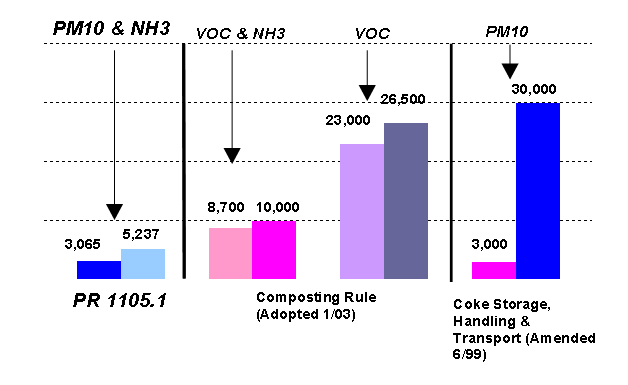
The cost effectiveness of $3,000 per ton to $5,000 per ton PM10 and ammonia reduced is based on the cost of installing electrostatic precipitators at five (5) affected refineries. Regarding the costs of installing electrostatic precipitators, in May 2003 and July 2003, staff contracted Vatavuk Engineering and SP Environmental to review both Nexant's cost analysis, and staff's analysis. Vatavuk Engineering offered a comment that staff's estimates in May 2003 of $56 million dollars in capital costs based on equipment costs provided by the two ESP vendors and EPA's cost estimate methodology are consistent with EPA's independent estimates of $50 million dollars for capital costs, particularly given the ±30% accuracy of the EPA's cost estimate methodology.
SP Environmental visited all six refineries to estimate the site specific costs associated with installing ESPs at the refineries and to evaluate the space constraint issue. SP Environmental also independently sized and estimated the equipment costs of ESPs based on the input provided by one manufacturer, other than the two manufacturers contacted by staff. SP Environmental estimated that the total capital costs for PR 1105.1 is between $88.2 million to $99.7 million.
In addition, Vatavuk Engineering and SP Environmental offered staff several recommendations on staff's approach to determine the capital costs for ESPs. Based on their recommendation, staff revised their costs and cost effectiveness estimates in September 2003. Table 3 summarizes the capital costs estimated by AQMD and SP Environmental.
Table 3: Costs of Installing ESPs at Five Refineries
|
EPA |
AQMD |
SP Environmental |
|
|
Equipment Costs |
--- |
28 to 40 |
38 to 43 |
|
Capital Cost (Including equipment costs and other costs) |
50 to 63 |
63 to 87 |
88.2 to 99.7 |
Note:
- Equipment costs of staff include materials, freight, taxes and contingencies.
- Capital costs of staff include equipment costs, site preparation, demolition, engineering, permit fee, and contingencies.
- The low end of costs is for ESPs without redundancy and the high end of costs is for ESPs with redundancy. Both designs will meet the limits of 0.005 grain/dscf filterable PM10 and 10 ppmv ammonia slip of PR 1105.1.
California Environmental Quality Act (CEQA)
Pursuant to the California Environmental Quality Act (CEQA) Guidelines § 15252 and AQMD Rule 110, the AQMD has prepared an Environmental Assessment (EA) for PR 1105.1. The Draft EA identified a direct air quality benefit of reducing emissions of solid filterable PM10 by approximately 0.5 ton per day and condensable PM10 and/or ammonia by about 1.5 tons per day by the end of 2008 at the latest. In addition, based on the construction activities necessary to comply with the proposed rule requirements, the quantity of emissions due to construction may exceed the AQMD’s daily significance thresholds. The Draft EA was released for a 45-day public review and comment period and three comment letters were received. The Final EA has been prepared with responses to the comments and is included as an attachment to this Governing Board package.
Socioeconomic Analysis
Proposed Rule 1105.1 affects six existing refineries that are currently using electrostatic precipitators to reduce PM10 emissions from FCCUs. All the six affected refineries are located in Los Angeles County and belong to the industry of petroleum products (SIC 2911). The total annualized cost of the proposed rule is projected to be $6.04 million with two jobs forgone annually in the entire four-county economy between 2006 and 2020 years. Staff estimates that the implementation of the PR 1105.1 would result in an increase of 0.09 cents per gallon of gasoline consumed in the four-counties. The Socio-Economic Impact Analysis has been included as an attachment to this Governing Board Package.
Implementation and Resources
It is expected that there will be a temporary minor workload increase due to applications submitted for installing new control equipment or retrofitting existing control equipment. No additional AQMD resources are required to implement the proposed rule.
Attachments (3,508 KB)
- Summary of Proposal
- Rule Development Process
- Key Contacts List
- Resolution and Attachment 1
- Rule Language
- Staff Report
- Final Environmental Assessment
- Socioeconomic Impact Analysis
ATTACHMENT A - SUMMARY OF PROPOSAL
|
PR 1105.1 - Reductions of PM10 and Ammonia Emissions |
| Emission Limits Proposed In Version 1 and Version 2 of PR 1105.1 — For filterable PM10: 3.6 lbs/hr, or 0.005 grain/dscf corrected to 3% O2, Alternative Compliance Provision in Version 2 of PR 1105.1 — Upper bound limit of 0.006 grain/dscf for filterable PM10 corrected to
Compliance Date — No later than December 31, 2006 Source Test Methods — AQMD Source Test Method 5.2, or Modified Source Test Method 5.2 for PM10 Annual Compliance Source Testing, Monitoring, Reporting and Record-Keeping — Annual compliance testing Exemption Refineries shall not be required to comply with the emission limits for a maximum of one hundred twenty (120) hours during any startup and shutdown periods related to FCCU turnaround; and a maximum of ten (10) consecutive days in a year for any routine maintenance related to control equipment that is installed and operated in compliance with the rule emission limits before the rule adoption date. The operator will pay $8,800 per day if there is a need to extend the routine maintenance period. |
ATTACHMENT B - RULE DEVELOPMENT PROCESS
ATTACHMENT C - KEY CONTACTS LIST
Affected Facilities
British Petroleum
Chevron-Texaco
ExxonMobil
Shell
ConocoPhillips
Valero
Manufacturers of Control Devices
Allen Sherman Hoff
AVC Specialist Inc.
Baghouses Services
Belco Technology Corporation
Croll Reynolds Clean Air Technology
Dustex
EnviTech Industry
Geo-Energy International
Grace Davidson
Hamon Research Cottrell
Intercat
McGill Air Clean Corporation
PPC Industries
Wheelabrator Air Pollution Inc.
Others
California Air Resources Board
CSI Engineering
Energy & Environmental Research Corporation
Maryland Department of Natural Resources
Puget Sound Clean Air Agency
SP Environmental
Technip-Coflexip
Texas Natural Resources Conservation Commission
U.S. Environmental Protection Agency
Vatavuk Engineering
Western States Petroleum Association
ATTACHMENT D - RESOLUTION
A Resolution of the South Coast Air Quality Management District (AQMD) Governing Board Certifying the Final Environmental Assessment for Proposed Rule (PR) 1105.1 – Reduction of PM10 and Ammonia Emissions From Fluid Catalytic Cracking Units.
A Resolution of the Governing Board Adopting Rule 1105.1 – Reduction of PM10 and Ammonia Emissions from Fluid Catalytic Cracking Units.
WHEREAS, the Governing Board finds and determines with certainty that the PR 1105.1 – Reduction of PM10 and Ammonia Emissions From Fluid Catalytic Cracking Units, is considered a "project" pursuant to the California Environmental Quality Act (CEQA); and
WHEREAS, the AQMD has had its regulatory program certified pursuant to Public Resources Code § 21080.5 and has conducted CEQA review and analysis pursuant to such program (AQMD Rule 110); and
WHEREAS, AQMD staff has prepared a Draft Environmental Assessment (EA) pursuant to its certified regulatory program and CEQA Guidelines §15252 setting forth the potential environmental consequences of PR 1105.1 – Reduction of PM10 and Ammonia Emissions From Fluid Catalytic Cracking Units; and
WHEREAS, the Draft EA was released for public review, all comments received were responded to, and the Draft EA has been revised such that it is now a Final EA; and
WHEREAS, it is necessary that the adequacy of the Final EA, including responses to comments be determined by the Governing Board prior to its certification; and
WHEREAS, it is necessary that the AQMD prepare a Statement of Findings and Statement of Overriding Considerations pursuant to CEQA Guidelines §§ 15091 and 15093, respectively, regarding adverse environmental impacts that cannot be mitigated to insignificance; and a Mitigation Monitoring Plan pursuant to Public Resources Code §21081.6, regarding the mitigation included in the Final EA; and
WHEREAS, the Governing Board prior to voting on PR 1105.1, has reviewed and considered the Final EA including responses to comments; and
WHEREAS, the Governing Board finds and determines, taking into consideration the factors in §(d)(4)(D) of the Governing Board Procedures, that the modifications adopted which have been made to PR 1105.1, since notice of public hearing was published do not significantly change the meaning of the proposed rule within the meaning of Health and Safety Code §40726 and would not constitute significant new information requiring recirculation of the Draft CEQA document pursuant to CEQA Guidelines § 15088.5; and
WHEREAS, the Governing Board has determined that the socioeconomic impact assessment of the PR 1105.1 – Reduction of PM10 and Ammonia Emissions From Fluid Catalytic Cracking Units, is consistent with the Governing Board March 17, 1989 and October 14, 1994 resolutions and the provisions of Health and Safety Code §§ 40440.8, 40728.5 and 40920.6; and
WHEREAS, the Governing Board has reviewed and considered the staff's findings related to cost and employment impacts of the PR 1105.1 – Reduction of PM10 and Ammonia Emissions From Fluid Catalytic Cracking Units set forth in the socioeconomic impact assessment made public with the agenda package for this meeting, and hereby find and determines that cost and employment impacts are as set forth in that assessment; and
WHEREAS, the Governing Board has determined that PR 1105.1 – Reduction of PM10 and Ammonia Emissions From Fluid Catalytic Cracking Units are cost-effective per ton of PM10 and ammonia reduced; and
WHEREAS, the Governing Board has actively considered the socioeconomic impact assessment and has made a good faith effort to minimize such impacts; and
WHEREAS, the Governing Board has determined that a need exists to adopt the PR 1105.1 – Reduction of PM10 and Ammonia Emissions From Fluid Catalytic Cracking Units to implement Control Measure CMB-09 of the 1997 AQMP and to reduce PM10 and ammonia emissions from fluid catalytic cracking units at refineries; and
WHEREAS, the Governing Board of the South Coast Air Quality Management District obtains its authority to adopt this proposed rule from Sections 39002, 39650, 40000, 40001, 40440, 40441, 40702, 41508 and 41700 of the California Health and Safety Code; and
WHEREAS, the Governing Board has determined that Proposed Rule 1105.1 – Reduction of PM10 and Ammonia Emissions From Fluid Catalytic Cracking Units, as proposed is written or displayed so that its meaning can be easily understood by the persons directly affected by it; and
WHEREAS, the Governing Board has determined that Proposed Rule 1105.1 – Reduction of PM10 and Ammonia Emissions From Fluid Catalytic Cracking Units, as proposed is in harmony with, and not in conflict with or contradictory to, existing federal or state statutes, court decisions, or regulations; and
WHEREAS, the Governing Board has determined that Proposed Rule 1105.1 – Reduction of PM10 and Ammonia Emissions From Fluid Catalytic Cracking Units, as proposed does not impose the same requirements as any existing state or federal regulation and the proposed rule is necessary and proper to execute the powers and duties granted to, and imposed upon, the District; and
WHEREAS, the Governing Board has determined that Proposed Rule 1105.1 – Reduction of PM10 and Ammonia Emissions From Fluid Catalytic Cracking Units, as proposed references the following statutes which the AQMD hereby implements, interprets or makes specific: Health and Safety Code 40001(a) and (b) (air quality standards and air pollution episodes); 40702 (adoption of rules and regulations), 40440(a) (rules to carry out plan); 40440(b) (best available retrofit control technology); and Federal Clean Air Act Section 172(c)(1) (reasonably available control technology); and
WHEREAS, the Governing Board has determined that there is a problem that Proposed Rule 1105.1 – Reduction of PM10 and Ammonia Emissions From Fluid Catalytic Cracking Units will help alleviate, that is the basin does not meet the ambient quality standards for PM10 and PM2.5, and the proposed rule will promote the attainment of these standards and reduce toxic emissions; and
WHEREAS, a public hearing has been properly noticed in accordance with the provisions of Health and Safety Code Section 40725; and
WHEREAS, the Governing Board has held a public hearing in accordance with all provisions of law; and
WHEREAS, the Governing Board specifies the manager of Proposed Rule 1105.1 – Reduction of PM10 and Ammonia Emissions from Fluid Catalytic Cracking Units as the custodian of the documents or other materials which constitute the record of proceeding upon which the adoption of this proposed rule is based, which are located at the South Coast Air Quality Management District, 21865 Copley Drive, Diamond Bar, California; and
NOW, THEREFORE, BE IT RESOLVED, that the Governing Board does hereby certify that the Final EA for Proposed Rule 1105.1 – Reduction of PM10 and Ammonia Emissions From Fluid Catalytic Cracking Units, was completed in compliance with CEQA and Rule 110 provisions; and finds that the Final EA was presented to the Governing Board, whose members reviewed, considered and approved the information therein prior to acting on Proposed Rule 1105.1 – Reduction of PM10 and Ammonia Emissions From Fluid Catalytic Cracking Units; and
BE IT FURTHER RESOLVED, that the Governing Board adopts a Statement of Findings and a Statement of Overriding Considerations pursuant to CEQA Guidelines §15091 and 15093, respectively, and a Mitigation Monitoring Plan pursuant to Public Resources Code §21081.6 regarding adverse environmental impacts that cannot be mitigated to insignificance, as required by CEQA, and which are included as Attachment 1 and incorporated herein by reference; and
BE IT FURTHER RESOLVED, that the Governing Board does hereby adopt, pursuant to the authority granted by law, Proposed Rule 1105.1 – Reduction of PM10 and Ammonia Emissions From Fluid Catalytic Cracking Units, as set forth in the attached and incorporated herein by reference. Should the Board adopt Version 2, staff is directed to submit to U.S. EPA for SIP approval only the emission reductions for filterable PM10 determined based on the upper compliance limit of 0.006 grain/dscf, not the alternative compliance plan mechanism, for facilities selecting the alternative compliance option.
_____________ ________________________________
Date Clerk of the District Board
/ / /