
BOARD MEETING DATE: April 2, 2004
AGENDA NO. 36
Addendum to the March 2000 Final Draft Air Toxics Control Plan for the Next Ten Years
SYNOPSIS:
The Air Toxics Control Plan (ATCP) was approved by the Board in March 2000. Significant progress has been made in reducing air toxics. This addendum provides a status of the various mobile and stationary source strategies in the original ATCP, revises projections based on what has been accomplished, provides new inventory information to reflect updates from the 2003 AQMP, and summarizes measures identified in the Cumulative Impacts Reduction Strategy and the 2003 AQMP.
COMMITTEE:
Stationary Source, March 26, 2004;
Mobile Source, March 26, 2004, Reviewed
RECOMMENDED ACTION:
Approve the Addendum to the Air Toxics Control Plan as a planning document for possible future actions.
Barry R. Wallerstein, D.Env.
Executive Officer
Background
The Board approved the Final Draft - an ATCP for the Next Ten Years at the March 2000 Board meeting. The original ATCP represented an unprecedented approach by the AQMD to develop a comprehensive plan to further reduce air toxics. Based on MATES II air monitoring and modeling data, the plan identified key toxic compounds and cancer risk levels in the Basin. The plan analyzed existing and on-going programs and laid plans for accelerating reductions based on technically and economically feasible strategies. Efforts at the local, state, and federal level have contributed to the continuing reduction of air toxics since its adoption.
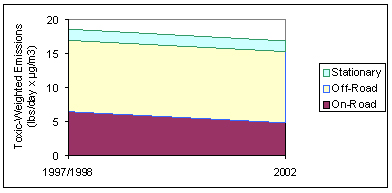
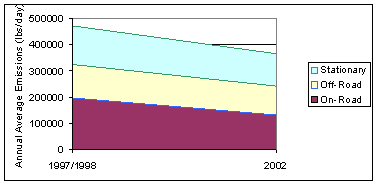
The Addendum to the final draft ATCP presents the status of implementation of stationary and mobile source control strategies. Air toxic emissions have been reduced approximately 22 percent on a mass basis, or 11 percent by toxicity-weighted emissions (lbs/day x µg/m3), between the base-year (1997/1998) and 2002, attributable to adopted local, state, and federal regulations (see Figure 1).
Figure 1
Air Toxics Emission Trends
|
|
 |
In addition to updating the significant progress made in implementation of the various mobile and stationary source strategies, the Addendum revises emission estimates based on the latest inventory methodology and adopted rules. The updated inventory methodology is consistent with that used in the 2003 AQMP. The addendum also discusses control strategies that were identified as part of the AQMD’s efforts to address cumulative impacts (August 2003 Draft White Paper on Potential Control Strategies to Address Cumulative Impacts from Air Pollution) and the 2003 AQMP measures.
Progress in Implementing the 2000 ATCP
Significant progress has been made in many areas towards reducing air toxic emissions and exposures with a total of 13 air toxic control strategies adopted by AQMD and 10 statewide ATCMs adopted, or approved with 15-day changes, by CARB since the 2000 ATCP. As previously mentioned, air toxic emissions have reduced approximately 22 percent or 11 percent by toxicity-weighted emissions between 1997/1998 and 2002, attributable to adopted local, state, and federal regulations.
Although mobile source emissions continue to be the predominant contributors (over 90 percent) to regional toxicity levels, stationary sources contribute to unique neighborhood impacts which remain of significance to the public. In addition to mobile source strategies in the 2003 AQMP, many strategies included in the Cumulative Impacts Reduction Strategies, are designed to address localized, or neighborhood impacts across the entire region.
Future Commitments
The ATCP will again be revised following the completion of MATES III which recently began with air sampling and will continue through early 2005. Significant air toxic reduction benefits are expected from full implementation of the 2003 AQMP (i.e., 50 percent reductions in toxicity-weighted emissions). However, it should be noted that some AQMD strategies will be controversial, and may rely on technological development, additional funding, or expanded authority. All agencies will need to work diligently and cooperatively, especially in the areas of mobile sources, to make sure that 2003 AQMP is implemented in a timely manner. AQMD has also committed to periodically update the ATCP, which will possibly include not only updating the inventory and control strategies, but also serve as milestones to improve technical tools in analyzing air toxics emissions and exposure.
Public Process
Development of the Addendum to the final draft ATCP included three public consultation meetings as an outreach effort to gather suggestions and input from the public. Staff has worked with U.S. EPA and CARB on the development of the Addendum. CARB staff provided assistance regarding their agency’s progress in adopting ATCM and other work to reduce air toxics, and provided comments regarding inventory procedures. U.S. EPA staff also reviewed the draft document and provided comments.
Key comments on the draft Addendum included: a request for increased accessibility to air toxics information; an expansion of data collection acknowledgement of the uncertainties involved with toxics monitoring, inventory and risk assessment; and the need to focus efforts on mobile sources, which compose 90% of the toxics inventory. A summary of comments and staff’s responses is attached.
Legal Mandates
Like the original ATCP, the Addendum is a planning document that is not required by state or federal law, so it will not be submitted as a part of the State Implementation Plan (SIP). Nor will it be a legally binding document. Development and implementation of specific strategies will require partnership with other agencies, the regulated community, environmental groups, and the public. Each rule developed will go through the appropriate public review and CEQA process. On this basis, the plan is exempt from the California Environmental Quality Act (CEQA) requirements. A copy of the Notice of Exemption is attached to this Board letter. As individual strategies are developed into regulatory programs, if deemed appropriate, applicable documents would then be prepared accordingly.
Recommendation
Staff recommends that the Addendum to the ATCP be approved as a planning document for possible future actions.
Attachment A - Comments and Responses
Resolution
Addendum to the Final Draft - An Air Toxics Control Plan for the Next Ten Years
Notice of Exemption
/ / /