
BOARD MEETING DATE: August 6, 2004
AGENDA NO. 11E
(Continued from the July 9, 2004 Board Meeting)
Award Multiple Contracts for Natural Gas Refueling Station Infrastructure
SYNOPSIS:
On October 3, 2003, the Board approved release of a $1.5 million RFP to solicit proposals for natural gas refueling station infrastructure projects from the Clean Fuels Fund. Staff believes that sixteen of the twenty-six proposals received deserve funding in the amount of $2,742,323. Staff proposes using the remaining RFP funds and de-obligated funding commitments for these additional projects. This action is to approve contract awards to RF Dickson Co., Inc., Downs Commercial Fueling, the Orange County Sanitation District, Consolidated Disposal Service, the City of La Verne and four contracts with Gas Equipment Systems. Total AQMD funding for these projects shall not exceed $1,033,523 from the Clean Fuels Fund and $346,800 from the AES Settlement Fund
COMMITTEE:
Technology, April 23, 2004, Recommended for Approval
RECOMMENDED ACTION:
1) Authorize the Chairman to execute contracts with the following entities in an amount not to exceed $1,033,523 from the Clean Fuels Fund and $346,800 from the AES Settlement Fund
a) A contract with RF Dickson Co., Inc., in an amount not to exceed $211,148 from the Clean Fuels Fund, to offset the costs of upgrading an existing CNG station at their facility in Bellflower.
b) A contract with Downs Commercial Fueling, in an amount not to exceed $203,137 from the Clean Fuels Fund, to offset the costs of purchasing and installing a new L/CNG fueling system at their commercial fueling station in Temecula.
c) A contract with Orange Co. Sanitation District, in an amount not to exceed $24,000 from the Clean Fuels Fund, to offset the costs of purchasing and installing a new dispenser and credit card payment system at their facility in Fountain Valley.
d) A contract with Consolidated Disposal Service, in an amount not to exceed $222,038 from the Clean Fuels Fund, to offset the costs of purchasing and installing a new LNG fueling system at their waste transfer station in Long Beach.
e) A contract with Gas Equipment Systems, Inc., in an amount not to exceed $150,000 from the Clean Fuels Fund, to offset the costs of purchasing and installing a new CNG fueling system at the County of Los Angeles Department of Beaches and Harbors’ facility in Malibu.
f) A contract with Gas Equipment Systems, Inc., in an amount not to exceed $150,000 from the Clean Fuels Fund, to offset the costs of purchasing and installing a new CNG fueling system at the County of Los Angeles Department of Beaches and Harbors’ facility in Zuma Beach.
g) A contract with Gas Equipment Systems, Inc., in an amount not to exceed $73,200 from the Clean Fuels Fund and $46,800 from the AES Settlement Fund to offset the costs of purchasing and installing a new CNG fueling station at the City of San Fernando Public Works Department yard.
h) A contract with Gas Equipment Systems, Inc., in an amount not to exceed $150,000 from the AES Settlement Fund, to offset the costs of purchasing and installing a new CNG fueling system at the intersection of California & Third Streets in the City of Beaumont
i) A contract with the City of La Verne, in an amount not to exceed $150,000 from the AES Settlement Fund, to offset the costs of purchasing and installing a new CNG fueling station at the City Hall in La Verne.
Barry R. Wallerstein, D.Env.
Executive Officer
Background
On October 3, 2003, the Board authorized release of RFP #P2004-09 soliciting cost-shared proposals for installing new natural gas fueling facilities within the South Coast AQMD jurisdictional boundaries. Continued expansion of the natural gas fueling infrastructure needs to occur in order to support increased public and private fleet fueling needs and support future incentive program awards such as the Chairman’s School Bus Replacement Initiative and the Carl Moyer Program.
The Board approved a total of $1.5 million from the Clean Fuels Fund to support the RFP. This funding is designed to offset capital investment costs, resulting in conveniently located, publicly-accessible fueling stations. For this RFP, funding was only provided for natural gas fueling stations. Applications were accepted from either public agencies or private entities (i.e. state and local governments, automobile manufacturers, alternative fuel suppliers, manufacturers of natural gas related equipment, and end users of natural gas motor fuel). While the RFP did not require components to be currently hydrogen compatible, it provided for additional points for considering such hydrogen compatibility issues. In any event, staff believes that natural gas fueling stations are inherently hydrogen-compatible because the fuel may be used to generate hydrogen.
The level of required cost share is based upon the amount of grant funds requested (see Table 1 below) and the cost share is based upon cash expenditures, (i.e. land/lease, equipment, engineering, permits, installation, etc.). In-kind services are limited to 10 percent.
Table 1. Cost-Share Request Limitations
|
Project Throughput
|
Percent AQMD
|
Maximum AQMD Cost Share |
|
Less or equal to 100 |
50 percent of project cost |
$ 75,000 |
|
Between 100 and 250 |
40 percent of project cost |
$150,000 |
|
At 250 and above |
30 percent of project cost |
$250,000 |
The general requirements of the RFP are identified below:
1) Proposed project must be located within the jurisdictional boundaries of the South Coast Air Quality Management District. 2) Proposed project shall be a natural gas "fast-fill" station with public access. 3) Project schedule shall be limited to an eighteen-month timeframe. 4) Proposed project may request cost-share funds for capital investment costs only. 5) Applicant will be contractually obligated to proposed station throughput.
Twenty-six proposals were received by December 16, 2003 (the closing date of the solicitation) totaling $4.6 million in requested funding.
In other actions considered by the Board in preceding agenda items, previous funding commitments were de-obligated and the subject funds were reverted to the original funding source account. As a result, staff is proposing to use a portion of those de-obligated funds to cover the additional funding requests beyond the Board approved RFP allocation of $1.5 million.
Proposal
As mentioned above, 26 proposals were received by the RFP deadline of December 16, 2003. Figure 1 shows the geographical locations of the 26 proposed refueling station projects and differentiates between stations that incorporated hydrogen compatibility design and equipment specifications and those that did not. As seen in Figure 1, in addition to the existing infrastructure network, these new projects are strategically located to help establish an infrastructure "backbone" that will allow for fueling of all types of natural gas vehicles throughout the Basin.
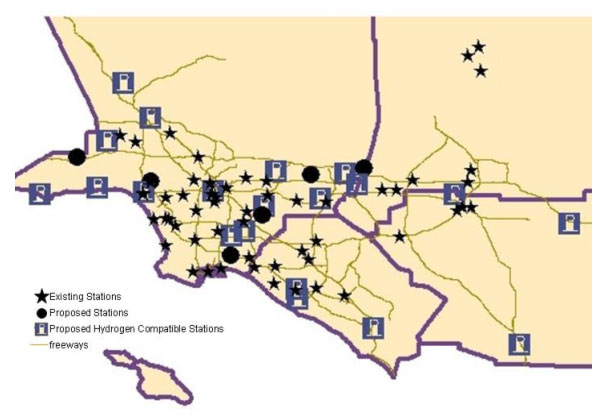
Figure 1. Locations of the Existing and the 26 Proposed Natural Gas Refueling Stations
All proposals received in response to RFP #2004-09 were evaluated and scored by a diverse, technically qualified panel in accordance with criteria contained in the RFP. The evaluation panel’s technical scores for each proposal are provided in Attachment A. Sixteen of the 26 proposals were deemed technically qualified.
As codes and standards for hydrogen fueling stations do not currently exist, the RFP did not require components to be currently hydrogen compatible; however, it provided for additional points to applicants committing to station designs and space consideration that could incorporate hydrogen compatible equipment for future transportation applications. Equipment modifications and retrofitting with hydrogen compatible plumbing, tubing, dispensers and compressors qualified for these additional points. Of the nine proposals being considered in this request, all have made specific commitments for making the fueling infrastructure project hydrogen compatible in the future.
Five projects proposed by Gas Equipment Services Inc., or where they will act as the contractor, will utilize 3,600 psi compressors manufactured by Ingersoll-Rand. These compressors are made from Type 316 stainless steel and, with appropriate field modifications to seals and other internals, should be able to perform with hydrogen at various delivery pressures.
The Orange County Sanitation District will use best engineering practices to design all electrical systems to be hydrogen compatible, specifically to NFPA 70 standards and cross reference these with NFPA 50A standards. Additional PVC conduit to house hydrogen plumbing/tubing made from Type 316 stainless steel will be installed. Space considerations will be incorporated into all station design for future hydrogen storage, dispensing and reforming equipment.
The two proposed LNG projects by Consolidated Services and Downs Commercial Fueling are already compatible with the dispensing of liquid hydrogen by the facility design and construction. Both projects will make space and design improvements in order to facilitate the addition of hydrogen refueling equipment later.
The project proposed by RF Dickson Co. has sufficient space for additional civil improvements for hydrogen-specific compression and storage systems. Best engineering practices will be employed to design all electrical, plumbing/tubing and fire safety systems for future hydrogen dispensing operations. In any event, AQMD staff believes that natural gas fueling stations are inherently hydrogen-compatible because the fuel may be used to generate hydrogen at some future date.
At the original funding level of $1.5 million only the top seven proposals could be completely funded. Table 2 lists the remaining nine proposals under the current solicitation that could be funded with the remainder of the RFP funds as well as the de-obligated funds proposed from earlier Board actions taken at this meeting. Staff is recommending that these additional nine proposals be funded at a cost not to exceed $1,380,323.
Table 2. Projects Proposed To Be Funded with the Remainder of the
Original $1.5 Million Board Allocated Funds and De-Obligated Funds
|
APPLICANT |
FUNDING PROPOSED |
|
R.F. Dickson Co, Inc. |
$211,148 |
|
Downs Commercial Fueling –Temecula |
$203,137 |
|
Orange Co. Sanitation District |
$ 24,000 |
|
Consolidated Disposal Service |
$222,038 |
|
GESI - Will Rogers |
$150,000 |
|
GESI – Zuma |
$150,000 |
|
GESI - City of Beaumont |
$150,000 |
|
GESI - City of San Fernando PWD |
$120,000 |
|
City of La Verne City Hall |
$150,000 |
|
TOTAL |
$1,380,323 |
All nine proposals listed in Table 2 received technical scores above the minimum criteria of 56 points. The remaining ten proposals received scores below the minimum criteria.
Benefits to AQMD
The AQMP relies on the expedited implementation of advanced technologies and clean–burning fuels in Southern California to achieve air quality standards. By constructing more natural gas fueling facilities, benefits from this project will accrue to all cities and area residents. Such new construction will provide a coordinated effort, plan for growth of the overall infrastructure and enable the transition to future hydrogen refueling infrastructure. There are economies of scale from the extensive infrastructure being planned and installed, possibly reducing the cost and making alternative refueling stations more affordable. While having no direct impact on air emission reductions, new CNG stations will help facilitate the introduction of low emission, natural gas fueled vehicles (NGVs) initially in private and public fleets in the area. Such increased penetration of NGVs will provide direct emissions reductions of NOx, VOC, CO, PM, and air toxic compounds throughout the Basin.
Outreach
In accordance with AQMD’s Procurement Policy and Procedure, a public notice advertising the RFP and inviting bids was published in the following publications:
|
1. |
Antelope Valley Press |
10. | Korea Central Daily |
19. | Precinct Reporter |
|
2. |
Black Voice News |
11. |
La Opinion |
20. |
Press Enterprise |
|
3. |
Chinese Daily News |
12. |
La Prensa Hispana |
21. |
Rafu Shimpo |
|
4. |
Desert Sun |
13. |
La Voz Publications |
22. |
San Bernardino Sun |
|
5. |
Eastern Group Publications |
14. |
Los Angeles Daily News |
23. | State of California Contracts |
|
6. |
El Chicano |
15. |
Los Angeles Sentinel |
Register |
|
|
7. |
El Informador |
16. |
Los Angeles Times |
24. | The Excelsior |
|
8. |
Inland Empire Hispanic News |
17. |
Orange County Register |
25. |
The Signal |
|
9. |
Inland Valley Daily Bulletin |
18. | Philippine News |
26. | Wave Community Newspapers |
Additionally, potential bidders were notified utilizing the Los Angeles County MTA Directory of Certified Firms, the Inland Area Opportunity Pages Ethnic/Women Business & Professional Directory; and AQMD’s own electronic listing of certified minority vendors. Notice of the RFP was mailed to the Black and Latino Legislative Caucuses and various minority chambers of commerce and business associations, and placed on the Internet at AQMD’s Web site (http://www.aqmd.gov where it could be viewed by making menu selections "Inside AQMD"/"Employment and Business Opportunities"/"Business Opportunities" or by going directly to http://www.aqmd.gov/rfp/index.html). Information was also available on AQMD’s bidder’s 24-hour telephone message line (909) 396-2724.
In addition to publication in the above-cited publications, over 100 individual RFP notices were mailed to interested businesses and individuals.
Bid Evaluation
Proposals received were evaluated by a diverse, technically qualified panel in accordance with criteria contained in the attached RFP. The evaluation panel consisted of a representative from CARB, an independent technical expert, and the AQMD Fleet Rules Implementation Manager. The panel make-up consisted of one Asian/Pacific Islander, one Caucasian, and one Hispanic; two female and one male. Attachment A provides a summary of the proposals received ranked by the scores received from the evaluation panel.
Twenty-six proposals were received with requested funding totaling $4.6 million. Of the 26 proposals received, 16 were scored with a technical value above 56 points (the minimum score needed for further consideration). The remaining 10 proposals are not deemed for funding consideration since they did not meet the requirements of the RFP or was not sufficiently clear in the project proposal.
In accordance with approved AQMD RFP guidelines, the least-cost proposal was awarded the most points in the cost category. All other proposals received a percentage of that highest score, with proposals costing over twice the lowest score getting zero points.
Some of the proposals are recommended to receive only partial funding compared to their original request. The partial funding recommendations are based on adjustments to the requested funding amount to represent the upper throughput limits specified in the RFP. In one proposal, the project proponent indicated that additional funds that were not originally anticipated are being provided at this time. Therefore, the recommended AQMD funding is reduced from the original request.
Resource Impacts
Funding in an amount not to exceed $1,380,323 is proposed to fund the nine proposals shown in Table 2. Funding for these projects shall not exceed $1,033,523 from the Clean Fuels Fund and $346,800 from the AES Settlement Fund.
Attachment
Attachment A. - Evaluation of Proposals RFP #P2004-09 Recommended for Awards
Attachment A
Evaluation of Proposals RFP #P2004-09 Recommended for Awards
|
APPLICANT |
LOCATION |
FUEL |
EQUIPMENT |
FUNDING |
TOTAL |
|
R.F. Dickson Co, Inc. |
Bellflower |
923,451 |
$703,828 |
$211,148 |
87.71 |
|
Downs Commercial Fueling |
Temecula |
1,268,286 |
833,333 |
203,137 |
86.21 |
|
Orange Co. Sanitation District |
Fountain Valley |
708,475 |
80,000 |
24,000 |
81.74 |
|
Consolidated Disposal Service |
Long Beach |
4,108,753 |
740,127 |
222,038 |
81.64 |
|
Burrtec Waste Industries |
Santa Clarita |
1,265,510 |
627,141 |
188,000 |
80.67 |
|
Sysco Food Services |
Walnut |
2,742,083 |
1,002,476 |
250,000 |
79.71 |
|
Clean Energy - Foothill Transit |
Pomona |
1,113,225 |
380,000 |
114,000 |
79.20 |
|
Clean Energy |
Mission Viejo |
908,475 |
842,050 |
250,000 |
76.92 |
|
Clean Energy |
Santa Monica |
807,475 |
634,500 |
190,000 |
76.42 |
|
Clean Energy |
Agua Mansa |
750,975 |
400,000 |
120,000 |
71.92 |
|
Clean Energy |
Canoga Park |
775,500 |
842,050 |
250,000 |
71.15 |
|
GESI |
Will Rogers State Bch |
160,000 |
525,000 |
150,000 |
70.68 |
|
GESI |
Zuma Beach |
160,000 |
525,000 |
150,000 |
70.68 |
|
GESI |
City of Beaumont |
136,000 |
405,000 |
150,000 |
65.77 |
|
GESI |
City of San Fernando |
136,000 |
405,000 |
120,000 |
63.67 |
|
City of La Verne |
City Hall |
52,000 |
425,000 |
150,000 |
60.46 |
|
Foothill Transit |
Arcadia |
6,175,400 |
4,000,000 |
0 |
71.57 |
|
City of Los Angeles |
Los Angeles |
2,196,480 |
2,011,000 |
0 |
61.78 |
|
UCLA Fleet & Transit Services |
UCLA |
441,596 |
95,000 |
0 |
60.03 |
|
GESI |
Whittier |
136,000 |
426,000 |
0 |
58.02 |
|
GESI |
City of Costa Mesa |
96,000 |
426,000 |
0 |
57.89 |
|
City of Covina |
City of Covina |
48,000 |
20,000 |
0 |
54.69 |
|
Whittier Union School Dist. |
Whittier |
83,160 |
95,000 |
0 |
52.64 |
|
City of Claremont |
Claremont |
200,000 |
720,000 |
0 |
51.94 |
|
OceanAire Env. Chevron/Mac |
Agoura |
65,000 |
213,966 |
0 |
32.38 |
|
City of Long Beach |
Long Beach |
0 |
288,000 |
0 |
31.74 |
|
GRAND TOTALS |
$17,665,471 |
$2,742,323 |
/ / /