
BOARD MEETING DATE: August 6, 2004
AGENDA NO. 33
Adopt Proposed Rule 1127 – Emission Reductions from Livestock Waste
SYNOPSIS:
Proposed Rule 1127 would implement AQMP control measure WST-01 and certain Senate Bill (SB) 700 requirements for dairy operations. Its purpose is to reduce ammonia, VOC and PM10 emissions from dairy manure. Proposed Rule 1127 would affect dairy and related operations such as heifer and calf ranches, as well as manure processing operations such as composters and digesters. It establishes on-farm best management practices, manure disposal requirements, and approval requirements for manure processors.
COMMITTEE:
Stationary Source, January 23, February 27, April 23, and June 25, 2004; Reviewed
RECOMMENDED ACTION:
Adopt the attached resolution:
- Certifying the CEQA Final Environmental Assessment for Proposed Rule 1127 – Emission Reductions from Livestock Waste; and
- Adopting Proposed Rule 1127 – Emission Reductions from Livestock Waste;
Barry R. Wallerstein, D.Env.
Executive Officer
Background
The South Coast AQMD exceeds state and federal ambient air quality standards for PM10 (fine particulate matter less than 10 microns in diameter) and ozone. Since 1994, the AQMD has prepared and adopted AQMPs that have included a control measure (WST-01) to reduce ammonia, VOCs, and PM10 from livestock waste. The control measure was updated in the 1997 AQMP, the 1999 AQMP/Ozone AQMP revision and the 2003 AQMP State Implementation Plan (SIP). The control measure calls for a 50% reduction in ammonia and a 30% reduction in VOC emissions from 1997 AQMP base year (1993) levels by 2006. California SB 700, adopted in September 2003, removes the exemption for agricultural sources from permitting requirements and requires that for each serious PM10 non-attainment area, districts must adopt best available control measures (BACM) for agricultural stationary sources of air pollution by July 1, 2005, with implementation no later than July 1, 2006. The proposed rules would implement 2003 AQMP control measure WST-01 – Emission Reductions from Livestock Waste and certain Senate Bill (SB) 700 requirements.
The local dairy industry is unique in many ways. Almost all dairies in this region use a dry-lot corral system, as opposed to the more prevalent flushed lane system used elsewhere in California and the nation. In recognition of this fact, the AQMD sponsored a $130,000 study in 1995 to develop ammonia emission factors for local dairies. Increasing urbanization is inducing many farmers to relocate; the same process occurred in the 1970s when dairies moved from Los Angeles County to San Bernardino and Riverside counties. By 2015 or 2020, the total number of dairy cows will probably be reduced by half or more from mid-1990 levels. Reduced cattle populations will reduce dairy manure emissions. In addition, stricter water quality regulations adopted in 1999 have changed the dairies’ manure handling and land spreading operations. Some of the water regulations also reduce manure emissions.
Proposal
PR1127 applies to dairy and related operations such as heifer and calf farms. It also applies to manure processing operations, such as anaerobic digesters and composting facilities. PR 1127 would require on-dairy best management practices (BMPs) to reduce PM10 dust and excess corral water and, beginning in January 2005, removal of surplus manure from corrals and stockpiles 4 times per year. (Current water quality regulations also seek to minimize corral moisture and require that manure stockpiles be removed twice a year.) Beginning January 2006, PR1127 also requires that manure processing operations, such as digesters and composters, be approved by the AQMD. Approvable manure processing operations include AQMD-permitted digesters, Rule 1133.2-compliant composting operations, and alternative manure composting operations that meet the requirements of PR1127. Requirements for alternative manure composting operations include the in-vessel composting of manure or manure and green materials only for both the active and initial curing phases (e.g. at least 60 days) and emissions testing as described in Rule 1133.2. The rule exempts small dairies or related farms with fewer than 50 animals on-site. It also exempts alternative manure processing operations that are in compliance with PR1127 provisions from Rule 1133.2.
As noted in the 2003 AQMP control measure WST-01, the 1997 AQMP set a "target" level of remaining emissions from dairy operations; 50% ammonia reductions and 30% VOC reductions from the 1993 base year emissions by 2006. Adjusted for the latest emission factors and emission methodologies, the 2003 AQMP baseline emissions for VOCs, ammonia, and PM10 from dairy manure are approximately 10.0, 25.9, and 1.3 tons per day, respectively, in 1993. In the absence of PR1127, but accounting for emission reductions from dairy relocations and water quality regulations enacted in 1999, the 2010 dairy manure emissions are estimated to be 4.5 tons per day VOC, 12.7 tons per day ammonia, and 0.8 tons per day PM10.
With the implementation of PR1127 and accounting for the impact of dairy relocation and water quality regulations, remaining emissions in 2006 are 10.7 tpd ammonia and 3.8 tpd VOC; the 2003 AQMP target levels are 13.0 tpd ammonia and 6.7 tpd VOC. Thus, the 2003 AQMP control requirements of WST-01in 2006 will be exceeded with the implementation of PR1127. SB700 BACM requirements for dairy and related operations will be met through implementation of existing Rule 1186 - PM10 Emissions from Paved and Unpaved Roads, and Livestock Operations, adopted in 1997 and amended in 2004, and adoption and implementation of PR1127.
Remaining emissions in 2010 after the implementation of PR1127 are estimated to be 3.3 tons per day VOC, 9.4 tons per day ammonia, and 0.8 tons per day PM10. Reductions from the impact of PR1127 alone (separate from reductions due to dairy relocation and the air quality benefit of water quality regulations) are 3.3 tpd ammonia and 1.2 tpd VOC in 2010. The cost effectiveness for PR1127 is $6,800 per ton of VOC reduced and $2,400 per ton of ammonia reduced and $1,800 per combined ton of ammonia and VOC reduced.
Policy Issues
Manure Clearing/Removal Frequency and Dairy Relocation Rate
The dairy industry has commented that 3 clearings/removals per year is more consistent with their business practices, since there are technical barriers to clearing corrals during the wet season. Staff still recommends 4 clearings/removals per year to maximize the emission reduction potential, with the dairies being able to claim exemption from 1 clearing per year if it can demonstrate that the corral manure is too wet (> 50% moisture). To further minimize the impact on the dairy farmers, while still achieving the emission reductions, staff has amended the draft rule to allow 3 months (rather than 1 month) to remove the stockpiles, and removed the notification requirements (recordkeeping and reporting requirements are sufficient to assess compliance.) In addition, dairies removing their feedlane manure to a digester would be exempt from the 4 clearings/removals per year requirement, since feedlane manure represents 30 to 60% of the total manure produced. Those dairies would still be required to remove on-dairy stockpiles twice yearly as required by water quality regulations.
Certain dairy representatives, especially those in the San Jacinto region that use land-spreading on local crops as their main manure disposal option, are still opposed to the 4 stockpile removals per year. They argue that crop lands are only available to fertilize with manure at certain times of the years (e.g. twice yearly for 2-crop rotations), and that PR1127 would require that they send manure cleared at the other two times to processing operations (e.g., composting operations). Although 4 removals per year may have a greater impact on these particular dairies, staff still recommends the 4 removals per year as a key element in achieving cost-effective emission reductions. In addition, proposed water quality regulations may dramatically limit land-spreading in the San Jacinto area, which would mean that local dairy manure disposal practices would have to change regardless. If the proposed water quality regulations go into effect, PR1127 allows an additional cost-effective manure disposal option (e.g. alternative manure composting operations) that would otherwise be unavailable to the farmers.
Industry also believes that relocation will occur at a much faster rate (10%/year) than assumed by staff (~2%/year). Staff believes that the 2%/year relocation rate gives a conservative estimate of emissions for SIP purposes and that the technical feasibility and cost-effectiveness of PR1127 controls remain unchanged even if fewer dairies remain.
Performance Standards
Certain technology providers and environmental groups have commented that PR1127 should establish performance standards for dairies and manure processing operations, similar to those established in Rule 1133.2. Staff believes that setting facility baseline and control performance standards for existing dairies (as opposed to equipment or operations, as is traditionally done) is not warranted at this time. It may be appropriate in the context of new dairies and their BACT requirements under SB700; this would be addressed through the application of Regulation XIII in the unlikely event of a new dairy in the AQMD’s jurisdiction. To better quantify the emission reduction and cost-effectiveness of alternative composting operations, such as fabric in-vessel systems, staff is recommending that the Board approve the AQMD’s co-sponsoring of a Pilot Demonstration Project initiated by the Inland Empire Utilities Agency (IEUA). The purpose of the project is to demonstrate that alternative composting technologies can achieve the needed VOC and ammonia emission reductions. The project is described more fully in the Implementation Plan section of this letter.
Emission Credit Generation
Recently, the emission credit generation potential of manure processing operations has arisen as a policy issue. There are both technical and policy barriers to the actual generation of usable emission credits from controlled manure processing. U.S. EPA’s credit criteria require that the credits be permanent, real, quantifiable, surplus, and enforceable. These criteria have traditionally been difficult to meet for area sources (as opposed to point sources). In addition, the greatest interest has been in the use of ammonia reductions as PM10 credits. The link between ammonia and PM10 is highly non-linear and dependent on the source location in reference to NOx and SOx sources, the source concentration, and meteorology. This makes it technically difficult to establish a relationship between ammonia reductions and PM10 reductions. Although PR1127 establishes control requirements, these are not BACT requirements; emission credits are generally BACT-discounted, which could limit the credit generation potential of many manure processing operations. In the Board resolution, staff proposes to explore the emission credit generation potential of manure processing operations with stakeholders, including state and federal agencies, and report back to the Board’s Stationary Source committee upon the completion of that assessment.
AQMP and Legal Mandates
The California Health and Safety Code require the AQMD to adopt an AQMP to meet state and federal ambient air standards in the Basin. In addition, the California Health and Safety Code requires that the AQMD adopt rules and regulations that carry out the objectives of the AQMP. The proposed rule implements 2003 AQMP control measure WST-01 – Emission Reductions from Livestock Waste. SB700 requires, in part, that serious PM10 non-attainment areas adopt and implement BACM for dairies and other confined animal farms (CAFs). PR1127, in conjunction with Rule 1186 – PM10 Reductions from Paved and Unpaved Roads and Livestock Operations, fulfils the SB700 BACM requirement for dairies and related operations.
CEQA & Socioeconomic Analysis
Pursuant to the California Environmental Quality Act (CEQA) Guidelines Section 15252 and the AQMD’s Certified Regulatory Program (Rule 110), staff has prepared an Environmental Assessment (EA) for PR1127. The Draft EA, which was made available for a 30-day review period, concluded that the proposed rule would not have any significant adverse affects on environment. No comments were received on the Draft EA, but minor modifications to the project description were made as a part of the Final EA. The changes to the project description are minor and do not change the conclusions made in the Draft EA or worsen the environmental impacts analyzed in the Draft EA.
PR1127 would affect approximately 300 dairy and related farms, the existing digester facilities, and future digester and composting operations. The average annual cost of PR1127 is estimated at $3.53 million. It is estimated that an average of 89 jobs could be created annually in the local economy as a result, with the greatest increase (36) in the service sector.
Implementation Plan
The proposed rule will affect dairies, related operations, and manure processing operations. Staff will continue to work with these affected facilities through the Rule 1127 Implementation Group to address any implementation issues in the future and to identify any new cost-effective compliance options. An outreach effort will also be conducted to inform dairies and manure processing operations regarding the registration and reporting requirements.
Technical Assessment of Fabric In-Vessel Composting Operations
PR1127 allows for alternative manure composting operations, as well as Rule 1133.2 compliant composting operations. Although these alternative manure composting operations have not been tested, their effectiveness when complying with PR1127 requirements is expected to be between open aerated static piles and Rule 1133.2-compliant operations. These alternative composting operations need to be evaluated for cost and emission reduction effectiveness. IEUA is sponsoring a technical study of fabric in-vessel composting systems, which could be cost-effective alternative manure composting operations. The purpose of this Pilot Demonstration Project is to demonstrate that alternative composting technologies can achieve the needed VOC and ammonia emission reductions. AQMD staff believes that the results of this study could also be used to optimize these systems, with the goal of achieving Rule 1133.2 emission reduction requirements. In a preliminary draft workplan, IEUA emphasizes the need for testing protocols and quality control that satisfy the AQMD’s technical requirements. The Board resolution calls for AQMD to co-sponsor this study. IEUA is approaching other potential stakeholders for support, including the public works departments of the cities of Chino, Los Angeles, Norco and Ontario, Eastern Municipal Water District, Metropolitan Water District, the Chino Basin Watermaster, Western Municipal Water District, the Los Angeles and Orange County Sanitation Districts, and the Milk Producers’ Council. Once the workplan is completed, staff would then seek Board approval to co-fund this study.
Resource Impacts
Implementation of the proposed rule is not expected to have an impact on AQMD fiscal resources. It will, however, increase staff's workload in making compliance determinations and processing registrations and annual reports for dairies and manure processing operations. The workload increase is expected to be such that no additional staff will be required.
Attachments (1,845 KB)
- Summary of Proposed Rule
- Rule Development Process
- Key Contacts
- Key Issues and AQMD Staff Responses
- Resolution
- Rule Language
- Staff Report
- Socioeconomic Assessment
- Environmental Assessment
ATTACHMENT A
SUMMARY OF PROPOSED RULE
Purpose and Applicability
The purpose of PR1127 is to reduce ammonia, VOC, and PM10 emissions from applicable operations, such as dairies, heifer, and calf farms (unless exempt). It also applies to manure processing operations, such as composting operations and anaerobic digesters.
Definitions
Key terms are defined, including alternative manure composting operation, anaerobic digester, dairy farm, manure processing operation, and operator.
Requirements
Best Management Practices (BMP)
BMPs are required by SB700 and are proposed to reduce direct emissions and increase the emission reduction effectiveness of certain manure processing requirements. The proposed BMPs would require all farms on or after December 1, 2004 to:
- Implement at least one of the following manure harvesting protocols to minimize fugitive dust emissions:
- Scrape or harrow in early morning (before 9 a.m.) only unless the moisture content is greater than 20% (as determined by specified test method); OR
- Clear corrals of manure such that an even surface of compacted manure remains on top of the soil. Do not scrape down to soil level; OR
- Water corral before manure harvesting to reduce dust through increased surface moisture (this measure is not recommended for areas holding lactating cows).
- Minimize water in corrals by
- Identifying and eliminating water leaks from trough and trough piping: and
- Complying with corral drainage standards in Engineered Waste Management Plan.
- Feedlanes must be paved at least eight feet on the corral side of the fence.
- Effective January 1, 2005, clear corrals of manure in excess of 3 inches deep at least four times per year and not less than 60 days between clearings. Recordkeeping is required.
- Effective January 1, 2005, clear all on-dairy stockpiles within three months of the last corral clearing day. Recordkeeping is required.
Manure Disposal Requirements
On or after January 1, 2006, a dairy operator disposing of manure within the jurisdiction of the South Coast Air Quality Management District shall only remove or contract to remove that manure from their dairy to approved agricultural land or a manure processing operation approved in accordance with the requirements below.
Manure Processing Operation Approval Requirements
Approvable manure processing operations include an anaerobic digester; or a Rule 1133.2-compliant composting facility; or an alternative manure composting facility as defined in the proposed rule. Approval procedures are described. An alternative manure composting facility must apply for approval with the AQMD and meet operation plan and testing requirements.
Reporting and Recordkeeping Requirements
- No later than January 1, 2005, the operator of an existing dairy farm shall submit a PR1127 notification to the AQMD, including operator’s name, farm location, and contact information.
- No later than 30 days after operations begin at a new dairy farm or an existing farm under a new operator, the operator shall notify the AQMD as above.
- After January 1, 2007, an annual report is to be submitted by an operator by the 15th of January of each year. The report shall include animal population and amount of annual manure removed to various destinations.
- Records should be maintained at the dairy farm for three years.
Test Methods
Moisture content of manure to be determined by using an electrical conductivity or microwave moisture meter, or other AQMD-approved method in the prescribed manner.
Fees
Operators of farms or facilities subject to reporting and recordkeeping requirements shall be assessed applicable filing and evaluation fees pursuant to AQMD Rule 306.
Exemptions
- Farms with fewer than 50 cows, heifers, and/or calves are exempt from this rule.
- An operator can be exempt from one corral clearing per year if conditions are such that the manure in the corral is too wet (above 50% moisture content) to remove.
- Alternative manure composting operations are exempt from Rule 1133.2 requirements if they meet the PR1127 operating and testing requirements for these operations.
- Dairy operators removing all feedlane manure to a digester at least 6 days per week can claim exemption from the requirements to clear/remove corral manure 4 times per year. (Water quality regulations still require twice yearly stockpile removal.)
Alternative Control Options
A person may comply with a plan for achieving equivalent emission reductions through alternative control measures. The plan must be approved by the AQMD, CARB, and the USEPA before implementation and rule compliance.
ATTACHMENT B
RULE DEVELOPMENT PROCESS
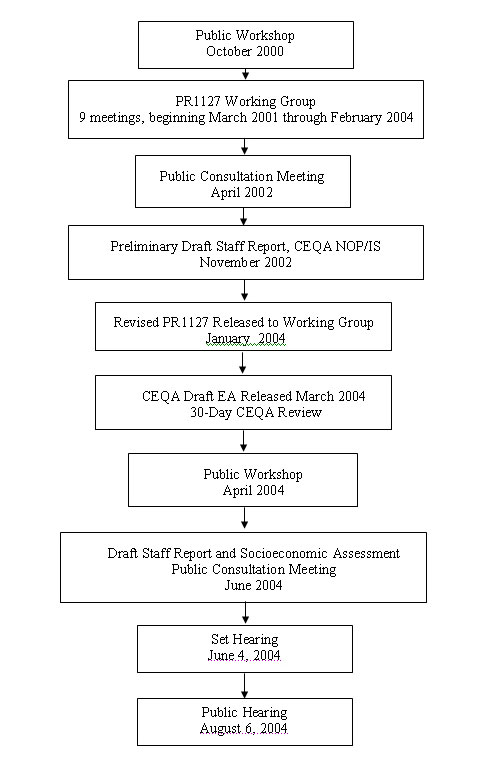
ATTACHMENT C
KEY CONTACT LIST
Academic Institutions
California State Polytechnic University, Pomona
California State Polytechnic University, San Luis Obispo
California State University Chico
California State University Fresno
Iowa State University
Texas A&M University
University of California at Davis
University of California at Riverside
Environmental Groups
Coalition For Clean Air
Center on Race, Poverty and the Environment
Earth Justice
Environmental Defense
Sustainable Conservation
Industry
AEI
Ag-Bag Environmental
Aquatics Inc.
Associated Engineers, Inc.
Automated Credit Exchange
AVES
Bion Technologies
BVD Dairy
CH2MHILL
Chino Organic Power
Clean Life Technologies
Curry Engineering
EM Living Soil Systems
Enviro Reality
Enviro Control Ltd.
Environmental Products & Technologies Corp.
Environmental Defense
Gladstein & Associates, LLC
Inland Energy
Jojo’z Enterprises
Kennedy/Jenks Consultants
Madrigal Distribution
Mead & Hunt
Michael Brandman & Associates
Montgomery Watson
Nolte & Associates
Organical, Inc.
Organic Power Ltd.
P.F. Ryan and Associates, Inc.
Planning Partners
Quad Knopf, Inc.
Rico Fertilizer Service
Spurgin & Associates
Synagro Composting
Tetra Tech Inc.
Trihydro, Inc.
Universal Agri Products, Inc.
Walt Disney Company
Westbrook Environmental, Inc.
YAH-WHOO Technologies
Industry Associations
Milk Producers Council
Western United Dairymen
Riverside County Farm Bureau
Public Agencies
Agriculture and Agri-Food Canada
California Air Resources Board
California Integrated Waste Management Board
City of Chino
Chino Basin Watermaster
City of Los Angeles, Bureau of Sanitation
City of Ontario
County of Kern, Environmental Health services Department
Eastern Municipal Water District
Inland Empire Utilities Agency
Inland Empire West Resource Conservation District (IEWRCD)
Merced County Division of Environmental Health
Orange County Water Board
Orange County Sanitation District
Santa Ana Regional Water Quality Control Board
San Joaquin Valley Air Pollution Control District
Santa Ana Watershed Project Authority (SAWPA)
South Coast Resource Conservation & Development Area (USDA)
Southern California Agricultural Land Foundation
U.S. Department of Agriculture (USDA)
USDA Agriculture Research Service (ARS)
USDA Natural Resource Conservation Service (NRCS)
U.S. Environmental Protection Agency
Ventura County Air Pollution Control District
Western Riverside Council of Governments
ATTACHMENT D
KEY ISSUES AND AQMD STAFF RESPONSES
|
PROPOSED RULE 1127 | |
|
Issue |
Response |
|
There are technical reasons that the corrals cannot be cleared during the wet season (4th clearing). 4 stockpile removals are too onerous. |
Staff has modified the earlier proposal to allow a dairy to claim exemption from the 4th clearing if corral manure moisture levels above 50% are monitored and recorded and to allow up to 3 months (instead of 1 month) after the last clearing to remove stockpiles. Staff has also included an exemption from the 4th clearing/removal for dairies removing all feedlane manure to a digester. |
|
Relocation is occurring faster than the 2% per year assumed by staff. No further controls should be required by dairies since reductions will occur because of the increased relocation. |
New dairies in the San Joaquin Valley are still subject to challenges from environmental groups and the public. Thus, AQMD staff feels the conservative estimate of 2% per year is still warranted. If greater relocation occurs, remaining emissions will decrease proportionally. However, PR1127 still represents feasible and cost-effective controls of the remaining emissions, which must be implemented according to state law. |
|
PR1127 should establish baseline emissions and performance standards for dairies and manure processing operations. |
A dairy is a facility, not a single operation or process. Although facility emissions may be considered for Regulation XIII (New Source Review) and Regulation XXX (Title V) rules, Regulation XI rules, including PR1127, establish requirements for specific equipment and/or processes only. Under SB700, the AQMD must adopt by July 2006 a rule for large dairies and other livestock operations (as defined by CARB no later than July 1, 2005) that would establish an emission reduction permit requirements for whole farms. In addition, staff recommends that the AQMD co-sponsor an IEUA study of the fabric in-vessel composting systems to better quantify their costs and emission reduction effectiveness. One goal of the study should be to recommend optimizations that would demonstrate compliance with Rule 1133.2 emission limits. |
|
Staff should investigate the emission reduction credit potential of farm and manure processing controls. |
There are significant technical and policy barriers to generating credits from manure processing controls. They include fulfilling EPA’s criteria that the credits must be real, permanent, quantifiable, surplus, and enforceable. In addition, the relationship between ammonia and PM10 is highly dependent on source location, concentration, local meteorology, and non-linear aerosol chemistry. Although PR1127 begins to address some of these criteria, significant additional analysis would be necessary. The Governing Board resolution includes direction to staff to continue to explore the emission credit reduction potential of manure processing controls. |
/ / /