
BOARD MEETING DATE: December 3, 2004
AGENDA NO. 8
Execute Contracts to Develop and Demonstrate Hydrogen Fueling Stations
SYNOPSIS:
On August 6, 2004, the Board authorized contracts to construct hydrogen fueling stations in four cities to support the AQMD’s hydrogen internal combustion engine (ICE) vehicle and fueling station program. The fueling stations will support a fleet of five hydrogen hybrid electric vehicles at each site. This action is to fund one additional hydrogen fueling station in Santa Monica and to augment funding for a mobile fueler for the hydrogen fueling station in Ontario. Funding is available from the Clean Fuels Fund in an amount not to exceed $1,066,000, with co-funding to also be provided through the Department of Energy Clean Cities program.
COMMITTEE:
Technology, November 19, 2004, Recommended for Approval
RECOMMENDED ACTION:
Authorize the Chairman to
- Execute a contract with Air Products and Chemicals, Inc. to install and demonstrate one electrolyzer and one mobile fueler, in an amount not to exceed $1,066,000 from the Clean Fuels Fund; and
- Recognize and receive into the Clean Fuels Fund the DOE Clean Cities Award of $237,939.
Barry R. Wallerstein, D.Env.
Executive Officer
Background
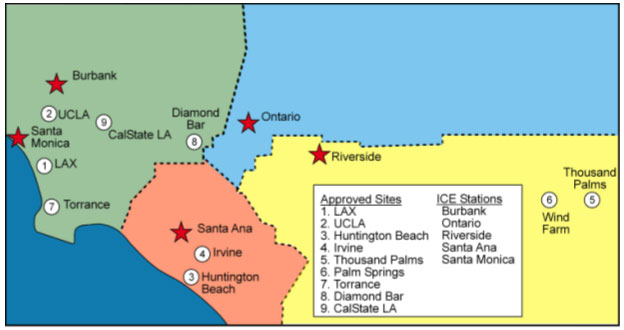
The AQMP has identified the use of alternative clean fuels in mobile sources as a key air quality attainment strategy. Hydrogen fuel cell vehicles are near zero-emission vehicles but currently have limited availability, high costs, and short warranty periods. Hydrogen-fueled internal combustion engine (ICE) vehicles show promise as a bridge technology between fuel cell vehicles and conventional vehicles and have the potential to significantly reduce VOC, NOx, CO and air toxic emissions as well as greenhouse gas emissions. Furthermore, hydrogen-fueled ICE vehicles will utilize the developing hydrogen infrastructure initiated by the AQMD and help to expedite infrastructure expansion across the South Coast basin. As part of this process, the Board approved RFP #P2004-01 to provide hydrogen ICE vehicles and fueling stations at five cities in the South Coast Air Basin. The original five cities that volunteered to participate in this project were Burbank, Ontario, Riverside, Santa Ana, and Santa Monica.
In response to the RFP, three proposals were received for the vehicle portion and nine proposals were received for the stations. On March 4, 2004 the Governing Board awarded the vehicle conversion project to Quantum Technologies, and on August 6, 2004, the Governing Board awarded contracts to Air Products and Chemicals, Inc. (Air Products) and Praxair, Inc. (Praxair) for four of the five cities in the program. The City of Santa Monica, the “fifth city,” received City Council approval to participate in the program on October 26, 2004, so staff is now recommending funding for this station.
Outreach
In accordance with the AQMD’s consulting and
contracting policies, a public notice advertising the RFP and inviting
applications was published in the following publications on two separate days:
|
1. |
Antelope Valley Press |
11. |
La Opinion |
21. |
Rafu Shimpo |
|
2. |
Black Voice News |
12. |
La Prensa Hispana |
22. |
San Bernardino Sun |
|
3. |
Chinese Daily News |
13. |
La Voz Publications |
23. |
State of California Contracts |
|
4. |
Desert Sun |
14. |
Los Angeles Daily News |
Register |
|
|
5. |
Eastern Group Publications |
15. |
Los Angeles Sentinel |
24. |
The Daily Breeze |
|
6. |
El Chicano |
16. |
Los Angeles Times |
25. |
The Excelsior |
|
7. |
El Informador |
17. |
Orange County Register |
26. |
The Signal |
|
8. |
Inland Empire Hispanic News |
18. |
Philippine News |
27. |
Wave Community Newspapers |
|
9. |
Inland Valley Daily Bulletin |
19. |
Precinct Reporter | ||
|
10. |
Korea Central Daily |
20 |
Press Enterprise |
Additionally, potential bidders were notified utilizing the Los Angeles County MTA Directory of Certified Firms, the Inland Area Opportunity Pages Ethnic/Women Business & Professional Directory; and AQMD’s own electronic listing of certified minority vendors. Notice of the RFP/RFQ was mailed to the Black and Latino Legislative Caucuses and various minority chambers of commerce and business associations, and placed on the Internet at AQMD’s Web site (http://www.aqmd.gov). Information was also available on AQMD’s bidder’s 24-hour telephone message line (909) 396-2724.
Bid Evaluation
Review and scoring of the proposals were addressed in detail in the August 6, 2004 Board Letter (item #8). Of the nine proposals submitted, four were deemed technically qualified, and these proposals were discussed with each of the participating cities to select the technology that best suited their desires and needs. The top two technical proposals were by Air Products, which offered the electrolyzer and mobile fueler technologies, and Praxair, which offered the station at their Ontario facility.
In the August 6, 2004 Board action, Burbank and Riverside selected the Air Products electroylzer technology, Santa Ana selected the Air Products mobile fueler, and the city of Ontario originally selected the off-site fueling option at the Praxair facility. After further consideration, however, the City of Ontario would now like to have a mobile fueler located on site. To comply with their subsequent request, staff recommends funding the mobile fueler technology from Air Products for the city of Ontario. Staff also recommends keeping the Praxair Ontario award open for consideration since this high capacity station is at a key strategic, Inland Empire location (near the Ontario International Airport), has the potential for leveraging through the Los Angeles World Airports and the LAX Praxair hydrogen station, and the has ability to service many fuel cell and hydrogen ICE vehicles through the AQMD and DOE programs.
The following recommendation is to provide a mobile fueler for the city of Ontario to accommodate their current desire to fuel on-site and to provide an electrolyzer for the city of Santa Monica.
Proposal
Air Products, partnering with Proton Energy and Northern Power Systems, submitted a proposal with multiple options, including electrolyzers powered by renewable photovoltaics, electrolyzers powered by the grid electricity, delivered liquid hydrogen, and mobile refuelers with compressed hydrogen. Based on the technical evaluation by the Technical Review Panel and input from the cities, staff recommends (1) installing an electrolyzer for the City of Santa Monica, and (2) providing a mobile fueler and one year of fuel for the City of Ontario.
The electrolyzer option allows the City of Santa Monica to follow their commitment to “green power” in the generation of hydrogen for their vehicles. Currently Santa Monica purchases green power from a hydroelectric power brokerage firm for use in their city. The city has also expressed interest in expanding their photovoltaic capabilities to ensure renewable hydrogen production in the future.
For the city of Ontario, the mobile fueler option provides budgetary and siting flexibility. Since the city has now expressed an interest to ultimately expand their hydrogen vehicle program, the mobile fueler option provides sufficient interim hydrogen until the need for a larger fueling station develops.
A summary of the city technology selections, costs, and the associated
bidders are presented in the following table.
| City | Technology | Contractor | AQMD Cost |
| Santa Monica | Electrolyzer | Air Products | $850,000 |
| Ontario | Mobile Fueler | Air Products | $216,000 |
|
TOTAL |
$1,066,000 |
Benefits to AQMD
The AQMP relies on the expedited implementation of advanced technologies and clean-burning fuels in Southern California to achieve air quality standards. This project will further develop technology for light-duty alternative fuel vehicles, and is expected to reduce NOx, CO and PM emissions to SULEV Standards. The projects will demonstrate that hydrogen powered vehicles equipped with internal combustion engines are a commercially viable bridge to hydrogen fuel cells, as well as utilize the emerging hydrogen fueling station infrastructure. The project fits within the charter of the AQMD to reduce criteria pollutants and offers the benefits of potential renewable hydrogen production and reduce dependence on foreign oil. Furthermore, the deployment of hydrogen stations advances the California Hydrogen Highway Network Executive Order as well as the Federal Hydrogen Energy Roadmap.
Resource Impacts
The Clean Fuels Program 2003 Annual Report and 2004 Plan Update includes “Develop and Demonstrate Distributed Hydrogen Production and Fueling Stations” as a proposed project. The total cost to the AQMD for the installation and development of the two additional hydrogen stations is not to exceed $1,066,000. Included in this funding is the cost for hydrogen fuel for the first year of the program at the city of Ontario site.
Sufficient funds are available from the Clean Fuels Fund, established as a special revenue fund resulting from the state-mandated Clean Fuels Program. The Clean Fuels Program, under Health and Safety Code Sections 40448.5 and 40512 and Vehicle Code Section 9250.11, establishes mechanisms to collect revenues from mobile sources and stationary sources to support projects to increase the utilization of clean fuels, including the development of the necessary advanced enabling technologies. Funds collected from motor vehicles are restricted, by statute, to be used for projects and program activities related to mobile sources that support the objectives of the Clean Fuels Program.
Additional funding will be provided through the DOE Clean Cities program, administered by the CEC. Staff applied for this grant and was recently notified by the CEC that $237,939 co-funding will be awarded once the commitment by each city is established. This funding will be used to offset the amount provided by the AQMD; however, the projects are not contingent upon receipt of this funding nor will the schedule be negatively impacted.
/ / /