
BOARD MEETING DATE: February 6, 2004
AGENDA NO. 26
Amend Rule 2202 – On-Road Motor Vehicle Mitigation Options and Guidelines
SYNOPSIS:
The proposed amendments will modify Rule 2202 to update the on-road mobile source emission factors to be consistent with CARB’s most current EMFAC model and with the 2003 AQMP, and will potentially generate additional VOC and NOx emission reductions through the addition of the inter-pollutant crediting and other emission reduction programs. Further, employers who participate in the Employee Commute Reduction Program (ECRP) who are unable to meet their AVR target will be required to demonstrate their "good faith effort" through enhanced program strategies, or to offset the difference in emission reductions by participating in the Air Quality Investment Program (AQIP) or by surrendering equivalent emission reductions credits from allowable credit sources. Proposed amendments also include language to clarify program options, facilitate meeting rule emission reduction targets, clarify definitions, and delete outdated language. Rule 2202 supporting implementation guidelines are also updated to reflect rule requirements, policies, and practices.
COMMITTEE:
Mobile Source, June 27, October 24, November 21, 2003, and January 23, 2004
RECOMMENDED ACTION:
Adopt the attached resolution:
- Certifying the Final Environmental Assessment (EA) for Proposed Amended
Rule 2202 - On-Road Motor Vehicle Mitigation Options, and
- Adopting the proposed amendments to:
Rule 2202 - On-Road Motor Vehicle Mitigation Options,
Rule 2202 Implementation Guidelines, and
Rule 2202 Employee Commute Reduction Program (ECRP) Guidelines.
Barry R. Wallerstein, D.Env.
Executive Officer
Background
On December 8, 1995, in response to state legislation prohibiting the mandatory submittal of trip reduction plans, the Board adopted Rule 2202 as a replacement rule that did not mandate trip reduction plan submittals, yet allowed the AQMD to remain in compliance with federal and state Clean Air Act requirements. The rule has provided members of the regulated community with a menu of flexible and cost effective emission reduction options from which they can choose to implement and meet the emission reduction targets for their worksites. Rule 2202 continues to allow employers the option to implement a traditional trip reduction plan and be deemed in compliance with the rule.
Proposal
The proposed amendments to Rule 2202 include updating the rule emission factors from the CARB EMFAC 7F model to the CARB EMFAC 2002 model. Updating the emission factors will ensure consistency with the 2003 AQMP. The proposed rule amendments also include clarification of definitions and deletion of outdated language. The rule emission tables will be removed from the rule and included in the Implementation Guidelines to facilitate future updates.
The proposed Implementation Guideline changes would clarify that emission credits generated are subject to rules, policies or AQMD approved quantification methodologies. New language is proposed to incorporate the use of Area Source Credits as a potential emission credit source for rule compliance and to broaden program specific emission reductions. Proposed Employee Commute Reduction Program (ECRP) Guidelines changes call for annual submittal of plans and specify conditions under which an ECRP is deemed to satisfy the rule requirements. Employers who are unable to meet the average vehicle ridership (AVR) requirement may also comply by either participating in the Air Quality Investment Program (AQIP) or surrendering emission reduction credits equivalent to the difference between the AVR requirement and current worksite AVR. Employers may also comply with the requirement through implementation of the defined good faith effort determination elements. The good faith effort determination elements include marketing strategies, basic support strategies, direct strategies, employer clean fleet vehicle program, and a mobile source diesel minimization plan.
The proposed rule amendments include the availability of inter-pollutant crediting to facilitate worksites in meeting their emission reduction target. The South Coast Air Basin is expected to stay in attainment for CO; however, reaching ozone attainment is a work in progress. Due to anticipated vehicle turnover, the final 2003 AQMP projected a 6% per year reduction in CO between now and 2006, which would ensure continued attainment of CO. However, the final 2003 AQMP also points out significant VOC and NOx reductions needed beyond current levels. Inter-pollutant crediting is designed to incentivize and expedite additional VOC and NOx reductions without compromising CO attainment status. Of the pollutants that are applicable to Rule 2202, VOC and NOx are important ozone precursors. To facilitate the AQMD's progress toward attaining the ozone standards, an employer may apply one pound of VOC to be equivalent to ten pounds of CO and one pound of NOx to six pounds CO. Using the emission credits in this way an employer may use surplus VOC and NOx emission credits in lieu of all or part of the worksite's required CO emission reduction target.
Key Issues
Section 182(d)(1)(B) of the 1990 Federal Clean Air Act (CAA) required that non-attainment regions implement a program that would require employers of 100 or more employees to reduce work related trips by employees commuting to work to a level 25% above the region's 1992 baseline AVR by the year 1998. The average vehicle ridership (AVR) targets were established by the AQMD such that the federally mandated goals could be achieved. This was determined to be the most effective approach in achieving the emission reduction goals. Subsequent amendments to the CAA removed work related trip mandates and allowed emission equivalency as an option for compliance. Accordingly, the AQMD's commitment to an AVR of 1.50 may be achieved either through trip reductions or through programs that result in equivalent emission reductions. This AVR represents the 25% above the region's 1992 baseline and accounts for additional trip reductions that should have resulted from all employers with 100 or more employees. The CAA allows the substitution of alternative measures that will meet the equivalent emission reductions. Although state legislation mandated that the rule applicability threshold be changed from 100 to 250 employees per worksite, the AQMD is still required to reduce work trips for 100 or more employee worksites or seek the equivalent emission reductions through other programs.
However in light of a significant amount of long-term reductions required by the 2003 AQMP through measures that have not yet been defined, it remains necessary to maximize the emission reduction potential for Rule 2202. The staff initial proposal considered a mandatory AVR requirement. Further staff analysis and comments received from the stakeholders indicated that there could be adverse financial impacts especially on the public sector, universities, and hospitals. Furthermore, a mandatory AVR requirement may cause inadvertent disincentives to continue current employee rideshare programs. Subsequently, a revised proposal was developed such that the regulated community would be responsible for their "fair share" of the required CAA emission reductions through the implementation of rule requirements that are cost effective and technically feasible. The proposed rule and guideline amendments were developed recognizing the importance of mobility through employee trip reductions in the South Coast Air Basin while maximizing the emission reduction potential to further meet the CAA requirements.
The design features of the proposed amendments are considered to be less administratively burdensome and retain the traditional trip reduction program through the implementation of good faith determination elements. The good faith determination elements were designed to maintain average vehicle ridership levels and assure continued progress toward the required CAA trip reductions. The determination elements were developed such that additional mobile source emission reductions would be obtained from facilities that are not achieving the equivalent reductions through AVR attainment. It is anticipated that additional emission reductions beyond the current rule could occur through the use of inter-pollutant crediting, more vigorous employee rideshare programs, employer clean fleet programs, and the diesel emission minimization program. The inter-pollutant crediting is expected to incentivize additional VOC and NOx reductions. The employer clean fleet and the diesel minimization programs were designed to seek further emission reductions from mobile sources.
One of several issues raised by the public was that military installations and other Federal facilities have unique security requirements and staffing needs that are not found at typical businesses or within other local and state organizations. It was recognized that there are unique security requirements and proposed language was added to the rule and the guidelines that would exempt federal field agents from participating in rideshare surveys.
It was also suggested that the rule implementation guidelines be modified to enhance various credit options and trading that is currently available to employers. Staff included proposed language that addresses the use of emission reduction credits from various non-Rule 2202 rules and programs. The proposal also includes amended language that clarifies the program administration of alternative proposed emission reduction programs.
Another issue raised is that the Employee Commute Reduction Program (ECRP) survey and trip reduction credits do not capture other trip reductions that result from overall program implementation. Employers, when implementing a trip reduction program, may choose to survey all employees regardless if they are subject to the rule or not in order to identify additional trip reductions such as those from variations of compressed work week schedules, reduced staffing, or non-regulated worksites. The ECRP guidelines are also proposed to be amended to allow the flexibility to survey seven days a week. The proposed amended language allows employers to include their non-regulated worksites on a strictly voluntary basis. These amendments should result in improved reporting of trip reductions and the resulting emission reductions.
California Environmental Quality Act (CEQA) Analysis
Pursuant to the California Environmental Quality Act (CEQA) and AQMD Rule 110, the AQMD has prepared environmental documentation evaluating potential significant adverse environmental impacts associated with implementing the proposed amendments to Rule 2202. A Notice of Preparation and Initial Study (NOP/IS) was prepared and released for a 30-day public review and comment from April 3, 2003 to May 2, 2003. The NOP/IS determined that a further evaluation of potential significant adverse air quality impacts was warranted, and that an environmental assessment (EA) would be prepared. No comments were received during the public review and comment period. A draft EA was prepared and released for a 45-day public review and comment period from August 13, 2003 to September 26, 2003. In response to comments on the proposed rule language received at the public workshops, the AQMD rule staff revised the proposed amendments to Rule 2202. This change to the project description triggered a recirculation of the environmental document in accordance with CEQA. A revised draft EA was prepared and circulated for a 45-day public review and comment period from November 25, 2003 to January 8, 2004. No comments were received on the revised draft EA.
Socioeconomic Analysis
Proposed amendments to Rule 2202 will affect 1,331 worksites in the four-county area. These worksites belong to all major sectors in the local economy. The average annual cost of the proposed amendments is projected to be $1.27 to $1.63 million between 2004 and 2010. Potential job and other socioeconomic impacts of the proposed amendments are typically projected through the use of the REMI (Regional Economic Models Inc.) model. However, due to the lack of information on the specific employers to be affected, control equipment necessary for the diesel minimization plans for large ECRP worksites, capital and operating and maintenance costs are unknown. These costs are essential inputs to the REMI model and thus a REMI analysis cannot be performed.
AQMP and Legal Mandates
The California Health and Safety Code requires the AQMD to adopt an AQMP to meet state and federal ambient air standards in the Basin. In addition, the California Health and Safety Code requires that the AQMD adopt rule and regulations that carry out the objectives of the AQMP. The proposed rule amendments are consistent with the intent and objectives of the AQMP.
Resource Impact
Existing AQMD resources will be sufficient to implement the proposed changes to this rule with minimal impact on the budget.
Attachments (1,116 KB)
- Summary of Proposed Rule and Guideline Amendments
- Rule Development Process
- Key Contacts List
- Resolution and Attachment I
- Rule Language
- Final Staff Report
- Socioeconomic Analysis
- Final Revised Environmental Assessment
- Proposed Language Rule 2202 Implementation Guidelines
- Proposed Language Employee Commute Reduction Program Guidelines
Attachment A
Summary of Proposed Rule and Guideline Amendments
Proposed Amended Rule 2202 - On-Road Motor Vehicle Mitigation Options
- Employers will be required to notify the AQMD within 30 days when they become subject to the rule and will have 90 days from date of notification to comply with the rule requirements.
- Add definitions: short term emission reduction credit (STERC), area source credit (ASC), RECLAIM trading credit (RTC), inter-pollutant crediting, federal field agents, and volunteer.
- Clarify the inclusion of other potential emission reduction credit sources such as STERCs based on Rule 1309, and ASCs, MSERCs and RTCs from pilot credit generation rule programs.
- Allow the use of inter-pollutant crediting of VOC and NOx to be applied toward meeting a worksite's, and the AQIP's, CO emission reduction target.
- Inclusion of shortfall penalties for emission reduction credits from pilot credit generation programs.
- ECRP exemption performance requirements to be implemented January 1, 2005. Employers may also comply by a combination of ECRP and emission reduction strategy or AQIP, or by implementing good faith effort determination elements as described in the ECRP Guidelines.
- Authorize the Executive Officer to retain up to 5% administrative costs under the AQIP, which will not affect participating employers.
Proposed Amended Implementation Guidelines
- Add language that clarifies the inclusion of other potential emission reduction credits sources such as ASCs.
- Program administration of Short Term Emission Reduction Credits (STERCs), Area Source Credits (ASCs) and other emission reduction strategies.
- Add language that allows the use of RTCs generated from pilot credit rule programs and associated conditions.
- Program administration of emission reduction credits from paragraph (f)(5) Other Emission Reduction Credits.
- Add language that describes the use of inter-pollutant crediting.
- Update emission factors using EMFAC 2002.
Proposed Amended Employee Commute Reduction Program Guidelines
- Reduce the employee transportation coordinator training time.
- Remove reference to emergency episode procedures.
- Reduce employer notifications.
- Clarify the inclusion of program alternatives to facilitate meeting AVR performance requirements.
- Good faith effort determination elements.
Marketing strategies,
Basic support strategies,
Direct strategies,
Employer clean fleet vehicles purchase/lease program, and
Mobile source diesel emission minimization plan. - Additional ECRP trip reduction credits.
Attachment B
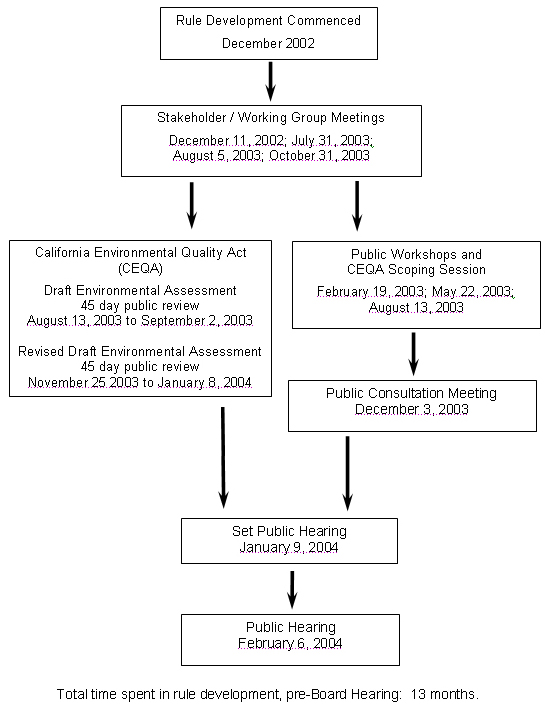
Rule Development Process
Attachment C
Key Contacts List
Associations
Association for Commuter Transportation (ACT)
California Council for Environmental and Economic Balance (CCEEB)
Glendale TMA
Warner Center TMO
Westchester/LAX TMA
Consultants
DeVinny Group
Market-Based Solutions
Ridelinks
TransVironmental Strategies
Government Agencies
California State University
Federal Bureau of Investigation
Los Angeles Community College
March AFB
Southern California Rideshare
University of California
Attachment D
RESOLUTION NO. 2004-
A Resolution of the Governing Board of the South Coast Air Quality Management District ("AQMD") certifying the Final Environmental Assessment for Proposed Amended Rule 2202 – On-Road Motor Vehicle Mitigation Options.
A Resolution of the AQMD Governing Board Adopting Proposed Amended Rule 2202 - On-Road Motor Vehicle Mitigation Options.
WHEREAS, the AQMD Governing Board has determined with certainty that Proposed Amended Rule 2202 – On-Road Motor Vehicle Mitigation Options is considered a "project" pursuant to the terms of the California Environmental Quality Act (CEQA); and
WHEREAS, the AQMD has had its regulatory program certified pursuant to Public Resources Code Section 21080.5 and has conducted CEQA review pursuant to such program (AQMD Rule 110); and
WHEREAS, AQMD staff has prepared a draft Environmental Assessment (EA) pursuant to its certified regulatory program and state CEQA Guidelines Section 15252, setting forth the potential environmental consequences of Proposed Amended Rule 2202 – On-Road Motor Vehicle Mitigation Options; and
WHEREAS, the draft EA was circulated for a 45-day public review and comment period between August 13, 2003 and September 26, 2003; and
WHEREAS, the project description was modified such that the criteria for recirculation was triggered pursuant to CEQA Guidelines §15088.5 and a revised draft EA was prepared and re-circulated for a 45-day public review and comment period between November 25, 2003 and January 8, 2004; no comments were received; and the revised draft EA has been modified such that it is now a Final EA; and
WHEREAS, it is necessary that the adequacy of the Final EA be determined by the Governing Board prior to its certification; and
WHEREAS, the AQMD Governing Board voting on Proposed Amended Rule 2202 – On-Road Motor Vehicle Mitigation Options hereby certifies the Final EA; and
WHEREAS, the AQMD Governing Board has determined that a need exists to amend Rule 2202 - On-Road Motor Vehicle Mitigation Options, to be consistent with the most current California Air Resources Board (CARB) emission factor model and the emissions inventories in the 2003 AQMP; and
WHEREAS, the AQMD Governing Board has determined that a need exists to amend Rule 2202 - On-Motor Vehicle Mitigation Options, Implementation Guidelines, and Employee Commute Program Guidelines to clarify language and facilitate compliance, and that there is a problem which the rule amendments will alleviate, i.e., non-attainment of federal ozone standards, and that the amended rule will promote attainment of state and federal standards; and
WHEREAS, the AQMD Governing Board adopts guidelines to ensure accuracy and usage of most current emission factors as adopted by CARB and EPA, and has determined that periodic review and amendment of rule guidelines is necessary to be consistent with these policy directions; and
WHEREAS, the AQMD Governing Board directs staff to report the status of inter-pollutant crediting and CO emissions inventories as part of the Rule 2202 annual report to the Governing Board, including, but not limited to, the quantity of credits exchanged, the types of projects, and location of these projects; and
WHEREAS, the AQMD Governing Board directs staff to report on the time to approve project applications submitted pursuant to paragraph (f)(5) of the rule as part of the Rule 2202 annual report to the Governing Board; and
WHEREAS, the AQMD Governing Board obtains its authority to adopt, amend, or repeal rules and regulation from the California Health and Safety Code Sections 39002, 40000, 40001, 40440(a), 40702 and 40725 through 40728; and
WHEREAS, the AQMD Governing Board has determined that the Proposed Amended Rule 2202 is written or displayed so that its meaning can be easily understood by persons directly affected by it; and
WHEREAS, the AQMD Governing Board has determined that Proposed Amended Rule 2202 is in harmony with, and not in conflict with or contradictory to, existing statutes, court decisions, federal or state regulations; and
WHEREAS, the AQMD Governing Board has determined that the proposed amendment to Rule 2202 does not impose the same requirements as any existing state or federal regulations, and the proposed amended rule is necessary and proper to execute the powers and duties granted to, and imposed upon the AQMD; and
WHEREAS, the AQMD Governing Board in amending and adopting this regulation, references the following statutes which the AQMD hereby implements, interprets or makes specific: California Health and Safety Code Sections 40001, 40716, 40717 and Federal Clean Air Act Section 182(d)(1)(B); and
WHEREAS, the AQMD Governing Board has determined that the socioeconomic impact assessment of the proposed amendment to Rule 2202, is consistent with the March 17, 1989 and October 14, 1994 Board Socioeconomic Resolution for rule adoption; and
WHEREAS, the AQMD Governing Board has considered the socioeconomic impact assessment and has made a good faith effort to minimize such impacts; and
WHEREAS, the AQMD Governing Board has determined that Proposed Amended Rule 2202 should be adopted for the reasons contained in the staff report; and
WHEREAS, a public hearing has been properly noticed in accordance with the provisions of Health and Safety Code Section 40725; and
WHEREAS, the AQMD Governing Board has held a public hearing in accordance with all provisions of law; and
WHEREAS, the AQMD specifies the Transportation Programs Manager of Rule 2202 as the custodian of the documents or other materials which constitute the record of proceedings upon which the adoption of this proposed amendment is based, which are located at the South Coast Air Quality Management District, 21865 Copley Drive, Diamond Bar, California.
NOW, THEREFORE, BE IT RESOLVED, that the AQMD Governing Board hereby certifies, pursuant to the authority granted by law, the Final Environmental Assessment for the proposed amendments to Rule 2202 – On-Road Motor Vehicle Mitigation Options; and
BE IT FURTHER RESOLVED, that the South Coast Air Quality Management District Governing Board adopts a Statement of Findings and Statement of Overriding Considerations pursuant to state CEQA Guidelines Sections 15091 and 15093, respectively, and a Mitigation Monitoring Plan pursuant to Public Resource Code Section 21081.6 regarding adverse environmental impacts that cannot be mitigated to insignificance, as required by CEQA, and which are included as Attachment 1 and incorporated herein by reference; and
BE IT FURTHER RESOLVED, that the AQMD Governing Board does hereby amend pursuant to the authority granted by law, Rule 2202, the Implementation Guidelines, and the Employee Commute Reduction Program Guidelines, as set forth in the attached and incorporated herein by this reference.
Attachment
DATE: _______________
_________________________
Clerk of the Boards
/ / /