
BOARD MEETING DATE: January 9, 2004
AGENDA NO. 21
Adopt Rule 1148.1 – Oil and Gas Production Wells; and Amend Rule 222 – Filing Requirements for Specific Emission Sources Not Requiring a Written Permit Pursuant to Regulation II
SYNOPSIS:
Proposed Rule 1148.1 will implement Control Measure FUG-05 of the 2003 AQMP by reducing VOC emissions from well cellars and wellheads at oil and gas production operations through increased inspection and maintenance, and control of produced gas emissions. Proposed Amended Rule 222 will include well cellars and wellheads at oil and gas production facilities subject to Proposed Rule 1148.1 in the filing program in lieu of conventional permitting. Currently, this equipment is exempt from written permit.
COMMITTEE:
Stationary Source, October 24, 2003, and November 21, 2003, Reviewed
RECOMMENDED ACTION:
Adopt the attached resolution:
- Certifying the Final Environmental Assessment (EA) for Proposed Rule 1148.1 – Oil and Gas Production Wells, and Proposed Amended Rule 222 – Filing Requirements for Specific Emission Sources Not Requiring a Written Permit Pursuant to Regulation II; and
- Adopting Rule 1148.1 - Oil and Gas Production Wells, and Amending Rule 222 – Filing Requirements for Specific Emission Sources Not Requiring a Written Permit Pursuant to Regulation II.
Barry R. Wallerstein, D.Env.
Executive Officer
Background
Proposed Rule (PR) 1148.1 – Oil and Gas Production Wells, has been developed to reduce VOC emissions from wellheads and well cellars at oil and gas production facilities through an enhanced self-inspection and maintenance program and by controlling produced gas that would have otherwise been vented to the atmosphere.
PR 1148.1 will implement Control Measure FUG-05 – Emission Reductions from Fugitive Sources of the 2003 AQMP, which has an emissions reduction target of 2.0 tons per day by the end of 2008. In addition, three other air pollution control districts in California have adopted rules that regulate emissions from well cellars and produced gas operations.
Staff worked closely with representatives from the oil and gas production industry, the California Division of Oil, Gas and Geothermal Resources, and the public. Staff has evaluated reported emissions and planning inventories and evaluated fugitive emissions control equipment and techniques for oil well operations. Based on this evaluation, staff has determined that further VOC emissions reductions are technically feasible and cost effective.
Oil and gas production operations may be located near sensitive receptors. To further minimize exposure of sensitive receptors to emissions, PR 1148.1 includes additional inspection and maintenance requirements for wells located near sensitive receptors.
Currently, oil and gas production wells are not permitted by the AQMD. To establish better emission inventories and compile other pertinent information necessary to implement and enforce the rule, staff is proposing that the oil and gas production well facilities file with the AQMD under Rule 222. Rule 222 is an alternative to permitting for equipment that emits small amounts of air contaminants. The rule establishes a filing program wherein operators of such equipment are required to submit to AQMD a description of the equipment and data for estimating emissions and determining compliance. The filing program under Rule 222 reduces permit and renewal fees for the operator, is less burdensome than the conventional permit process, and also decreases the permitting workload at AQMD.
Affected Facilities
PR 1148.1 affects approximately 220 onshore oil and gas facilities that operate 3,588 oil wells. These facilities are primarily located in Los Angeles and Orange counties. Staff has determined the VOC emissions inventory to be 1.21 tons per day from the well cellars and another 0.83 tons per day from produced gas vented to the atmosphere.
Public Process
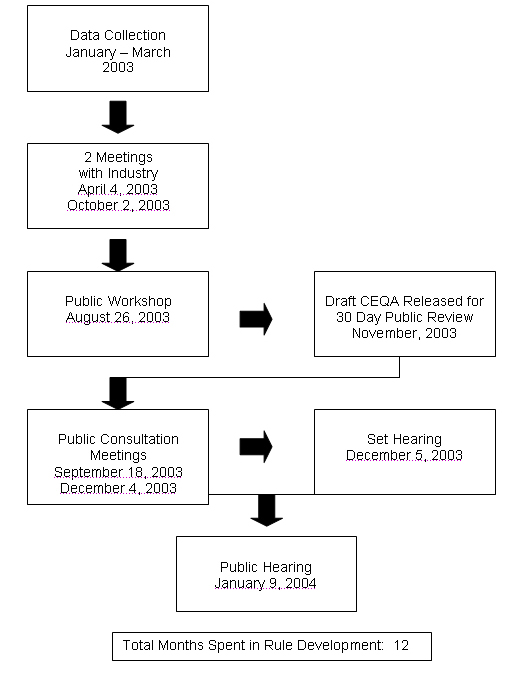
During the rulemaking process, staff met five times with industry representatives. These meetings consisted of a scoping session with industry on April 4, 2003, a Public Workshop on August 26, 2003, two Public Consultation Meetings on September 18, 2003, and December 4, 2003, and an industry working group meeting on October 2, 2003.
Proposal
PR 1148.1
The primary objective of PR 1148.1 is to reduce VOC emissions from well cellars as well as from sources of untreated process gas located at oil and gas production facilities. The following is a summary of the proposed rule.
- Upon adoption, the operator shall not allow the concentration of the total organic compound (TOC) in the well cellar to exceed 500 ppm.
- Effective July 1, 2004, the operator must conduct daily, weekly or monthly audio-visual and TOC measurement inspections depending on the type and location of the oil well; and use a portable container to collect organic liquid anytime a valve is opened at the wellhead; pump out or remove organic liquid accumulated in a well cellar when TOC concentration in the well cellar is greater than 250 ppm, and after maintenance on the oil well.
- Effective July 1, 2006, the operator must collect and control or treat any produced gas that is produced at an oil and gas production facility.
- For well oil cellars located within 100 meters of a sensitive receptor, the operator must pump out organic liquid accumulated in a well cellar within 24 hours when the TOC concentration in the well cellar is greater than 250 ppm, or the depth of accumulated organic liquid exceeds two (2) inches. In addition, the operator must repair or take action to prevent liquid leaks and gaseous leaks within 24 hours of discovery for TOC concentrations of 250 ppm TOC or greater.
- The operator must maintain records of inspection, maintenance, repair and pump outs.
PAR 222
The primary objective of PAR 222 is to provide an alternative to permits. The proposed amended rule would require the operator of oil production wells to file with the AQMD and submit information regarding the source. PAR 222 has a compliance date of January 1, 2004, and the operator must comply with the requirements of the proposed amended rule within one year of the compliance date.
Exemptions
Several exemptions are allowed in PR 1148.1. The most important exemptions are: 1) the operator is not required to comply with the pump-out or produced gas requirements during maintenance and repair of this equipment, and 2) well cellars can be used for emergency containment for a limited time provided they comply with the requirements of SCAQMD Rule 1176.
Key Issues
Staff has worked diligently with the impacted industry and resolved most of the issues raised during the rule development process. However, there are three remaining issues that industry continues to express concerns about: 1) the 2-inch accumulated organic material depth that triggers well cellar pump-out if a facility is located within 100 meters of a sensitive receptor, 2) the measurement of TOC at a distance within three inches above the organic liquid surface in the well cellar, and 3) the fee structure used in PAR 222, which charges a well operator an initial filing and an annual facility filing fee for each group of four wells located at a facility.
The 2-Inch Accumulated Organic Liquid Pump-Out Requirement
The industry believes that the measurement of the TOC concentration in the well cellar is the most accurate method to determine the fugitive VOC emissions from the well cellar and that the additional requirement to pump out the well cellar when the organic liquid depth reaches 2 inches is not necessary since the depth of the liquid may not always correlate to emission potential. Although staff believes the 250 ppm of TOC threshold is sufficient to limit emissions from well cellars in most instances, an additional factor of safety is appropriate near sensitive receptors. Organic material accumulation in a well cellar is indicative of a leak that should be repaired if good housekeeping and maintenance procedures are in place. The current proposal has been amended to require the additional requirement for pump-out when 2 inches or more of organic material has accumulated in the well cellar for only those well cellars located within 100 meters of a sensitive receptor
Measurement of TOC in the Well Cellar
The industry is requesting that the measurement of the TOC in the well cellar be conducted along the perimeter of the cover over the well cellar instead of within three inches above the organic liquid. Staff has determined that the concentration can vary significantly at different heights above the liquid and that the wind will significantly dilute the TOC concentration at the well cellar cover. In discussions with a major manufacturer of portable organic vapor analyzers, staff was informed that additional probe extensions could be added without compromising the accuracy of the TOC/VOC measurement, which will enable the operator to take measurements just above the oil in the well cellar.
PAR 222 Fees for Oil Wells
Staff has explored other options to determine a fee structure that would be equitable to industry, and at the same time address the cost associated with AQMD staff conducting periodic inspections and quarterly TOC well cellar measurements. Our analysis has determined that a filing fee for a group of up to four oil wells is the best approach that would be equitable and revenue-neutral. The proposed fee per oil well is consistent with the fees assessed by the other air pollution control districts that have specific rules that regulate oil wells.
Emission Reductions and Cost Effectiveness Determination
PR 1148.1 will achieve an overall VOC emission reduction of 1.76 tons per day. Of this amount, 0.97 tons per day of VOC emission reductions will come from the improved maintenance of wellheads and well cellars. Another 0.79 tons per day of VOC emission reductions will be obtained by controlling produced gas that would have otherwise been vented to the atmosphere.
Based on the reduction of emissions from both well cellars and produced gas sources, the overall cost effectiveness of PR 1148.1 is $2,483 per ton of VOC reduced.
AQMP and Legal Mandates
PR 1148.1 will implement Control Measure FUG-05 of the 2003 AQMP. This control measure proposes further VOC emissions reduction from fugitive emission sources, such as refineries, oil and gas production facilities, terminals, chemical plants and manufacturing facilities.
The AQMD, as a non-attainment area, is also required to adopt and implement all feasible measures. Similar rules have been adopted by Santa Barbara County APCD, San Luis Obispo County APCD, and Ventura County APCD. The Implementation of PR 1148.1 will result in emission reductions that are needed to meet federal and state ozone standards.
California Environmental Quality Act (CEQA) Analysis
Pursuant to the California Environmental Quality Act (CEQA) and the AQMD’s Certified Regulatory Program (Rule 110), staff has prepared an Environmental Assessment (EA) for proposed Rule 1148.1 – Oil and Gas Production Wells, and proposed amended Rule 222 – Filing Requirements for Specific Emission Sources Not Requiring a Written Permit Pursuant to Regulation II. The Draft EA, which was made available for a 30-day public review period from November 20, 2003, to December 19, 2003, concluded that proposed Rule 1148.1 and proposed amendments to Rule 222 would not have any significant adverse effect on the environment. The Final EA, which includes responses to comments made on the draft document, is included as part of the attached package for the public hearing on the proposed amendments.
Socioeconomic Analysis
The socioeconomic analysis was conducted to assess the impact of PR 1148.1 and PAR 222. PR 1148.1 will affect 220 oil and gas production facilities in the four-county area. These facilities belong to the sector of crude petroleum and natural gas (Standard Industrial Classification 1311). The total annualized cost of PR 1148.1 and PAR 222 is estimated at $2.080 million.
Implementation and Resources
To facilitate implementation uniformity, the provisions for self-inspection and recordingkeeping are designed to be consistent with current industry practice and requirements under Rule 1173. However, a small number of wells located within 100 meters of a sensitive receptor will require additional resources.
A temporary minor workload increase is expected due to applications submitted to control produced gas. However, no additional AQMD resources are needed for the engineering evaluation of the control equipment. PR 1148.1 will require additional inspections of oil wells, in particular, those wells located near sensitive receptors. The cost of these inspections will be recovered, in part, through the revenue fees included in PAR 222.
Attachments (2,560 KB)
- Summary of Proposal
- Rule Development Process
- Key Contacts List
- Resolution
- Rule Language
- Final Staff Report
- Final Socioeconomic Impact Assessment
- Final Environmental Assessment
ATTACHMENT A
PROPOSED RULE 1148.1 SUMMARY
|
Purpose |
|
Applicability |
|
Requirements |
|
Operator Inspection Requirements |
|
Recordkeeping Requirements |
|
Test Methods |
|
Exemptions |
PROPOSED AMENDED RULE 222 SUMMARY
|
Applicability |
|
Definitions |
ATTACHMENT B
RULE DEVELOPMENT PROCESS
ATTACHMENT C
KEY CONTACTS LIST
|
Affected Facilities | |
|
Aera Energy LLC |
Sempra Utilities |
|
Brea Canon Dr. Co., Inc. |
The Termo Co. |
|
BreitBurn Energy Co. |
THUMS Long Beach Co. |
|
Columbine Associates |
Tidelands Oil Production Co. |
|
Cooper & Braun, Inc. |
Venoco |
|
Griffin Technologies LLC |
PXP/Plains Exploration |
|
Others |
| Avanti Environmental |
| BSI/RKH Consulting |
| Calif. Dept. of Conservation, Div. of Oil, Gas & Geothermal Resources |
| California Independent Petroleum Association (CIPA) |
| Crosby Consulting Co. |
| Omnibus Environmental Services |
| Shaeffer Environmental Consultants |
| Trinity Consultation |
| Weston Benshoof |
| Public |
| Jody Kleinman |
| Joy Horowitz |
| Neighbors for a Safe Environment (NASE) |
ATTACHMENT D
RESOLUTION NO. 2004-
A Resolution of the South Coast Air Quality Management District (AQMD) Governing Board Certifying the Final Environmental Assessment for Proposed Rule 1148.1 – Oil and Gas Production Wells, and Proposed Amended Rule 222 – Filing Requirements for Specific Emission Sources Not Requiring a Written Permit Pursuant to Regulation II.
A Resolution of the Governing Board Adopting Proposed Rule 1148.1 – Oil and Gas Production Wells, and Proposed Amended Rule 222 – Filing Requirements for Specific Emission Sources Not Requiring a Written Permit Pursuant to Regulation II.
WHEREAS, the Governing Board finds and determines with certainty that the Proposed Rule 1148.1 – Oil and Gas Production Wells, and Proposed Amended Rule 222 – Filing Requirements for Specific Emission Sources Not Requiring a Written Permit Pursuant to Regulation II, are considered a "project" pursuant to the California Environmental Quality Act (CEQA); and
WHEREAS, the AQMD has had its regulatory program certified pursuant to Public Resources Code §21080.5 and has conducted CEQA review and analysis pursuant to such program (AQMD Rule 110); and
WHEREAS, AQMD staff has prepared a Draft Environmental Assessment (EA) pursuant to its certified regulatory program and CEQA Guidelines §15252 setting forth the potential environmental consequences of Proposed Rule 1148.1 – Oil and Gas Production Wells; and Proposed Amended Rule 222 – Filing Requirements for Specific Emission Sources Not Requiring a Written Permit Pursuant to Regulation II; and
WHEREAS, the Draft EA was circulated for public review, comments received have been responded to, and a Final EA has been prepared; and
WHEREAS, it is necessary that the adequacy of the Final EA, including the responses to comments, be determined by the Governing Board prior to its certification; and
WHEREAS, the AQMD is not required to prepare a Statement of Findings, a Statement of Overriding Considerations, or a Mitigation Monitoring Plan because the proposed project is not expected to generate significant adverse environmental impacts; and
WHEREAS, the AQMD Governing Board voting on proposed Rule 1148.1 – Oil and Gas Production Wells, and proposed amended Rule 222 – Filing Requirements for Specific Emission Sources Not Requiring a Written Permit Pursuant to Regulation II, has reviewed and considered the Final EA including responses to comments; and
WHEREAS, the Governing Board has reviewed and considered the staff's findings related to cost and employment impacts of the Proposed Rule 1148.1 – Oil and Gas Production Wells, and Proposed Amended Rule 222 – Filing Requirements for Specific Emission Sources Not Requiring a Written Permit Pursuant to Regulation II, set forth in the Socioeconomic Impact Assessment made public with the agenda package for this meeting, and hereby find and determines that cost and employment impacts are as set forth in that assessment; and
WHEREAS, the Governing Board has determined that Proposed Rule 1148.1 – Oil and Gas Production Wells, and Proposed Amended Rule 222 – Filing Requirements for Specific Emission Sources Not Requiring a Written Permit Pursuant to Regulation II, will result in increased costs to industry, yet are cost-effective as described in the Socioeconomic Impact Assessment; and
WHEREAS, the Governing Board has actively considered the Socioeconomic Impact Assessment and has made a good faith effort to minimize such impacts; and
WHEREAS, the Governing Board has determined that a need exists to adopt the Proposed Rule 1148.1 – Oil and Gas Production Wells and Proposed Amended Rule 222 – Filing Requirements for Specific Emission Sources Not Requiring a Written Permit Pursuant to Regulation II, to implement Control Measure FUG-05 of the 2003 AQMP and implement all control measures feasible to control VOC from oil wells and well cellars at oil and gas production facilities; and
WHEREAS, the Governing Board of the South Coast Air Quality Management District obtains its authority to adopt this proposed rule from Sections 39002, 40000, 40001, 40440, 40702, 41506.1, 41508, 41700, and 42300.1 of the California Health and Safety Code; and
WHEREAS, the Governing Board has determined that Proposed Rule 1148.1 – Oil and Gas Production Wells, and Proposed Amended Rule 222 – Filing Requirements for Specific Emission Sources Not Requiring a Written Permit Pursuant to Regulation II, as proposed is written or displayed so that its meaning can be easily understood by the persons directly affected by it; and
WHEREAS, the Governing Board has determined that Proposed Rule 1148.1 – Oil and Gas Production Wells, and Proposed Amended Rule 222 – Filing Requirements for Specific Emission Sources Not Requiring a Written Permit Pursuant to Regulation II, as proposed is in harmony with, and not in conflict with or contradictory to, existing federal or state statutes, court decisions, or regulations; and
WHEREAS, the Governing Board has determined that Proposed Rule 1148.1 – Oil and Gas Production Wells, and Proposed Amended Rule 222 – Filing Requirements for Specific Emission Sources Not Requiring a Written Permit Pursuant to Regulation II, as proposed does not impose the same requirements as any existing state or federal regulation and the proposed rule is necessary and proper to execute the powers and duties granted to, and imposed upon, the District; and
WHEREAS, the Governing Board has determined that Proposed Rule 1148.1 – Oil and Gas Production Wells, and Proposed Amended Rule 222 – Filing Requirements for Specific Emission Sources Not Requiring a Written Permit Pursuant to Regulation II, as proposed references the following statutes which the AQMD hereby implements, interprets or makes specific: Health and Safety Code 40001(a) and (b) (air quality standards and air pollution episodes); 40702 (adoption of rules and regulations), 40440(a) (rules to carry out plan); 40440(b) (best available retrofit control technology); 4-920.5(c) (and other feasible controls), and Federal Clean Air Act Section 172(c)(1) (reasonably available control technology); and
WHEREAS, the Governing Board has determined that there is a problem that Proposed Rule 1148.1 – Oil and Gas Production Wells, and Proposed Amended Rule 222 – Filing Requirements for Specific Emission Sources Not Requiring a Written Permit Pursuant to Regulation II, will help alleviate, that is the basin does not meet the ambient quality standards for ozone and the proposed rule will promote the attainment of this standard; and
WHEREAS, the Governing Board has determined that Proposed Rule 1148.1 - Oil and Gas Production Wells, and Proposed Amended Rule 222 – Filing Requirements for Specific Emission Sources Not Requiring a Written Permit Pursuant to Regulation II, should be adopted to implement Control Measure FUG-05 of the 2003 AQMP and implement all control measures feasible to control VOC emissions from oil wells and well cellars at oil and gas production facilities; and
WHEREAS, a public hearing has been properly noticed in accordance with the provisions of Health and Safety Code Section 40725; and
WHEREAS, the Governing Board has held a public hearing in accordance with all provisions of law; and
WHEREAS, the Governing Board specifies the manager of Proposed Rule 1148.1 – Oil and Gas Production Wells, and Proposed Amended Rule 222 – Filing Requirements for Specific Emission Sources Not Requiring a Written Permit Pursuant to Regulation II, as the custodian of the documents or other materials which constitute the record of proceeding upon which the adoption of this proposed rule is based, which are located at the South Coast Air Quality Management District, 21865 Copley Drive, Diamond Bar, California; and
WHEREAS the Governing Board has determined that Proposed Rule 1148.1 – Oil and Gas Production Wells, and Proposed Amended Rule 222 – Filing Requirements for Specific Emission Sources Not Requiring a Written Permit Pursuant to Regulation II, should be adopted for the reasons stated in the Staff Report; and
NOW, THEREFORE, BE IT RESOLVED, that the Governing Board does hereby certify that the Final EA for Proposed Rule 1148.1 – Oil and Gas Production Wells, and Proposed Amended Rule 222 – Filing Requirements for Specific Emission Sources Not Requiring a Written Permit Pursuant to Regulation II, was completed in compliance with CEQA and Rule 110 provisions; and finds that the Final EA was presented to the Governing Board, whose members reviewed, considered and approved the information therein prior to acting on Proposed Rule 1148.1 – Oil and Gas Production Wells; and Proposed Amended Rule 222 – Filing Requirements for Specific Emission Sources Not Requiring a Written Permit Pursuant to Regulation II; and
BE IT FURTHER RESOLVED, that the Governing Board does hereby adopt, pursuant to the authority granted by law, Proposed Rule 1148.1 – Oil and Gas Production Wells, and Proposed Amended Rule 222 – Filing Requirements for Specific Emission Sources Not Requiring a Written Permit Pursuant to Regulation II, as set forth in the attached and incorporated herein by reference.
_____________ ________________________________
Date Clerk of the District Board
/ / /