
BOARD MEETING DATE: April 1, 2005
AGENDA NO. 25
Approve Guidance Document for Addressing Air Quality Issues in General Plans and Local Planning
SYNOPSIS:
The AQMD Environmental Justice Program is designed to protect district residents’ right to live and work in an environment of clean air, free of airborne health threats. In 2002, the Board expanded the program to include the development of a model air quality element for local governments to consider as they develop or revise their General Plans. The "Guidance Document for Addressing Air Quality Issues In General Plans and Local Planning" provides a list of voluntary options for local governments to control air pollution and reduce health risks. The combined implementation of these strategies throughout the region will provide greater environmental equity and strengthen the local government partnership with AQMD to meet clean air standards.
COMMITTEE:
Mobile Source; November 19, 2004, February 25, 2005, and March 25, 2005; Reviewed
RECOMMENDED ACTION:
Approve the guidance document as a voluntary tool to assist local governments in developing or revising air quality elements in their General Plans and local planning efforts.
Barry R. Wallerstein, D.Env.
Executive Officer
Background
In September 2002, the Board introduced the development of a model air quality element as part of its enhanced environmental justice work plan to encourage local agencies to address air quality concerns in their General Plans, particularly those associated with land use decisions. Subsequently, AQMD contracted with two Councils of Governments to develop a user-friendly resource guide for cities and counties to update or add an optional air quality element to their General Plans.
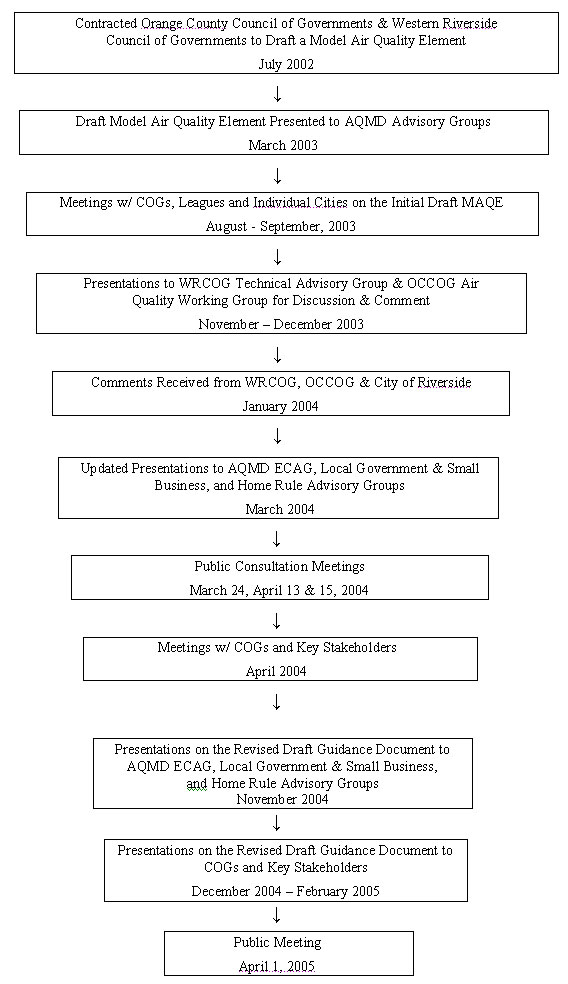
In response to a series of public consultation meetings and presentations that began on the draft model air quality element (MAQE) in July 2002, AQMD staff received numerous comments of varied perspectives and insights. In response to comments, the draft MAQE was reformatted into three tiers (air quality goals, objectives, and suggested policies/strategies) to be more consistent with the format of General Plans. Also, specific air quality and health effects information was added to provide rationale for the suggested policies, particularly for those policies related to land use. Many of the suggested policies were reworded to emphasize that the appropriate mix and inclusion of any suggested policies, as they are adopted in General Plans or considered in land use decisions, remains at the complete discretion of local jurisdictions. Combined, these changes broadened the scope of the MAQE; therefore the document was re-titled "Guidance Document for Addressing Air Quality Issues in General Plans and Local Planning."
Proposal
Clean air for all the residents in the basin cannot be accomplished by air quality agencies alone. Local governments have the flexibility and authority to address air quality issues through ordinances and General Plans that guide the development of local circulation systems, transportation services, and land use. Achieving the mutual goals of protecting public health and providing environmental equity to citizens in the district can only be accomplished through a strong partnership with the local jurisdictions. Many land use decisions made by local governments represent opportunities to complement air regulations in preventing or lowering adverse air quality impacts.
The guidance document is intended as a discretionary framework for local government decision makers and planners to consider in developing General Plan policies, particularly as they are related to land use. The ideas, technical information, and references presented in the guidance document are also useful for private developers, residents, and community organizations. The combined implementation of strategies across the district will strengthen local government partnership with the AQMD for cleaner air, and demonstrate the resolve of cities and counties in the district to provide environmental equity and protect the health of their residents. The guidance document is considered a "living document" that will be modified as appropriate to reflect the latest science on air quality and to address feedback from local governments on implementation issues.
Key Issues
Numerous comments were received during the public comment period and considered for inclusion in the draft final document.
The remaining outstanding issues are those listed below:
Issue #1. Changes in General Plan land use policies have long-term horizons. Since the air is getting cleaner and cancer risk associated with living in close proximity to roadways is expected to diminish substantially over time, the suggested policies in the guidance document may not be necessary.
Response: While there continues to be an overall reduction in air pollution for the region, the emission reductions expected from cleaner engine standards that employ new control technologies often require a lengthy "fleet turnover" time to be effective. Given projections for future growth and additional vehicles that will utilize the region’s transportation corridors, there are no guarantees that localized cancer risk and non-cancer impacts will diminish rapidly in the short term or adequately in the long run. Cities are encouraged to join the AQMD in a proactive approach to address existing health concerns in their communities identified in the AQMD’s Multiple Air Toxics Emissions Study (MATES II). Policies and strategies suggested in the guidance document can offer a near-term remedy to lower cancer risk from exposure to air pollution, and at the same time, provide preventive measures that protect health over the long-term planning horizon of the General Plan.
Issue #2. The guidance document should be reorganized to highlight the importance of reducing stationary/mobile source emissions, not land use decisions as a strategy.
Response: Staff has included expanded discussions on the ongoing local, state and federal regulatory and incentive programs that propose to reduce emissions from diesel engines. While regulatory agencies are clearly responsible for achieving mandated emission reductions, the collective impact of local government land use decisions can assist in furthering clean air progress. Especially, local governments have unique land use decisions and authorities that air quality agencies do not have. Land use decisions incorporating air quality consideration form the focus of this guidance document.
Issue #3. AQMD Rule 403 is effective in reducing fugitive dust emissions; therefore, suggested policies for additional local government actions are unnecessary.
Response: Rule 403 requires implementation of control measures to prevent, reduce, or mitigate fugitive dust emissions and prohibits visible emissions from crossing any property line. Large operations are required to notify the AQMD of the project location and implement control measures if necessary. In the Coachella Valley, local governments have adopted dust control ordinances that require approval of a dust control plan prior to local government issuance of grading permits. AQMD Rule 403.1 (Supplemental Fugitive Dust Control Requirements for Coachella Valley Sources) is a companion regulation that establishes special requirements for Coachella Valley fugitive dust sources under high-wind conditions and requires AQMD approval of dust control plans for sources not subject to local government ordinances (e.g., school districts).
Local government adoption of a dust control ordinance that requires submittal of a dust control plan under certain circumstances prior to issuance of grading permits would complement Rule 403 and facilitate development of site-specific control measures. Local government knowledge of site-specific conditions (i.e., high-wind area, unstable soils, etc.) would also assist in development of site-specific control measures for dust control plans. Clustering of several construction projects that, individually, are below Rule 403 large operation notification thresholds could also be addressed by local government adoption of a dust control ordinance that requires submittal of dust control plans. Under this scenario, local governments could require additional site-specific control measures for multiple construction projects in one area that are individually small but could be cumulatively significant. Finally, local government approval of dust control plans for construction projects would allow faster reaction by local government code enforcement officers and inspectors to mitigate fugitive dust impacts at construction sites. Local government code enforcement officers and inspectors make many more visits to construction sites throughout the development process when compared to AQMD compliance staff.
Issue #4. The current document does not include examples of air quality element policies that have been adopted in the region, nor examples of local ordinances that have been adopted to help reduce air pollution.
Response: AQMD staff has provided, in appendix A of the guidance document, a listing of local jurisdictions in the District with air quality elements in their General Plans. Examples of two air quality elements are also included in the appendix. Local governments can be contacted directly in order to obtain copies of the air quality elements included in their General Plans. In future revisions to the guidance document staff will consider including internet links to General Plans and local ordinances that support AQMD emission reduction programs.
Issue #5. The format of the guidance document should be identical to the four-tier approach recommended in State Guidelines for General Plans (goals, objectives, policies/strategies, and implementation measures).
Response: The final draft of the guidance document was revised with a three-tier format (goals, objectives, and policies/strategies) which closely parallels the four-tier format outlined in state guidelines. A number of stakeholders suggested that not expanding beyond the "policies/strategies" category is more helpful and less prescriptive and allows more flexibility to interpret and craft policy statements that are specific to the needs of the local jurisdiction. During the implementation phase, staff will continue to solicit feedback from stakeholders. If appropriate, AQMD staff will move toward a four-tier format in the future and consider an additional subcategory of "implementation measures" upon Board direction.
Future Actions
The guidance document is a living document that will be updated periodically. Future AQMD actions include:
- Distribute the guidance document to local planning agencies and stakeholders, and continue outreach to local governments and COGs.
- Periodically revise the guidance document, upon Board approval, to:
- update current air quality and health effects information, including MATES III data;
- include examples of General Plan policies and local ordinances that could be used as models for other jurisdictions; and
- consider a four-tier format for consistency with state guidelines for General Plans.
- Serve as a clearinghouse for adopted air quality elements; and
- Develop a web page to provide information that will provide resources and information that will assist local governments in addressing air quality issues.
Resource Impacts
Existing staff resources are adequate to continue the outreach effort to local governments, periodically update the guidance document, and develop and maintain a clearinghouse and a web page on local government-related air quality issues.
Attachments (9,530 KB)
- AQMD Staff Outreach to Develop the Guidance Document for Addressing Air Quality Issues in General Plans and Local Planning
- Guidance Document for Addressing Air Quality Issues in General Plans and Local Planning
ATTACHMENT A
OUTREACH FOR THE GUIDANCE DOCUMENT
/ / /