
BOARD MEETING DATE: April 1, 2005
AGENDA NO. 26
Trends of Particulate Air Quality: An Update
SYNOPSIS:
In 2004, the South Coast Air Basin and the Coachella Valley recorded the lowest maximum annual average PM10 concentrations since monitoring commenced in 1987. Similarly, annual average PM2.5 concentrations were also the lowest since monitoring began six years ago. Unlike the Coachella Valley, the Basin continues to exceed the federal standards for both annual average PM10 and PM2.5. While the Basin did not experience a violation of the 24-hour average PM10 standard in 2004, the daily average concentration exceeded the standard on one day in the Coachella Valley. However, this exceedance is being investigated as a potential "High Wind Event" for exclusion based on U.S. EPA's Natural Events Policy. Daily average PM2.5 concentrations in the Basin exceeded the federal standard at the majority of the sites. Favorable weather conditions which led to cooler temperatures and weaker inversions, together with continued implementation of air pollution control strategies, have contributed to the 2004 observed trend.
COMMITTEE:
Mobile Source, March 25, 2005, Reviewed
RECOMMENDED ACTION:
Receive and file.
Barry R. Wallerstein, D.Env.
Executive Officer
Background
Recent health studies have prompted both U.S. EPA and CARB to review the primary annual and short-term particulate standards (Table 1). In 2003, the CARB revised the state standards for both PM10 and PM2.5, lowering the standard threshold concentration in efforts to enhance the protection of public health. U.S. EPA is also considering lowering the recently established federal annual and short-term PM2.5 standards and is further considering eliminating the PM10 designation by creating a new standard for coarse (PM10-2.5) particles. While significant effort has been undertaken to resolve the health impacts due to size and duration of exposure, levels of both PM10 and to a lesser extent PM2.5 have been reduced in the South Coast Air Basin (Basin) and have maintained attainment status in the Coachella Valley. In 2004, the trend continued.
Table 1
Primary Annual and 24-Hour Average Particulate Standards (µg/m3)
|
Jurisdiction |
PM10 |
PM2.5 | ||
|
Annual |
24-Hours |
Annual |
24-Hours |
|
|
Federal |
50 |
150 |
15 |
65 |
|
California |
20 |
50 |
12 |
-- |
Year 2004 Particulate Air Quality
In 2004, the Basin recorded the lowest maximum annual average PM10 concentration since monitoring began in 1987. Only one monitoring site continues to measure PM10 concentrations in excess of the federal annual standard (Rubidoux, with an annual average of 54.5 µg/m3). The maximum annual average concentration for the Coachella Valley valued 80 percent of the federal standard (40.4 µg/m3 at Indio). The Basin maximum 24-hour average standard was not exceeded in the Basin. Over the past decade, the majority of days exceeding the 24-hour average PM10 standard in the Basin resulted from high winds in association with Santa Ana wind conditions. Short-term PM10 concentrations greater than 150 µg/m3 occurred on one day in Coachella Valley in 2004; however, this day is being flagged for possible exclusion from standard determination under U.S. EPA's "Natural Event Policy."
For particulates, a three-year moving annual average concentration is used to define the ongoing trend. The three-year moving average sets the design value for standard determination and also helps reduce the impacts from year-to-year variations of weather to the trend. Overall, the three-year moving average of Basin maximum annual PM10 concentrations (Figure 1) has declined 35 percent (1987-1989 through 2002-2004). While a 22 percent long-term improvement in annual maximum PM10 concentrations (1987-1989 through 2002-2004) has occurred in the Coachella Valley, the trend over the past decade has been relatively flat (Figure 2).
In contrast, PM2.5 concentrations exceeded the federal standards at the majority of stations monitoring fine particulate in the Basin. Fine particulate is typically associated with combustion processes and secondary formation of aerosol particles. As a consequence, PM2.5 concentrations tend to be more homogeneously distributed throughout the Basin, yet a localized peak occurs in the Riverside area due to enhanced formation of nitrates and organic carbon. While Basin concentrations continued to exceed the federal standards in 2004, the Basin maximum annual average PM2.5 concentration (22.0 µg/m3 measured at San Bernardino) was the lowest since comprehensive monitoring began in 1999. The peak short-term concentration (94 µg/m3 measured at Rubidoux) was 45 percent above the federal standard. (See Figure 3).
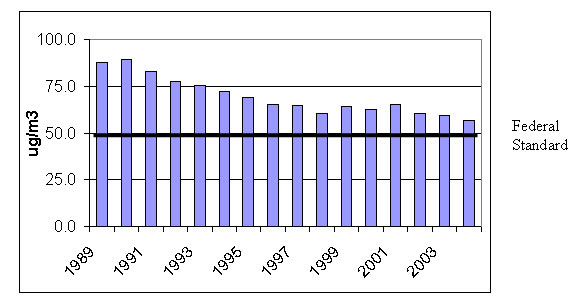
Figure 1
3-Year Moving Average of Basin Annual Maximum PM10 (µg/m3)
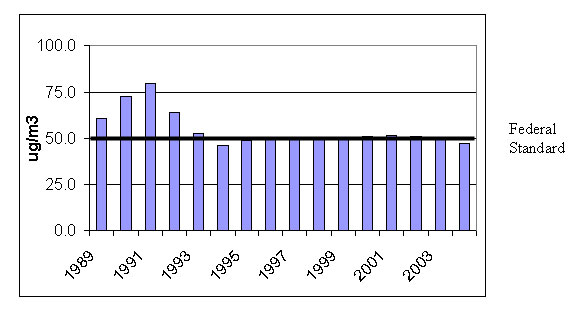
Figure 2
3-Year Moving Average of Coachella Valley Annual Maximum PM10 (µg/m3)
Over the six-year trend period, the Basin maximum annual PM2.5 levels have decreased 29 percent. PM2.5 concentrations have met both annual and 24-hour federal standards in each year of the six years of monitoring in the Coachella Valley.
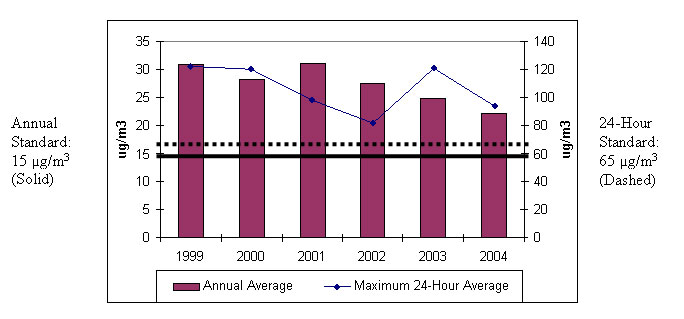
Figure 3
Basin Annual Maximum PM2.5 and Maximum 24-Hour Average Concentration (µg/m3)
Favorable weather conditions which led to cooler temperatures (and a slower rate of secondary aerosol formation) and weaker inversions played a role in 2004 observed particulate matter air quality. In addition, an early start to the rain season contributed to lowered particulate levels in fall. Completion of the statewide fuel reformulation program together with the continued implementation of the air pollution control strategy also contributed.
2006 PM10 Standards
The Clean Air Act (CAA) requires the Basin to attain the federal standards for PM10 by 2006. As previously discussed, the overwhelming majority of days exceeding the 24-hour standard in the past decade occurred during high wind "natural events." Provisions to exclude these days from both 24-hour average and annual average evaluation are available through the Natural Events Policy. Projections of the Basin maximum annual average PM10 concentration derived from the trends indicate that ambient levels of particulate will approach the standard but the Basin will not reach attainment without further controls. Additional emissions reductions are expected due to implementation of adopted and proposed particulate rules that will come into effect by 2006. Staff is also currently performing a study on emission source characterization in the area exceeding the annual standard. Findings from the study may result in additional local programs to ensure 2006 attainment of the PM10 standards.
/ / /