
BOARD MEETING DATE: January 7, 2005
AGENDA NO. 24
(Continued from December 3, 2004 Board Meeting)
Adopt Proposed Rule 1157 – PM10 Emission Reductions from Aggregate and Related Operations
SYNOPSIS:
Proposed Rule 1157 is developed to reduce PM10 emissions from aggregate and related operations as part of 2003 AQMP Control Measure BCM-08 – Further Emission Reductions from Aggregate and Cement Manufacturing Operations. The proposed rule would reduce fugitive dust PM10 emissions from various dust sources including loading and unloading activities, process equipment, open storage piles, unpaved and paved roads inside the facilities, and track out.
COMMITTEE:
Stationary Source, September 24, 2004, October 22, 2004, and November 19, 2004; Reviewed
RECOMMENDED ACTION:
Adopt the attached resolution:
- Certifying the CEQA Final Environmental Assessment (EA) for the proposed rule;
and- Adopting Proposed Rule 1157 - PM10 Emission Reductions from Aggregate and Related Operations.
Barry R. Wallerstein, D.Env.
Executive Officer
Background
The South Coast Air Basin (Basin) is classified as a serious non-attainment area for PM10 (particulate matter less than 10 microns in diameter) and must demonstrate compliance with the state and federal clean air acts, and in particular, the federal ambient air quality standards for PM10, by 2006. To address these mandates, the 2003 AQMP for the Basin included Control Measure BCM-08 – Further Emission Reductions from Aggregate and Cement Manufacturing Operations, which identified aggregate and cement operations as sources of PM10 emissions. As such, Control Measure BCM-08 calls for the development of controls to reduce the emissions from these industries. Proposed Rule 1157 (PR 1157) – PM10 Emission Reductions from Aggregate and Related Operations, is developed to implement a portion of Control Measure BCM-08. Subsequently, a separate rule will be proposed to address emissions generated by cement manufacturing operations.
Currently, aggregate and related operations are regulated by Rule 403- Fugitive Dust. While Rule 403 allows a choice of compliance options for general fugitive dust source categories, PR 1157 seeks to further minimize particulate emissions from this industry by establishing source specific performance standards and specifying operational PM10 controls for various types of equipment, processes, storage piles, internal roadways at aggregate and related operations, and track-out of materials onto paved public roads.
Affected Facilities
PR 1157 affects approximately 389 aggregate and related operations categorized as follows: 29 aggregate, 100 concrete batching (CB), 152 concrete product (CP), 45 hot-mix asphalt, 25 crushed miscellaneous base (CMB) for concrete and asphalt recycling, and 38 "other" facilities (i.e., sand and cement blending and bagging, inert landfills handling construction and demolition debris, etc.) These facilities generate PM10 during their mining, processing, and handling (i.e., transporting, loading/unloading, conveying, crushing, screening, mixing, and storing) of the aggregates. Unpaved roads and track-out from these facilities are two other significant sources of PM10 emissions. Based on staff’s recent industry wide survey, the PM10 emissions inventory for these industries is estimated to be 29 tons per day.
Public Process
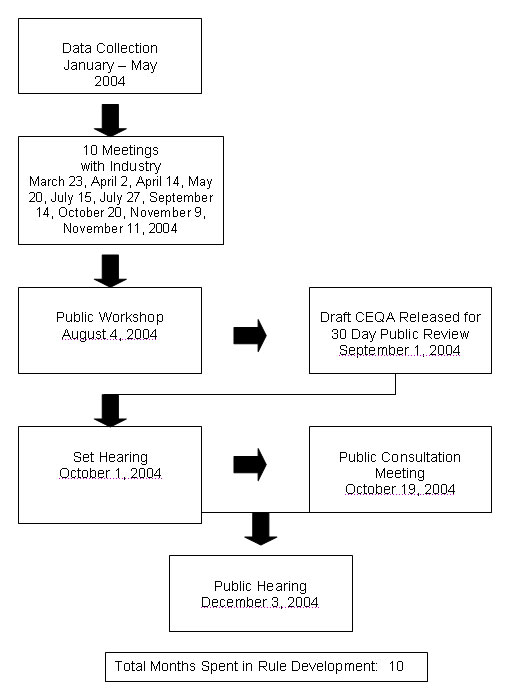
To assist staff with the rule development, a working group was formed. Staff and industry representatives held ten working group meetings. These meetings consisted of a kick-off meeting on March 23, 2004 and two subsequent meetings were held on April 2 and April 14, 2004 to discuss the development of facility surveys. Subsequent industry working group meetings were held on the following dates: May 20, July 15, July 27, September 14, October 20, November 9, and November 11, 2004. Staff also visited facilities and met individually with technical representatives of the industry associations to gather information on this industry.
Approximately 1,000 public workshop notices were mailed to potentially impacted sources and to members of the public. A public workshop was held on August 4, 2004 and a Public Consultation was held on October 19, 2004. In addition to being notified by mail, community representatives who had expressed interest in these operations were contacted by District staff by telephone in advance of the Public Consultation meeting in October and informed of the availability of the draft rule and staff report.
Proposal
The primary objective of PR1157 is to further reduce PM10 emissions from aggregate and related operations. The following is a summary of the proposed rule:
- General Performance Standards:

No dust emissions exceeding 20 percent opacity based on an average of twelve consecutive readings, or
No discharge of dust emissions exceeding 50 percent opacity, based on five individual, consecutive readings, or
No dust plume beyond 100 feet from any emission source
Removal and/or stabilization of spills
Specifications of gravel pad
- Process Control Options:
Apply dust suppressants or other dust control methods for loading/unloading/transferring activities, conveyors, crushers, screening equipment, and storage piles
Baghouse and/or enclosure options for crushers and screening equipment
- Internal Paved Roads:
Sweep daily or every other day depending on facility’s activity level.
Apply dust suppressants (i.e. watering) on the days that sweeping is not required
- Internal Unpaved Roads, Parking and Staging Areas:
Apply chemical stabilizers or gravel pads
- Track-out:
All loads must be leveled, maintained with freeboard, and either covered or stabilized
Active Facilities – Install rumble grates and wheel washers
Less Active Facilities – A choice of rumble grates or wheel washers or truck washers
- Repeat Violators:
Require Emission Reduction Plan
- Exemptions where controls are infeasible
- Compliance Dates: July and December 2005.
Key Issues
Staff has worked diligently with the impacted industry and has resolved most of the issues raised during the rule development process. However, there are three issues around which industry continues to express concern. These issues are: (1) enforcement of the performance standard of 50% opacity and the associated test method; (2) operational limitations during high wind periods and (3) a federal EPA requirement for tarping or stabilization of loads exiting the facilities. Staff believes that recent changes to staff’s proposal should accommodate their concerns, be protective of air quality and not diminish the effectiveness of the rule.
In response to recent discussions on the first two issues, staff has partially adjusted its proposals. First, industry has questioned a new opacity limit of 50% where a violation can be measured after 4 individual, consecutive readings exceeding the 50% standard for facility processes and activities. Industry has asked for clarification to the test method and that the number of readings necessary for a Notice of Violation (NOV) be increased from 4 to 5. Staff has confidence in this standard and method. The purpose of the 50% standard is to capture short-term, but significant fugitive emissions. However, in response to industry comments, staff has clarified the test method to clearly define the activities subject to the 50% standard and to state that no more than one NOV can be issued for that one activity. Staff committed to conducting training classes well in advance of the effective date of this standard so that the industry better understands how it will be used and how to prevent violations at their facilities. Finally, staff is recommending to the Governing Board, as part of this proposal, not to submit this requirement as part of the State Implementation Plan and, as such, proposes that this standard be enforced locally and not to be enforced by the federal EPA.
Second, with respect to the high winds exemption, industry wants to exempt all aggregate loading/unloading/transferring activities since they are supplying continuous pour concrete and asphalt construction jobs. Because of the fact that interruption of the pour can create irreparable damage to the project, staff clarified the exemption, limited it to ready-mix and asphalt production related activities that produce materials for use in on-going pouring and paving projects, and has required that records be kept of all aggregate materials supplied to projects that meet the criteria for high wind exemptions.
Relative to the third issue described above, EPA has sent a comment letter on the rule asking for tarping or stabilization of aggregate material loads in the beds of trucks exiting facilities. EPA has stated that the rule cannot be approved by the agency in the absence of this requirement. Thus, staff has proposed the incorporation of similar language that EPA has approved in a bulk handling rule recently adopted by the San Joaquin Valley APCD. Industry remains concerned that they are being required to "ensure" that truck drivers, the vast majority of whom are not employed by them, cover and stabilize the loads prior to exiting to a public road. District staff has assured them that if the facilities post reminder signs and make space available to the drivers to tarp or wet their materials, that this obligation will be considered to be fulfilled.
Emission Reductions and Cost Effectiveness Determination
The 2003 AQMP estimated PM10 emission reductions from aggregate and related operations to be approximately 0.7 tons per day. After completing a thorough study of the industry, staff now estimates that PR 1157 would achieve an additional PM10 emission reduction of 18 tons per day (beyond Rule 403) through good housekeeping and the use of effective dust control methods including: dust suppressants (water and/or chemical), baghouses, enclosures, rumble grates (to remove dust agglomerated on the vehicle’s tires), truck washers, and wheel washers.
Based on the reduction of emissions, the overall cost-effectiveness of PR 1157 is estimated at $1,132 per ton of PM10 reduced.
AQMP and Legal Mandates
PR1157 will implement a portion of Control Measure BCM-08 of the 2003 AQMP. This control measure calls for the development of controls to reduce the emissions from aggregate and related operations, as well as for cement manufacturing operations.
The AQMD, as a serious non-attainment area, is also required to adopt and implement all feasible measures. State of Texas, the San Joaquin Valley APCD, Clark County (Nevada), and Maricopa County (Arizona) has developed similar rules, primarily for process operations. The Implementation of PR1157 will result in emission reductions that are needed to meet federal and state PM10 standards.
California Environmental Quality Act (CEQA) Analysis
Pursuant to the California Environmental Quality Act (CEQA) and the AQMD’s Certified Regulatory Program (Rule 110), staff has prepared an Environmental Assessment (EA) for proposed Rule 1157 – PM10 Emission Reductions from Aggregate and Related Operations. The Draft EA, which was made available for a 30-day public review period from September 2, 2004, to October 1, 2004, concluded that PR 1157 would not have any significant adverse effect on the environment. The Final EA, which includes responses to comments made on the draft document, is included as part of the attached package for the public hearing on the proposed amendments.
Socioeconomic Analysis
A socioeconomic analysis was conducted to assess the impact of PR 1157. PR 1157 will affect 389 aggregate and related operations in the four-county area. These facilities belong to the following sectors: Construction Sand and Gravel (SIC 1442), Industrial Sand (SIC 1446), Ready Mixed Concrete (SIC 3273), Concrete Products (SICs 3271-72), Asphalt Paving Mixtures & Blocks (SIC 2951), Crushed and Broken Limestone (SIC 1422), and Lime & Gypsum Products (SICs 3274-75). The total annualized cost of PR 1157 is estimated at $9.26 million. Based on the compliance cost of PR 1157 and application of the AQMD’s regional economic model, it is estimated that an average of 325 jobs could be forgone annually from the future projected growth in the four-county area between 2005 and 2020.
Implementation and Resources
Implementation of the PR 1157 is not expected to have an impact on AQMD fiscal resources. It will, however, increase staff's workload in making compliance determinations and evaluating emission reduction plans submitted by facilities with recurrent violations, as well as industry requests for certain exemptions. The workload increase is expected to be such that no additional staff will be required.
Attachments (1,891 KB)
- Summary of Proposed Rule 1157
- Rule Development Process
- Key Contacts List
- Resolution
- Key Issues
- Rule Language
- Final Staff Report
- Final Socioeconomic Impact Assessment
- Final Environmental Assessment
ATTACHMENT A
SUMMARY OF PROPOSED RULE 1157
Purpose
Reduce PM10 emissions from aggregate and related operations
Applicability
Apply to all permanent and temporary aggregate and related operations, unless otherwise exempt
Requirements:
- General Performance Standards:
No dust emissions exceeding 20 percent opacity based on an average of twelve consecutive readings, or
No discharge of dust emissions exceeding 50 percent opacity, based on five individual, consecutive readings, or
No dust plume beyond 100 feet from any emission source
Removal and/or stabilization of spills
Specifications of gravel pad
- Process Control Options:
Apply dust suppressants or other dust control methods for loading/unloading/transferring activities, conveyors, crushers, screening equipment, and storage piles
Baghouse and/or enclosure options for crushers and screening equipment
- Internal Paved Roads:
Sweep daily or every other day depending on facility’s activity level.
Apply dust suppressants (i.e. watering) on the days that sweeping is not required
- Internal Unpaved Roads, Parking and Staging Areas:
Apply chemical stabilizers or gravel pads
- Track-out:
All loads must be leveled, maintained with freeboard, and either covered or stabilized
Active Facilities – Install rumble grates and wheel washers
Less Active Facilities – A choice of rumble grates or wheel washers or truck washers
- Repeat Violators:
Require Emission Reduction Plan
- Exemptions where controls are infeasible
Compliance Dates: July and December 2005.
ATTACHMENT B
RULE DEVELOPMENT PROCESS
ATTACHMENT C
KEY CONTACTS LIST
|
Affected Facilities |
|
3M |
|
Catalina Pacific Concrete |
|
CEMEX/SCRPA |
|
Chandler Aggregates |
|
Dan Copp Crushing |
|
Fourth Street Rock Crusher |
|
FST Sand and Gravel |
|
Hanson Aggregates |
|
Holliday |
|
Metropolitan Water District of Southern California |
|
MonierLifetile |
|
R.J. Noble Company |
|
Riverside County Waste Management |
|
Robertson’s |
|
Sully Miller |
|
United Rock Products |
|
Utility Vault Company |
|
Vulcan Materials Company |
|
Others |
|
Bulot, Inc. |
|
California Dump Truck Owners Association |
|
CIAQC |
|
City of Irwindale |
|
Construction Industry & Air Quality Coalition |
|
Environmental Engineering Studies, Inc. |
|
Environmental Mediation Inc. |
|
Justice & Associates |
|
Law Office of Curt Coleman for SCRPA/SCRMCA |
|
National Environmental Service Co., Inc. |
|
SCRPA/SCRMCA |
|
Shaffer Environmental |
|
South Western Sealcoating, Inc. |
|
The ACT Group |
|
West Coast Environmental and Engineering |
|
Yeager Slanska |
ATTACHMENT D
RESOLUTION NO. 2004-xx
A Resolution of the South Coast Air Quality Management District (AQMD) Governing Board Certifying the Final Environmental Assessment for Proposed Rule 1157 – PM10 Emission Reductions from Aggregate and Related Operations.
A Resolution of the Governing Board Adopting Proposed Rule 1157 – PM10 Emission Reductions from Aggregate and Related Operations.
WHEREAS, the Governing Board finds and determines with certainty that the Proposed Rule 1157 – PM10 Emission Reductions from Aggregate and Related Operations is considered a "project" pursuant to the California Environmental Quality Act (CEQA); and
WHEREAS, the AQMD has had its regulatory program certified pursuant to Public Resources Code § 21080.5 and has conducted CEQA review and analysis pursuant to such program (AQMD Rule 110); and
WHEREAS, AQMD staff has prepared a Draft Environmental Assessment (EA) pursuant to its certified regulatory program and CEQA Guidelines §15252 setting forth the potential environmental consequences of Proposed Rule 1157 – PM10 Emission Reductions from Aggregate and Related Operations; and
WHEREAS, the Draft EA was circulated for public review, comments received have been responded to, and a Final EA has been prepared; and
WHEREAS, it is necessary that the adequacy of the Final EA, including the responses to comments, be determined by the Governing Board prior to its certification; and
WHEREAS, the AQMD is not required to prepare a Statement of Findings, a Statement of Overriding Considerations, or a Mitigation Monitoring Plan because the proposed project is not expected to generate significant adverse environmental impacts; and
WHEREAS, the AQMD Governing Board voting on Proposed Rule 1157 – PM10 Emission Reductions from Aggregate and Related Operations, has reviewed and considered the Final EA including responses to comments; and
WHEREAS, the Governing Board has reviewed and considered the staff's findings related to cost and employment impacts of the Proposed Rule 1157 – PM10 Emission Reductions from Aggregate and Related Operations, set forth in the Socioeconomic Impact Assessment made public with the agenda package for this meeting, and hereby find and determines that cost and employment impacts are as set forth in that assessment; and
WHEREAS, the Governing Board has determined that Proposed Rule 1157 – PM10 Emission Reductions from Aggregate and Related Operations, will result in increased costs to industry, yet are cost-effective as described in the Socioeconomic Impact Assessment; and
WHEREAS, the Governing Board has actively considered the Socioeconomic Impact Assessment and has made a good faith effort to minimize such impacts; and
WHEREAS, the Governing Board has determined that a need exists to adopt the Proposed Rule 1157 – PM10 Emission Reductions from Aggregate and Related Operations to partially implement Control Measure BCM-08 of the 2003 AQMP; and
WHEREAS, the Governing Board of the South Coast Air Quality Management District obtains its authority to adopt this proposed rule from Sections 39002, 40000, 40001, 40440, 40441, 40702, 41506.1, 41508, 41700, and 42300.1 of the California Health and Safety Code; and
WHEREAS, the Governing Board has determined that Proposed Rule 1157 – PM10 Emission Reductions from Aggregate and Related Operations, as proposed is written or displayed so that its meaning can be easily understood by the persons directly affected by it; and
WHEREAS, the Governing Board has determined that Proposed Rule 1157 – PM10 Emission Reductions from Aggregate and Related Operations, as proposed is in harmony with, and not in conflict with or contradictory to, existing federal or state statutes, court decisions, or regulations; and
WHEREAS, the Governing Board has determined that Proposed Rule 1157 – PM10 Emission Reductions from Aggregate and Related Operations, as proposed does not impose the same requirements as any existing state or federal regulation and the proposed rule is necessary and proper to execute the powers and duties granted to, and imposed upon, the District; and
WHEREAS, the Governing Board has determined that Proposed Rule 1157 – PM10 Emission Reductions from Aggregate and Related Operations, as proposed references the following statutes which the AQMD hereby implements, interprets or makes specific: Health and Safety Code 40001(a) and (b) (air quality standards and air pollution episodes); 40702 (adoption of rules and regulations), 40440(a) (rules to carry out plan); 4-920.5(c) (and other feasible controls), and Federal Clean Air Act Section 172(c)(1) (reasonably available control technology); and
WHEREAS, the Governing Board has determined that there is a problem that Proposed Rule 1157 – PM10 Emission Reductions, will help alleviate, that is the basin does not meet the ambient quality standards for ozone and the proposed rule will promote the attainment of this standard; and
WHEREAS, the Governing Board has determined that Proposed Rule 1157 – PM10 Emission Reductions from Aggregate and Related Operations, should be adopted to partially implement Control Measure BCM-08 of the 2003 AQMP; and
WHEREAS, the Governing Board has determined that the changes to the rule since the Set Hearing were significant; therefore the Public Hearing was continued to the next regular meeting in accordance with Health and Safety Code Section 40726.
WHEREAS, a public hearing has been properly noticed in accordance with the provisions of Health and Safety Code Section 40725; and
WHEREAS, the Governing Board has held a public hearing in accordance with all provisions of law; and
WHEREAS, the Governing Board specifies the manager of Proposed Rule 1157 – PM10 Emission Reductions from Aggregate and Related Operations, as the custodian of the documents or other materials which constitute the record of proceeding upon which the adoption of this proposed rule is based, which are located at the South Coast Air Quality Management District, 21865 Copley Drive, Diamond Bar, California; and
NOW, THEREFORE, BE IT RESOLVED, that the Governing Board does hereby certify that the Final EA for Proposed Rule 1157 – PM10 Emission Reductions from Aggregate and Related Operations, was completed in compliance with CEQA and Rule 110 provisions; and finds that the Final EA was presented to the Governing Board, whose members reviewed, considered and approved the information therein prior to acting on Proposed Rule 1157 – PM10 Emission Reductions from Aggregate and Related Operations, and
BE IT FURTHER RESOLVED, that the AQMD Governing Board directs staff to conduct a technology assessment to determine whether the use of chemical stabilizers during wet season results in more track-out of materials onto paved public roads, and report to the Stationary Source Committee of the Governing Board as to his conclusions by September 1, 2005.
BE IT FURTHER RESOLVED, that the AQMD Governing Board directs staff to continue working closely with the facilities affected by Proposed Rule 1157 to further evaluate the test method used to determine compliance with the 50% opacity performance standards of clause (d)(1)(A)(ii), and report back to the Stationary Source Committee of the Governing Board as to his conclusions by September 1, 2005.
BE IT FURTHER RESOLVED, that the AQMD Governing Board directs staff not to submit clause (d)(1)(A)(ii), the 50% performance standard to the federal EPA as part of the State Implementation Plan in order that this paragraph be locally enforced;
BE IT FURTHER RESOLVED, that the AQMD Governing Board directs staff to include a review of the emission inventory for Proposed Rule 1157-PM10 Emission Reductions from Aggregate and Related Operations, in the development work for the AQMP and that any necessary revisions be incorporated into the baseline emissions inventory for the AQMP.
BE IT FURTHER RESOLVED, that the Governing Board does hereby adopt, pursuant to the authority granted by law, Proposed Rule 1157 – PM10 Emission Reductions from Aggregate and Related Operations, as set forth in the attached and incorporated herein by reference.
_____________ ________________________________
Date Clerk of the District Board
ATTACHMENT E
KEY ISSUES AND STAFF RESPONSES
|
Issue |
Response |
|
The 50% opacity performance standard (d)(1)(A)(ii) and associated test method were introduced late in the rule development process. Neither industry nor the District has had time to evaluate the standard and whether it can be met. There are flaws in this method and thus, the 50% opacity is an unusable standard. |
The 50% opacity standard is a very usable standard and it is designed to complement the 20% opacity standard by addressing short-term emissions. The 20% standard is an average reading over a 3 minute or a 1 minute period (depending on the test method) in any one hour. The 50% standard covers emissions of shorter duration in that it specifies that 5 individual, consecutive readings exceeding 50% opacity are considered a violation. Staff does not agree that there are flaws in the test method for measuring 50% opacity and recording observations. This method is currently used by Clark County, Nevada and is endorsed by EPA Region IX for use in bulk handling rules. However, staff is willing to insert clarifications in the method to make it more understandable by all parties. Thus, in response to industry comments, staff has clarified the test method to clearly define the activities subject to the 50% standard and to state that no more than one Notice of Violation can be issued for that one activity. Staff has committed to conducting training classes well in advance of the effective date of this standard (December, 2005), so that the industry can better understand how it will be used and how to prevent violations at their facilities. Staff is recommending to the Governing Board, as part of this proposal, not to submit this requirement as part of the State Implementation Plan and, as such, proposes that this standard be enforced locally and not be enforced by the federal EPA. Finally, because of the industry’s lack of familiarity with this standard, violations of the new standard will not be counted as a trigger for the submission of the compliance plan under Paragraph (g), Additional Requirements Triggered by Recurrent Violations. |
|
During high winds, exemption (h)(2) should exempt all activities except aggregate production. Product load out must be allowed to continue under any wind conditions so that large jobs can be completed. This provision could result in the shut down of all facilities during high wind conditions. Many construction activities throughout the District would cease. |
While adjustments have been made to the rule proposal to give the industry more flexibility during these high wind periods, staff does not agree that the rule requires that many construction activities must be halted during high winds. The proposed rule exempts facilities from having to comply with the performance standards in the rule, but in many cases the industry can continue production if they use control measures to prevent dust emissions, i.e. dust suppressants. Effective control measures can be found in Table 3 of Rule 403. However, the staff proposal has been modified to recognize this potential problem. Staff has broadened the exemption from performance standards for opacity and dust plume to include more asphalt paving and concrete pouring projects, as well as the loading and transporting of aggregate materials to supply hot mix asphalt and concrete batching plants. Staff has also required that records be kept of all aggregate materials supplied to projects that meet the criteria for high wind exemption. |
| The proposed rule requires the facility operator to ensure transport trucks provide a 6 inch freeboard and to cover or stabilize their loads. The California Vehicle Code has specific provisions for freeboard and/or load covering. Compliance is the responsibility of the truck operator alone and is monitored by the Highway Patrol or Local Law Enforcement. The operators of these facilities typically do not own or control these trucks. Only the truck operator has control over his vehicle. In addition, the rule contains no test method for evaluating stabilization of material that has been loaded in a truck. |
EPA has sent a comment letter on the rule asking for tarping or stabilization of aggregate material loads in the beds of trucks exiting facilities. EPA has stated that the proposed rule cannot be approved by the agency in the absence of this requirement. EPA states that "tarping or watering of truck loads addresses both windblown dust emissions as well as emissions from bulk materials that fall onto paved roads and are re-entrained by vehicle traffic." Thus, staff has proposed the incorporation of similar language that EPA has approved in a bulk handling rule recently adopted by the San Joaquin Valley APCD. District staff has stated that the facilities shall post signs, make space available to the drivers to tarp or wet their loads, and take some reasonable steps to comply with the requirement. In addition, the rule requires the operators to stabilize the loads if they’re not tarped or suitably covered by the drivers. The test for stabilization of the materials will be the opacity test method 9B found in Appendix B of the staff report for this proposal. The stabilization must be sufficient to meet the performance standards in (d)(1)(A) which are the opacity and plume distance standards. |
| Small facilities with limited space, lower volumes of truck traffic and where all internal roads are paved, have requested more flexibility in the required sweeping frequencies and with other methods of controlling track out to public roads. | Staff has redrafted the proposal to accommodate these concerns. As a result, smaller or less active facilities are not required to install wheel washers or to sweep their paved roads as often as originally proposed. Instead, they are required to install a rumble grate, apply a well-constructed gravel pad on the unpaved roads leading to a paved public road, and water their paved roads on the days sweeping are not required. |
| Recent heavy rains have raised concern by some industry representatives that the use of chemical stabilizers on unpaved roads near the facility exits creates unusually "sticky mud" that increases track out of dust to public roads. | Staff finds no evidence to support these conclusions. Staff contacted chemical stabilizer manufacturers and many facilities with experience in regularly applying these stabilizers and have concluded that facilities can avoid these problems in the future as they gain more experience in their proper application and use. In addition, some stabilizers are more resistant to moisture than others so facilities should try a number of options for chemical stabilization. However, staff will work with the industry following rule adoption to further study this issue. |
/ / /