
BOARD MEETING DATE: July 8, 2005
AGENDA NO. 31
Amend Rule 1162 – Polyester Resin Operations
SYNOPSIS:
Proposed Amended Rule 1162 removes the requirement of applying gel coats solely with nonatomizing spray application techniques, establishes a list of acceptable low emitting spray application techniques for gel coat, and clarifies the use of hand-held spray equipment for gel coat touch-up and repair. In addition, the proposed amendment will add a transfer efficiency exemption for limited usage of certain specialty gel coat applications.
COMMITTEE:
Stationary Source, April 22, 2005 Reviewed
RECOMMENDED ACTION:
Adopt the attached resolution:
- Certifying the CEQA Final Environmental Assessments (EAs) for Proposed Amended Rule 1162 - Polyester Resin Operations;
- Amending Rule 1162 - Polyester Resin Operations.
Barry R. Wallerstein, D.Env.
Executive Officer
Background
Rule 1162 requirements apply to all polyester resin (composite) operations in the South Coast AQMD, which include but are not limited to, the manufacturing of bathware products, vanity installations, hulls for recreational and commercial watercraft, bodies for recreational vehicles, building panels and appliances, automotive, aerospace and aircraft components, and structural components for chemical process equipment and storage tanks.
Spray applications of resins and gel coats, in composite manufacturing, release a significant amount of monomer, resulting in volatile organic compound (VOC) emissions. Emission rates are the highest when such materials are applied through atomized spraying techniques. Past amendments to Rule 1162 sought to reduce VOC emissions by limiting the allowable monomer content of resins and gel coats and requiring the use of nonatomizing spray application techniques.
On July 1, 2003, Rule 1162 required composite fabricators to operate their nonatomizing spray application equipment at conditions that result in emissions at or below the values stated in the Unified Emission Factors (UEF) table included as an attachment to Rule 1162. The industry documented that they were experiencing difficulty in implementing the requirement to apply gel coat using the nonatomizing spray application technique defined in Rule 1162. The Board amended Rule 1162 on July 9, 2004, to extend the effective date of the requirement for using nonatomizing spray application techniques for gel coat from July 1, 2004, to July 1, 2005 to allow staff to conduct testing of equipment used in the nonatomizing spray application of gel coat. The purpose of this testing was to verify the effectiveness of the nonatomizing spray application technique and identify a more appropriate definition for it.
Staff, in cooperation with American Composite Manufacturers Association (ACMA), spray equipment manufacturers, gel coat manufacturers, and major composite fabricators, developed the AQMD Gel Coat Testing Program Protocol and conducted testing of the nonatomizing spray application techniques of gel coat. Testing included VOC emission and surface quality measurements (porosity, gloss, orange peel and water resistance tests) of sprayed gel coat materials. The four (4) major spray equipment manufacturers participated in the testing program, which was conducted from August through October 2004. VOC emissions were measured by AQMD staff. Surface quality analyses were conducted by California Polytechnic State University, San Luis Obispo.
The AQMD Gel Coat Testing Program verified that the pressure at the tip of the spray gun is a critical parameter affecting emission rates and quality of the gel coat finish. The testing also demonstrated that emission reductions from the use of nonatomizing spray equipment at levels predicted by the UEF were not technically feasible. When operated at pressures necessary to obtain UEF in the rule, the product was inferior. When operated at pressures under which the product specifications could be met, the emission reductions obtained were not statistically significant.
Proposal
Proposed Amended Rule 1162 will delete the requirement for nonatomizing spray application technique of gel coat. This technique and associated application equipment are allowed but are no longer required to be used to apply gel coat to an open mold. The proposed amendments also delete the definition of nonatomizing spray application technique of gel coat and add a definition of air-assisted airless spray, electrostatic application and high-volume, low-pressure spray. Additionally, the amendments clarify that a hand-held spray gun can be used for gel coat touch-up and repair. Staff also proposes a small usage exemption from the transfer efficiency requirement for the application of no more than one gallon per day per facility of pin striping gel coat. The proposed amendments will result in foregone VOC emission reductions of 0.45 tons per day.
AQMP and Legal Mandates
The California Health and Safety Code requires the AQMD to adopt an Air Quality Management Plan (AQMP) to meet state and federal ambient air standards in the Basin. In addition, the California Health and Safety Code requires that the AQMD adopt rules and regulations that carry out the objectives of the AQMP.
The amendment of Rule 1162 in November 2001 partially implemented Control Measures CTS-08 and CTS-09 of the 1997 AQMP and the 1999 amended AQMP. The proposed amendments affect only sources subject to CTS-08. That portion of the claimed emission reduction (0.4 ton per day) attributed to the use of nonatomizing spray application techniques for gel coat will not be achieved since the technology for achieving that reduction is infeasible. However, rulemaking actions to date (i.e., Rule 1122 and Rule 1162 in 2001) have resulted in a total of 5.5 tpd reduction exceeding the SIP commitment of 3 tpd in the 1997/1999 SIP for CTS-08(P2). The excess reductions would more than offset the foregone reductions of 0.4 tpd from this proposed action, thus substitution of reductions foregone is not necessary.
CEQA & Socioeconomic Analysis
The proposed project consists of two parts: rescinding the nonatomized gel coat application technique requirement and introducing an exemption for gel coat pin striping operations. The AQMD was the lead agency and prepared a Final Supplemental Environmental Assessment (SEA) and Final EA for the July 8, 2005 modifications to Rue 1162. The Final SEA and Final EA were prepared pursuant to CEQA Guidelines §15252 and the AQMD’s certified regulatory program (AQMD Rule 110). The purpose of the Final SEA and Final EA was to describe the proposed project and to identify, analyze, and evaluate any potentially significant adverse environmental impacts that could have resulted from adopting and implementing the proposed amendments to Rule 1162.
The Draft SEA (SCAQMD No. 050316JK, dated March 16, 2005) was prepared for rescinding the nonatomized gel coat application technique requirement because this proposal was considered to be a modification of a previously approved project. The Draft EA was circulated to the public for a 45-day review and comment period from March 17, 2005 to May 3, 2005. The only environmental topic where significant adverse impacts were identified was air quality. Rescinding the nonatomizing gel coat application technique requirement would permanently forego the previously expected 853 pounds of styrene emission reductions per day, which exceeds the AQMD VOC significance threshold of 55 pounds per day. In addition, acute and chronic noncarcinogenic risk associated with styrene emissions would exceed the AQMD’s hazard index significance threshold of 1.0. Therefore, rescinding the nonatomized gel coat application technique is significant for air quality. Minor modifications have been made to the Draft SEA such that it is now a Final EA.
A Draft EA (SCAQMD No. 050504JK, dated May 4, 2005) was prepared for the proposed gel coat pin striping exemption because this modification was outside of the scope of impacts analyzed in the Draft SEA. The Draft EA was circulated to the public for a 30-day review and comment period from May 5, 2005 to June 3, 2005. No environmental topics were significantly adversely affected by the exemption. The analysis concluded that the gel coat pin striping exemption could result in an increase in total VOC emissions by as much as 46.9 pounds per day, which is below the AQMD VOC significance threshold of 55 pounds per day. The chronic and acute hazard indices were estimated to be below 1.0, which is the AQMD significance threshold for noncarcinogenic risk. Therefore, the exemption would not substantially increase the severity of the air quality impact or change any of the conclusions in the Final SEA.
Although evaluated in a separate CEQA document, modifying the project to include the gel coat pin striping exemption would not add a new significant environmental impact, substantially increase the severity of an environmental impact, nor alter the conclusions relative to the Draft SEA. Because of the focused nature of the proposed project evaluated in the Draft SEA, a second CEQA document (Draft EA) was prepared to allow the public and public agency decision-makers an opportunity to review and comment on the gel coat pin striping exemption. The AQMD did not receive any comments on either the Draft SEA or Draft EA during the public review and comment periods. Copies of the EAs have been included as an attachment to this report.
There is no additional cost to the composite industry resulting from these amendments and, therefore, there is no socioeconomic impact.
Resource Impacts
The proposed amendments are expected to have little or no impact on AQMD resources.
Attachments (EXE 3.9mb)
- Summary of Proposed Rule
- Rule Development Process
- Key Contacts
- Resolution
- Rule Language
- Final Staff Report
- Final Subsequent Environmental Assessment
- Final Environmental Assessment
ATTACHMENT A
SUMMARY
Rule 1162 – Polyester Resin Operations
| Applicability:
Proposed Amendments
|
 The rule amendments apply to all composite facilities in the
ATTACHMENT B
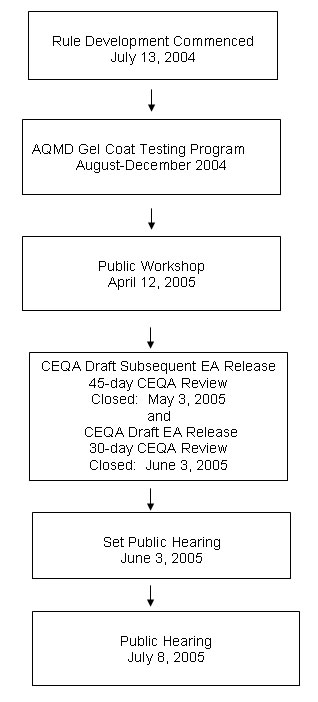
RULE DEVELOPMENT PROCESS
Proposed Amended Rule 1162 – Polyester Resin Operations
ATTACHMENT C
KEY CONTACT LIST
Proposed Amended Rule 1162 – Polyester Resin Operations
Composite Manufacturers
Catalina Yachts
Disneyland
Gold Shield
Gruber System
Lasco Bathware, Inc.
Universal Studio
Polyester Resin and Gel Coat Manufacturers
Ashland, Incorporation
Cook Composites and Polymers (CCP)
Eastman Chemical Company
Interplastic Incorporation
Reichhold
Valspar
Equipment Manufacturers
Glas-Craft, Inc.
GS Manufacturing
Illinois Tools Works Company (ITW) - ITW Poly-Craft
Magnum Industries
Industry Associations
American Composite Manufacturers Association (ACMA)
ATTACHMENT D
RESOLUTION -05
A Resolution of the Governing Board of the South Coast Air Quality Management District Certifying the Final Subsequent Environmental Assessment and Final Environmental Assessment for Proposed Amended Rule 1162 – Polyester Resin Operations as the California Environmental Quality Act Documents for the Currently Proposed Project Subject to California Environmental Quality Act Guideline §15153
A Resolution of the Governing Board of the South Coast Air Quality Management District Amending Rule 1162 – Polyester Resin Operations
WHEREAS, the South Coast Air Quality Management District (AQMD) Governing Board finds and determines that the proposed amendments to Rule 1162 – Polyester Resin Operations, are considered a "project" pursuant to the California Environmental Quality Act (CEQA); and
WHEREAS, the AQMD has had its regulatory program certified pursuant to Public Resources Code §21080.5 and has conducted CEQA review and analysis pursuant to such program (AQMD Rule 110); and
WHEREAS, the proposal to rescind the nonatomizing gel coat application technique requirement is a modification of a previously approved project, AQMD staff has prepared a Final Subsequent Environmental Assessment (SEA); and
WHEREAS, subsequent to the circulation of the draft SEA for public review and comment, industry requested an exemption for gel coat pin striping, and since the gel coat pin striping exemption was outside of the scope of the SEA, a Final Environmental Assessment (EA) was prepared; and
WHEREAS, both the SEA and EA were prepared pursuant to the AQMD’s certified regulatory program (Rule 110), and together the Final SEA and Final EA constitute the Final CEQA documents for the currently proposed project pursuant to CEQA Guidelines §15252; and
WHEREAS, notices of completion were circulated to the public indicating that the Final SEA was available for a 45-day public review and the Final EA was available for a 30-day public review, no comments were received on either document; and
WHEREAS, it is necessary that the adequacy of the Final SEA and Final EA be determined by the Governing Board prior to their adoption; and
WHEREAS, it is necessary that the AQMD prepare a Statement of Findings and Statement of Overriding Considerations pursuant to CEQA Guidelines §§15091 and 15093, respectively, regarding adverse environmental impacts that cannot be mitigated to insignificance; and
WHEREAS, a Mitigation Monitoring Plan pursuant to Public Resources Code §21081.6, has not been prepared since no mitigation measures were identified; and
WHEREAS, the AQMD Governing Board has determined that a need exists to amend Rule 1162 – Polyester Resin Operations to: (1) delete the requirement of nonatomizing spray application technique for gel coat, (2) require the use of a low emissions application technique to apply gel coat; (3) clarify that a hand-held spray gun can also be used for gel coat touch-up and repair, and (4) exempt pin striping from the low emissions application technique requirement provided that the total amount of gel coat sprayed does not exceed one gallon per day per facility, and
WHEREAS, the AQMD Governing Board obtains its authority to adopt, amend, or repeal rules and regulations from California Health and Safety Code §§39002, 40000, 40001, 40440, 40702, and 41508; and
WHEREAS, the AQMD Governing Board has determined that Rule 1162 – Polyester Resin Operations, as proposed to be amended, is written or displayed so that its meaning can be easily understood by the persons directly affected by it; and
WHEREAS, the AQMD Governing Board has determined that Rule 1162 – Polyester Resin Operations, as proposed to be amended, is in harmony with, and not in conflict with or contradictory to, existing statutes, court decisions, or state or federal regulations; and
WHEREAS, the AQMD Governing Board has determined that Rule 1162 – Polyester Resin Operations, as proposed to be amended, does not impose the same requirements as any existing state or federal regulation, and the proposed amended rule is necessary and proper to execute the powers and duties granted to, and imposed upon, the District; and
WHEREAS, the AQMD Governing Board, in amending and adopting this regulation, references the following statutes which the District hereby implements, interprets, or makes specific: California Health and Safety Code §§40001(a), 40440 40702, and Federal Clean Air Act §172(c)(1); and
WHEREAS, the AQMD Governing Board has determined that there is a problem that the proposed amendments to Rule 1162 – Polyester Resin Operations will alleviate; that is, the implementation of the requirement to use nonatomizing spray application techniques for gel coat is infeasible to implement by July 1, 2005, and that there is no indication that any technology is or will be developed that will enable emission reductions anticipated for the rule to be obtained, and
WHEREAS, the AQMD Governing Board has determined that the proposed amendments to Rule 1162 – Polyester Resin Operations will not result in increased costs to industry by virtue of existing material technology and existing emission controls; and
WHEREAS, the AQMD Governing Board finds that it is infeasible to implement the nonatomizing spray application technique requirement for gel coats; and
WHEREAS, the AQMD Governing Board has determined that there is no need for a socioeconomic impact assessment as this amendment has no additional cost for the composite industry; and
WHEREAS, the AQMD Governing Board has determined that Proposed Amended Rule 1162 should be adopted for the reasons contained in the staff report; and
WHEREAS, a public hearing has been properly noticed in accordance with the provisions of Health and Safety Code §40725; and
WHEREAS, the AQMD Governing Board has held a public hearing in accordance with all the provisions of law; and
WHEREAS, the AQMD specifies the Manager of Rule 1162 as the custodian of the documents or other materials which constitute the record of proceedings upon which the adoption of this proposed amendment is based, which are located at the South Coast Air Quality Management District, 21865 Copley Drive, Diamond Bar, California; and
NOW, THEREFORE BE IT RESOLVED that the AQMD Governing Board hereby certifies, pursuant to the authority granted by law, the Final Subsequent Environmental Assessment and Final Environmental Assessment for Proposed Amended Rule 1162 – Polyester Resin Operations, used as the Final CEQA documents for the currently proposed project; and
BE IT FURTHER RESOLVED, that the AQMD Governing Board hereby approves the Statement of Findings and the Statement of Overriding Considerations prepared pursuant to CEQA Guidelines §15091 and 15093, respectively, regarding adverse environmental impacts that cannot be mitigated to insignificance, which are included in Attachment 1, attached and incorporated herein by reference: and
BE IT FURTHER RESOLVED, that the AQMD Governing Board does hereby amend, pursuant to the authority granted by law, Rule 1162 – Polyester Resin Operations, as set forth in the attached and incorporated herein by this reference.
Attachment
DATE:
________________
__________________________
CLERK OF THE BOARDS
/ / /