
BOARD MEETING DATE: June 3, 2005
AGENDA NO. 39
PROPOSAL:
Amend Rule 461 – Gasoline Transfer and Dispensing
SYNOPSIS:
Proposed Amended Rule 461 implements California Health and Safety Code (H&S Code) Section 40724 to require best available retrofit control technology for agricultural sources by phasing out the exemptions for agricultural operations. Additional amendments are proposed to enhance recordkeeping and reporting, to require personnel training and improve clarity and enforceability of the rule. An exemption from the Phase II requirements is proposed for fueling Tournament of Roses Parade floats.
COMMITTEE:
Stationary Source, March 25 and April 22, 2005, Reviewed
RECOMMENDED ACTIONS:
Adopt the attached resolution:
- Certifying the CEQA Notice of Exemption for Proposed Amended Rule 461 – Gasoline Transfer and Dispensing;
- Amending Rule 461 – Gasoline Transfer and Dispensing; and
- Finding that AQMD permits are necessary for all agricultural gasoline transfer and dispensing operations subject to Rule 461 and directing staff to amend Rule 219, as necessary.
Barry R. Wallerstein, D.Env.
Executive Officer
Background
Rule 461 is designed to regulate gasoline vapor emissions into the atmosphere from gasoline transfer and dispensing processes. Gasoline is a petroleum distillate and its vapors contain volatile organic compounds (VOCs) and toxic air contaminants (TACs) such as benzene, toluene and xylenes. VOCs react in the atmosphere photochemically to form ozone, which is a major ingredient of smog. Rule 461 was initially adopted in 1976 and has been amended a number of times.
The gasoline transfer and dispensing VOC fugitive emission inventory is among the largest stationary and area sources inventories in the South Coast Basin. Therefore, control of these emissions is essential in improving the air quality in the Basin and a critical component of its attainment strategy. Rule 461 seeks to reduce emissions from this source category by 95 percent through use of CARB-certified vapor recovery systems. Without such systems, emissions from this source category could be as high as 170 tons per day. Vapor recovery systems at gasoline dispensing facilities (GDFs) are designed to recover vapors, and thus reduce emissions, during both fuel delivery from the tank trucks (Phase I operations) and vehicle refueling (Phase II operations).
Until recently, gasoline storage and dispensing operations and other equipment used at agricultural operations were exempt from written permits. Additionally, many local air districts, including the AQMD, included exemptions for agricultural operations in their gasoline transfer and dispensing rules.
However, with the passage of H&S Code Section 40724 (SB 700), best available control measures (BACM) and best available retrofit control technology (BARCT) became requirements to be implemented at agricultural operations. SB 700 mandates the schedule for implementation. The air districts are to adopt rules by July 1, 2005 requiring BACM and BARCT and implementation of these requirements is to commence by January 1, 2006. Rule 461 is BARCT for gasoline storage and dispensing.
In addition, SB 700 authorized air districts to require written permits for large agricultural operations and also for smaller operations provided certain findings are made at a public hearing. Rule 219 was amended in December 2004 to require written permits for large agricultural operations. However, during the development of PAR 461, it was recognized that without written permit requirements, enforcement of the gasoline storage and dispensing rule requirements to ensure that emission reductions would be achieved was impractical, at best. Therefore, staff is recommending the permitting of vapor recovery systems subject to Rule 461 installed and operated by agricultural operations, regardless of their size.
Proposal
The amendment is designed to satisfy the requirements of SB 700 by requiring BARCT at agricultural operations with GDFs. Rule 461 proposed amendments will eliminate by July 1, 2007, the exemptions from the rule requirements currently enjoyed by agricultural operations by subjecting them to the same requirements that apply to all other non-retail gasoline transfer and dispensing operations. It is staff’s recommendation that the operators that elect to install CARB-certified systems and be subject to the requirements of Rule 461 also be permitted by the AQMD, regardless of the size of the agricultural operation. The permit requirement and associated fees are the same as those imposed on all other retail and non-retail operators subject to the requirements of Rule 461. All operators using gasoline storage and dispensing from 250 gallon tanks or smaller will continue to be exempt from regulation.
In addition, the proposed amendments will also improve the compliance and efficiency of the Rule 461 Program to ensure emission reductions are maintained by: requiring that persons responsible for installing and altering Enhanced Vapor Recovery (EVR) equipment participate and successfully complete manufacturer installation training programs; requiring the owner/operator of the GDF and the installer/contractor of the underground storage tank equipment to share the responsibility of ensuring that backfilling is properly completed; requiring the owner/operator to record all equipment and component installations and also require that all maintenance cycles specified by the manufacturer be referenced in the operation and maintenance (O&M) manual; requiring non-retail GDFs to implement, keep and maintain O&M records; and requiring all performance and reverification tests to be initiated and concluded between the hours of 7:00 a.m. and 8:00 p.m.
The proposed rule also provides relief from the Phase II vapor recovery requirements for the fueling of Tournament of Roses parade floats, since it is not technologically feasible to do so in a safe manner.
CEQA
The AQMD has reviewed the proposed project pursuant to state CEQA Guidelines §15002(k)(1). Because the proposed project will not require major modifications at existing facilities to comply and no daily operational emission increases are anticipated, it can be seen with certainty that there is no possibility that the proposed project in question has the potential to have a significant adverse effect on the environment. Thus, the proposed project is exempt from CEQA pursuant to CEQA Guidelines §15061(b)(3) - Review for Exemption. A Notice of Exemption has been prepared in accordance with state CEQA Guidelines §15062 for the proposed project and will be filed with the county clerks immediately following the adoption of the proposed amendments to the rule.
Socioeconomic Analysis
The proposed amendments to Rule 461 would affect approximately 100 agricultural facilities in the four-county area. These facilities mainly belong to dairy cattle and milk production, beef cattle ranching and farming, poultry production, and nursery and tree production. The proposed amendments would also limit the hours of performance and verification testing to between 7:00 a.m. and 8:00 p.m., Monday through Friday. This amendment would affect approximately 3,200 retail gasoline service stations and 1,500 non-retail gasoline dispensing operations.
The affected agricultural facilities are required to use CARB-certified vapor recovery for storage and dispensing tanks greater than 250 gallons. The total annualized cost of the proposed amendments is estimated at $35,613. The proposed amendments to the testing hours are not expected to impose additional costs to the affected retail and non-retail gasoline dispensing operations. Overall, the proposed amendments to Rule 461 will have few costs and socioeconomic impacts. Further, bringing vapor recovery systems subject to Rule 461, installed and operated by agricultural sources, that are less than half of the major source emission threshold into the permitting system, is no more burdensome than on other regulated industrial sectors.
AQMP and Legal Mandates
H&S Code Section 40724 requires local air pollution control districts and air quality management districts to adopt rules requiring best available control measures (BACM) and best available retrofit control technology (BARCT) for agricultural operations on or before July 1, 2005 and commence implementation of these rules on or before January 1, 2006. The requirements in Rule 461 are BARCT for gasoline dispensing. The proposed changes are necessary for Rule 461 to be included into the SIP.
Public Process
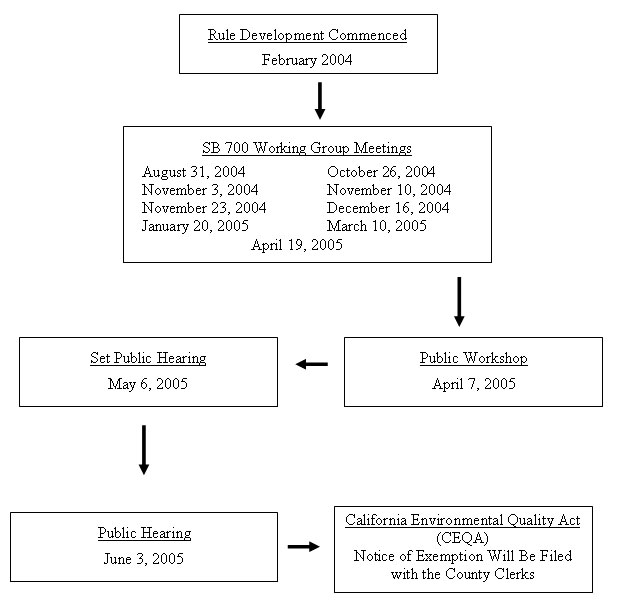
In order to explain the impact of SB 700 to agricultural operations, staff conducted an Agricultural Operations Survey that was mailed out to a total of 1,925 agricultural operations in the Basin. The mailing was not directly undertaken by AQMD staff, but was done by a clearinghouse mailing service, which received mailing lists from the Western United Dairymen, Pacific Egg and Poultry Association, Los Angeles Farm Bureau, the Regional Water Quality Board and other similar agencies and associations. The contact list was used for mailing notifications and to send e-mail messages regarding public meetings. In addition, a working group on implementation of SB 700 that includes AQMD staff, representatives of the agricultural community and their trade associations was formed to address issues including this rule amendment. The working group meets regularly and this proposal was discussed at the last five of those working group meetings. The Public Workshop for Rule 461 was held on April 7, 2005.
Implementation Plan
The proposed rule will become effective July 1, 2006, for all retail and non-retail gasoline transfer and dispensing facilities except those at agricultural operations. The effective date for agricultural operations will be July 1, 2007. Staff has been working with these affected facilities and will continue its outreach and educational efforts.
Resource Impacts
Existing AQMD resources will be sufficient to implement the proposed changes to this rule.
- Summary of Proposed Rule
- Rule Development Process
- Key Contacts
- Key Issues and Responses
- Resolution
- CEQA – Notice of Exemption
- Rule Language
- Staff Report
ATTACHMENT A
SUMMARY
Proposed Amendments to Rule 461 – Gasoline Transfer and Dispensing
|
Staff proposes amending Rule 461 as follows:
|
ATTACHMENT B
RULE DEVELOPMENT PROCESS
Proposed Amended Rule 461 – Gasoline Transfer and Dispensing
ATTACHMENT C
KEY CONTACT LIST
Proposed Amended Rule 461 – Gasoline Transfer and Dispensing
Owners and Operators of Gasoline Dispensing Facilities
|
ARCO Products Company |
Scott Brothers |
|
Chevron Products Company |
Shell Oil |
|
Costco |
Stadium Shell |
|
G & M Oil Company |
Universal Studios |
Consultants
Environ International Corp.
Shirley Environmental
White Environmental Associates
Testers, Equipment and Service Suppliers
|
Gilbarco Veeder-Root |
Protech Petroleum |
|
L.A. Nozzle |
Redwine Testing |
|
OPW Fueling Components |
Vapor Recovery Testers |
|
Packham and Toomey |
Industry Associations
|
California Farm Bureau Federation |
Riverside County Farm Bureau |
|
California Milk Producers Council |
San Bernardino County Farm Bureau |
|
Los Angeles County Farm Bureau |
Western States Petroleum Association |
|
Orange County Farm Bureau |
Western United Dairymen |
|
Pacific Egg and Poultry Association |
Public Agencies
California Air Resources Board
Los Angeles County Sanitation Districts
Los Angeles Department of Water and Power
Metropolitan Water District of Southern California
U.S. Environmental Protection Agency
ATTACHMENT D
KEY ISSUES AND RESPONSES
Proposed Amended Rule 461 – Gasoline Transfer and Dispensing
|
ISSUE |
RESPONSE |
|
Small potential for emission reductions from agricultural sources. Retain exemption for agricultural sources. |
In establishing the best available retrofit control strategies for an agricultural source, SB 700 explicitly directs the development of a rule or regulation by taking into account what is being required of other similar sources (non-agricultural sources) and to the extent that those strategies are feasible, to also require them for agricultural sources as well. Staff has estimated the emission inventory to be 4.24 tons per year. The cost-effectiveness value for this proposed amended rule is $11,970 per ton of VOC emissions reduced. Therefore, while acknowledging the relatively small emission inventory from this source category, staff believes that given both the technological and economic feasibility of the emission reductions, coupled with the availability of reasonable exemption levels applicable to these sources, retaining the agricultural exemption in its current form would be contrary to the spirit and letter of SB 700. |
|
Permit requirements for agricultural sources. |
Currently, permits are required only at agricultural operations with actual emissions equal to or exceeding one half of the Title V emission thresholds. H&S Code Section 42301.16 allows written permits to be required for equipment at agricultural operations with emissions of less than one half the Title V emission thresholds provided the Board finds, at a public hearing, that a permit is necessary to impose or enforce reductions of emissions of air pollutants that cause or contribute to the exceedance of an ambient air quality standard and the requirement to obtain a permit is not significantly more burdensome for the agricultural source operators than the requirement for other operators at similar sources to obtain permits. Staff believes permits are necessary to effectively enforce and ensure compliance with the requirements of PAR 461 at agricultural sources. Staff’s socioeconomic analysis indicates that the permit burden is no different than that of all other stationary source operators that are required to obtain written permits for gasoline storage and dispensing equipment. Further, permitting will allow the AQMD to partially recover the cost of its permitting and enforcement staff overseeing the implementation of Rule 461 for the agricultural operations. |
|
Time frame for initiating and completing the required testing for control equipment. |
The proposed language would require testing to be completed between the hours of 7:00 a.m. and 8:00 p.m. Monday through Friday. The key purpose of proposing the restriction on test time is to maximize the AQMD’s ability to witness those tests and ensure they are being run properly. Staff’s proposal provides both the AQMD staff, as well as the inspected facilities and testers with a reasonable window of time that extends beyond AQMD business hours. There are safety/security concerns when staff is out in the middle of the night and furthermore it is desirable to limit the cost to the agency because having a crew of inspectors ready and available in the early hours of the night or day is costly for the agency. There is allowance for weekend testing provided it is approved by the Executive Officer. |
/ / /