
BOARD MEETING DATE: May 6, 2005 AGENDA NO. 37
(Continued from April 1, 2005 Board Meeting)
Pre-Hearing for Proposed Rule 1401.1 – Requirements for New and Relocated Facilities Near Schools
SYNOPSIS:
A concept paper on Proposed Rule 1401.1 – Requirements for New and Relocated Facilities was presented to the Board in November 2004 and circulated for public review and comment for 60 days. The purpose of the pre-hearing is to highlight key issues with the rule development and to seek guidance from the Board including whether or not to proceed with rulemaking. Proposed Rule 1401.1 would establish more stringent risk requirements for new or relocated facilities siting near existing schools and impacting the schools.
COMMITTEE:
Stationary Source, February 25, 2005, Reviewed
RECOMMENDED ACTION:
Provide guidance to staff on Proposed Rule 1401.1 including whether to proceed with rulemaking.
Barry R. Wallerstein, D.Env.
Executive Officer
Background
In September 2003, AQMD staff presented a White Paper, Potential Control Strategies to Address Cumulative Impacts from Air Pollution (White Paper), to the Board. The White Paper contained recommendations for numerous strategies to reduce cumulative air pollution impacts. Strategy #2 was a proposal to look into amending Rule 1401 – New Source Review of Toxic Air Contaminants to make the risk requirements more stringent for new or relocated facilities near existing schools and possibly other sensitive receptors.
A concept paper, "More Stringent Risk Requirements for New or Relocated Facilities Located Near Schools", was prepared as a first step in addressing Strategy #2. Because existing schools within the District are already subject to the combined effects of mobile and area sources, as well as permitted facilities nearby, the concept paper recommended more stringent risk requirements for new or relocated businesses that sited near an existing school. The concept paper was presented to the Board on November 5, 2004 and released to the public for a 60-day public review and comment period. Staff committed to return to the Board following the comment period for this pre-hearing to highlight key policy issues and seek guidance on staff’s proposal.
Concept Paper
Based on an evaluation of historical permitting data for the past six years, the concept paper concluded that approximately 97 percent of all new facilities during that time were located more than 1,000 feet from the outer boundary of an existing school. The majority of new or relocated facilities that have sited near a school have been service stations. The concept paper included recommendations for basic concepts for Proposed Rule 1401.1 – Requirements for New and Relocated Facilities that included establishing a facility-wide risk threshold of 1 in-one-million for cancer risk and an acute or chronic hazard index of 1.0 for non cancer risk, for any new or relocated facility located within 1,000 feet of an existing school (kindergarten through 12th grade, public or private). In addition, the concept paper recommended that the following sources be exempt from Proposed Rule 1401.1: diesel engines subject to Rule 1470, soil decontamination equipment subject to Rule 1166, and various locations equipment.
Process for Proposed Rule 1401.1
During the adoption of the Cumulative Impacts White Paper in September 2003, AQMD staff committed to implementing a two-step hearing process to first identify key policy issues and seek Board direction prior to the rule adoption hearing for Proposed Rule 1401.1. Consistent with a two-step hearing process, the AQMD staff is presenting key issues for the Board’s consideration for Proposed Rule 1401.1. These key issues are based on comments received on the Concept Paper, Public Workshops, and Working Group meetings for Proposed Rule 1401.1.
Key Issues
The AQMD staff has received a variety of written and oral comments on Proposed Rule 1401.1. As a result two key issues were identified: 1) the need for a rule, and 2) the appropriate distance from the source to the school. These two key issues are discussed below.
Need for a Rule
While the environmental and community organizations are in general support the development of Proposed Rule 1401.1, business stakeholders question the need for such a rule since recent permit data indicates that there have been few new facilities with toxic emissions sited near schools and there are other non-stationary sources that pose a greater risk than new stationary sources and resources could be better used reducing exposure at the school rather than through implementation of Proposed Rule 1401.1.
Although recent permit data indicates that new facilities are electing to site away from schools, the opportunity still exists for a toxic emitting facility to site near a school since there is currently no regulatory mechanism to prevent such an action. Proposed Rule 1401.1 could provide the added assurance and health protection for school children that toxic emitting facilities are located away from school grounds. In addition, the impacts on new businesses to be subject to stricter requirements when siting near schools is expected to be minimal since recent permit data indicates that businesses are electing to site away from schools indicating that there are many siting options away from schools.
The business community has commented that other non-stationary sources such as neighboring freeways, school buses, and idling cars pose a greater risk than new stationary sources, and thus the focus should be on these sources. Although non-stationary sources may pose a greater health risk than new stationary sources for some schools, this does not diminish the need to provide additional health protective measures to protect school children from the exposure of toxics from new stationary sources, particularly as many schools are already impacted by a variety of air pollution sources. The AQMD as well as other state agencies are working to address the air quality issues that many schools are currently facing through programs such as the AQMD’s School Bus Replacement Program, implementation of SB 352 which prohibits a local educational agency from approving acquisition of a school site within 500 feet of a busy roadway unless the air quality at the site does not pose a health risk to pupils or staff, and California Environmental Protection Agency’s information sheets for schools and parents regarding air pollution from nearby traffic and children’s health.
Staff believes that a proactive approach to prevent the problem is a better use of resources and is less resource intensive than a reactive approach where resources are used to solve a problem that could have otherwise been prevented. Past experience in addressing community concerns on toxic sources in proximity to schools is more resource intensive than the development and implementation of Proposed Rule 1401.1.
Distance to School
Several comments were received regarding the appropriate distance from the toxic emitting source to the school and the variety of distances in existing regulations. Commentors expressed a desire to have some consistency among various regulatory programs and that the distance selected should be based on science. A concern was also raised on restrictions of site selections.
A review of current source-specific AQMD and CARB toxics regulations found stricter requirements for facilities within 300 to 500 feet of an existing school. A recent study1 by the California Office of Environmental Health Hazard Assessment (OEHHA) and the California Department of Health Services noted that the concentration of freeway emissions could impact downwind receptors up to 1,500 feet (460 meters) before diminishing to background levels (Figure 1). In addition to reviewing existing regulations, staff looked at profiles of risk levels from spray booths and service stations which show that emissions and risk drop-off significantly at about 500 feet. A profile of the risk from a service station with worst-case meteorological conditions indicates that a cancer risk of 10 in-one-million at 65 feet drops to 1 in-one-million at about 330 feet. As staff proceeds with rulemaking, AQMD staff will continue to work with stakeholders to determine the appropriate distance for Proposed Rule 1401.1.
1 Proximity of California Public Schools to
Busy roads, Environmental Health Perspectives,
January 2004.
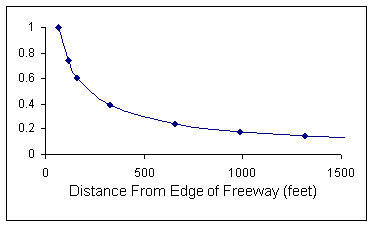
Figure 1: Relative Cancer Risk from Freeway
as a Function of Downwind Distance
Staff Recommendation and Conclusion
Staff recommends further investigation into ways to mitigate the effects of freeway emissions for children attending schools close to a freeway. Attachment A includes a possible draft rule for Proposed Rule 1401.1 – Requirements for New and Relocated Facilities Near Schools to facilitate discussion at the April Board meeting. Possible Rule 1401.1 incorporates key concepts presented in the initial concept paper. Staff requests the Board’s guidance on whether to proceed with final rulemaking to make more stringent toxic risk requirements for new and relocated facilities near existing schools. Staff recommends to proceed with rulemaking and stakeholder discussions to further refine the proposal including distance and risk limits.
- Possible Rule 1401.1 – Requirements for New and Relocated Facilities Near Schools
/ / /