
BOARD MEETING DATE: November 4, 2005
AGENDA NO. 36
Adopt Rule 1156 – Further Reductions of Particulate Emissions from Cement Manufacturing Facilities.
SYNPOSIS:
Proposed Rule 1156 has been developed to reduce particulate emissions from cement manufacturing as part of the 2003 AQMP Control Measure BCM-08 - Further Emission Reductions from Aggregate and Cement Manufacturing Operations. The proposed rule would reduce particulate emissions from process equipment, such as primary crushers, kilns, clinker coolers, raw mills, finish mills, as well as fugitive emissions from open storage piles, and unpaved and paved roads at the facilities.
COMMITTEE:
Stationary Source, May 27, July 22, and September 23, 2005, Reviewed
RECOMMENDED ACTIONS:
Adopt the attached resolution:
- Certifying the Final Environmental Assessment (EA) for Proposed Rule 1156 - Further Reductions of Particulate Emissions from Cement Manufacturing Facilities; and
- Adopting Rule 1156 - Further Reductions of Particulate Emissions from Cement Manufacturing Facilities.
Barry R. Wallerstein, D.Env.
Executive Officer
Background
Proposed Rule (PR) 1156 – Further Reductions of Particulate Emissions from Cement Manufacturing Facilities has been developed to implement a portion of the 2003 Air Quality Management Plan (AQMP) Control Measure BCM-08 – Further Emission Reductions from Aggregate and Cement Manufacturing Operations.1
Control Measure BCM-08 estimated a total inventory of 1.4 tons per day PM10 from all cement manufacturing, aggregate and aggregate processing facilities, and a reduction of 0.7 tons per day PM10 by 2010, in which the two cement manufacturing facilities located in the District would contribute approximately 25% of the emission inventory (or 0.35 tons per day PM10) and emission reductions (0.2 tons per day PM10).
The two cement manufacturing facilities addressed under Control Measure BCM-08 and PR 1156 are California Portland Cement Company (CPCC) located in Colton, and Texas Industry (TXI), called Riverside Cement Company, located in Riverside. These two cement manufacturing facilities are significant sources of particulate emissions. California Portland Cement Company is ranked #11, and Riverside Cement Company is ranked #28 on the list of the top 50 particulate emitters in the Basin for 2000-2001.2
Control Measure BCM-08 and PR 1156 are developed to address particulate emissions generated from all process equipment at these two facilities such as crushers, screens, raw mills, finish product mills, kilns, clinker coolers, storage bins, hoppers etc. as well as fugitive emissions generated from open storage piles and vehicular traffic on paved and unpaved roadways.
Air Quality Air Management Plan and Legal Mandates
In 2002, the District requested the U.S. EPA to extend the Basin's attainment date for PM10 to 2006. The District's request for extension and its revised PM10 implementation strategy was approved by U.S. EPA in April 2003. Proposed Rule 1156 is developed to implement the 2003 Control Measure BCM-08, and when fully implemented, will generate emission reductions to help the region in fulfilling its obligations toward the PM10 State Implementation Plan (SIP), and in attaining the state and federal PM10 ambient air quality standards in 2006.
Affected Facilities
Two facilities in the Basin will be affected by the Proposed Rule 1156, California Portland Cement Co. (CPCC) and TXI-Riverside Cement (TXI). They are all identified by Standard Industrial Classification (SIC) 3241. CPCC manufactures grey cement and TXI manufactures both grey and white cement.
Public Process
Staff started the development of PR 1156 in February 2004. A Survey Questionnaire was developed in March 2004 to gather the most up-to-date information from the industry. Staff analyzed information received for emissions inventory and determination of emission reductions, conducted a technical assessment for feasibility and cost effectiveness, and held a Public Workshop in January 2005. In developing PR 1156, staff has conducted numerous working group meetings and worked closely with representatives of the impacted industry to resolve issues raised during the rule development process. As a result, PR 1156 was finalized and a Public Hearing was scheduled.
Summary of Proposal
PR 1156 establishes opacity performance standards for all operations, and future PM emission limits for process equipment vented to baghouses. Additional features of the proposed rule are to specify compliance options for open storage piles, primary crushing operations, conveying systems, and a method of verifying and assuring compliance with the rule requirements.
- Visible Emissions. PR 1156 specifies an opacity standard of 10% for all operations, except open storage piles and unpaved roads; and 20% for open storage piles and unpaved roads.
- Loading, Unloading and Transferring. PR 1156 specifies covers for conveying systems and enclosures for conveying system transfer points, and loading/unloading through an enclosed system. The covered/enclosed systems shall be vented to baghouses.
- Crushing, Screening, Milling, Grinding, Blending, Drying, Heating, Mixing, Sacking, Palletizing, Packaging, and Other Related Operations. PR 1156 requires the primary crusher to be enclosed with wind screens and controlled by wet suppression; and requires other operations be enclosed and vented to baghouses.
- Kilns and Clinker Coolers. PR 1156 specifies that kilns and clinker coolers shall be enclosed and vented to baghouses.
- Material Storage. PR 1156 requires that clinker storage piles with a cumulative storage area of more than 4 acres, or a cumulative 12-month rolling average loading/unloading rate of more than 80,000 tons per month shall be enclosed. For other open storage piles, PR 1156 provides four compliance options: 1) use chemical dust suppressants, 2) use three-sided barrier with roof; 3) use three-sided barrier without roof, or 3) use tarps.
- Baghouse Performance Standards: PR 1156 specifies an outlet
concentration standard and a performance standard for ventilation and hood
systems.
- 0.01 grain/dscf measured at the outlet for existing baghouses;
- 0.005 grain/dscf for new baghouses;
- Ventilation and hood system must meet a minimum capture velocity requirement specified in the U.S. Industrial Ventilation Handbook, American Conference of Governmental Industrial Hygienists.
- Internal Roadways and Areas. PR 1156 requires the operator to pave 0.25 miles of internal roads leading to public roads; use chemical dust suppressant, install and operate rumble grates, truck washers, or wheel washers if necessary to reduce track-out; sweep with Rule 1186 compliant street sweeping equipment; and enforce a vehicle speed limit within the facility to reduce fugitive road dust.
- Monitoring and Source Testing
- PR 1156 requires the operator to source test the kilns and clinker coolers annually, and source test the top process particulate emitters (e.g. raw mills and finish mills) every 5 years. The frequency of source testing is reduced for equipment equipped with the U.S. EPA verified filtration products;
- PR 1156 requires the operator to monitor, record and report (MRR) several pertinent operating parameters of the air pollution control device to ensure continuous compliance with the emission standards; install and operate Continuous Opacity Monitor Systems (COMS) or Bag Leak Detection Systems (BLDS) on top process particulate emitters; and develop and implement Operational & Maintenance (O&M) Procedures for all operations at the facility.
Emission Inventory, Reductions and Cost Effectiveness
Based on current data submitted by the two facilities, staff estimates an inventory of about 4 tons per day PM and anticipates a reduction of about 2 tons per day PM when PR 1156 is fully implemented. Assuming that the average fraction of PM10 in PM at the cement manufacturing facilities is 0.5, the PM10 emission inventory at these two facilities is estimated to be 2 tons per day, and the PM10 emission reduction is estimated to be 1 ton per day. It appears that the emission inventory (0.35 tons per day PM10) and reductions (0.2 tons per day PM10) documented in Control Measure BCM-08 based on the Annual Emission Reports submitted by CPCC and TXI are underestimated. The emission inventory analysis for the adopted Rule 1157 revealed a similar level of underestimation.3 The average cost effectiveness of PR 1156 is estimated at $1,000 per ton PM reduced (or $2,000 per ton PM10 reduced assuming the average fraction of PM10 in PM is 0.5.)
Table 1
Emission Inventory and Emission Reductions
|
Equipment/Process |
PM Emission Inventory (tpd) |
PM Emission Reduction (tpd) |
|
Kilns and Clinker Coolers |
0.4 |
0.2 |
|
Other Processes |
0.7 |
0.5 |
|
Open Storage Piles |
0.07 |
0.04 |
|
Vehicle Traffic |
3.0 |
1.5 |
|
Total |
4 |
2 |
Note: Detailed explanations are presented in the Staff Report.
Key Issues
Staff worked closely with representatives of the impacted industry and resolved all key issues raised by the industry. The following is a list of the significant issues raised during the public comment period.
• Compliance Options
Both facilities requested that the proposed optional alternative standard of 99.5% efficiency for baghouses and the proposed optional emission factors be removed from the rule. Both facilities indicated that they would not elect to comply with the alternative standards. Staff agreed to remove these compliance options.
• Performance Standard
Staff initially proposed performance standards in terms of PM10. Both facilities indicated that the fraction of PM10 to PM emissions can vary for certain processes; and information on this fraction is not currently available for all of the processes at a cement manufacturing facility; and therefore an average fraction of PM10 to PM of 0.5 is only accurate to be used for developing an emission inventory but not for setting the PM10 performance standards for all processes at a cement manufacturing facility. Staff agreed that the performance standards should be expressed in terms of total particulate matter (PM) and not PM10.
• Enclosure of Storage Piles
The initial staff proposal set forth criteria for full enclosure of all open storage piles containing materials with a silt content of more than 5% and where loading and unloading activity amounts to more than 50,000 tons per year. Based on further evaluation of the costs of full enclosure, staff changed the proposal to require enclosure on material storage piles that pose a significant potential source of fugitive emissions. Therefore, full enclosure will only apply to clinker storage piles and only in the event that their cumulative storage area exceeded 4 acres, or the facility’s cumulative 12-month rolling average loading/unloading rate (or processing rate) exceeded 80,000 tons per month.
• Primary Crusher
Only one of the facilities has a primary crusher. This facility presented technical evidence that the staff proposal for enclosure of the existing primary crusher and venting to a baghouse control system would require an expensive redesign of the crushing system without significant additional emission reductions. Staff agreed and language was added to allow the operator to use wind fences on at least two sides of the primary crusher with one side facing the prevailing winds and wet suppression as a control for the primary crusher in lieu of the total enclosure and baghouse control system. Staff estimated that the wind fences and wet suppression would provide a reasonable level of control at reduced costs.
• Overlap with Existing Rules
One facility argued that some of the proposed requirements in PR 1156 overlapped with, and in some cases exceeded, existing requirements of newly-adopted Rule 1157 that affects aggregate processing operations found at the cement manufacturing facility. Language has been added to the proposal to provide an exemption for equipment subject to Rule 1157 and Rule 1158 with the exception of the primary crusher, conveyors and certain raw material storage piles exclusive to cement manufacturing operations, where further controls were feasible.
California Environmental Quality Act (CEQA)
Pursuant to the California Environmental Quality Act (CEQA) Guidelines § 15252 and AQMD Rule 110, the AQMD has prepared an Environmental Assessment (EA) for PR 1156. The Draft EA was released on August 11, 2005 for a 45-day public review and comment period and staff has received no comment letters. The Final EA has been prepared and is included as an attachment to this Governing Board package.
Socioeconomic Analysis
The two affected facilities under the proposed rule belong to the industry of cement manufacturing (NAICS 327310). The average annual cost of implementing the proposed requirements for both facilities is projected to be $1.1 million, which includes permit fees related to new and modified control devices. Based on this cost and the resulting additional sales to vendors of control devices, a macroeconomic analysis was performed to assess the overall job impacts on the entire local economy. It is projected that an average of 34 jobs would be forgone annually from 2006 to 2020 in the four-county area. The cost impact of the CEQA alternative scenarios, ranging from $0.97 million to 1.54 million, for a less stringent to a more stringent control scenario compared to PR 1156, were also discussed as part of the socioeconomic report. The cost effectiveness of these scenarios ranged from $830 per ton PM to $1,320 per ton of PM reduced (or from $1,660 per ton PM10 to $2,640 per ton PM10.) The Socioeconomic Report for PR 1156 has been included as an attachment to this Governing Board Package.
Implementation and Resources
It is expected that there will be a temporary minor workload increase due to applications submitted for installing new control equipment or retrofitting existing control equipment. No additional AQMD resources are required to implement the proposed rule.
-
Control Measure BCM-08 is to be implemented by PR1156 and Rule 1157. Rule 1157 - PM Emission Reductions from Aggregate and Related Operations, was adopted in January 2005 to address air quality issues related to aggregate and related operations at aggregate facilities.
-
List of Top 50 Particulate Emitters in the Basin Based On Annual Emission Reports for Year 2000-2001.
-
The Staff Report of Rule 1157 reported an estimate an inventory of 29 tons per day PM10 for 389 facilities.
Attachments (EXE 72MB)
A. Summary of Proposal
B. Rule Development Process
C. Key Contacts List
D. Resolution
E. Rule Language
F. Staff Report
G. Environmental Assessment
H. Socioeconomic Report
ATTACHMENT A - SUMMARY OF PROPOSAL
PR 1156 – Further Reductions of
Particulate Emissions
from Cement Manufacturing Facilities
- Opacity standard of 10% for all operations, except open piles and unpaved roads; and 20% for open piles and unpaved roads
- Standard for baghouses:
- 0.01 gr/dscf outlet concentration for existing equipment
- 0.005 grain/dscf or lower for new equipment installed after rule adoption date
- Ventilation and hood system must meet minimum capture velocity requirement in the U.S. Insdustrial Ventilation Handbook
- Use cover or enclosure for conveying system and transfer points
- Enclose clinker storage piles of more than 4 acres or with loading/unloading rate (or processing rate) of more than 80,000 tons per month cumulative 12-month rolling average. For other open storage piles, use chemical dust suppressants to stabilize the open piles; use wind fences, berms, three-sided bunkers, or tarps
- Pave 0.25 mile internal roads leading to public roads; use chemical dust suppressant, install and operate rumble grates, truck washers, or wheel washers if necessary to reduce track-out; sweep with Rule 1186 compliant street sweepers; and enforce a vehicle speed limit within the facilities to reduce fugitive road dust
Compliance Date
- No later than December 31, 2006 for pulse jet baghouses and December 31, 2010 for other types of baghouses.
- For other requirements: No later than 6 months after rule adoption date.
Compliance Source Testing
- Annual source testing for kilns and clinker coolers, and every 5 years for other top process particulate emitters (e.g. raw mills and finish mills) with AQMD or EPA Source Test Methods. The frequency of source testing can be reduced for best performers or for equipment equipped with U.S. EPA verified filtration products
Monitoring, Reporting and Record-Keeping
- Install and operate Continuous Opacity Monitor System or Bag Leak Detection System for top process particulate emitters
- Monitor visible emissions with EPA Method 22 and EPA Method 9.
- Develop and operate Operation & Maintenance Procedures
Exemption
- Equipment subject to R1157 or R1158, except primary crushing, open storage piles and conveying systems.
ATTACHMENT B - RULE DEVELOPMENT PROCESS
Total Time Spent in Rule Development: 22 Months
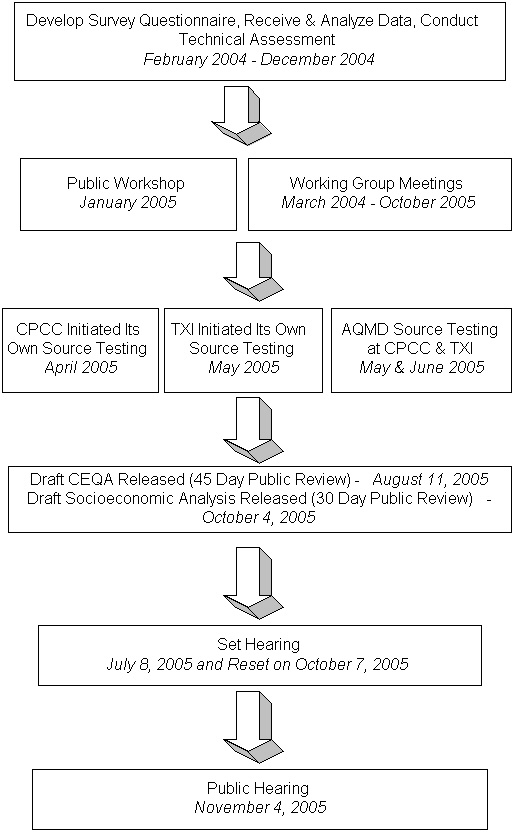
ATTACHMENT C - KEY CONTACTS LIST
Affected Facilities
California Portland Cement Company
Texas Industries – Riverside Cement Company
Manufacturers of Control Devices
Applied Conveyor Technology, Inc.
Air Purator Corp.
BHA Group Inc.
BWF America Inc.
Dust Control Technologies, Inc.
Donalson Company, Inc.
Domtec International, LLC
Flex-Kleen Div. Met-Pro Corp.
Fiberdome Inc.
Filtersense Automation
Geometrica
Land Instruments International
Menardi-Criswell
Mertec Engineering
Teledyne Instrument
Temcor
W.L. GORE & Associates, Inc.
Others
Arizona Department of Environment Quality
California Air Resources Board
ETS Inc.
Kern County APCD
Mojave Desert AQMD
U.S. Environmental Protection Agency
ATTACHMENT D - RESOLUTION
A Resolution of the South Coast Air Quality Management District (AQMD) Governing Board Certifying the Final Environmental Assessment for Proposed Rule (PR) 1156 – Further Reductions of Particulate Emissions from Cement Manufacturing Facilities.
A Resolution of the Governing Board Adopting Rule 1156 – Further Reductions of Particulate Emissions from Cement Manufacturing Facilities.
WHEREAS, the Governing Board finds and determines with certainty that the PR 1156 – Further Reductions of Particulate Emissions from Cement Manufacturing Facilities, is considered a “project” pursuant to the California Environmental Quality Act (CEQA); and
WHEREAS, the AQMD has had its regulatory program certified pursuant to Public Resources Code § 21080.5 and has conducted CEQA review and analysis pursuant to such program (AQMD Rule 110); and
WHEREAS, AQMD staff has prepared a Draft Environmental Assessment (EA) pursuant to its certified regulatory program and CEQA Guidelines §15252 setting forth the potential environmental consequences of PR 1156 – Further Reductions of Particulate Emissions from Cement Manufacturing Facilities; and
WHEREAS, the Draft EA was released for public review, during which AQMD staff received no comments, and the Draft EA has been revised such that it is now a Final EA; and
WHEREAS, it is necessary that the adequacy of the Final EA be determined by the Governing Board prior to its certification; and
WHEREAS, the Governing Board prior to voting on PR 1156, has reviewed and considered the Final EA; and
WHEREAS, it is necessary that the AQMD prepare a Statement of Findings and a Statement of Overriding Considerations pursuant to state CEQA Guidelines §§15091 and 15093, respectively, regarding adverse environmental impacts that cannot be mitigated to insignificance; and a Mitigation Monitoring Plan pursuant to Public Resources Code §21081.6, regarding the mitigation included in the Final EA; and
WHEREAS, the Governing Board finds and determines, taking into consideration the factors in §(d)(4)(D) of the Governing Board Procedures, that the modifications adopted which have been made to PR 1156, since notice of public hearing was published do not significantly change the meaning of the proposed rule within the meaning of Health and Safety Code §40726 and would not constitute significant new information requiring recirculation of the Draft CEQA document pursuant to CEQA Guidelines § 15088.5; and
WHEREAS, the Governing Board has determined that the socioeconomic impact assessment of the PR 1156 – Further Reductions of Particulate Emissions from Cement Manufacturing Facilities, is consistent with the Governing Board March 17, 1989 and October 14, 1994 resolutions and the provisions of Health and Safety Code §§ 40440.8, 40728.5 and 40920.6; and
WHEREAS, the Governing Board has reviewed and considered the staff's findings related to cost and employment impacts of the PR 1156 – Further Reductions of Particulate Emissions from Cement Manufacturing Facilities set forth in the socioeconomic impact assessment made public with the agenda package for this meeting, and hereby find and determines that cost and employment impacts are as set forth in that assessment; and
WHEREAS, the Governing Board has determined that PR 1156 Further Reductions of Particulate Emissions from Cement Manufacturing Facilities are cost-effective per ton of PM10 reduced; and
WHEREAS, the Governing Board has actively considered the socioeconomic impact assessment and has made a good faith effort to minimize such impacts; and
WHEREAS, the Governing Board has determined that a need exists to adopt the PR 1156 - Further Reductions of Particulate Emissions from Cement Manufacturing Facilities to implement Control Measure BCM-08 of the 2003 AQMP and to reduce PM10 from Aggregate and Cement Manufacturing Operations; and
WHEREAS, the Governing Board of the South Coast Air Quality Management District obtains its authority to adopt this proposed rule from Sections 39002, 40000, 40001, 40440, 40702, and 41508 of the California Health and Safety Code; and
WHEREAS, the Governing Board has determined that Proposed Rule 1156 – Further Reductions of Particulate Emissions from Cement Manufacturing Facilities, as proposed is written or displayed so that its meaning can be easily understood by the persons directly affected by it; and
WHEREAS, the Governing Board has determined that Proposed Rule 1156 – Further Reductions of Particulate Emissions from Cement Manufacturing Facilities, as proposed is in harmony with, and not in conflict with or contradictory to, existing federal or state statutes, court decisions, or regulations; and
WHEREAS, the Governing Board has determined that Proposed Rule 1156 – Further Reductions of Particulate Emissions from Cement Manufacturing Facilities, as proposed does not impose the same requirements as any existing state or federal regulation and the proposed rule is necessary and proper to execute the powers and duties granted to, and imposed upon, the District; and
WHEREAS, the Governing Board has determined that Proposed Rule 1156 – Further Reductions of Particulate Emissions from Cement Manufacturing Facilities, as proposed references the following statutes which the AQMD hereby implements, interprets or makes specific: Health and Safety Code 40001(a) and (b) (air quality standards and air pollution episodes); 40702 (adoption of rules and regulations), 40440(a) (rules to carry out plan); 40440(b) (best available retrofit control technology); and Federal Clean Air Act Section 172(c)(1) (reasonably available control technology); and
WHEREAS, the Governing Board has determined that Proposed Rule 1156 – Further Reductions of Particulate Emissions from Cement Manufacturing Facilities, is primarily performance oriented and allows available alternative technology that can meet the applicable performance standards, and staff has addressed and evaluated the impacts and costs associated with the alternative control measures that are either more stringent or less stringent to the requirements in the CEQA and Socioeconomic analyses of Proposed Rule 1156 following the requirement in H&SC Section 40440.5(c)(3), and the Governing Board has determined that PR 1156 has been selected instead of the alternatives discussed in the CEQA document because it represents the best balance of emission reductions and costs; and
WHEREAS, the Governing Board has determined that there is a problem that Proposed Rule 1156 – Further Reductions of Particulate Emissions from Cement Manufacturing Facilities will help alleviate, that is the basin does not meet the ambient quality standards for PM10 and PM2.5, and the proposed rule will promote the attainment of these standards; and
WHEREAS, a public hearing has been properly noticed in accordance with the provisions of Health and Safety Code Section 40725; and
WHEREAS, the Governing Board has held a public hearing in accordance with all provisions of law; and
WHEREAS, the Governing Board specifies the director of Area Sources as the custodian of the documents or other materials which constitute the record of proceeding upon which the adoption of this proposed rule is based, which are located at the South Coast Air Quality Management District, 21865 Copley Drive, Diamond Bar, California.
NOW, THEREFORE, BE IT RESOLVED, that the Governing Board does hereby certify that the Final EA for Proposed Rule 1156 – Further Reductions of Particulate Emissions from Cement Manufacturing Facilities, was completed in compliance with CEQA and Rule 110 provisions; and finds that the Final EA was presented to the Governing Board, whose members reviewed, considered and approved the information therein prior to acting on Proposed Rule 1156 – Further Reductions of Particulate Emissions from Cement Manufacturing Facilities; and
BE IT FURTHER RESOLVED that the Governing Board hereby adopts the Statement of Findings and Statement of Overriding Considerations pursuant to state CEQA Guidelines §§15091 and 15093, respectively, and a Mitigation Monitoring Plan pursuant to Public Resources Code §21081.6 regarding adverse environmental impacts that cannot be mitigated to insignificance, as required by CEQA, and which are included in Attachment 1, attached and incorporated herein by reference; and
BE IT FURTHER RESOLVED, that the Governing Board directs staff to follow up and act consistently with staff’s effort stated in the Resolution of Rule 1157 (i.e. to further evaluate the test method used to determine compliance with the 50% opacity standard, and report back to the Stationary Source Committee of the Governing Board as to staff’s conclusions), and not to submit paragraph (d)(1)(B) related to the 50% opacity standard to the federal EPA as part of the State Implementation Plan since this 50% opacity standard is locally enforced; and
BE IT FURTHER RESOLVED, that the Governing Board does hereby adopt, pursuant to the authority granted by law, Proposed Rule 1156 – Further Reductions of Particulate Emissions from Cement Manufacturing Facilities, as set forth in the attached and incorporated herein by reference.
Date:____________________________
____________________________________________
Clerk of the District Board
/ / /