
BOARD MEETING DATE: October 7, 2005
AGENDA NO. 26
Adopt Proposed Rule 1401.1 – Requirements for New and Relocated Facilities Near Schools
SYNOPSIS:
Proposed Rule 1401.1 implements Strategy No. 2 from the White Paper titled Potential Control Strategies to Address Cumulative Impacts from Air Pollution. The proposed rule consists of more stringent risk requirements for new or relocated facilities siting near schools.
COMMITTEE:
Stationary Source, February 25, 2005, April 22, 2005, July 22, 2005, and September 23, 2005 Reviewed
RECOMMENDED ACTIONS:
Adopt the attached resolution:
- Certifying the Notice of Exemption for Proposed Rule 1401.1 – Requirements for New and Relocated Facilities Near Schools; and
- Adopting Rule 1401.1 – Requirements for New and Relocated Facilities Near Schools.
Barry R. Wallerstein, D.Env.
Executive Officer
Background
Proposed Rule 1401.1 – Requirements for New and Relocated Facilities Near Schools, is based on Strategy 2 of the 2003 White Paper "Potential Control Strategies to Address Cumulative Impacts from Air Pollution." The concept of the strategy was to establish more stringent toxics requirements for new or relocated toxic-emitting facilities that site near schools. The objective of Proposed Rule 1401.1 is to achieve a risk level at schools of no greater than one in one million cancer risk from new facilities. Rule 1401.1 is needed to reduce exposure to toxic emissions for children at schools. Over the past few years, the AQMD staff has worked with a number of schools that were concerned about neighboring toxic-emitting facilities. Proposed Rule 1401.1 is preventative in nature and will provide a greater assurance that a toxic-emitting facility locating near a school meets stricter toxic risk requirements. The proposed rule is designed to be more health protective for school children by establishing more stringent risk requirements, thereby reducing the exposure of toxic emissions on school children.
Regulatory Background
Current regulations for toxic sources include Rules 1401, 1402, and 212, as well as source-specific toxic rules. Rule 1401 – New Source Review for Toxic Air Contaminants is equipment-based and applies to any increase in toxic emissions from new, relocated, or modified equipment. Rule 1401 requires cancer risk for the subject equipment not to exceed one in one million, or if Best Available Control Technology for toxics (T-BACT) is used, it may not exceed ten in one million. Rule 1402 – Control of Toxic Air Contaminants from Existing Sources, is facility-based and applies to facilities with facility-wide cancer risk exceeding 25 in one million. Rule 1402 may require submittal of an inventory, public noticing, health risk assessment, and/or risk reduction, depending upon a facility’s risk level. Rule 212 – Standards for Approving Permits and issuing public notice requires public noticing for permitting of new, relocated, and modified equipment that results in an increase in any air pollutant, toxic or non-toxic. Public noticing is required for a permit unit with emissions or risk increase that is within 1,000 feet of the outer boundary of the school
Proposed Rule 1401.1
Proposed Rule 1401.1 specifies facility-wide limits for cancer risk and non-cancer acute and chronic hazard indices at schools for new and relocated facilities within 500 feet (1,000 feet in some cases) of a school or school under construction. Proposed Rule 1401.1 will apply to new or relocated toxic-emitting facilities siting near schools and schools under construction. Schools under construction include a property: 1) where construction for a school has begun, or 2) for which a Notice of Preparation (NOP ) of a specific project Environmental Impact Report (EIR) has been issued for a school, or 3) that has been identified as a school site in an approved local government specific plan. For all three conditions, the Executive Officer must have been notified of the triggering condition. Since the Set Hearing package was released, Proposed Rule 1401.1 has been revised to provide that facilities must comply with the rule’s requirements for any school for which an NOP has been issued or the site has been identified in a specific plan for a school. Risk is calculated at the school. Under Proposed Rule 1401.1, once a facility is subject to the risk requirements of the rule, it is always subject to those requirements for future modifications, regardless of any future change of ownership.
Requirements for New Facilities
Under the proposed rule, the facility-wide cancer risk for new facilities may not exceed one in one million and facility-wide chronic and acute hazard indices for any target organ may not exceed 1.0 at any school or school under construction within 500 feet of the facility. If there are no schools within 500 feet, the same risk levels must be met at any school within 500 to 1,000 feet unless there is a residential or sensitive receptor within 150 feet of the facility. Table 1 summarizes the risk requirements for new facilities. Risk is calculated at any school or school under construction at the time a NOP for an EIR for the facility is published or, if there is no NOP, at the time a facility’s first Permit to Construct/Operate application is deemed complete.
The NOP date was added since the Set Hearing package was published due to concerns raised by industry about long-term projects and the possibility a school might begin construction sometime during the planning process. This change along with the addition of school sites where an NOP is published or school sites identified on a local government’s specific plan protects both the facility with long-term planning and new schools.
Table 1
Risk Requirements for New Facilities
|
Distance from |
Residential |
*Risk |
*Risk |
|
< 500 feet |
N/A |
Yes |
N/A |
|
500 – 1,000 ft |
Yes |
N/A |
N/A |
|
500 – 1,000 ft |
No |
N/A |
Yes |
*Risk Demonstration at school for New Facility:
< 1 in one million cancer risk and hazard indices < 1.0
Requirements for Relocated Facilities
Two compliance options are allowed for relocated facilities. The risk requirements apply to any relocated facility within 500 feet of a school or school under construction. Under Proposed Rule 1401.1, for each school or school under construction (including schools for which a NOP for an EIR has been issued or the school has been identified on a local government’s specific plan) within 500 feet, a relocated facility must demonstrate that the facility-wide risk at each school either: 1) does not exceed the risk for that same school when the facility was at its previous location, or 2) does not exceed one in one million cancer risk and 1.0 for acute and chronic hazard indices for any target organ. As with new facilities, risk is calculated for schools that exist or meet the definition of school under construction at the time a NOP for an EIR for the facility is published or, if there is no NOP, at the time a facility’s first application is deemed complete.
Other Requirements
The proposed rule requires additional information for those public notices that are currently required under Rule 212 for new or relocated facilities within 1,000 feet of a school if the cancer risk at the school exceeds one in one million.
The proposed rule also requires that once a facility is determined to be subject to Rule 1401.1, it is always required to comply with the rule requirements for all subsequent applications, regardless of change of ownership. A new or relocated facility is only required to calculate risk or add information to Rule 212 notices for schools or schools under construction at the time their first application was deemed complete or, if a NOP for an EIR for the facility was published, at the time the NOP was published. Risk calculation for all subsequent applications only applies to those schools originally identified.
The proposed rule contains six equipment exemptions. The equipment exemptions are proposed because the equipment is subject to school-related requirements of other rules, is used to clean up contaminated soil or water, is temporary in nature, and/or does not require an AQMD permit because its emission are de minimis. An additional exemption specifies that if the Executive Officer has been notified and can confirm that a school will not be constructed at a specific location, the property is no longer considered a school under construction.
Public Process
During the development of the 2003 Cumulative Impacts White Paper, a Cumulative Impacts Working Group met several times to provide input on the strategies. A working group for Proposed Rule 1401.1 was formed and met five times throughout the rulemaking process. At the time the White Paper was approved, the Governing Board approved a two-step hearing process to first identify key policy issues and seek direction prior to the rule adoption hearing. As part of the first step, a Concept Paper, "More Stringent Risk Requirements for New or Relocated Facilities Near Schools" was presented to the Governing Board in November 2004 and released for a 60-day public comment period. The concept paper presented results of data analysis of the past six years permitting data and suggested initial concepts for a proposed rule. Staff returned to the Board in May 2005 for a pre-hearing and was directed to begin rule development. The proposed rule has also been discussed with several AQMD advisory groups since the pre-hearing.
A Public Workshop was held on July 6, 2005. Comments received throughout the rulemaking process are summarized in Appendix A of the Staff Report, along with staff’s responses.
Key Issues
One issue that has been raised throughout the development of Proposed Rule 1401.1 is the precedent of the proposed rule on future toxics rulemaking. AQMD staff has indicated that Proposed Rule 1401.1 will not set precedence for other rulemaking and has included a clause in the Resolution (Attachment E) to this effect.
Following is a list of the remaining key issues associated with Proposed Rule 1401.1
- Buffer Zone vs. Risk Assessment
- Distance
- Long-term projects
Buffer Zone vs. Risk Assessment
Environmental and community groups expressed a concern that a risk assessment
approach, especially for children, may not adequately assess risks to children
because of physiological and behavioral pattern differences from adults. They
recommended using a 1,000 foot buffer zone from any school inside which no new
or relocated toxic-emitting facility could site.
Using a 1,000 foot buffer zone will restrict siting options for new and relocated facilities. The AQMD risk assessment guidelines use a series of conservative assumptions for risk assessment based on OEHHA’s Toxics Hot Spots risk assessment guidelines, including, among others, a 70-year exposure for sensitive receptors such as school children and maximum allowable emissions.
Distance Criteria based on the Cumulative Impacts White Paper (300 feet)
Another concern raised by some members of the business community was that the proposed rule uses a distance criteria of 500 feet rather than the 300 feet consistent with the initial concept in the Cumulative Impacts White Paper. During the rulemaking process for Proposed Rule 1401.1, the distance issue was studied in more detail and it was determined that a 500 foot radius around the facility would be more appropriate based on the dilution of risk from stationary sources over distance. The distance criteria for risk requirements in Proposed Rule 1401.1 is 500 feet for most new facilities and for all relocated facilities, and 1,000 feet for some limited new facilities. Even using these distances, an analysis of the last six years of permitting activity indicates that only a few sources would be affected.
Long Term Projects
One further concern raised by some members of the business community is the possibility that construction of a new school may begin during the planning stages of a project that requires a long lead time which spans several years. A similar concern was also raised by the environmental community that a new business may be permitted after a future school site is selected. To address this issue, staff has modified the proposal to apply to both new schools and new facilities at the time NOP of an EIR is issued. The staff proposal balances the interests of school siting as well as long range business development.
Impact Assessment
The concept paper concluded that approximately 97 percent of all new facilities were located more than 1,000 feet from the outer boundary of a school during the past six years, based on an evaluation of historical permitting data. Out of approximately 12,000 new or relocated facilities, sixteen were identified with a cancer risk of between one and ten in one million which were located within 1,000 feet of a school. Relocation impacts are also expected to be small. Further analysis of the sixteen facilities indicated only two were relocations and neither would have been impacted by the proposed rule since they were located beyond 500 feet from schools. The impacts to facilities of the proposed rule are expected to be minimal based on historical permitting data. However, the proposed rule provides greater health protection for school children and is a better utilization of AQMD resources, as well as facility resources, in that it is a proactive and preventative approach to the issues of toxic-emitting facilities siting near schools. It is much easier for a facility to avoid siting near a school or reduce its risks in the planning stages, than to be faced with community demands that it close or relocate after it has already begun operations. The modified staff proposal to address long-term projects further reduces business uncertainty in site selection for new development.
Socioeconomic Assessment
Potential socioeconomic impacts of the proposed rule were evaluated based on permit applications from previously new and relocated facilities. Analysis of historical permit data identified 12,000 new or relocated facilities that were issued permits between 1998 and 2004. Sixteen of the facilities were located within 1,000 feet of a school and had a maximum individual cancer risk (MICR) between one and 10 in a million at the nearest receptor (not necessarily the school). Of the 16 facilities, using the criteria for the proposed rule, only nine new and no relocated facilities would have been subject to the risk demonstration requirements of Proposed Rule 1401.1. All nine were service stations. Over a six-year period, less than one tenth of a percent of the 12,000 new and relocated facilities would potentially have been affected by Proposed Rule 1401.1.
Several compliance options are available for facilities that site near schools. For large facilities, the toxic-emitting equipment can be located on a part of the facility which is further from the school. Facilities may also accept a throughput or emission limit which limits risk to comply with the proposed rule. The facility may also choose to site further from a school than 500 or 1,000 feet to avoid having to limit risk beyond what is required under Rule 1401.
Relocated facilities have less stringent requirements than new facilities in recognition of socioeconomic impacts on a business which is already operating in the area. They have the option of demonstrating no increase in risk at the school or meeting the one in one million cancer risk and 1.0 hazard index thresholds. Impacts on relocated facilities are expected to be small based on permitting history. The proposed rule is preventative in nature to provide assurance that school children are protected.
While facilities could be affected by fewer siting options due to the proposed rule, the proposal also prevents additional expenditures by businesses in the future to address community concerns over toxic exposure for school children. Community concern, in many cases, also consumes a great deal of AQMD staff resources. A total of more than 8,000 staff hours have been spent on the two latest cases involving near-school locations. Responding to these issues requires AQMD resources for such things as testing, monitoring, lab analysis, engineering evaluation, public meetings, and responding to public comments. This could have been avoided if a facility’s potential risk at a school is addressed when it is permitted.
California Environmental Quality Act (CEQA)
Pursuant to State California Environmental Quality Act (CEQA) Guidelines, the AQMD is the Lead Agency and will prepare a Notice of Exemption for the project identified above. The AQMD has reviewed the proposed project pursuant to state CEQA Guidelines §15002(k)(1), the first step of a three-step process for deciding which document to prepare for a project subject to CEQA. Staff has determined based on the permit activity of the past six years that PR 1401.1 will not result in a significant impact.
Staff analysis of all 12,000 new and relocated facility permits over the past six years identified 16 facilities that are located within 1,000 feet of a school and have a cancer risk greater than one-in-one-million after the installation of T-BACT in compliance with existing Rule 1401. The environmental effects of installing T-BACT at facilities emitting air toxics have previously been analyzed by the AQMD in CEQA documents prepared for Rules 1401, 461, 1421, etc., and are not a result of 1401.1. These 16 facilities would have complied with PR 1401.1 by either reducing production levels or operating at another location. Of these options none would generate significant adverse environmental impacts. Because the proposed project will not require major modifications at existing facilities to comply beyond what is required from existing AQMD rules and regulations, it can be seen with certainty that there is no possibility that the proposed project in question has the potential to have additional significant adverse effect on the environment. Thus, the proposed project is exempt from CEQA pursuant to CEQA Guidelines §15061(b)(3) - Review for Exemption. A Notice of Exemption will be prepared pursuant to state CEQA Guidelines §15062 – Notice of Exemption. The Notice of Exemption will be filed with the county clerks of Los Angeles, Orange, Riverside and San Bernardino counties immediately following the adoption of the proposed project.
Attachments (EXE 589kb)
- Summary of Proposal
- Key Issues and Responses
- Rule Development Process
- Key Contacts List
- Resolution
- Proposed Rule
- Staff Report
- Notice of Exemption
ATTACHMENT A
SUMMARY OF PROPOSAL
|
Proposed Rule 1401.1 – Requirements for New and Relocated Facilities Near Schools |
|
|
|
|
ATTACHMENT B
KEY ISSUES AND RESPONSES
|
Proposed Rule 1401.1 – Requirements for New and Relocated Facilities Near Schools |
|
Comment:
Response:
Comment:
Response:
Comment:
Response:
Comment:
Response:
|
ATTACHMENT C
RULE DEVELOPMENT PROCESS
Proposed Rule 1401.1 – Requirements for New and Relocated Facilities Near Schools
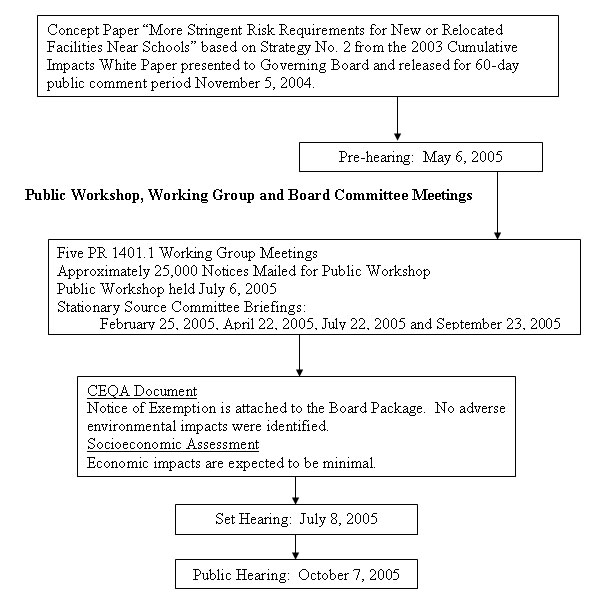
Fifteen (15) months spent in rule development.
ATTACHMENT D
KEY CONTACTS LIST
|
American Lung Association of Los Angeles County |
ATTACHMENT E
RESOLUTION NO.
A Resolution of the Governing Board of the South Coast Air Quality Management District (AQMD) certifying the Notice of Exemption for Proposed Rule 1401.1 – Requirements for New and Relocated Facilities Near Schools.
A Resolution of the AQMD Governing Board to Adopt Rule 1401.1 – Requirements for New and Relocated Facilities Near Schools.
WHEREAS, a need exists to adopt Rule 1401.1 – Requirements for New and Relocated Facilities Near Schools to provide additional health protection to school children from new or relocated facilities emitting toxic air contaminants; and
WHEREAS, the AQMD staff conducted a public workshop regarding Proposed Rule 1401.1 – Requirements for New and Relocated Facilities Near Schools and potential impacts relative to sources subject to Proposed Rule 1401.1; and
WHEREAS, the AQMD has reviewed the proposed project pursuant to California Environmental Quality Act (CEQA) Guidelines Section 15002(k)(1) and since it can be seen with certainty that there is no possibility that the activity in question may have a significant effect on the environment, the project is exempt from the requirements of CEQA pursuant to state CEQA Guidelines Section 15061(b)(3); and
WHEREAS, the AQMD staff has prepared, pursuant to CEQA Guidelines Section 15164, a Notice of Exemption for Proposed Rule 1401.1 – Requirements for New and Relocated Facilities Near Schools; and
WHEREAS, it is necessary that the adequacy of the environmental document be determined by the AQMD Governing Board prior to its certification; and
WHEREAS, the AQMD is not required to prepare a Statement of Findings, a Statement of Overriding Considerations, or a Mitigation Monitoring Plan because the proposed project is not expected to generate significant adverse environmental impacts; and
WHEREAS, the AQMD Governing Board obtains its authority to adopt, amend, or repeal rules and regulations from Sections 39002, 39650 et seq., 40000, 40001, 40440, 40441, 40463, 40702, 40725 through 40728, 41508, 41700, and 42300, of the California Health and Safety Code; and
WHEREAS, the AQMD Governing Board has determined that a need exists to adopt Proposed Rule 1401.1 – Requirements for New and Relocated Facilities Near Schools to further protect school children from cancer and non-cancer effects of Toxic Air Contaminants; and
WHEREAS, the AQMD Governing Board has determined that Proposed Rule 1401.1 – Requirements for New and Relocated Facilities Near Schools is written and displayed so that the meaning can be easily understood by persons directly affected by it; and
WHEREAS, the AQMD Governing Board has determined that Proposed Rule 1401.1 – Requirements for New and Relocated Facilities Near Schools is in harmony with, and not in conflict with, or contradictory to, existing statutes, court decisions, or state or federal regulations; and
WHEREAS, the AQMD Governing Board has determined that Proposed Rule 1401.1 – Requirements for New and Relocated Facilities Near Schools does not impose the same requirement as any existing state or federal regulation, and the proposed rule is necessary and proper to execute the powers and duties granted to, and imposed upon, the AQMD; and
WHEREAS, an analysis as required by Health & Safety Code Section 40727.2 has been prepared for Proposed Rule 1401.1 – Requirements for New and Relocated Facilities Near Schools and is incorporated in the staff report for the proposed rule; and
WHEREAS, the AQMD Governing Board, in adopting Proposed Rule 1401.1 – Requirements for New and Relocated Facilities Near Schools, references the following statutes which the AQMD hereby implements, interprets or makes specific: Health and Safety Code Sections 39666 (District New Source Review rules for toxics), 41700 (nuisance), and Federal Clean Air Act Section 112 (Hazardous Air Pollutants); and
WHEREAS, Proposed Rule 1401.1 is not a control measure in the 2003 Air Quality Management Plan (AQMP) and thus, was not ranked by cost-effectiveness relative to other AQMP control measures in the 2003 AQMP and further, that cost-effectiveness in terms of dollars per ton of pollutant reduced is not applicable to rules regulating toxic air contaminants; and
WHEREAS, the AQMD Governing Board has determined that the Socioeconomic Impact Assessment of Proposed Rule 1401.1 – Requirements for New and Relocated Facilities Near Schools contained within the staff report is consistent with the March 17, 1989 Board Socioeconomic Resolutions for rule adoption; and
WHEREAS, the AQMD Governing Board has determined that the Socioeconomic Impact Assessment contained within the staff report complies with the provisions of Health and Safety Code Sections 40440.8 and 40728.5; and
WHEREAS, the AQMD Governing Board has actively considered the Socioeconomic Impact Assessment contained within the staff report and has made a good faith effort to minimize adverse socioeconomic impacts; and
WHEREAS, the AQMD specifies the Manager of Proposed Rule 1401.1 as the custodian of the documents or other materials which constitute the record of proceedings upon which the adoption of this proposed rule is based, which are located at the South Coast Air Quality Management District, 21865 Copley Drive, Diamond Bar, California; and
WHEREAS, a public hearing has been properly noticed in accordance with all provisions of Health and Safety Code Section 40725; and
WHEREAS, the AQMD Governing Board has held a public hearing in accordance with all provisions of law; and
WHEREAS, the AQMD Governing Board voting to adopt Proposed Rules 1401.1 – Requirements for New and Relocated Facilities Near Schools has reviewed and considered the information contained in the Notice of Exemption for Proposed Rule 1401.1 – Requirements for New and Relocated Facilities Near Schools, and has determined that the document has been completed in compliance with CEQA; and
WHEREAS, the AQMD Governing Board finds and determines, taking into consideration the factors in Section (d)(4)(D) of the Governing Board Procedures, that the modifications adopted which have been made to Proposed Rule 1401.1 since notice of public hearing was published do not significantly change the meaning of the proposed project within the meaning of Health and Safety Code Section 40726 and would not constitute significant new information requiring recirculation of the Draft CEQA document pursuant to CEQA Guidelines Section 15088.5; and
WHEREAS, Proposed Rule 1401.1 – Requirements for New and Relocated Facilities Near Schools has requirements that have been developed specifically for new and relocated facilities siting near schools and does not set a precedent for future rulemaking.
NOW, THEREFORE BE IT RESOLVED, that the AQMD Governing Board does hereby direct staff to conduct a public outreach program on Proposed Rule 1401.1 for local governments and school districts and to report to the Stationary Source Committee on the implementation of the program twelve months after the rule adoption; and
BE IT FURTHER RESOLVED, that the AQMD Governing Board does hereby direct staff to, for a six-month period, convene a group of stakeholders, including environmental representatives, community members, business representatives, and agency representatives to have policy discussions on various risk management approaches, such as risk assessment-based, technology-based, and emissions-based controls; and
BE IT FURTHER RESOLVED, that the AQMD Governing Board certifies the Notice of Exemption for Proposed Rule 1401.1 – Requirements for New and Relocated Facilities Near Schools; and
BE IT FURTHER RESOLVED that the AQMD Governing Board does hereby adopt, pursuant to the authority granted by law, Proposed Rule 1401.1 – Requirements for New and Relocated Facilities Near Schools, as set forth in the attached, and incorporated herein by reference.
DATE: _________________
___________________________________________________________
CLERK OF THE BOARDS
/ / /