
BOARD MEETING DATE: October 7, 2005
AGENDA NO. 27
Adopt Proposed Rule 3503 – Emissions Inventory and Health Risk Assessment for Railyards
SYNOPSIS:
Proposed Rule 3503 requires railroad operators to develop criteria pollutant and toxic emissions inventories for railyards in the Basin and to conduct health risk assessments to estimate the cancer and noncancer risks caused by emissions at railyards. In addition, Proposed Rule 3503 requires railroad operators to notify the public regarding such health risks. The proposed rule is applicable to railyards operated by Class I freight railyards and switching and terminal railroads in the Basin.
COMMITTEE:
Mobile Source, March 25, 2005, July 22, 2005, and September 23, 2005
RECOMMENDED ACTIONS:
Adopt the attached resolution:
- Certifying the Notice of Exemption for Proposed Rule 3503 – Emissions Inventory and Health Risk Assessment for Railyards; and
- Adopting Proposed Rule 3503 – Emissions Inventory and Health Risk Assessment for Railyards.
Barry R. Wallerstein, D.Env.
Executive Officer
Background
In October 2004, the California Air Resources Board (CARB) completed a Health Risk Assessment to estimate the cancer risk from diesel exhaust from locomotives at one of the largest railyards in the state, the Union Pacific J.R. Davis Yard, located in Roseville.1 The results of this analysis showed that the maximum off-site diesel PM cancer risks from the J.R. Davis Yard ranged from 900 to 1,000 in a million.
The health risk assessment conducted at the J.R. Davis Yard was the first of its kind by any air quality agency in California. As a result, the cancer risks from railyards in the Basin are not known. Based on the size of railyards and their proximity to residents, the risks at railyards in the Basin may well be significant. The purpose of Proposed Rule 3503 is to develop emissions inventories and health risk assessments at freight railyards in the Basin, and to notify the public if the risks from railyards are above a specified threshold.
1 California Environmental Protection
Agency, Air Resources Board, 2004.
Roseville Railyard Study.
Regulatory Authority
The authority to regulate air pollution in California is divided between the CARB and the local and regional air pollution control districts. Under state law "local and regional authorities2 have the primary responsibility for control of air pollution from all sources, other than emissions from motor vehicles. The control of emissions from motor vehicles, except as otherwise provided in this division, shall be the responsibility of the State board." (Health & Safety Code §40000). Locomotives are not motor vehicles as defined in the vehicle code because they do not operate on the highway and because they operate on stationary tracks. Since they are not motor vehicles, they are under the jurisdiction of the districts. (Health & Safety Code §40000). CARB was also granted authority to regulate locomotives by Health & Safety Code §43013(b), as amended in 1988. However, even after the enactment of this statute, the districts retain concurrent authority to regulate nonvehicular sources, including locomotives.
District staff believes that much of the non-locomotive equipment operated by railroads at their yards is also non-vehicular in nature. Accordingly, it also would be subject to the jurisdiction of the air districts, including the District. The districts also have general authority under state law to regulate "indirect sources," which are sources that attract mobile sources3. This includes the authority to regulate railyards where trucks are used to deliver or distribute freight, locomotives are used to carry freight, and non-road equipment is used to handle freight. Pursuant to Health & Safety Code §40716(a)(1), a district may adopt and implement regulations to "reduce or mitigate emissions from indirect and areawide sources of air pollution." Therefore, under state law the district may regulate railyards to reduce or mitigate emissions resulting from the mobile sources associated with or attracted to the railyards.
2 The term “local or regional authority”
means the governing body of any city, county or
district. Health & Safety Code
§39037. “District” means an air pollution control district or
air quality
management district created or continued in existence pursuant to provisions of
Part 3 (commencing with Section 40000). Health & Safety Code §39025.
3 State law does not contain a definition for
indirect source, but the federal Clean Air Act
provides that the term “indirect
source” means “a facility, building, structure,
installation, real property,
road, or highway which attracts, or may attract, mobile sources
of pollution.”
42 U.S.C. §7410(a)(5)(C).
Proposed Rule 3503
The purpose of Proposed Rule 3503 is to develop a criteria pollutant and toxic emissions inventory from railyards, to conduct HRAs to estimate the cancer risk and chronic and acute hazard indices caused by emissions at railyards, and to notify the public regarding such health risks. Proposed Rule 3503 is applicable to railyard operations operated by Class I freight railroads and switching and terminal railroads in the Basin. Of the freight and switching and terminal railroads with operations in the District, the AQMD staff has identified 19 railyards that would be subject to Proposed Rule 3503 (please refer to Attachment A for list of Railyards affected by Proposed Rule 3503)
Under Proposed Rule 3503, the operator of a railyard is required to submit an interim emissions inventory report outlining the inventory approach, six months after the proposed rule is adopted. In addition, 12 months after the proposed rule is adopted, the operator of a railyard affected by the proposed rule is required to submit an emissions inventory, with a health risk assessment due 15 months after the proposed rule is adopted. Under the proposed rule, the emissions inventory is to include criteria and toxic emissions, while the health risk assessment is to include toxic emissions only, and all stationary and on- and off-road mobile sources within the railyard. The proposed rule also requires that the emissions inventory be updated every two years, and if there is a 10 percent increase in toxicity-weighted emissions or a shift in the impacted area, the proposed rule requires that the Health Risk Assessment also be updated. The AQMD staff has developed guidelines for estimating mobile source emissions and to conduct the health risk assessment for railyards.
Under Proposed Rule 3503, if an approved Health Risk Assessment shows a cancer risk level greater than or equal to 10 in a million or a hazard index greater than one for non-cancer compounds, the operator of a railyard is required to notify the public annually, until the risk at the railyard is below the public notification risk level.
Public Process
Throughout the rule development process, the AQMD staff worked with a Proposed Regulation XXXV Working Group. The Working Group was comprised of representatives from the railroad industry, environmental and community groups and other agency representatives. Through September 22, 2005, five Working Group meetings were held on Proposed Rule 3503. During development of Proposed Rule 3503, three public workshops were held on March 8, 2005, April 6, 2005, and August 26, 2005.
KEY ISSUES
The AQMD staff has received two comment letters from the Association of American Railroads (AAR), which represent UP and BNSF, one from Pacific Harbor Lines (PHL), and one comment letter from CARB. The following key issues have been identified: (1) Proposed Rule 3503 should not be considered exempt under CEQA, and the AQMD must prepare a CEQA document which analyzes Proposed Rules 3501 and 3502 before adopting Proposed Rule 3503; (2) AQMD’s legal authority to adopt Proposed Rule 3503; (3) communication of risk should be based on an average as compared to a maximum individual cancer risk; (4) schedule for emissions inventories and health risk assessments; (5) duplication with the 2005 CARB Railroad MOU; and (6) non-Class I railyards should be excluded. The following provides a brief summary of the key issues. The Staff Report for Proposed Rule 3503 has a more detailed discussion of these issues in the response to comments.
CEQA Document for Proposed Rule 3501 and 3502
The AAR has commented that the District should consider the effects of Proposed Rule 3503 with Proposed Rules 3501 and 3502 as a whole in a single CEQA document. As a result, the AAR is requesting that Proposed Rule 3503 be delayed and included in the CEQA document for Proposed Rules 3501 and 3502.
Implementation of Proposed Rule 3503 will not cause any significant environmental impact, therefore it is not subject to preparation of an EIR under CEQA. Proposed Rule 3503 is an information gathering rule intended to advise the District and public about the type of, amount of, and risks from, air pollution emissions associated with railyards. Such projects are exempt under CEQA. This function is independent from any future adoption of Proposed Rules 3501 and 3502, which will address emission reductions from unnecessary locomotive idling throughout the Basin. Adoption of Proposed Rule 3503 does not create any need to adopt rules relating to locomotive idling. Nor is adoption of Proposed Rules 3501 and 3502 in any way dependent on adoption of PR3503. Therefore, Proposed Rule 3501 and 3502 are properly considered a separate project from Proposed Rule 3503. Thus, it is not necessary to address impacts from Proposed Rules 3501 and 3502 with Proposed Rule 3503 under CEQA.
Legal Authority
The AAR has commented that the District is pre-empted under federal law from
proceeding with Proposed Rule 3503. AQMD staff believes that AQMD has the legal
authority to adopt and implement Proposed Rule 3503. Proposed Rule 3503 is an
information gathering rule and requires public notification if health risks are
above specified threshold. Implementation of Proposed Rule 3503 would not
interfere with the railroads’ interstate operations; hence the rule is not
federally preempted by the Interstate Commerce Commission Termination Act.
Proposed Rule 3503 does not affect how the manufacturer designs the engine or
locomotive, thus it is not a standard or requirement related to the control of
emissions for purposes of preemption under the Clean Air Act.
Emissions Inventory and HRA Schedule
The AAR and CARB have commented that the schedule to submit emissions inventories and health risk assessments for 19 railyards under Proposed Rule 3503 are too aggressive and are infeasible. Proposed Rule 3503 allows sufficient time for the railroads to develop emissions inventories and HRAs. AQMD staff has developed a Railyard Emissions Inventory Methodology and a Health Risk Assessment Guidance for Railyards and Intermodal Facilities to provide guidance to railroads. Numerous clarification and additions were made to the guidance documents to facilitate the preparation of emissions inventory and HRAs. The emissions inventory methodology is designed to allow the railroads to estimate annual average emissions based on a minimum of three months of data from the past two years. This approach eliminates the need to develop a detailed emissions inventory on each individual piece of equipment and unnecessarily collect data over a 12-month period. AQMD staff believes that emissions inventories can be developed for all 19 railyards within 12 months. For safety and other purposes, the railroads are closely tracking railyard activities, which will facilitate the collection of inventory data called for under Proposed Rule 3503. Furthermore, in preparing inventories and HRAs for multiple railyards, it is expected that the railroads will achieve economies of scale, which will reduce the amount of time needed to prepare inventories and HRAs. AQMD staff believes 12-months to prepare the emissions inventory are clearly feasible. To further address the concern on the overall schedule, Proposed Rule 3503 has been revised to extend the schedule to submit the HRA from 12 to 15 months from rule adoption.
Communication of Risk
The AAR and CARB have commented that the communication of risk to the public should be based on the risk that is averaged over a spatial area as opposed to a maximum individual cancer risk (MICR) as required under Proposed Rule 3503. In the Roseville Railyard Study the highest average risk was estimated to be over 500 in a million as compared to the maximum cancer risk of over 1,000 in a million. The CARB staff has commented that an average risk is more appropriate due to the large size of the railyard and the potential movement of mobile sources within the railyard. The AQMD HRA Guidance for Railyards and Intermodal Facilities addresses the movement of mobile sources within the railyard. The HRA Guidance allows railroads to average the emissions within the area in which the mobile source is expected to move. In addition, communication of risk based on an MICR is consistent with AQMD rules and regulations for stationary sources. AQMD staff’s communication with OEHHA staff indicates the selection of MICR for risk communication is within the discretion of the AQMD’s Governing Board for risk management and is consistent with OEHHA guidelines.
Duplication with the 2005 ARB/Railroad Statewide Agreement
The AAR has commented that Proposed Rule 3503 duplicates requirements in the 2005 Statewide Agreement between CARB and the Class I Railroads. AQMD staff has reviewed the 2005 Statewide Agreement (CARB MOU) and has determined that Propose Rule 3503 is broader in applicability and more prescriptive. The following summarizes key differences between Proposed Rule 3503 and the 2005 Statewide Agreement:
- Proposed Rule 3503 requires 19 railyards in the Basin to conduct emissions inventories and HRAs. The CARB MOU applies to only 10 railyards in the Basin.
- Proposed Rule 3503 establishes emissions inventory guidelines for railyards. The CARB MOU allows railroads to develop their "study plan".
- Proposed Rule 3503 requires that emissions inventories include all stationary and mobile sources for criteria and toxic air contaminants. The CARB MOU requires emissions inventories to focus on "major" diesel equipment.
- Proposed Rule 3503 includes specific dates and the process for approving or disapproving emissions inventories. Therefore, no such requirements in the CARB MOU.
- Proposed Rule 3503 requires railroads to develop HRAs and submit the HRA to the AQMD within 15 months. Under the CARB MOU, railroads have 18 to 30 months to prepare emissions inventories, CARB commits to developing HRAs at the expense of the public and does not commit to any timeframe to complete HRAs.
- Proposed Rule 3503 requires annual public notifications of health risk if over specified thresholds and updates to emissions inventories and HRAs. The Statewide Agreement commits to an initial public meeting upon approval of the HRA, however, no provisions for subsequent public meetings on the health risk at the railyard or updates to the emissions inventories or HRAs are included in the CARB MOU.
Non-Class I Railroads Should be Excluded
Pacific Harbor Lines (PHL), a switching and terminal railroad, met with AQMD staff for the first time on Friday September 23, 2005, to inform the AQMD of their commitment to implement risk reduction projects within their railyard in the next few years. In addition, PHL requested an exclusion from Proposed Rule 3503 based on the cost of compliance and their relatively low emissions. In addition, PHL has commented that the Port of Los Angeles has declared its intention to relocate the railyard in the next two years.
The AQMD staff believes that PHL should be included in Proposed Rule 3503 as the public has a right to know the potential health risks. The emissions inventory and health risk assessment are needed to quantify the potential health risk from the facility before it can be determined that PHL does not impose a significant health risk to the community. The AQMD staff estimates the cost for complying with Proposed Rule 3503 represents 0.7% of Anacostia and Pacific Company’s (parent company of PHL) gross revenue. In addition, the analysis for inclusion of railroads under Proposed Rule 3503 is based on the overall source category of freight rail operations which account for 90 percent of rail emissions in the Basin compared to 10 percent for all passenger operations taken together.
Regarding potentially relocating the railyard, the AQMD staff believes that the community has a right to know the health risk exposure since rail operations have existing in that location for a number of years. As indicated in comments from PHL, it is "likely" that PHL will be relocated in two years, indicating uncertainty for the timing of the relocation. The AQMD staff is concerned that siting for such a facility could extend well beyond two years. If an exemption were allowed for PHL and the relocation does not materialize, the emissions inventory and HRA could be delayed fore several years. Therefore, it is environmentally prudent that PHL be included in Proposed Rule 3503.
California Environmental Quality Act
Under the California Environmental Quality Act (CEQA), the SCAQMD is the Lead Agency and has reviewed Proposed Rule (PR) 3503 pursuant to CEQA Guidelines §15002(k)(1). PR 3503 is an information-gathering rule that requires railroads to develop an emissions inventory and health risk assessment to estimate cancer risk and chronic and acute hazard indices caused by emissions at railyards. The information gathered by PR 3503 will then be used to determine whether to even adopt a risk reduction rule, and if so, the rule’s scope and form. The SCAQMD believes that information to be gathered from railroads as a result of PR3503 will assist the SCAQMD in best fashioning any future rule regarding railyard risk reduction plans. Based upon future information provided from the railroads under PR 3503, the SCAQMD may or may not proceed with a health risk reduction rule, or may take a completely different approach to health risk reduction. PR 3503 also requires the public to be notified of this information if the railyard’s approved health risk assessment exceeds a certain significant risk threshold level. Accordingly, this proposed rule is exempt from CEQA pursuant to CEQA Guidelines §§15306 and 15262.
As provided in CEQA Guidelines §15306, the proposed project is exempt because it will consist of basic data collection, research and resource evaluation activities and will not result in a serious or major disturbance to an environmental resource. CEQA Guidelines §15306 exempts such a project for information-gathering purposes, or as part of a study leading to future action which the agency has not yet taken. As also provided in Guidelines §15262, the proposed project is also exempt because it involves only feasibility or planning studies for possible future actions.
Moreover, implementing PR 3503 will have no significant adverse environmental impacts. Since the requirements are administrative in nature, in that they involve only gathering and disseminating information, it can be seen with certainty that there is no possibility that the activity in question may have a significant effect on the environment, and thus, the project is also exempt from the requirements of CEQA pursuant to state CEQA Guidelines §15061(b)(3).
A Notice of Exemption has been prepared pursuant to CEQA Guidelines §15062 - Notice of Exemption. The Notice of Exemption will be filed with the county clerks of Los Angeles, Orange, Riverside and San Bernardino counties immediately following the adoption of the proposed project.
Cost Analysis
The proposed rule would affect two Class I railroads companies Burlington Northern Santa Fe (BNSF) and Union Pacific (UP) and two switching and terminal railyards, Los Angeles Junction Railways (LAJ) and Pacific Harbor Lines (PHL) in the district. LAJ is wholly owned by BNSF and PHL is a subsidiary of Anacostia and Pacific Company. PR 3503 would affect 19 railyard facilities in the district. Out of the 19 facilities, eight belong to BNSF including LAJ, 10 belong to UP Company, and the remaining one belongs to PHL. Proposed Rule 3503 would also affect new railyards established by these railroads. Based on the latest (July 2005) financial reports, the UP had 48,000 employees with a gross revenue of $12.2 billion and BNSF had 38,000 employees with a gross revenue of $10.9 billion in 2004, and Anacostia and Pacific Company has gross revenues of $37.5 million with 220 employees.
PR 3503 would potentially affect 19 facilities. Fourteen out of 19 facilities are considered as large and the remaining 5 are considered as smaller railyards based on information in the 2005 CARB Statewide Agreement. The total average annual compliance cost of PR 3503 is estimated at $4.53 million from year 2006 to 2020. The compliance cost of PR 3503 would include cost of preparing emission inventory, HRA, update of emission inventory and HRA for every two years, and public notification. In addition, the affected facilities would pay AQMD fees for its review of the emission inventories and HRAs every two years. The majority of the cost (84 percent) is from the public notification requirements. Staff believes the cost estimates may be overstated because potential cost savings from economy of scale of preparing multiple inventories and HRAs and combined public notifications for multiple railyards are not included. Furthermore, the public notification cost is largely based on the size of impact area of the Roseville study, one of the largest railyards in the state. As a result, the actual compliance costs of PR 3503 could be significantly lower than the staff estimates. This cost represents about 0.02 percent of the gross revenues of the UP and BNSF combined ($22 billion) in 2004.
Attachments (EXE 5,461kb)
- Railyards Affected by Proposed Rule 3503
- Summary of Proposal
- Key Issues and Responses
- Rule Development Process
- Key Contacts List
- Resolution
- Proposed Rule
- Staff Report
- Notice of Exemption
ATTACHMENT A
RAILYARDS AFFECTED BY PROPOSED RULE 3503
Burlington Northern and Santa Fe Railway Company:
- Commerce Diesel Maintenance Facility, 6300 Sheila Avenue, Commerce, CA 90040;
- Commerce/Eastern Intermodal Facility, 2818 Eastern Avenue, Commerce, CA;
- La Mirada Yard, 14503 Macaw Street, La Mirada, CA 90638;
- Los Angeles Intermodal Facility, 3770 Washington Boulevard, Commerce, CA 90023;
- Pico Rivera Yard, 7427 Rosemead Boulevard, Pico Rivera, CA 90660;
- San Bernardino Yard, 1535 W 4th Street, San Bernardino, CA 92411; and
- Watson Yard, 1302 Lomita Boulevard, Wilmington, CA 90744.
Los Angeles Junction Railway:
- A railyard operated by Los Angeles Junction Railway, 4433 Exchange Avenue, Los Angeles, CA 90058
Pacific Harbor Lines:
- A railyard operated by Pacific Harbor Lines, 340 W. Water Street, Wilmington, CA 90744
Union Pacific Railroad Company:
- Anaheim Yard, 200 S. Adams Street, Anaheim, CA 92802;
- City of Industry Yard, 17225 Arenth Street, City of Industry, CA 91748;
- Colton Yard, 19100 Slover Avenue, Bloomington, CA 92316;
- Commerce Intermodal Facility, 4341 E. Washington Boulevard, Commerce, CA 90023;
- Dolores Yard, 2442 Carson Street, Carson, CA 90810;
- Intermodal Container Transfer Facility (ICTF), 2401 Sepulveda Blvd, Long Beach, CA 90810;
- Los Angeles Transportation Center Intermodal Facility, 750 Lamar Street, Los Angeles, CA 90031;
- Meade Yard, 2402 Anaheim Street, Wilmington, CA 90744
- Mira Loma Auto Distribution Facility, 4500 Etiwanda Avenue, Mira Loma, CA 91752; and
- Montclair Yard, 10773 Central Place, Montclair, CA 91763.
ATTACHMENT B
SUMMARY OF PROPOSAL
|
Proposed Rule 3503 – Emissions Inventory and Health Risk Assessment for Railyards |
|
ATTACHMENT C
KEY ISSUES AND RESPONSES
|
Proposed Rule 3503 – Emissions Inventory and Health Risk Assessment for Railyards |
|
Comment:
Response:
|
|
Comment:
Response:
|
|
Comment:
Response:
|
|
Comment:
Response:
|
|
Comment:
Response:
|
|
Comment:
Response:
|
ATTACHMENT D
RULE DEVELOPMENT PROCESS
Proposed Rule 3503 – Emissions Inventory and Health Risk Assessment for Railyards
Public Workshop, Working Group and Board Committee Meetings
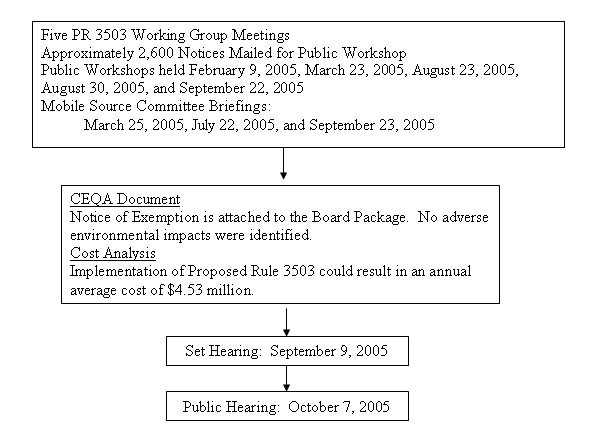
Thirteen (13) months spent in rule development.
ATTACHMENT E
KEY CONTACTS LIST
|
American Lung Association |
ATTACHMENT F
RESOLUTION NO.
A Resolution of the Governing Board of the South Coast Air Quality Management District (AQMD) certifying the Notice of Exemption for Proposed Rule 3503 –Emissions Inventory and Health Risk Assessment for Railyards.
A Resolution of the AQMD Governing Board to Adopt Rule 3503 –Emissions Inventory and Health Risk Assessment for Railyards.
WHEREAS, the purpose of Proposed Rule 3503 – Emissions Inventory and Health Risk Assessment for Railyards is to develop emissions inventories and perform health risk assessments at railyards in the Basin to calculate the cancer and non-cancer risk from railyards and identify the impact to communities surrounding railyards; and
WHEREAS, the AQMD staff conducted three public workshops regarding Proposed Rule 3503 – Emissions Inventory and Health Risk Assessment for Railyards and potential impacts relative to sources subject to Proposed Rule 3503; and
WHEREAS, the AQMD has reviewed the proposed project pursuant to California Environmental Quality Act (CEQA) Guidelines Section 15002(k)(1) and since it can be seen with certainty that there is no possibility that the activity in question may have a significant effect on the environment, the project is exempt from the requirements of CEQA pursuant to state CEQA Guidelines Section 15061(b)(3) and further Proposed Rule 3503 is exempt pursuant to CEQA Guidelines Sections 15306 and 15262; and
WHEREAS, the AQMD staff has prepared, pursuant to CEQA Guidelines Section 15061(b)(3), 15262, and 15306, a Notice of Exemption for Proposed Rule 3503 – Emissions Inventory and Health Risk Assessment for Railyards; and
WHEREAS, it is necessary that the adequacy of the environmental document be determined by the AQMD Governing Board prior to its certification; and
WHEREAS, the AQMD is not required to prepare a Statement of Findings, a Statement of Overriding Considerations, or a Mitigation Monitoring Plan because the proposed project is not expected to generate significant adverse environmental impacts; and
WHEREAS, the AQMD Governing Board obtains its authority to adopt, amend, or repeal rules and regulations from Sections 39002, 40000, 40001, 40702, 40725 through 40728, 41508, 41511, and 41700 of the California Health and Safety Code; and
WHEREAS, the AQMD Governing Board has determined that a need exists to adopt Proposed Rule 3503 – Emissions Inventory and Health Risk Assessment for Railyards to develop emissions inventories for railyards and to perform health risk assessments to estimate the magnitude and the scope of impacts to neighboring communities from toxic air contaminants from railyards and to notify the public of such risks; and
WHEREAS, the AQMD Governing Board has determined that Proposed Rule 3503 – Emissions Inventory and Health Risk Assessment for Railyards is written and displayed so that the meaning can be easily understood by persons directly affected by it; and
WHEREAS, the AQMD Governing Board has determined that Proposed Rule 3503 – Emissions Inventory and Health Risk Assessment for Railyards is in harmony with, and not in conflict with, or contradictory to, existing statutes, court decisions, or state or federal regulations; and
WHEREAS, the AQMD Governing Board has determined that Proposed Rule 3503 – Emissions Inventory and Health Risk Assessment for Railyards does not impose the same requirement as any existing state or federal regulation, and the proposed rule is necessary and proper to execute the powers and duties granted to, and imposed upon, the AQMD; and
WHEREAS, an analysis as required by Health & Safety Code Section 40727.2 has been prepared for Proposed Rule 3503 – Emissions Inventory and Health Risk Assessment for Railyards and is incorporated in the staff report for the proposed rule; and
WHEREAS, the AQMD Governing Board, in adopting Proposed Rule 3503 – Emissions Inventory and Health Risk Assessment for Railyards, references the following statutes which the AQMD hereby implements, interprets or makes specific: Health and Safety Code Sections 41700 (nuisance), 41511 (emissions information), and 40702 (rules to carry out duties); and
WHEREAS, Proposed Rule 3503 is not a control measure in the 2003 Air Quality Management Plan (AQMP) and thus, was not ranked by cost-effectiveness relative to other AQMP control measures in the 2003 AQMP and further, that cost-effectiveness in terms of dollars per ton of pollutant reduced is not applicable to rules regulating toxic air contaminants; and
WHEREAS, the AQMD Governing Board has determined that a Socioeconomic Impact Assessment is not required for Proposed Rule 3503 – Emissions Inventory and Health Risk Assessment for Railyards consistent with the March 17, 1989 Board Socioeconomic Resolutions for rule adoption, however the staff has proposed a cost analysis for the proposed rule; and
WHEREAS, the AQMD Governing Board has determined that a Socioeconomic Impact Assessment is not required consistent with the provisions of Health and Safety Code Sections 40440.8 and 40728.5 because the rule does not significantly affect air quality or emissions limitations; and
WHEREAS, the AQMD Governing Board has actively considered the cost analysis contained within the staff report and has made a good faith effort to minimize adverse cost impacts to the affected facilities; and
WHEREAS, the AQMD specifies the Manager of Proposed Rule 3503 as the custodian of the documents or other materials which constitute the record of proceedings upon which the adoption of this proposed rule is based, which are located at the South Coast Air Quality Management District, 21865 Copley Drive, Diamond Bar, California; and
WHEREAS, a public hearing has been properly noticed in accordance with all provisions of Health and Safety Code Section 40725; and
WHEREAS, the AQMD Governing Board has held a public hearing in accordance with all provisions of law; and
WHEREAS, the AQMD Governing Board voting to adopt Proposed Rule 3503 – Emissions Inventory and Health Risk Assessment for Railyards has reviewed and considered the information contained in the Notice of Exemption for Proposed Rule 3503 – Emissions Inventory and Health Risk Assessment for Railyards, and has determined that the document has been completed in compliance with CEQA; and
WHEREAS, the AQMD Governing Board finds and determines, taking into consideration the factors in Section (d)(4)(D) of the Governing Board Procedures, that the modifications adopted which have been made to Proposed Rule 3503 since notice of public hearing was published do not significantly change the meaning of the proposed project within the meaning of Health and Safety Code Section 40726 and would not constitute significant new information requiring recirculation of the Draft CEQA document pursuant to CEQA Guidelines Section 15088.5; and
WHEREAS, the AQMD Governing Board finds and determines, taking into consideration the factors in Section (d)(4)(D) of the Governing Board Procedures, that the modifications adopted which have been made to Proposed Rule 3503 since notice of public hearing was published do not significantly change the meaning of the proposed project within the meaning of Health and Safety Code Section 40726 and would not constitute significant new information requiring recirculation of the Draft CEQA document pursuant to CEQA Guidelines Section 15088.5.
NOW, THEREFORE BE IT RESOLVED, that the AQMD Governing Board directs staff to return with a report summarizing information submitted pursuant to Proposed Rule 3503 and staff’s recommendation whether to proceed with a risk reduction rule; and
BE IT FURTHER RESOLVED, that the AQMD Governing Board certifies the Notice of Exemption for Proposed Rule 3503 – Emissions Inventory and Health Risk Assessment for Railyards; and
BE IT FURTHER RESOLVED that the AQMD Governing Board does hereby adopt, pursuant to the authority granted by law, Proposed Rule 3503 – Emissions Inventory and Health Risk Assessment for Railyards, as set forth in the attached, and incorporated herein by reference.
DATE: _________________
___________________________________________________________
CLERK OF THE BOARDS
/ / /