
BOARD MEETING DATE: December 1, 2006
AGENDA NO. 15
PROPOSAL:
Ratify Revised Emissions Inventory for Adopted Rule 1157 – PM10 Emission Reductions from Aggregate and Related Operations
SYNOPSIS:
Rule 1157 was adopted by the Board in January 2005. The Board directed staff to work with industry to re-examine the emissions inventory for the adopted rule. Although still significantly higher (eleven fold) than the inventory used for the 2003 AQMP control measure (BCM-08), the revised inventory reflects an approximate 50 percent decrease from the pre- and post-rule calculated emissions inventories, as included in the staff report for Rule 1157. The revised assumptions and methodologies will be used in all future emission calculations for permitting, CEQA, and annual emissions reporting purposes.
COMMITTEE:
Stationary Source, November 17, 2006, Reviewed
RECOMMENDED ACTION:
Receive and ratify the attached revised emissions inventory and authorize the Executive Officer to provide a letter to the California Mining Association acknowledging this revision.
Barry R. Wallerstein, D.Env.
Executive Officer
Introduction
Rule 1157 was adopted on January 7, 2005 to further reduce particulate (PM10) emissions from aggregate and related operations as part of the 2003 AQMP Control Measure BCM-08 – Further Emission Reductions from Aggregate and Cement Manufacturing Operations. During the public hearing for adoption of Rule 1157, some members of the aggregate industry raised concerns regarding the methodology for estimating the PM10 emissions inventory presented in the staff report, particularly as related to emission factors and assumptions (e.g., throughput). West Coast Environmental and Engineering (WCE) submitted a written report on behalf of the Southern California Rock Products Association (SCRPA) analyzing the emissions inventory developed by AQMD staff and expressing their strong disagreement with staff’s analysis.
In the adopting resolution, the Board directed staff to “include a review of the emissions inventory for Proposed Rule 1157…in the development work for the AQMP and that any necessary revisions be incorporated into the baseline emissions inventory for the AQMP.”
On February 10, 2005, the California Mining Association (CMA) filed a lawsuit against the AQMD alleging, among other claims, that the rule was based on a “flawed emissions inventory.” On September 2, 2005, CMA and the AQMD executed a formal settlement agreement. As part of the settlement agreement, the AQMD acknowledged, in conjunction with the aforementioned Board direction, that a review of the data and methodologies used to derive the inventory was warranted. Since that time, staff and industry have met on numerous occasions to arrive at a mutually acceptable inventory.
As a part of the settlement, the parties agreed that once a final inventory was agreed upon, “…staff shall present, and CMA shall support, the modified or revised emissions inventory to the Governing Board for full public review and ratification.” This report fulfills this requirement.
The settlement also states that “…thereafter the revised emissions inventory shall be used, as appropriate, in all AQMD internal and external communications, including without limitation in all CEQA review and permitting analyses.” This is staff’s intent, including using all data and methodologies for reporting under the District’s Annual Emissions Reporting (AER) program.
Finally, the settlement states that “…AQMD shall promptly provide an open and public letter addressed to CMA stating that the prior Rule 1157 emissions inventory has been revised and that the revised inventory shall be used for all future purposes until a new emissions inventory is approved by the Governing Board.” Upon Board approval, staff will develop such a letter for Executive Officer signature.
Background
Following the Board direction to review the emissions inventory, staff carefully evaluated WCE’s report, and began working with SCRPA and WCE representatives to review issues related to the emissions inventory development.
AQMD staff met with representatives of SCRPA and WCE on more than a dozen occasions to reexamine the development of the emissions inventory. This includes assumptions used and survey data provided by industry during rule development that staff used for developing the PM10 emissions inventory. As a result of these meetings, staff made adjustments to the PM10 emissions inventory based on best available scientific and supportive documentation that staff gathered. Not all areas under dispute were mutually resolved; however, sufficient progress was made such that an negotiated, adjusted emissions inventory was eventually completed.
Methodology for Developing the Initial PM10 Emissions Inventory
During the development of Rule 1157, AQMD staff conducted a survey of aggregate and related facilities using survey forms that were developed with approval from industry including SCRPA/SCRMA (Southern California Ready Mixed Concrete Association). The purpose of the survey was to refine the emissions inventory listed in the 1997 AQMP for these source categories. Data collected from the survey was used for the following:
- identify and characterize facilities subject to the proposed rule;
- estimate PM10 emissions generated by these facilities; and
- establish the baseline PM10 emissions for this industry in the air basin.
Staff used the information provided by the SCRPA and SCRMA, data obtained from the AQMD permit system and the 2001-02 Annual Emissions Reporting (AER) database to identify 395 potential survey respondents.
The survey forms were distributed in March 2004. Based on the survey results and additional input from the industry, staff estimated the number of aggregate and related facilities in the air basin by category, summarized as follows:
Aggregate and Related Facilities in the SouthCoastBasin
| Category | Number of Facilities |
| Aggregate | 29 |
| Concrete Batching | 100 |
| Concrete Product | 152 |
| Crushed Miscellaneous Base | 25 |
| Hot Mix Asphalt | 45 |
| “Other” | 38 |
| Total | 389 |
Additionally, staff estimated PM10 emissions for each facility and category based on inputs provided by the facilities participating in the survey. Emissions for each facility are classified into three main emission sources: process equipment, stockpiles, and road (paved/unpaved) emissions. PM10 emissions from process equipment include emissions generated from loading and unloading activity, hoppers and surge bins, conveyor transfer points, crushers, screens, milling equipment, and truck load-outs.
The survey-based average PM10 emissions generated for each category were then scaled up to estimate the baseline emissions inventory for the entire aggregate industry and related operations. Staff used only data from dry aggregate materials to calculate PM10emissions for each applicable activity, equipment, and/or emission source (i.e., loading/unloading, hopper/surge bin, conveyor transfer point, crushing, screening, milling, silo, cement truck loading, HMA load-out, open storage pile, unpaved roads, and track-out).
The pre- and post-rule emissions inventories were calculated to be approximately 29 and 11 tons per day, respectively, for an overall rule effectiveness of 62%. The pre-rule emissions inventory is in significant contrast to that used in the 2003 AQMP control measure, which set the inventory for aggregate processing at 1.2 tons per day.
Findings
As mentioned earlier, staff met with the SCRPA and WCE representatives on numerous occasions to discuss the methodologies and assumptions used in developing the PM10emissions inventory. All aspects of the emissions inventory, such as development of the assumptions, interpretation of the survey data, selection of the emission factors, and formulas used for estimating emissions have been carefully re-evaluated by industry representatives and staff. The following summarizes the key issues pertaining to the development of the PM10emissions inventory.
Areas of Agreement/Resolved Issues
- Proper use of throughput for calculating process emissions.
- Post-rule control efficiency of water at 95%.
- No crushing of fine materials.
- Fly ash and cement throughput were used to calculate cement truck loading emissions.
- Haul truck capacity of 75 tons used to determine roadway emissions.
- Silt loading for uncontrolled paved roads.
- Use of 80% control efficiency for unpaved roads treated with chemical dust suppressants.
- Credit given in calculations for pre-rule compliance with Rule 403 and appropriate federal New Source Performance Standards (NSPS) provisions.
Areas of Compromise
- Fines screening of 20%.
- Facility-specific data only released for facilities waiving confidentiality of data.
Areas of Disagreement/Unresolved Issues
- Basis for a general pre-rule control efficiency of water of 50%, supported by compliance history of issued Notices of Violation.
- Moisture content used as a proportional measurement to control efficiency.
- Calculation method of stockpile emissions (tons throughput vs. acre-day emissions factors).
- Confidentiality of individual survey forms for all responding facilities (non-CMA members).
Revised PM10 Emissions Inventories and Assumptions
A. Pre-Rule
As stated earlier, baseline (pre-rule) PM10 emissions for the aggregate and related operations were estimated to be 29 tons per day (Rule 1157 Staff Report, December 3, 2004). It should be noted that industry representatives provided valuable additional information that assisted in refining certain key assumptions. The revised PM10 baseline emissions inventory is now estimated to be 13.7 tons per day, which represents a 53% decline from the adopted Rule 1157 emissions inventory. The increase in the current level of pre-rule control from 20% to 50% and other revised assumptions resulted in lower PM10 baseline emissions for process equipment, open piles/storage, and unpaved roads. However, baseline emissions from paved roads increased because it was agreed that emissions from these roads have been essentially uncontrolled up to the time that the rule was adopted.
B. Post-Rule
For PM10 emission reduction calculations (post-rule), staff has agreed to assign a 95% control efficiency to water application based on the assumption that the industry will strictly adhere to the PM10 control requirements of Rule 1157. Using the revised PM10 baseline emissions, staff recalculated the PM10emission reductions for each PM10 emission source. The revised total PM10 emission reduction is now 5.7 tons per day based on the revised baseline versus 18 tons per day reduction as reported in the Staff Report for Rule 1157. The remaining inventory with full implementation of Rule 1157 is now 5.3 tons per day (versus 11 tons per day as reported in the Staff Report for Rule 1157).
The final revised pre-and post-Rule 1157 emissions inventories were sent to CMA representatives on October 6, 2006. A letter of response from CMA dated October 17, 2006 indicated that CMA has agreed to the revised pre-and post-rule emissions inventories presented by staff, notwithstanding the remaining areas of disagreement. CMA recognized the significant progress in refining the emissions inventory and the development of a better working relationship as both parties continue to work on other areas of the settlement agreement. It should be noted that CMA’s calculations put the pre- and post-rule emissions for the industry at less than half that of staff’s calculations.
Figure A provides a summary of the emissions from this industry assumed in the 2003 AQMP, the baseline and post-rule implementation remaining emissions included in the December 2004 Staff Report, and the revised baseline and remaining emissions, which will be incorporated into the 2007 AQMP.
Figure A: Rule 1157 Revised Inventory Comparison
Tons Per Day
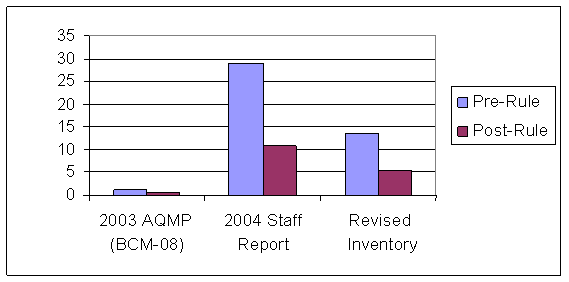
Appendix A shows a comparison of the revised PM10 baseline emissions and remaining PM10emissions by category with those presented in the December 2004 Staff Report.
Attachment(s)
(DOC 99kb)
A-1. Comparison of PM10 Baseline Emissions (Pre-Rule 1157 Inventory)
A-2. Comparison of PM10 Remaining Emissions (Post-Rule 1157Inventory)
///